As well as this blog, I also have a website and Instagram page with lots more images of my work as well as a few more stories.
If you like woodcarvings, you might want to have a look.

Wednesday, 16 July 2014

Revisiting the Green Man - a mysterious image from the past

The Green Man is a face that can be seen in many old churches and stately homes throughout northern Europe. The face has several basic forms, but is either made up of leaves, is sprouting leaves from eyes, ears and/or mouth or is sometimes simply a face peering out through vegetation, like these ones at St Mary Redcliffe in Bristol:


Mike Harding, in his Little book of the Green Man, points out that the name 'Green Man' was probably first used by Lady Raglan in 1939. We don't know what the medieval carvers who produced some of the finest examples would have called these faces.

We don't really know what they mean either, but the images are so powerful that they have persisted through time. They even, in many cases, escaped the stupid vandalism done to British church art by the Puritans.

In The Hidden World of Misericords, Dorothy and Henry Kraus suggest 'That so much underseat carving should have survived Protestant iconoclasm was no doubt due in large measure to the prevailingly secular subject matter'. These foliate faces are not obviously portraying Christian religious ideas either, which may be the reason that we can still appreciate so many of them today whether carved as misericords, roof bosses or elsewhere.

Hayman, in 'Church Misericords and Bench Ends' says that green men have 'often been misinterpreted as an indigenous pagan deity or as a spirit of nature. In fact green men represent sin and mortality.'

The Green Man also seems to hold a special fascination for carvers. In Understanding Woodcarving, John Foyle comments 'You may think we have enough of that fraternity around already. And, yes, the woodcarving world is certainly not short of pre-Christian sylvan dieties, or foliate men as they are sometimes called'. But the design is so strange and its origins so mysterious that carvers keep returning to it. In The Green Man: The Pitkin Guide, Jeremy Harte says that 'The Green Man was always a carver's device, whether in wood or stone. It is rare to find him in jewellery, illuminated books or stained glass'. Master carver Chris Pye, for one, has spoken of his fascination with the subject.

Similar faces can be seen carved on temples in India and there are even green cats, lions and snakes. In St John's chapel in St Mary Redcliffe church in Bristol, there is an animal sprouting leaves from its mouth hidden amongst the medieval roof bosses.

Image from http://stmaryredcliffe.co.uk/files/2014/08/St-Mary-Redcliffe-NW-tower-vaulting-report-revised-assembled-reduced.pdf
As with many such images, it's a bit hard to tell what kind of animal it is: Mike Harding thinks it is a dog, Jerry Sampson (in an interesting architectural report on these bosses) thinks it is more like a cow. Here is a more recent green dog carved on the end of a pew in St Newlyn's church in Cornwall:


Many Green Man faces are quite obviously men, with beards etc. but I haven't heard of many carvings of a Green Woman. Jeremy Harte also makes this point; 
'The real Green Lady, with foliage sprouting from her face or mouth, is hardly ever seen (although there is one at Sampford Courtenay church in Devon). At Kings Nympton church, also in Devon, there is a series of heads: all the male ones are Green Men, but none of the female heads are Green Ladies.'  
I wonder why?

Recently, I've been reworking a green man face carved in oak for 'Mayfest' in Bristol. It was okay, but didn't look exactly how I wanted it to, so I decided to recarve the eyes, nose and mouth. It was an interesting challenge, carving some fairly deep detail into an oak board only 10mm (25/64 inch) thick without going through. Here's how the face now looks:

green man

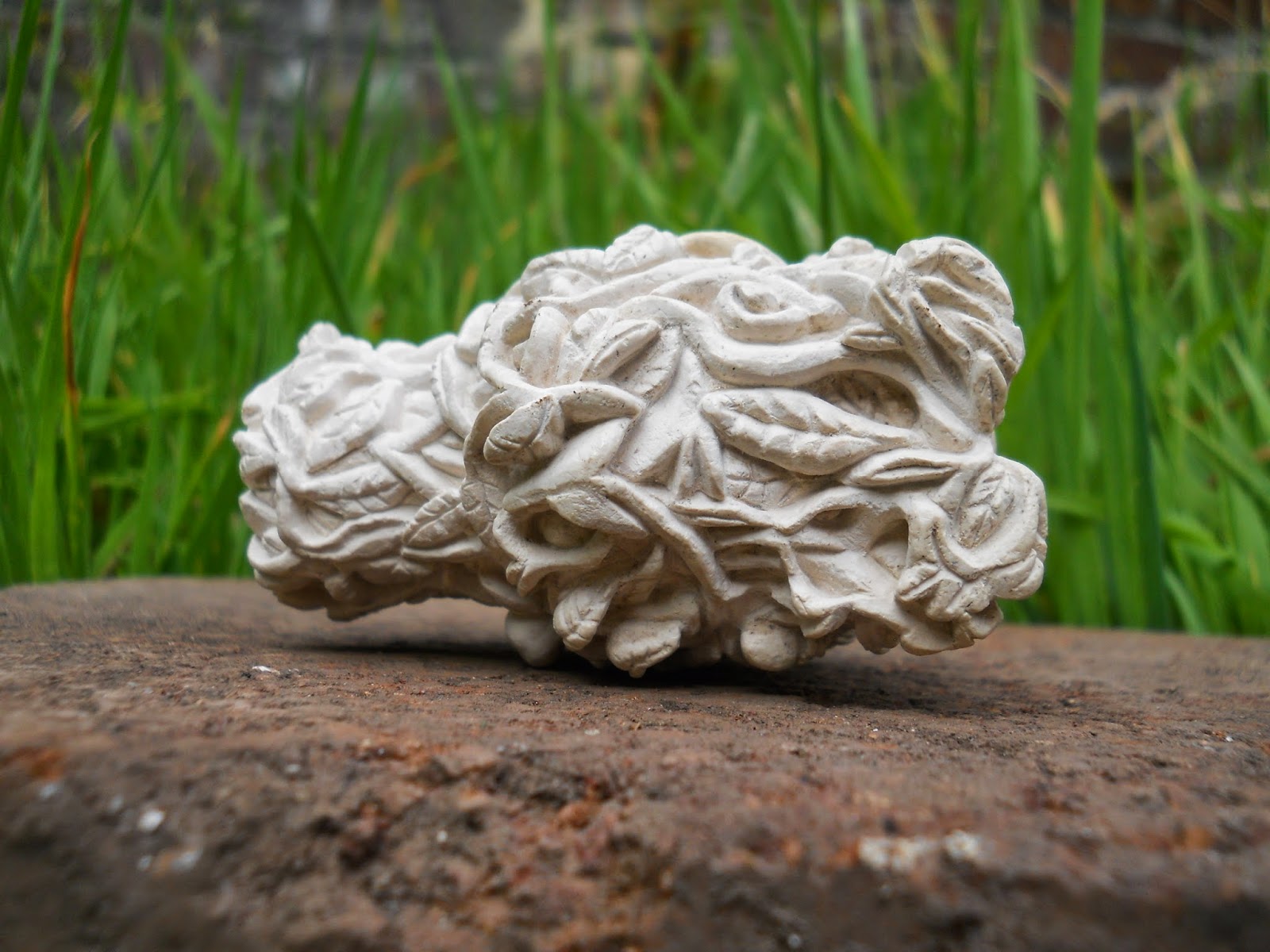
This green man's face was carved on-and-off over four years from 1998 to 2002. It is not made from wood, but instead from meerschaum, a kind of stone which is prized for use in making pipe bowls. The carving isn't finished, as it still needs to have finishing wax applied. I'd also like to carve a stem for it, probably from cherry wood.

meerschaum pipe bowl

meerschaum green man


My own favourite Green Man is one that can be found in Bamberg cathedral in Bavaria. It is possibly one of the most well-known Green Man designs and dates to around the mid-thirteenth century. Some friends have commented that they think that the face is scary and it certainly has something quite powerful about it. As Jeremy Harte says, 'often the most beautiful ones are the most sinister.'

Image from: http://www.gargoylesandgrotesques.com/index.php?p=1_6_Photos


Wednesday, 9 July 2014

The family bible of Thomas and Sarah Rutter, who married at St Dunstan and All Saints church in Stepney, London in September 1801


This post is a bit different from my others. When my grandparents passed away, I inherited an old, heavily-worn bible from them. The central page, between the Old and New Testaments, has the family history of the Rutters written down and I really wanted to make sure that it is online, as it seems a great shame for their descendants to be unable to see it.


I don't know if the Rutters were my ancestors or how the bible came into my grandparent's possession, although I certainly had family in nearby Whitechapel at that time. I do know that people called Rutter emigrated to America after these words were written in the book. Hopefully, now that this is here, any of their descendants will be able to read it.

The entries read:

Thomas and Sarah Rutter
Maried  Septbr the 13: 1801

Sarah Susanah Rutter
Born Octobr 11: 1802
day (word I can't read)

MaryAnn Rutter
Born August 21st 1804
at half past five morn

Elinor Francis Rutter
Born October 13 1807
02 minutes past twelve
at Noon

Thomas Rutter Died
May 27 118019 (sic)

Sara (unfinished) Sarah Suanah (unfinished)
Rutter Died

Sar (Jan?) (unfinished)


Since starting this post, I've done a bit more research into the family. Thomas Rutter was a mariner by trade and was a widower when he married Sarah Milburn on the 13th September 1801 at St Dunstan and All Saints

There is a Thomas Rutter recorded as dying at the age of 70 on the 4th July 1819 and being buried at the church in Plot 4. His abode is given as Ratcliff. This date of death differs, however, from the one given in the bible record.

Sarah Susanna Rutter was baptised on the 21 November 1802 at St Dunstans. Interestingly, her mother's name is also given as Sarah Susanna Rutter. Mary Ann was baptised on the 2nd June 1805 and Eleanor Frances Azela Rennison Rutter was baptised on the 13th October 1807 at the same church.

I wonder if the Sarah Susanna Rutter listed as dying in the last entry in the bible was the first-born daughter, or the mother herself?

Friday, 4 July 2014

Meeting Tim Gatfield at the Cherry Wood Project, a centre for green woodworking, practical woodland management and education

The Cherry Wood Project is situated near Marshfield in South Gloucestershire.


Eight years ago, Tim Gatfield began the sustainable woodland management project and he and his family live onsite, together with apprentices who stay and work alongside them.


The project has a strong emphasis on living with minimum impact on the environment and also on education, especially in using woodland products. There are several green woodworking courses run there every year and guests can stay in cabins next door.


Thursday is volunteer day and I travelled to Cherry Wood along with my friend Alex Arthur, an expert charcoal burner based around Bristol. Alex is regular visitor there and on this trip was planning to move and set up a charcoal kiln for a burn.


The morning was spent levelling an area for the kiln to sit on, then moving it down the slope from a previous site. It was hard work in the hot sun, but there was a very infectious enthusiasm amongst all the volunteers and I didn't hear any complaints.


It was clear that the people helping really enjoyed being there and the hard work was repaid by a great lunch of chilli, rice, bread and salad and also tea and delicious cake later in the day. The food was cooked in the wood-fired cob oven and hob on site.


After lunch, a group of disengaged young people helped with the kiln and there were plenty of people there, so I lent a hand cutting timber (milled on site from larch trees that grew in these woods) for a reciprocating roof on the new roundhouse.


After a while, there seemed to be enough folks to help there too, so it seemed like time to wander back towards where all the woodworking is done.


Tim (on the left in the picture below) and Charlie, one of the apprentices, were busy sharpening tools for an upcoming green woodworking course and it was definitely a good opportunity to help out. Sharpening carving knives is something that I can happily do all day!


It was also very interesting seeing Merlin nearby, bringing an old two-man saw back to the correct set and sharpness for use on hardwoods. Many of the folks there on Thursdays are obviously also fellow tool nuts and really enjoy discussing sharpening methods etc. I felt right at home!


When the saw was ready, he and Tim put it through its paces and it cut beautifully.


It was a great way to spend a Thursday and thanks to Tim and everyone else for making me so welcome. If you would like to volunteer, visit or are interested in a course, contact details can be found on the Cherry Wood website. I hope to be able to drop by again soon!


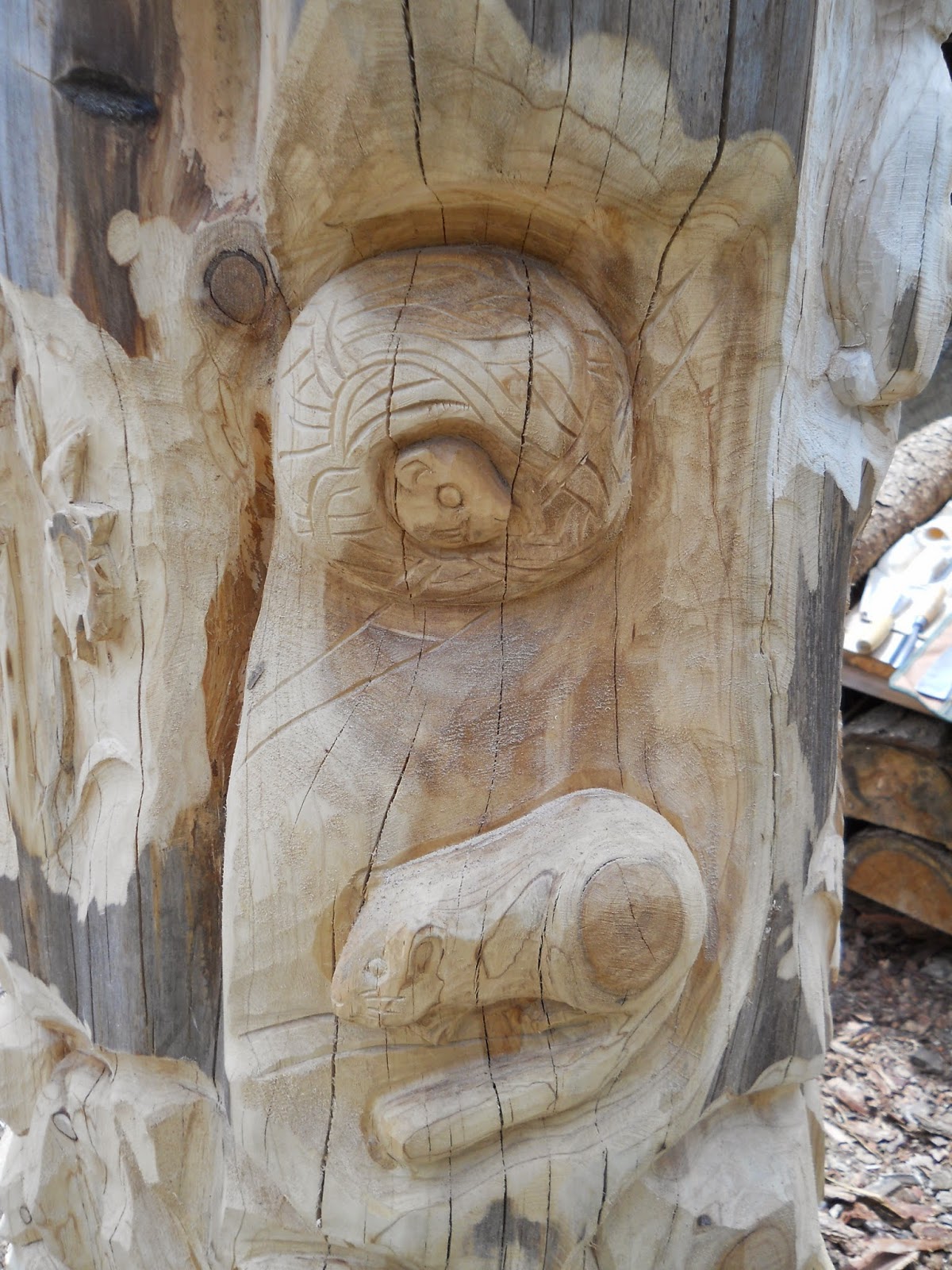
A carved cedar log as a sign for Rock Meadow, a new housing development in the Forest of Dean


This carved Cedar of Lebanon log is a sign for a new development at Redmarley in the Forest of Dean and was commissioned by Severn Vale Housing.


The piece has been carved to show animals and plants that can found in the local area. The bottom 40-50cm will be set into the ground in concrete, so that part only has notches cut into it. Above this is a band of carved rocks, as the development is called 'Rock Meadow'.


The carved animals include two rabbits, a shrew, two hazel dormice and their nest, a peacock butterfly, a comma butterfly and a dragonfly. 


The flowers are wild daffodils and a common spotted orchid.


Most of the carving on the sign was done using an angle grinder with a Holey Galahad disc, a curved metal disc covered in spikes. I also used traditional woodcarving hand tools a lot, to carve details and the lettering.


The Rock Meadow sign was a lot of fun to make and I hope that the future residents enjoy it too.


Friday, 27 June 2014

Celebrating the Braishfield Oak: Running carving workshops at Braishfield School in Hampshire

Braishfield primary school is in the rural village of Braishfield in Hampshire. A large old oak tree used to grow in its playground and was the symbol of the school and of the village.


Unfortunately the tree became infected with honey fungus and was going to die, so the difficult decision was made to cut it down before it became dangerous.

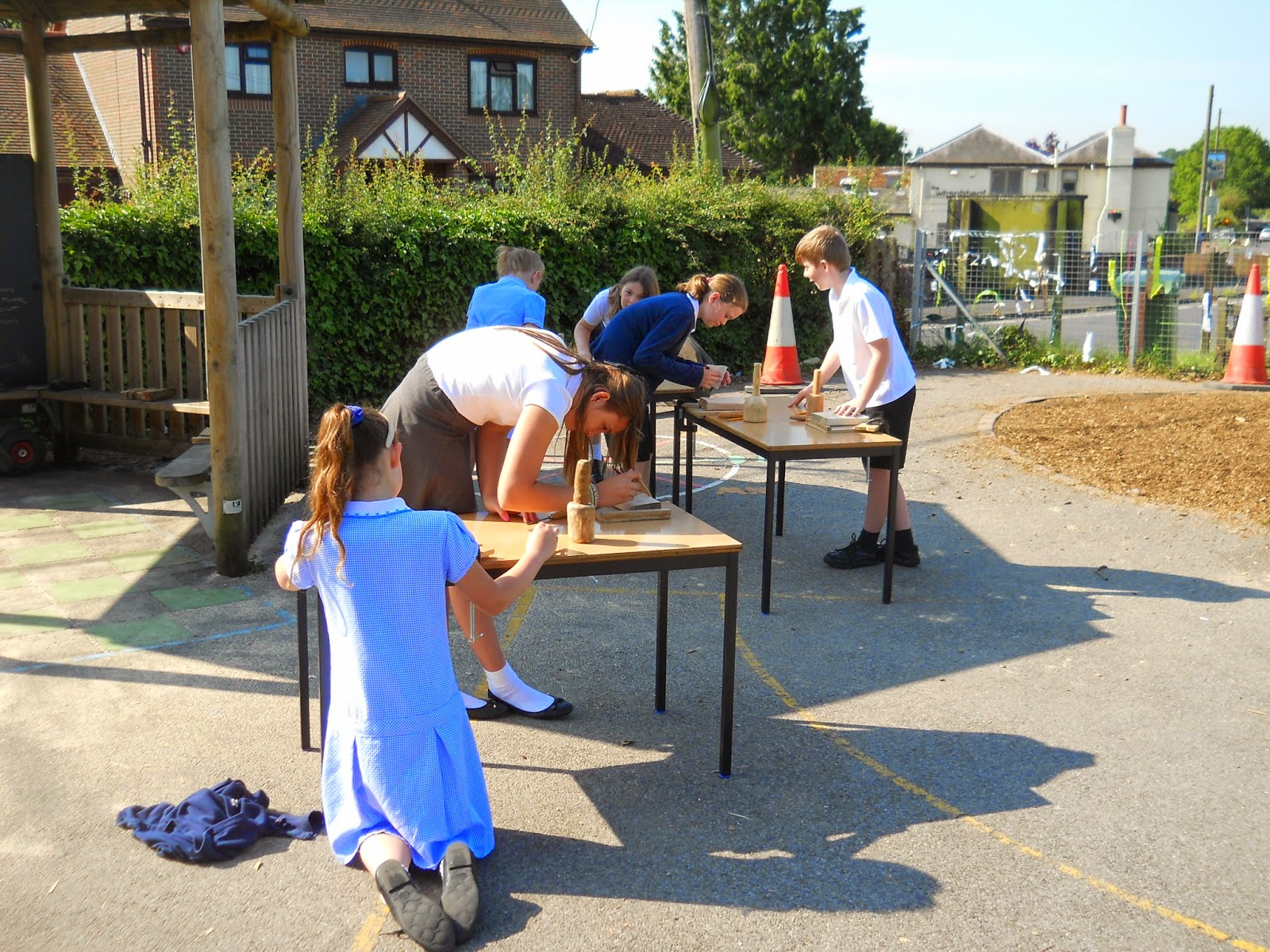
The school wanted to give the children a way of remembering the tree and so they decided to get me in to run carving workshops, using pieces of timber from the old oak to carve on.


The children could not only learn about carving but also take home their bits of wood as mementos. I spent a day cleaving parts of the oak into lumps, which were then sanded to remove splinters and make them easier to carve on.


Nearly sixty pupils at the school, aged between five and ten years old, then got the chance to try woodcarving over the next couple of days.


The weather was hot and sunny and everyone seemed to have a great time. Even the teachers and school staff got to try out their carving skills!


Thanks to the school for inviting me over and for a very enjoyable few days in Hampshire.


Wednesday, 18 June 2014

Chatting with Nat and Leo: more about journeymen travelling in the German tradition


journeymen in the German tradition

I spent some time recently with Nat and Leo, journeymen travelling in the traditional way that originated in Germany (travelling carpenters in the tradition are sometimes called 'zimmermen'). The tradition of the travelling journeyman has pretty much died out in Britain and only the name 'journeyman' gives a clue as to its origins. I  know that many people are, like me, from countries without such a system in place and are very interested in what it involves. I'd like to share with you my interpretation of what was said when we chatted about their experiences.

Clothes

When walking around town, the appearance of the journeymen got a lot of attention and several people came up and asked for photos with them, which was always met politely. They both noted that it was always appreciated when people asked them if they minded being photographed beforehand. Many people also wished to try on their hats which was met with an equally polite request please not to do so. 

The journeyman's appearance is very traditional and marks them out as people travelling for a particular reason, which must have helped in places suspicious of new faces as potential tramps or vagabonds. The coat, waistcoat and bell-bottomed trousers are very well made from tough materials and the designs are based on traditional carpenter's clothing in Germany. The bell-bottomed trousers originally stopped sawdust from going into the wearer's boots. One explanation given for the double zip is that ship's carpenters would have them to make heavy, waterlogged trousers easier to remove quickly if the worker went into the water accidentally. Many of the dress codes were formalised in the 1930s and even later, so older photos of journeymen may show slightly different styles of trouser etc. ( as in this photo from 1928).

It was a surprise to feel how heavy the coats were! The openings of the pockets are edged with leather and these details are important as these clothes must be comfortable and will get hard wear every day for the duration of the journeyman's travels; traditionally three years and a day, although this can vary between different clubs. 

Nat's corduroy clothing is black, the traditional colour for a woodworker, with red seams inside the trousers. His belt buckle is decorated with a square and dividers, showing that he is a cabinet maker and joiner.  He was wearing smart black trainers, but he explained that his boots had recently worn out and he needed this footwear only until he could buy new ones. Nat also said that his clothing caused some confusion when travelling in Jamaica, where the local police wear black trousers with red seams. He needed to explain fairly quickly to certain people on the street that he wasn't a wandering undercover cop when they saw the red seams inside his black trousers.

Different trades traditionally wear clothing in different colours: tailors wear red, woodworkers black, metalworkers blue and stone workers grey for example. Some particular trades or clubs may also wear particular combinations of colours to identify themselves, or for certain events.

Leo's is blue/grey and his belt buckle has a cog-like design, showing that he is a metalworker (his particular speciality being working on bike frames - an unusual trade for a journeyman). They wear shirts with collars tucked inside and no neckties, to show that they are free journeymen who are not tied to one of the six traditional 'guilds'. The word 'Guild' is probably the expression used most frequently to describe these groups in English but both Nat and Leo preferred the word 'club' as being more accurate in their opinion. Different 'clubs' have slightly different rules; for instance, some admit women to travel in the tradition but some don't. They pointed out that, although the rules and dress code are traditional, the original medieval guilds died out a long time ago (their existence has been threatened more recently too: travelling in this way was also banned by the Nazis because of suspected links to communism and some journeymen at that time were sent to concentration camps).

Some Other Things Carried Whilst Travelling

Apart from the traditional pack, both Nat and Leo would have had a Stenz: a distinctive twisted wooden walking stick that shows that they are journeymen. I didn't see the full-size ones because it isn't really practical to carry one at all times. On a Saturday night in the centre of a large European city, wandering around carrying a big wooden stick could quite easily get someone in a lot of trouble! However, Nat and Leo both had a smaller representation of theirs that they kept in their waistcoat pockets, while the larger version was left at the place where they were staying.

Both wear simple earrings in their left earlobes which were pierced with a nail before leaving to travel, in the traditional way. The earrings were not the elaborate ones showing insignia for their professions but were much simpler in design.


They also had a Wanderbuch each, a journal in which people who they worked for could write something at the time of their departure. You can see it wrapped in cloth and clipped to Nat's belt loop in the photo above. It serves as a record of their travels, an aid to memory and would also be stamped at the town hall in each place that they visited, to prove that they had fulfilled the conditions of their journeyman travels. Free journeymen and members of certain clubs may also get their journals filled in by people that they have stayed with but not worked for.

They would go to the town hall with their pack and Stenz on departing from each place and recite a traditional speech in German before getting the stamp. Unfortunately, Bristol isn't used to travelling journeymen and the town hall didn't have such a stamp!

Their belongings are wrapped in square cloths, called 'Charlies'. This is short for 'Charlottenberger'. The origin of the name was explained to me as dating from the time of the plague. As the Black Death swept across Europe, travelling journeymen entering the town of Charlottenberg were given cloths to wrap their belongings in, as these were easier to keep clean and so prevent the disease from spreading. 

One thing that neither of them carries is a mobile phone or other electronic communications device. I suppose that not having one must give less distraction from existing in the present and in the place where you are, as well as being one less valuable thing to worry about losing or getting stolen. It must also particularly help to give focus on travelling in the early days of the journey, when the temptation for friends and family to contact someone undertaking their journeyman years must be very strong. It did, however, make organising meeting up quite tricky occasionally! 

Travelling in the Tradition

Nat and Leo set out as journeymen separately and were travelling together for a bit before inevitably heading their separate ways. Both had been travelling for longer than the minimum three years and a day by this point. I asked Nat how he would know when the time came to finish his wandering years.
Was there a set point, or was it up to him?

He said that he would travel 'in the tradition' until he knew that it was time to stop. He had already travelled to Japan, Canada, Jamaica and around Europe. Perhaps he would decide to settle because he needed a permanent workshop, perhaps for another reason. Some journeymen continue to travel around after finishing their Wandergeselle years, they just don't do it following some of the ways of the tradition.

Traditionally, a journeyman could apprentice themselves to a master craftsman and would study with them until they were ready to make a 'master piece'. If this was good enough, they would be accepted as a master craftsman and only then did they have the right to open their own workshop. Nowadays, many people do not follow this route as it is very expensive and the power of the guilds to enforce it has diminished.

Leo had travelled around Europe and to Jamaica, where he could explore the reggae music that he likes a lot. He said that it took a year of travelling before he really started to understand what the rules governing behaviour, dress and other aspects of the life of a travelling journeyman actually meant.

The traditional dress and rules were very, very important to both Nat and Leo. They did seem to mark them out and got a lot of attention. The life of a travelling journeyman doesn't seem like it is always an easy one and the reputation earned by previous visiting journeymen is vital when trying to find work and contacts in a new town. Both Nat and Leo understood how important their behaviour was to those who might follow them along this path. One particularly important trait is honesty and keeping your word, which seems like a good point of view for any serious craftsperson.

When two journeymen drink together, they don't clink glasses together in the way that is common in Europe. This tradition began as a way of exchanging a little of the liquid in each cup, to prove that there was no poison added to either of them. Journeymen don't need to prove their honour to each other and so they look at each other and tap the drinking vessels against the table instead.


People travelling in the tradition aren't allowed to own their own transport and traditionally they would travel by foot or hitchhike to the next destination.

Setting out to Travel

Nat is Danish and was introduced to travelling in the tradition by a German journeyman. He had to learn about what the tradition meant before setting out and also had to learn more of the language, since this tradition is a German one. Only one of the six clubs has connections to Denmark and Nat felt that travelling as a free journeyman felt like the right path for him, so that was the route he chose.

When they set out, each of them carried five euros (it was originally five deutschmarks in pre-euro days). They must return home after their travels with the same amount, no more. They have to fund themselves on their travels by finding work and must be unmarried, childless and debt-free when they start out. They cannot use the tradition to run away from responsibilities at home.

When they set out, Nat and Leo climbed over the signs for their hometowns and cannot return within 50km of them for three years and a day (unless there are certain specific reasons, like an immediate relative becoming dangerously ill). When they complete their travels, they will climb over the signs again to show that the wandering has ended. When Nat set out, the person who had introduced him to the tradition came with him for a while to ensure that he understood what he needed to do. 
(I was there when Nat finished his journeyman years and have written about it here.)

 It may be worth saying here that the clubs maintaining the tradition of the travelling journeyman are definitely not secret societies and have no particular religious or political agendas that I'm aware of. One drunken person on the street did ask loudly if Nat and Leo were Jewish- I suppose that he mistook their clothes and hats for those worn by an orthodox Jew! Other journeymen have told me that the same thing has happened to them.

Paragraph Eleven

§11 Section Eleven

I had seen this on various items that the journeymen had with them and wondered what it meant. 

It was explained to me that a long time ago laws were passed prohibiting journeymen from meeting unless for a celebration (with drinking). At this time, it was not uncommon for confrontations between different guilds to occur and so this may have been an attempt to prevent such trouble. The specific section allowing gatherings with drinking for celebrations was paragraph(shown using §, the symbol for 'section' or 'paragraph') eleven. 

Nowadays, §11 on display shows travelling journeymen that they are welcome.


More information

If you are interested in this subject, there is more about the tradition of the travelling journeyman as well as some links to other online resources on another post, which you can go to by clicking on this link.

It was great meeting Nat and Leo and thanks to them for sharing their time and knowledge with me. Thanks also to Timon, Steifen, Viktor, Erdmann, Hansen, Jul, Achim, Arnold and Ryki for doing the same.

Safe travels to all of you.