As well as this blog, I also have a website and Instagram page with lots more images of my work as well as a few more stories.
If you like woodcarvings, you might want to have a look.
Showing posts with label relief carving. Show all posts

Friday, 22 December 2017

Demonstrating relief carving techniques at a sign maker's trade fair - SignLink Live 2017

SignLink Live 2017

I've done many things as a woodcarver over the last twenty three years but one thing I've never tried is demonstrating at a trade fair. The chance to do so came in October with an invitation to carve at SignLink Live in Telford.


The stand was part of an area called 'Craftsman's Corner', where traditional skills related to sign making were demonstrated amongst all the vinyl cutting machines and other modern machinery associated with the trade. 

I used the opportunity to produce a charming commissioned piece that was requested just before the show began - a relief carving of a kitten in oak.


wood carving of a kitten


Apart from me, there were four other craftspeople showing their skills: Simon, of Nefarious Pinstriping, was doing pinstriping - a very exacting and skilful craft where precise lines and other designs are applied to surfaces. It is particularly associated with owners of motorbikes and hot rods.


nefarious pin striping


pin striping

Pete, of PKM signs, demonstrated gilding techniques. I couldn't resist buying a copy of Mctaggart's 'Practical Gilding' from him!
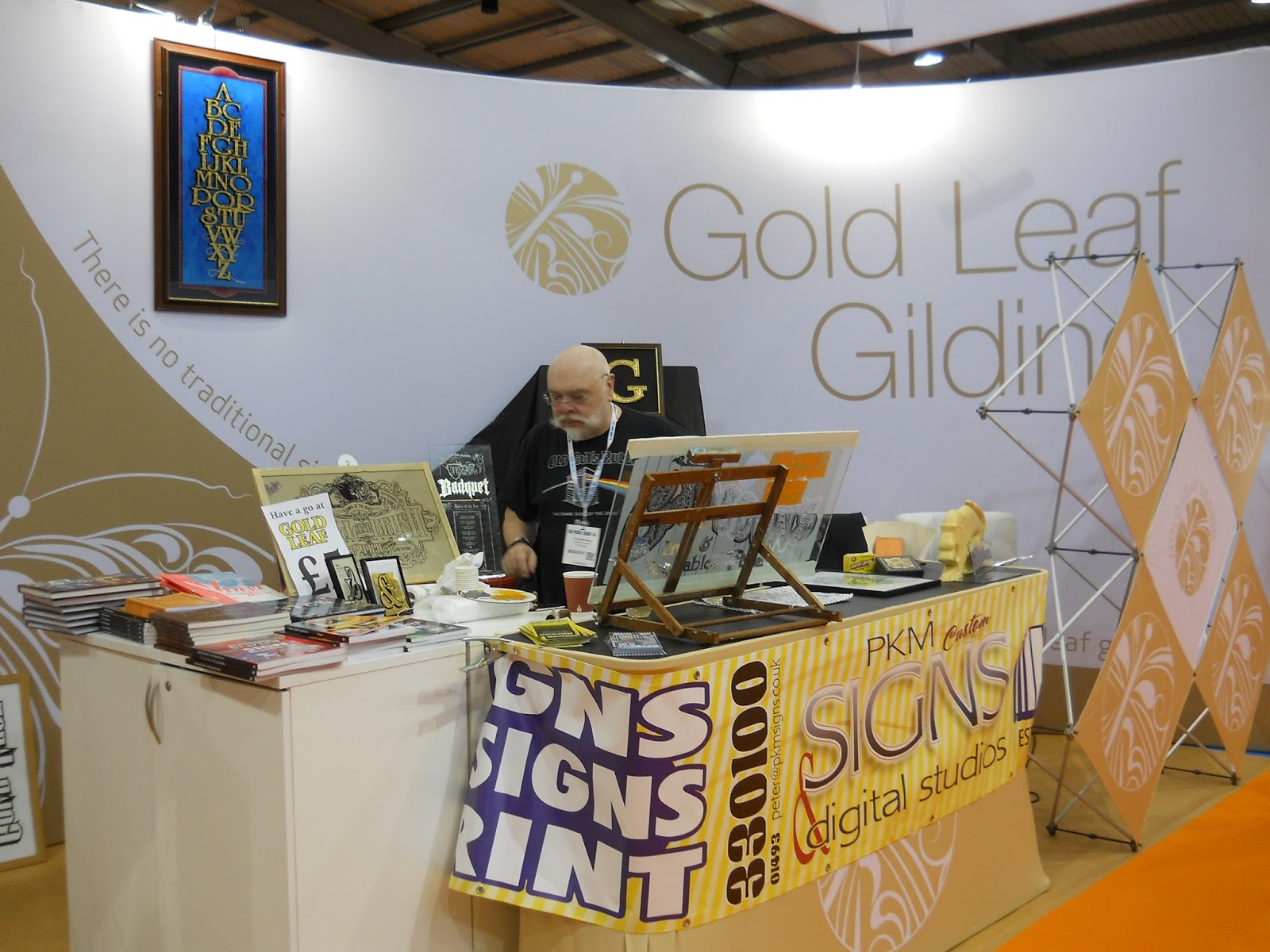

Pkm signs gilding

On the fourth stand, Neil of H signs and Tim of Merlin Signs demonstrated traditional sign painting techniques. It was very interesting talking to them about which paints they prefer to use. One useful tip that they mentioned was to undercoat with aluminium oxide as it lasts the longest.


Tim of Merlin Signs at SignLink 2017

Neil Horne of H signs

It was great fun chatting with these folks, as well as interested people passing by. Quite a few visitors were keen to get pointers for their own hobby carving and I was happy to help! They also came along with their own tips and interesting ideas too, so it wasn't all one-way conversation by any means.

Many people also said how much they enjoyed having the contrast there between the modern advanced technology of sign making and the slower, precise ways of the older crafts. I hope to be able to participate in next year's planned 'Sign Show' in Birmingham. If you are in the sign trade, I may see you there!


Monday, 2 January 2017

Carving a scene featuring a canoe from the North American pioneer days


This picture, slightly larger than an A4 sheet of paper in size, was commissioned as a gift. The recipient loves his canoe and so the person who commissioned me to make it wanted the panel to show a canoe being used in a historical setting, as well as an otter and a heron (which were favourites of the person receiving the present).

Luckily the grey heron that is commonly seen along European waterways has a North American cousin, the great blue heron, which looks similar apart from being slightly bigger.  

The oak panel was carved using a mix of traditional tools and a Dremel hand drill. The drill was used to give the texturing effects to the woodlands in the background.


The mountain man and his Algonquin friend/guide look more surprised than overjoyed to see the heron take flight. Maybe they are carefully watching to see exactly what disturbed it? 

I think that the picture has the feel of a 'Boy's Own' style illustration from the 1940s or 50s, which is perfect! I'm also very pleased with the way that the grain of the wood adds to the feel of movement in the image.


I'm also happy to let you know that Kirsty, who commissioned the carving, was very pleased with it. She wrote on my Facebook page to say:

'I'm extremely honoured and happy to have commissioned this beautiful plaque. You're a hugely talented fella, Alistair. The whole process, from conception to passing it over to the delighted recipient, was wonderful x'

Thursday, 15 December 2016

'Starman', a portrait of David Bowie carved in wood


They are strange, the routes that lead into some projects. 

I had signed up to have a stall at the St Werburghs Community Centre Christmas fair in Bristol and planned to sell wooden stars. I've always liked these stars, made from locally-grown larch timber, so decided to make a few and see if they appealed to other people too. 


After making quite a few of the larch stars, I cut a couple from some oak that was lying around in the studio. The largest one, the same size as the largest stars shown on the table, is about 18cm (7") across. It seemed to need a carving on it and the star shape made me think of the song 'Starman'.

I like to test myself by carving portraits. They aren't easy. Carving a face can be tricky enough, particularly in relief. All the elements of a face carved in relief need to work together without having the same distances between them as in a face seen in full three dimensions: the tip of the nose doesn't come out as much as in a real face, for example.

To successfully make it look like a well-known person is even tougher.

A day was spent before the fair carving to get the piece looking roughly right, then more work was done during the fair itself, in quiet moments between talking to visitors.


I left the portrait with the tool cuts still visible. Sanding carvings of faces can sometimes make them look lifeless and 'plasticky' and hopefully this finish keeps some vitality in the appearance of the carving. 

The star sat in front of me at my workbench for a few days after the fair, being taken down and worked on again as the changing light showed areas that needed reworking. I'm happy with it now.

Tuesday, 27 September 2016

Revisiting Eggenfelden: my first large woodcarving and the first piece made using chisels, carved and painted over twenty years ago


In the summer of 1995, an international environmental work camp was held outside Eggenfelden in Bavaria. I was the only British person there, with other volunteers from the US, Canada, France, Germany, Slovenia, Poland, Czech republic and Lithuania.

We worked with the LBV (Landesbund für Vogelschutz), a local environmental group, to transform a disused electricity substation into a wildlife sanctuary with spaces for birds and bats to roost. It was a great time, camping in the adjoining field and cooking for each other.


Woodcarving had interested me more and more over the previous year but I'd only produced work using found timber with my Opinel knife up until that point. As the construction project drew towards a close, I asked if it would be okay to carve a date plaque for the building. With a piece of softwood (probably larch), a gouge and two carpenter's chisels donated by the neighbour, the date plaque took shape. I painted it and then fixed it onto the tower. 


carving a wooden date plaque


With the help of Emmanuelle, a French volunteer, the two metal doors on the structure were  also brightly painted.


painted flowers

At the end of the work camp a small conifer tree was put onto the roof, the traditional way that the end of a building project is celebrated in the area.


At the time, I never got a decent photo of the carved plaque and had always regretted it. The panel was the largest project that I'd worked on for several years afterwards and it was also my first carving made without using my knife. I often wondered if the panel was still there and what it looked like.

So last week, with mounting excitement, I sat in a car travelling along a dusty farm track towards the same spot. The satellite view on Google maps had told me that the building was still there, but were the panel and paintings?

As the car pulled up next to the tower, I pretty much threw myself out and ran round to the other side. There it was, aged but with the colours still visible and the whole panel looking in much better shape than I'd feared!


The painted doors hadn't fared quite as well, with one almost completely faded and rusted away.


However, the birds and bat on the main door were still quite easy to make out. I wonder why someone had gone to the trouble to paint out the blue tit sitting on the fencepost?


It was fantastic to see that the plaque was still there and also that the tower was clearly still very much serving its purpose as a wildlife refuge. 


LBV Bayern


LBV Projekt Eggenfelden


Thursday, 26 May 2016

Carving an award for Penny Brohn UK, to be given to a very deserving person

Penny Brohn UK  are a charity working with people who have cancer. They contacted me recently to ask if I could make an award to thank a remarkable person called Nina Barough for her hard work raising money for cancer charities.

Among other things, Nina founded Walk the Walk events, which have been hugely successful. They have raised millions for organisations helping those affected by cancer. 

The folks at Penny Brohn were very keen to present her with a thank you gift carved using timber from a recently-cut Cedar of Lebanon in their grounds. It also had to be carved for a deadline in a month's time.


While cedar is a fairly stable wood as it seasons, using the green timber did mean that certain things had to be considered. Seasoning timber will move and change and the design had to take this into account. I normally carve timber that has been seasoned for much longer but I do also love a challenge!

Slices were cut from the log, keeping the rings as close to being at right angles to the large surfaces as possible. This means that the seasoning wood moves mainly in one plane (at right angles to the rings), rather than warping all over the place. 


The piece of wood wasn't really big enough to get a single large slab from, so I decided to join smaller bits together carefully. It took a few tests to find the best glue to use (Bostik Wood Adhesive) but eventually they glued well. I like the bands of differing colours through the timber.


After drawing the design that they had requested on to the timber directly, I started carving. The cedar carved very cleanly, even though many other softwoods don't.


The bands of colour worked nicely in the design as fields going into the distance. When the carving was completed, it looked good but I wanted to put a frame around it that would hold the cedar panel and account for any movement in seasoning.  Some seasoned ash timber was ideal. 


The frame has a small gap between it and the cedar, with the panel being held by four dowels (two at the top and two at the bottom) that aren't glued into it but are glued into the frame. This means that any movement in the cedar panel will just travel along the dowels and the assembly won't be weakened by the change. The finishing touch was a brass plaque with an inscription that was fixed to the frame.


A representative from Penny Brohn UK collected the plaque and seemed very happy with it. I suggested to her that it be hung somewhere away from direct sun and sources of heat such as radiators (to stop it drying too fast). 


Apparently Nina was very happy to have received the award and it now hangs on her wall. Here's a photo from the award ceremony, kindly supplied by Penny Brohn UK and used with their permission:

Nina barough

Thursday, 17 March 2016

Making carved wooden panels with braille on them for Southmead Hospital in Bristol: an artwork for blind and partially-sighted people as well as those who have good vision. Part One - first steps in researching

I have to say that this project has been one of the most interesting that I've been lucky enough to be commissioned to do.

Ruth Sidgwick, arts organiser for the North Bristol NHS Trust, contacted me in April 2015. Some large plane trees were due to be removed from the grounds of the hospital at Southmead in Bristol and Ruth wondered if the wood could be used for a sculptural project to be permanently installed in the Brunel building there.


As part of the project, two day-long workshops, which I would oversee, would also take place at the hospital. During the 'Fresh Arts Festival', patients, staff and visitors to the hospital would get the chance to learn some carving skills and contribute to the final sculpture.

The artwork also needed to include or reference some words and phrases that had been selected by patients at the hospital, who were members of the writing and knitting groups, as being important to them.

Well, it didn't start off exactly as planned. Timber from a previously felled tree that had been stored at the hospital for the project had disappeared in the meantime!

While talking about what would be carved for the sculpture with Ruth, I looked at the other artworks that were already installed in the Brunel building. There were a lot of very interesting pieces but they were nearly all either flat paintings, behind glass or high up in the air. It occurred to me that there wasn't a lot for people who were blind or partially-sighted and that there must be quite a few such visitors and patients at the hospital.


So began the journey. As someone with pretty good vision, it was important to me that the sculpture shouldn't just be a gesture, but should really try and engage those with partial or no eyesight. Looking online for ideas didn't turn up much though. It seemed like there were no woodcarvings out there that were trying to do exactly what I wanted mine to. However, everyone seems to love the feel of wood and it seemed a great tactile material to use in this kind of project.


There were some restrictions on what could be done, as the hospital had strict guidelines to prevent potential sources of infection on the sculpture. It couldn't have any deeply carved cavities, for example. That also ruled out using textures such as fur.

First, I contacted the RNIB (the Royal National Institute of Blind People). Mark Croft, an advice worker there, sent a helpful list of organisations involved in making art more accessible to blind people. Helen Deevy, who works at one of them called The Art House,  passed on my contact details to a blind artist and sculptor in Wakefield named Alan Michael Rayner.

Alan has a lot of experience in producing his own woodcarvings and is a member of the West Riding Woodcarvers Association. He came up with many very interesting and useful suggestions for consideration. These included (amongst many others) using a thermo-formed plastic covering on the sculpture to prevent cross-contamination, methods of accessing audio descriptions that could be embedded into the sculpture and the pros and cons of using braille as part of the artwork. He also put me in touch with an organisation called Living Paintings.

Camilla Oldland at Living Paintings explained about the process of thermoforming plastic and we both felt it was probably impractical on a piece this size. She also pointed out that a large area can be difficult for a blind person to navigate around. Camilla suggested making a smaller 'orientation panel' to act as a guide to the larger one.

After talking with Ruth at the hospital, audio descriptions were also ruled out due to possible interference with medical equipment and procedures (as well as possible expense).

Thanks to the help of all these people, a design was starting to form in my mind. I sketched it out and sent it to the hospital for approval.


The next stage was to begin making the panels, but I didn't realise at this point that I was still to meet the Bristol Braillists...

Making carved wooden panels with braille on them for Southmead Hospital in Bristol: Part Two - Fresh Arts Festival and meeting the Bristol Braillists

After the initial process of research, my design for the wall-mounted sculpture in the Brunel building at Southmead hospital had been okayed and I now needed to assemble a panel to be carved at the Fresh Arts festival.

Since the timber originally earmarked for the project had vanished, I decided to buy some kiln-dried oak instead. Suitable locally grown wood wasn't available, so instead I did the next best thing and bought some that had been PEFC certified (indicating that it had come from sustainably and responsibly managed forests) from a local timber merchant.


The boards were joined and glued without using dowels or biscuits, as they can look awful if carved into by accident. Once the board had been sanded the design was drawn on and then it went with me in September 2015 to the Fresh Arts Festival.


Carving at 'Fresh Arts', with music provided by the 'Gasmen' choir. Photo by Ruth Sidgwick
The design was created to have plenty of straight lines and simple carving, so that passers-by could have a go and get stuck in with minimal carving experience. Several visitors and patients remarked to me that they found the carving process very relaxing and that it was 
a welcome activity at that time.

After the festival, I continued to carve the panel but was still undecided about using braille. Alan Michael Rayner had previously pointed out that there was more than one kind of braille and that, if I wished to use it, it was worth getting experienced advice.

One evening, sitting in the pub, I mentioned the project to my friend Steph. He reminded me that he was currently involved in a project to design a Kindle for blind people and then said that the group was meeting soon and that several braille users would be there. He invited me to join them. 

Perfect!

That was how I came to meet the Bristol Braillists, who provided a lot of helpful information and expertise during a very interesting evening indeed. It's very rare, I would imagine, that a sighted artist gets to sit with five blind people and to chat about how they interact with the world and how an artwork could be made more accessible for them.

One story from the evening stood out for me. I was told about a young woman, blind from birth, who was asked to draw a bus. She drew three straight lines. The first was the step, the second her route up the aisle of the bus and the third the pole that she held on to. The rest of the bus was irrelevant to her as she couldn't feel her way around it all.

I also found out that some blind people have a name for sighted people: 'light dependants'. Very true!

The braillists at the meeting came up with several good ideas and points. Hazel noted that someone who is blind may not have any reference for what is portrayed in a representational carving; a landscape has never been seen by some blind people. Dave thought that metal pins could be used to represent the braille dots - an idea that I later used. 


Later, when I had begun carving the main panel, Paul and Hazel Sullivan from the Braillists group very kindly came to my workshop and tried out the panel to check it for 'usability'. It was very interesting to hear their comments and Paul had typed out, on a braille typewriter, the wording that I wanted to use. This meant that I could drill straight through the dots on the printed card, so using it as a template.


I used brass jeweller's ball-head pins to make the braille dots, each snipped to length and then glued into an individually drilled and recessed hole - over 1600 pins!


Making carved wooden panels with braille on them for Southmead Hospital in Bristol: Part Three - the finished panels!

After nearly one hundred hours of work, the oak panels for Southmead hospital were ready to install. They were finished with Danish oil, for an attractive appearance together with some durability.


The main panel measures 61cm by 122 cm (2 feet by four feet). It shows figures writing, knitting and carving. They are deliberately vague, so can represent the patients who put forward their important words and phrases or anyone at the hospital seeing the sculpture.

The writing, knitting and carvings are spilling off the table and flowing off to become a landscape with fields, rivers and roads. Some of the fields have the phrases and words on them. To the top right are well-known buildings in Bristol with the sun breaking out from between clouds above as a hot air balloon floats by. I liked the idea of the words and phrases guiding across a landscape of memories and experience.

Along the top left of the panel, brass pins are set in to form an inscription in braille. There is no translation, so sighted people who cannot read braille must use the nearby key to read it.


The second panel is smaller, about 22cm by 30cm (8.6" by 11.8"). I took the advice of Camilla Oldland at Living Paintings, who had pointed out that blind people can get 'lost' feeling their way around a large panel without knowing where the boundaries of it are. This panel is an 'orientation panel'. Blind and partially sighted people can feel around the manageably-sized carving to find their way across the main panel. To help them, certain features are also named in braille. I think these names are like a poem on their own: fields, birds, trees, people, Bristol etc.


The third panel is about 21cm by 21 cm (8.27 inches square). It is a key to grade one (or uncontracted) braille, so that sighted people can translate the braille inscriptions. Grade one is the simplest form of braille used in the UK, being pretty much a direct translation letter-by-letter. There was some discussion with the Bristol Braillists about whether to use this or grade two, which uses contracted words so needs less room and is quicker to read. It was agreed that grade one was easier for non-users or braillists from other countries to get used to, so that was the one that I decided on.

I really wanted to include this panel as there are clearly a lot of people waiting around in the hospital with things on their minds. I hope that these sculptures will be an interesting puzzle for non-braillists, as well as introducing them to using this form of communication. That is why none of the other braille used is translated. Viewers must work out what it says.

At the beginning of March 2016, the panels were installed on the wall at the hospital. The Chief Executive of the North Bristol NHS Trust, Andrea Young, unveiled them on the 11th March.


One highlight of the day for me was being able to show Hazel and Paul the finished panels. We discussed that even though what the design shows may not be obvious to some users (think about it, no one who has been completely blind from birth knows what a landscape looks like), it can read as an abstract and still be enjoyed for the textures and the fact that braille users are directly engaged. It was great to chat to Paul about this, as he works for Bristol museum and art gallery making the displays there more accessible for other blind visitors.  In an interview with the Bristol Post newspaper, he said:

"There aren't many opportunities to feel artwork but this one invites it, which is brilliant. 
To have information in Braille and to find that I can read it is great.
I also like the idea that we can read this but most other people can't, when in 99 per cent of our lives it is the other way around."


Left - Right: Ruth Sidgwick (Arts Programme manager North Bristol NHS Trust), me, Andrea Young (Chief Executive North Bristol NHS Trust), Hazel, Paul. Photo by S. Cook

One thing that I find a bit of a shame is that I can't show the finished panels to some of the other people who gave me such helpful guidance. Obviously, emailing a photo isn't much use for some of them. I'd like to thank everyone here for their input on what has been one of the most interesting projects that I have worked on so far.

Wednesday, 16 March 2016

Carving a rabbit onto a wooden bench

This elm bench seat had already been made by Alex Arthur at the Woodworks Project in Bath. He suggested to the client that I could carve the design that they wanted on it.


I didn't want to make the lettering too deep, so carved a textured surface inside a double border. This catches the light so that the letters read easily from any angle. All of the carving here was done using traditional hand tools.


It was a nice surprise when the person commissioning the bench asked if I could also produce a simple, quick carving of a rabbit on there, peeping out from behind a log. The rabbit needed to look cute, but still fairly realistic. I'm very happy with the result as the young rabbit looks out from behind the old log with a bluebell growing nearby.