As well as this blog, I also have a website and Instagram page with lots more images of my work as well as a few more stories.
If you like woodcarvings, you might want to have a look.
Showing posts with label carved signs. Show all posts

Friday, 22 December 2017

Demonstrating relief carving techniques at a sign maker's trade fair - SignLink Live 2017

SignLink Live 2017

I've done many things as a woodcarver over the last twenty three years but one thing I've never tried is demonstrating at a trade fair. The chance to do so came in October with an invitation to carve at SignLink Live in Telford.


The stand was part of an area called 'Craftsman's Corner', where traditional skills related to sign making were demonstrated amongst all the vinyl cutting machines and other modern machinery associated with the trade. 

I used the opportunity to produce a charming commissioned piece that was requested just before the show began - a relief carving of a kitten in oak.


wood carving of a kitten


Apart from me, there were four other craftspeople showing their skills: Simon, of Nefarious Pinstriping, was doing pinstriping - a very exacting and skilful craft where precise lines and other designs are applied to surfaces. It is particularly associated with owners of motorbikes and hot rods.


nefarious pin striping


pin striping

Pete, of PKM signs, demonstrated gilding techniques. I couldn't resist buying a copy of Mctaggart's 'Practical Gilding' from him!
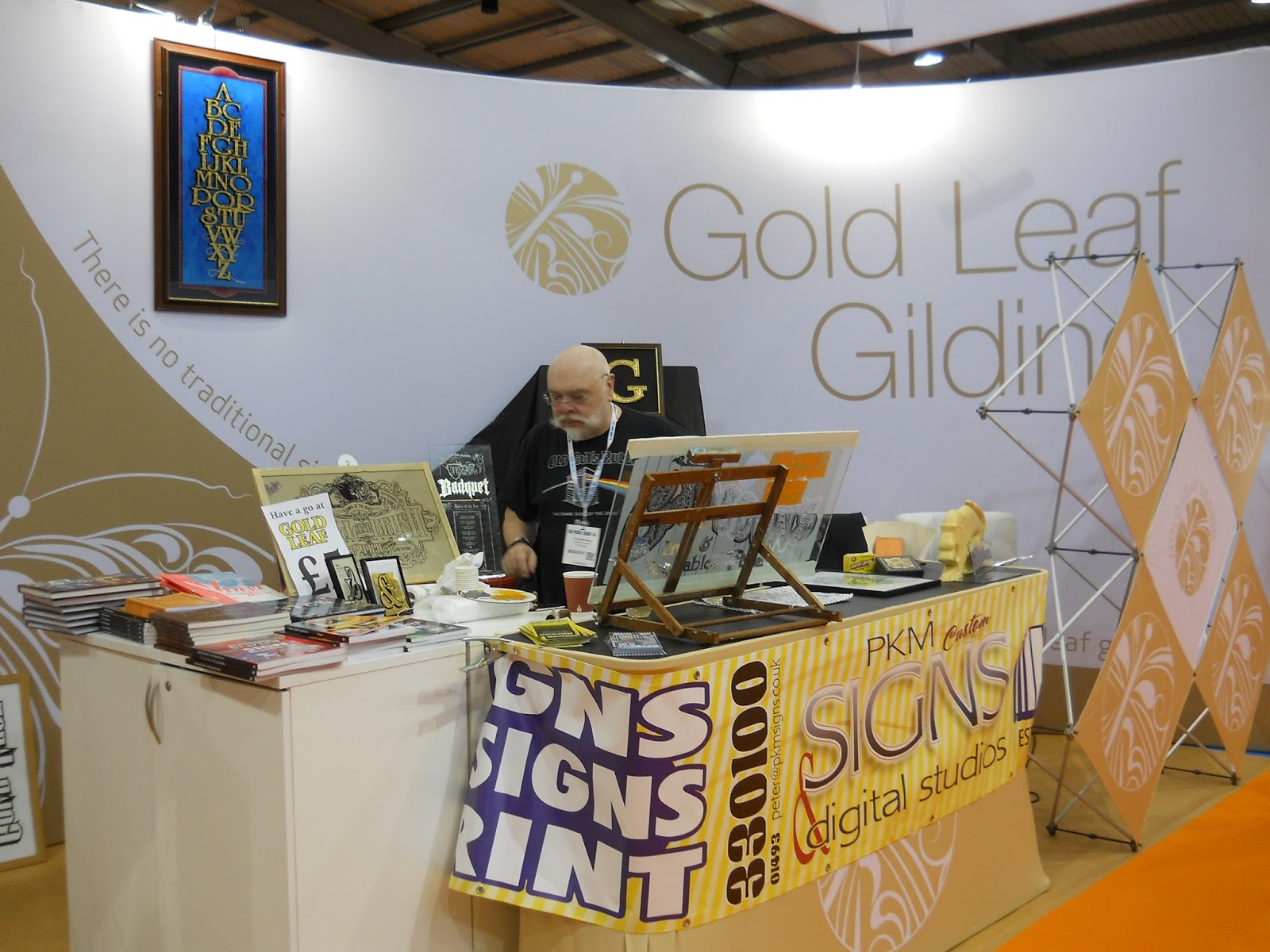

Pkm signs gilding

On the fourth stand, Neil of H signs and Tim of Merlin Signs demonstrated traditional sign painting techniques. It was very interesting talking to them about which paints they prefer to use. One useful tip that they mentioned was to undercoat with aluminium oxide as it lasts the longest.


Tim of Merlin Signs at SignLink 2017

Neil Horne of H signs

It was great fun chatting with these folks, as well as interested people passing by. Quite a few visitors were keen to get pointers for their own hobby carving and I was happy to help! They also came along with their own tips and interesting ideas too, so it wasn't all one-way conversation by any means.

Many people also said how much they enjoyed having the contrast there between the modern advanced technology of sign making and the slower, precise ways of the older crafts. I hope to be able to participate in next year's planned 'Sign Show' in Birmingham. If you are in the sign trade, I may see you there!


Saturday, 30 January 2016

Carving and painting a sign in Greek

This one was a first for me: creating an oak sign with the wording in Greek (not a language that I'm familiar with). It will be hung on a house in Greece and so I waited for the recipients to okay the lettering before starting work. 

In case you are wondering, the sign says 'House of Flowers'.


The edges of the sign were deliberately left with tool marks to seem more rustic and the white lettering will stand out even if the oak starts to age and 'silver' on exposure to the weather.

I really enjoyed painting the hibiscus flower. It's nice to lay down the carving tools and pick up a paintbrush now and again.

Saturday, 24 October 2015

Some recently carved wooden signs and lettering, for clients including a cider maker and a well-known DJ (together with a sign featuring a portrait of a cat)

I've had a few interesting commissions lately, some of which I'll show on the blog when they are closer to being completed. Some of the recent commissions involving carved lettering have been quite unusual too...


oak swing seat

This seat for a swing was carved from locally-sourced oak, which originally grew on the Quantock Hills in Somerset. It was shaped using modern and traditional techniques, including knives and drawknives, then carved with the name of the girl who will receive it. 

The wood was originally destined to become part of a ship's figurehead in memorial of a friend. After that project fell through, it's nice to know that this timber is going to be enjoyed by children playing and having fun.


cat portrait carved in wood

This sign was carved for clients who wanted one of their Devon Rex cats to be shown on it. It's a bit nerve-wracking carving a portrait of a pet for someone, as they will always know the animal far better than I can from a photograph. 

carved portrait of a cat in wood

Happily, they were very pleased with the outcome. It was quite a relief when a visitor to my studio saw the almost-completed carving and said (with no prompting) that it looked like a Devon Rex!


The next sign was carved for the Lenches Cider Company. I was particularly pleased with the lettering on this sign, as the squared shapes of the font used were not that easy to carve by hand and they came out very well. The oak was also a very nicely figured piece.


carved oak sign

This project involved carving an inscription on a chopping board for a client, who had commissioned me to carve a similar project before. As you might imagine, it always feels satisfying when someone asks for another carving to be done for them because they are happy with the previous one.


An unusual next project, as the lettering had to be carved onto a sphere. I wondered at the time whether a computer-controlled routing machine would be able to do this kind of work?


I was also asked recently to correct someone else's letter cutting! The client had bought a rustic oak bench but wasn't happy with the inscription on it. It did look like it had been cut by someone with a blunt router blade who was in a bit of a hurry.


What a great afternoon, re-cutting the letters in their beautiful garden!


Everyone agreed that the lettering looked better once re-cut too:


 I received a lovely email afterwards saying ;

'Dear Alistair, Just to thank you once again fro the splendid job you did on my garden bench for me yesterday. I have to say also that it was a genuine pleasure to meet you and 'do business' with you! I wish you every success in the future'.

Finally, this sign was carved for a DJ and music producer. I'm reluctant to name him on the blog, as I'd rather respect his privacy (sorry!). I will say that he was a big part in the early drum and bass scene and is still playing to big crowds now. The sign was carved from oak and then stained.


If you'd like to see more of my previous letter cutting work, have a look at some by clicking on this link to the page on my website.

Saturday, 11 April 2015

From a log to a carved plaque - making a carving from a cedar tree that had been cut down.

I recently completed an interesting carved plaque for the St Monica Trust in Bristol. The trust runs retirement homes and nursing homes around Bristol and wanted a gift for the chairman Gerald Lee, who is retiring from his post.


A much-loved Himalayan cedar (deodar) tree was recently felled in the grounds of the Cote Lane site and the Trust wanted to use some of the timber to create a gift for Mr Lee.


The tree surgeons took away most of the timber, so there were only sections of branches that they didn't want left behind with diameters of 18cm (7") or less. The tree was also felled a matter of months ago, so the timber was unseasoned and would not be seasoned by the deadline for the presentation of the piece. Two interesting challenges to think about. I obviously told the clients about these considerations before beginning work!


I decided to quarter-saw the timber so that the rings were at right angles to the widest flat faces of the 'boards'. This means that, when they are glued together, the wood of the plaque will shrink and expand sideways and will hopefully not warp as it seasons.

I was not so worried about the timber cracking, as cedar seems to be fairly stable and not too badly prone to that. Carving the logs in the round seemed risky though, as the tensions set up as the wood dried would make such a sculpture more likely to crack than a flat panel would be.

The quarter-sawn pieces were quite small, as the logs weren't big to begin with, however they glued well to make a board that was big enough. The smell of the cut cedar was very strong; I don't think my workshop will have moth problems for a long time to come. Let's hope the smell of cedar repels other insects too (like furniture beetles!)


After the glue had dried, the boards were trimmed and run over a planer thicknesser to get a nice, even thickness throughout.


The design was to be a sundial, which is the logo of the St Monica Trust,  together with the motto 'Tempus fugit, caritas manet' (which means 'time flies, love remains') and a short text. It was laid out on paper and then transferred onto the surface of the timber. The sundial was carved in relief using traditional hand tools and the lettering, in an informal 'Chancery' style, was carved using a Dremel multitool. The cedar proved to be lovely timber to carve.


And here's the finished plaque:


Friday, 4 July 2014

A carved cedar log as a sign for Rock Meadow, a new housing development in the Forest of Dean


This carved Cedar of Lebanon log is a sign for a new development at Redmarley in the Forest of Dean and was commissioned by Severn Vale Housing.


The piece has been carved to show animals and plants that can found in the local area. The bottom 40-50cm will be set into the ground in concrete, so that part only has notches cut into it. Above this is a band of carved rocks, as the development is called 'Rock Meadow'.


The carved animals include two rabbits, a shrew, two hazel dormice and their nest, a peacock butterfly, a comma butterfly and a dragonfly. 


The flowers are wild daffodils and a common spotted orchid.


Most of the carving on the sign was done using an angle grinder with a Holey Galahad disc, a curved metal disc covered in spikes. I also used traditional woodcarving hand tools a lot, to carve details and the lettering.


The Rock Meadow sign was a lot of fun to make and I hope that the future residents enjoy it too.


Monday, 5 May 2014

A new carved oak sign


This sign was carved from oak for someone who has worked for a long time with a scout group in, I believe, Chipping Sodbury. The lettering was cut using a Dremel hand drill but the scout emblem (shown below) was carved by hand using traditional tools.


Sunday, 4 August 2013

Carved oak signs for the Olde Jack Inn, Calverhall, Shropshire. One shows a fabled drinking vessel, the other a spaniel and pheasant

These oak plaques were carved for the Olde Jack Inn at Calverhall in Shropshire. They were delivered last weekend and will be installed into recesses in the bar.


The Olde Jack gets it's name from a drinking vessel that the village was famous for, called a 'jacorra'. According to Wikipedia:

' (a) famed historical drinking vessel made of leather with a silver mounted enscripted band around the rim known as "the Jacorra" ("Corra" incidentally being an ancient name of the village). It was purported to be a challenge for any man to drink the full contents (just over a pint) of the Jacorra vessel in one go as quickly as possible but this wasn't as easy as it sounds due to the width of the vessels rim only allowing a thin trickle to pour from it. Unfortunately the whereabouts of the fabled Jacorra are no longer known, and is believed to have disappeared without trace some 120 years ago.
The village has a long hunting history, it now lies within the North Shropshire Hunt's country, though the Cheshire foxhounds notably hunted the Shavington estate and it once lay within Sir Watkin Williams Wynn's hunting country.'

The spaniel and pheasant image seems to go well with the hunting history of the area and the background to that plaque shows a local reserve called 'Browns Moss'.


The plaques were mostly hand-carved, with a Dremel hand drill being used to write the inscription on the jacorra's bands.


The people running the pub seemed very pleasant and it has a good reputation for food apparently, although we had a long way to travel so had to turn down their kind offer of something to eat. I hope to be able to see the plaques installed one day and try a meal there!

Thursday, 4 July 2013

A few recent projects: A giant creepy-crawley to hand carved oak signs

There's been some very varied projects recently...


This giant Arthropleura (an ancestor of millipedes and centipedes from 300 million years ago) is the seat for a bench to be installed at Pucklechurch, near Bristol. The bench project has been in motion for a while now, but discussions with a local landowner have slowed things up a bit. I thought I'd get on with making the seat anyway, so it is ready for installation when things have been sorted out. It was mostly carved using power tools: chainsaws, Arbortech, Galahad and other angle grinder discs.


The seat is about 2.5 metres (approximately 8 feet) long and is carved from oak sleepers. The holes are where stainless steel threaded bar holds the sleepers together. They will be capped with wooden dowels when the bench is installed. The backrest has already been carved;
(see http://carvingswithstories.blogspot.co.uk/2012/09/tutoring-brisfest-and-giant-scorpion.html)
but I'm waiting to see where the bench will be situated before deciding on what kind of legs to fit to it.

Whilst working on the huge bug, I was also carving this charming gift for a commission. The quote: "A friend may well be reckoned the masterpiece of nature" was written by the American poet Ralph Waldo Emerson. The plaque is about 30 cm (12") long and shows an oak leaf, which ties in nicely with the oak timber that was used for the plaque.


Continuing with the carved oak plaques, this much larger one is destined to be fitted at the entrance to a new housing development near Bristol. All of the lettering was cut by hand and the sign is 159 cm (about 63") long . I am particularly happy with the contrast of the white lettering against the dark oak. The large 'V' is the logo of the developer, NT Voisey and Co.


9th October 2013:

Martin of NT Voisey has just very kindly sent me some pictures of the sign installed in place. Here's one of them:


At the moment, I'm focussed on sorting things out for the exhibition at the end of this month: 'Inspired' at Ashton Court, Bristol. Here's a sneak preview of the sculpture in progress. It looks quite cat-like at the moment, but will eventually be a strange-looking creature that would have evolved to eat the semi-mechanical insects from the 'Metainsecta' series ( see the previous post for more details).


Speaking of which, I'd better finish posting and get on with some carving - not long now before the exhibition opens!