I spent some time recently with Nat and Leo, journeymen travelling in the traditional way that originated in Germany (travelling carpenters in the tradition are sometimes called 'zimmermen'). The tradition of the travelling journeyman has pretty much died out in Britain and only the name 'journeyman' gives a clue as to its origins. I know that many people are, like me, from countries without such a system in place and are very interested in what it involves. I'd like to share with you my interpretation of what was said when we chatted about their experiences.
Clothes
When walking around town, the appearance of the journeymen got a lot of attention and several people came up and asked for photos with them, which was always met politely. They both noted that it was always appreciated when people asked them if they minded being photographed beforehand. Many people also wished to try on their hats which was met with an equally polite request please not to do so.
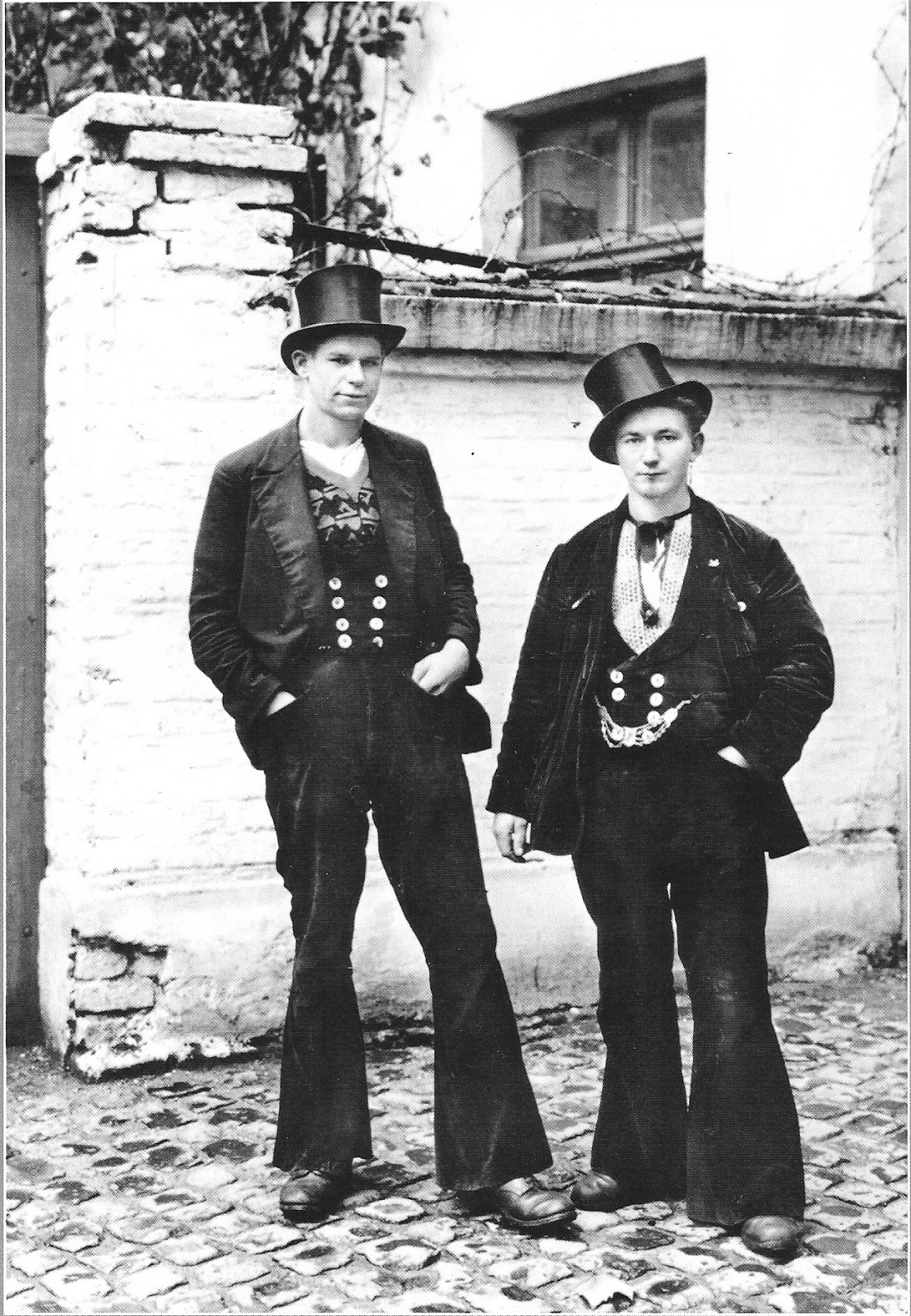
The journeyman's appearance is very traditional and marks them out as people travelling for a particular reason, which must have helped in places suspicious of new faces as potential tramps or vagabonds. The coat, waistcoat and bell-bottomed trousers are very well made from tough materials and the designs are based on traditional carpenter's clothing in Germany. The bell-bottomed trousers originally stopped sawdust from going into the wearer's boots. One explanation given for the double zip is that ship's carpenters would have them to make heavy, waterlogged trousers easier to remove quickly if the worker went into the water accidentally. Many of the dress codes were formalised in the 1930s and even later, so older photos of journeymen may show slightly different styles of trouser etc. ( as in this photo from 1928).
It was a surprise to feel how heavy the coats were! The openings of the pockets are edged with leather and these details are important as these clothes must be comfortable and will get hard wear every day for the duration of the journeyman's travels; traditionally three years and a day, although this can vary between different clubs.
It was a surprise to feel how heavy the coats were! The openings of the pockets are edged with leather and these details are important as these clothes must be comfortable and will get hard wear every day for the duration of the journeyman's travels; traditionally three years and a day, although this can vary between different clubs.
Nat's corduroy clothing is black, the traditional colour for a woodworker, with red seams inside the trousers. His belt buckle is decorated with a square and dividers, showing that he is a cabinet maker and joiner. He was wearing smart black trainers, but he explained that his boots had recently worn out and he needed this footwear only until he could buy new ones. Nat also said that his clothing caused some confusion when travelling in Jamaica, where the local police wear black trousers with red seams. He needed to explain fairly quickly to certain people on the street that he wasn't a wandering undercover cop when they saw the red seams inside his black trousers.
Different trades traditionally wear clothing in different colours: tailors wear red, woodworkers black, metalworkers blue and stone workers grey for example. Some particular trades or clubs may also wear particular combinations of colours to identify themselves, or for certain events.
Different trades traditionally wear clothing in different colours: tailors wear red, woodworkers black, metalworkers blue and stone workers grey for example. Some particular trades or clubs may also wear particular combinations of colours to identify themselves, or for certain events.
Leo's is blue/grey and his belt buckle has a cog-like design, showing that he is a metalworker (his particular speciality being working on bike frames - an unusual trade for a journeyman). They wear shirts with collars tucked inside and no neckties, to show that they are free journeymen who are not tied to one of the six traditional 'guilds'. The word 'Guild' is probably the expression used most frequently to describe these groups in English but both Nat and Leo preferred the word 'club' as being more accurate in their opinion. Different 'clubs' have slightly different rules; for instance, some admit women to travel in the tradition but some don't. They pointed out that, although the rules and dress code are traditional, the original medieval guilds died out a long time ago (their existence has been threatened more recently too: travelling in this way was also banned by the Nazis because of suspected links to communism and some journeymen at that time were sent to concentration camps).
Some Other Things Carried Whilst Travelling
Apart from the traditional pack, both Nat and Leo would have had a Stenz: a distinctive twisted wooden walking stick that shows that they are journeymen. I didn't see the full-size ones because it isn't really practical to carry one at all times. On a Saturday night in the centre of a large European city, wandering around carrying a big wooden stick could quite easily get someone in a lot of trouble! However, Nat and Leo both had a smaller representation of theirs that they kept in their waistcoat pockets, while the larger version was left at the place where they were staying.
Both wear simple earrings in their left earlobes which were pierced with a nail before leaving to travel, in the traditional way. The earrings were not the elaborate ones showing insignia for their professions but were much simpler in design.
Both wear simple earrings in their left earlobes which were pierced with a nail before leaving to travel, in the traditional way. The earrings were not the elaborate ones showing insignia for their professions but were much simpler in design.

They also had a Wanderbuch each, a journal in which people who they worked for could write something at the time of their departure. You can see it wrapped in cloth and clipped to Nat's belt loop in the photo above. It serves as a record of their travels, an aid to memory and would also be stamped at the town hall in each place that they visited, to prove that they had fulfilled the conditions of their journeyman travels. Free journeymen and members of certain clubs may also get their journals filled in by people that they have stayed with but not worked for.
They would go to the town hall with their pack and Stenz on departing from each place and recite a traditional speech in German before getting the stamp. Unfortunately, Bristol isn't used to travelling journeymen and the town hall didn't have such a stamp!
Their belongings are wrapped in square cloths, called 'Charlies'. This is short for 'Charlottenberger'. The origin of the name was explained to me as dating from the time of the plague. As the Black Death swept across Europe, travelling journeymen entering the town of Charlottenberg were given cloths to wrap their belongings in, as these were easier to keep clean and so prevent the disease from spreading.
They would go to the town hall with their pack and Stenz on departing from each place and recite a traditional speech in German before getting the stamp. Unfortunately, Bristol isn't used to travelling journeymen and the town hall didn't have such a stamp!
Their belongings are wrapped in square cloths, called 'Charlies'. This is short for 'Charlottenberger'. The origin of the name was explained to me as dating from the time of the plague. As the Black Death swept across Europe, travelling journeymen entering the town of Charlottenberg were given cloths to wrap their belongings in, as these were easier to keep clean and so prevent the disease from spreading.
One thing that neither of them carries is a mobile phone or other electronic communications device. I suppose that not having one must give less distraction from existing in the present and in the place where you are, as well as being one less valuable thing to worry about losing or getting stolen. It must also particularly help to give focus on travelling in the early days of the journey, when the temptation for friends and family to contact someone undertaking their journeyman years must be very strong. It did, however, make organising meeting up quite tricky occasionally!
Travelling in the Tradition
Nat and Leo set out as journeymen separately and were travelling together for a bit before inevitably heading their separate ways. Both had been travelling for longer than the minimum three years and a day by this point. I asked Nat how he would know when the time came to finish his wandering years.
Was there a set point, or was it up to him?
He said that he would travel 'in the tradition' until he knew that it was time to stop. He had already travelled to Japan, Canada, Jamaica and around Europe. Perhaps he would decide to settle because he needed a permanent workshop, perhaps for another reason. Some journeymen continue to travel around after finishing their Wandergeselle years, they just don't do it following some of the ways of the tradition.
Traditionally, a journeyman could apprentice themselves to a master craftsman and would study with them until they were ready to make a 'master piece'. If this was good enough, they would be accepted as a master craftsman and only then did they have the right to open their own workshop. Nowadays, many people do not follow this route as it is very expensive and the power of the guilds to enforce it has diminished.
Leo had travelled around Europe and to Jamaica, where he could explore the reggae music that he likes a lot. He said that it took a year of travelling before he really started to understand what the rules governing behaviour, dress and other aspects of the life of a travelling journeyman actually meant.
The traditional dress and rules were very, very important to both Nat and Leo. They did seem to mark them out and got a lot of attention. The life of a travelling journeyman doesn't seem like it is always an easy one and the reputation earned by previous visiting journeymen is vital when trying to find work and contacts in a new town. Both Nat and Leo understood how important their behaviour was to those who might follow them along this path. One particularly important trait is honesty and keeping your word, which seems like a good point of view for any serious craftsperson.
When two journeymen drink together, they don't clink glasses together in the way that is common in Europe. This tradition began as a way of exchanging a little of the liquid in each cup, to prove that there was no poison added to either of them. Journeymen don't need to prove their honour to each other and so they look at each other and tap the drinking vessels against the table instead.

People travelling in the tradition aren't allowed to own their own transport and traditionally they would travel by foot or hitchhike to the next destination.
He said that he would travel 'in the tradition' until he knew that it was time to stop. He had already travelled to Japan, Canada, Jamaica and around Europe. Perhaps he would decide to settle because he needed a permanent workshop, perhaps for another reason. Some journeymen continue to travel around after finishing their Wandergeselle years, they just don't do it following some of the ways of the tradition.
Traditionally, a journeyman could apprentice themselves to a master craftsman and would study with them until they were ready to make a 'master piece'. If this was good enough, they would be accepted as a master craftsman and only then did they have the right to open their own workshop. Nowadays, many people do not follow this route as it is very expensive and the power of the guilds to enforce it has diminished.
Leo had travelled around Europe and to Jamaica, where he could explore the reggae music that he likes a lot. He said that it took a year of travelling before he really started to understand what the rules governing behaviour, dress and other aspects of the life of a travelling journeyman actually meant.
The traditional dress and rules were very, very important to both Nat and Leo. They did seem to mark them out and got a lot of attention. The life of a travelling journeyman doesn't seem like it is always an easy one and the reputation earned by previous visiting journeymen is vital when trying to find work and contacts in a new town. Both Nat and Leo understood how important their behaviour was to those who might follow them along this path. One particularly important trait is honesty and keeping your word, which seems like a good point of view for any serious craftsperson.
When two journeymen drink together, they don't clink glasses together in the way that is common in Europe. This tradition began as a way of exchanging a little of the liquid in each cup, to prove that there was no poison added to either of them. Journeymen don't need to prove their honour to each other and so they look at each other and tap the drinking vessels against the table instead.

People travelling in the tradition aren't allowed to own their own transport and traditionally they would travel by foot or hitchhike to the next destination.
Setting out to Travel
Nat is Danish and was introduced to travelling in the tradition by a German journeyman. He had to learn about what the tradition meant before setting out and also had to learn more of the language, since this tradition is a German one. Only one of the six clubs has connections to Denmark and Nat felt that travelling as a free journeyman felt like the right path for him, so that was the route he chose.
When they set out, each of them carried five euros (it was originally five deutschmarks in pre-euro days). They must return home after their travels with the same amount, no more. They have to fund themselves on their travels by finding work and must be unmarried, childless and debt-free when they start out. They cannot use the tradition to run away from responsibilities at home.
When they set out, Nat and Leo climbed over the signs for their hometowns and cannot return within 50km of them for three years and a day (unless there are certain specific reasons, like an immediate relative becoming dangerously ill). When they complete their travels, they will climb over the signs again to show that the wandering has ended. When Nat set out, the person who had introduced him to the tradition came with him for a while to ensure that he understood what he needed to do.
(I was there when Nat finished his journeyman years and have written about it here.)
When they set out, each of them carried five euros (it was originally five deutschmarks in pre-euro days). They must return home after their travels with the same amount, no more. They have to fund themselves on their travels by finding work and must be unmarried, childless and debt-free when they start out. They cannot use the tradition to run away from responsibilities at home.
When they set out, Nat and Leo climbed over the signs for their hometowns and cannot return within 50km of them for three years and a day (unless there are certain specific reasons, like an immediate relative becoming dangerously ill). When they complete their travels, they will climb over the signs again to show that the wandering has ended. When Nat set out, the person who had introduced him to the tradition came with him for a while to ensure that he understood what he needed to do.
(I was there when Nat finished his journeyman years and have written about it here.)
It may be worth saying here that the clubs maintaining the tradition of the travelling journeyman are definitely not secret societies and have no particular religious or political agendas that I'm aware of. One drunken person on the street did ask loudly if Nat and Leo were Jewish- I suppose that he mistook their clothes and hats for those worn by an orthodox Jew! Other journeymen have told me that the same thing has happened to them.

I had seen this on various items that the journeymen had with them and wondered what it meant.
It was explained to me that a long time ago laws were passed prohibiting journeymen from meeting unless for a celebration (with drinking). At this time, it was not uncommon for confrontations between different guilds to occur and so this may have been an attempt to prevent such trouble. The specific section allowing gatherings with drinking for celebrations was paragraph(shown using §, the symbol for 'section' or 'paragraph') eleven.
Nowadays, §11 on display shows travelling journeymen that they are welcome.
If you are interested in this subject, there is more about the tradition of the travelling journeyman as well as some links to other online resources on another post, which you can go to by clicking on this link.
Paragraph Eleven

It was explained to me that a long time ago laws were passed prohibiting journeymen from meeting unless for a celebration (with drinking). At this time, it was not uncommon for confrontations between different guilds to occur and so this may have been an attempt to prevent such trouble. The specific section allowing gatherings with drinking for celebrations was paragraph(shown using §, the symbol for 'section' or 'paragraph') eleven.
Nowadays, §11 on display shows travelling journeymen that they are welcome.
More information
It was great meeting Nat and Leo and thanks to them for sharing their time and knowledge with me. Thanks also to Timon, Steifen, Viktor, Erdmann, Hansen, Jul, Achim, Arnold and Ryki for doing the same.
Safe travels to all of you.
Safe travels to all of you.