My name is Alistair Park and I'm a professional carver who is based in Bristol, England. I've been carving for over twenty-eight years and I also enjoy teaching my skills to people of all ages. You'll find posts here about all kinds of things to do with carving; the work that I do, the people that I meet and the things that I see which inspire me. Please feel free to comment on anything of interest, it'd be great to hear from you!
If you like woodcarvings, you might want to have a look.
Showing posts with label ecobuilding. Show all posts
Wednesday, 9 August 2017
Building a shelter/gazebo at the allotment garden using reclaimed materials
Recently, work slowed up a bit. It's a natural part of the cycle of being a self employed maker but can certainly be stressful - wondering when the next job will come in. However, it does give a chance to catch up on things like website updates and also doing projects that are a bit different.
Luckily, this period of free time coincided with some redevelopment work at the woodyard where I have my studio. As part of this work, a quantity of reclaimed European larch was up for reuse. This larch timber is very durable outdoors and so I decided to use it to build a shelter at the allotment that I share with a friend.
For those who don't know what an allotment is, most towns and cities in the UK have areas that are owned by the local council which are rented out to local people for them to grow their own flowers, fruit and vegetables. There are usually regular inspections and some rules about what can be grown. I find the allotment a great place to unwind - digging all day certainly clears the mind.
Our allotment really needed somewhere to shelter from rain (ah! British weather!) as well as a place to just relax and enjoy the place. As well as the larch lumber and some slab wood left over from milling timber, a couple of larch trunks were available which had been drilled full of holes by wood wasps (horntails) and so were not suitable for use by the businesses that had bought them originally.
I set to making the structure. All of the work was done using hand tools (apart from a couple of battery-powered drills) as there was no power on site. There was also no one else to help with the build but that was quite nice - being free to just do it by myself.
After a few days of work, the main structure was finished. I then fitted a small jettied platform going out over the pond. It was lovely to sit and watch the wildlife around. Brightly coloured damselflies flitted over the water and several different kinds of wasp and bee flew around the posts. Some were large, strange looking parasitic ichneumonid wasps - harmless to humans and looking to lay their eggs on the wood wasp larvae. Others were small bees investigating the holes as nest sites. They were no threat to me and some, in fact, were helpful predators on pests feeding on the plants. Another welcome creature that is happy to eat garden pests is the slow-worm. It's neither a worm nor a snake, being a lizard without legs. I think that they are very beautiful animals and they can live for around twenty years.
The next stage of construction was to fit a roof. This meant buying two sheets of FSC-certified plywood - the only timber bought for the project. Getting the sheets up onto the roof was a bit of a struggle but once in place, they could be covered with offcut strips of tough butyl rubber. This was reclaimed waste material left over from building bike sheds. Joined with Sikaflex EBT+ adhesive, the rubber is a perfect waterproof covering.
That's the shelter done for now. I may fit some removable walling to protect from driving rain that can get under the roof but I'm happy with it the way it is at the moment - simple, natural and understated. The local allotments officer likes it and it is definitely a relaxing spot to appreciate the plants growing and wildlife busying around you.
Thanks very much to Roundwood Design, Touchwood Play and the Bike Shed Company for kindly donating the materials used to make this structure.
Friday, 4 July 2014
Meeting Tim Gatfield at the Cherry Wood Project, a centre for green woodworking, practical woodland management and education
The Cherry Wood Project is situated near Marshfield in South Gloucestershire.
Eight years ago, Tim Gatfield began the sustainable woodland management project and he and his family live onsite, together with apprentices who stay and work alongside them.
The project has a strong emphasis on living with minimum impact on the environment and also on education, especially in using woodland products. There are several green woodworking courses run there every year and guests can stay in cabins next door.
Thursday is volunteer day and I travelled to Cherry Wood along with my friend Alex Arthur, an expert charcoal burner based around Bristol. Alex is regular visitor there and on this trip was planning to move and set up a charcoal kiln for a burn.
The morning was spent levelling an area for the kiln to sit on, then moving it down the slope from a previous site. It was hard work in the hot sun, but there was a very infectious enthusiasm amongst all the volunteers and I didn't hear any complaints.
Eight years ago, Tim Gatfield began the sustainable woodland management project and he and his family live onsite, together with apprentices who stay and work alongside them.
The project has a strong emphasis on living with minimum impact on the environment and also on education, especially in using woodland products. There are several green woodworking courses run there every year and guests can stay in cabins next door.
Thursday is volunteer day and I travelled to Cherry Wood along with my friend Alex Arthur, an expert charcoal burner based around Bristol. Alex is regular visitor there and on this trip was planning to move and set up a charcoal kiln for a burn.
The morning was spent levelling an area for the kiln to sit on, then moving it down the slope from a previous site. It was hard work in the hot sun, but there was a very infectious enthusiasm amongst all the volunteers and I didn't hear any complaints.
It was clear that the people helping really enjoyed being there and the hard work was repaid by a great lunch of chilli, rice, bread and salad and also tea and delicious cake later in the day. The food was cooked in the wood-fired cob oven and hob on site.
After lunch, a group of disengaged young people helped with the kiln and there were plenty of people there, so I lent a hand cutting timber (milled on site from larch trees that grew in these woods) for a reciprocating roof on the new roundhouse.
After a while, there seemed to be enough folks to help there too, so it seemed like time to wander back towards where all the woodworking is done.
Tim (on the left in the picture below) and Charlie, one of the apprentices, were busy sharpening tools for an upcoming green woodworking course and it was definitely a good opportunity to help out. Sharpening carving knives is something that I can happily do all day!
It was also very interesting seeing Merlin nearby, bringing an old two-man saw back to the correct set and sharpness for use on hardwoods. Many of the folks there on Thursdays are obviously also fellow tool nuts and really enjoy discussing sharpening methods etc. I felt right at home!
When the saw was ready, he and Tim put it through its paces and it cut beautifully.
It was a great way to spend a Thursday and thanks to Tim and everyone else for making me so welcome. If you would like to volunteer, visit or are interested in a course, contact details can be found on the Cherry Wood website. I hope to be able to drop by again soon!
Friday, 24 January 2014
The Boiling Wells roundhouse roof- eight months on.
Here's a couple of images of the repaired roundhouse roof, eight months after the last of the sedum had been laid. It's looking good!
We had to put some black net around the back of the roof, as a fox or some other wildlife was getting up there and pulling up the sedum mat to look for food. The very dry summer last year also gave the roof a bit of a hard time and meant that a few buckets of water needed to be thrown over it. However, it has grown well to cover a lot of the timber terracing and hopefully next year will see it flourish again.
Thursday, 11 July 2013
The Boiling Wells roundhouse roof, July 2013
The repaired roundhouse roof is looking great at the moment, so I thought it might be nice to put a picture here so that you can see how it turned out.
It's now midsummer in this country and the sedum has started to grow to cover the wooden terracing on the roof. It is in flower, so lots of bees are visiting it. Given the tough times that bees are having at the moment, that's a happy sight to see.
The rest of the site also looks good at the moment. Teams of volunteers have repaired a lot of the steps and cleared the paths. It's also shaping up to be a bumper crop year for fruit, even the fig tree has some great-looking figs on it.
It's now midsummer in this country and the sedum has started to grow to cover the wooden terracing on the roof. It is in flower, so lots of bees are visiting it. Given the tough times that bees are having at the moment, that's a happy sight to see.
The rest of the site also looks good at the moment. Teams of volunteers have repaired a lot of the steps and cleared the paths. It's also shaping up to be a bumper crop year for fruit, even the fig tree has some great-looking figs on it.
Wednesday, 6 March 2013
Building a strawbale urinal at Boiling Wells in St Werburghs
The sun came out yesterday and the temperate reached double figures (hurray!), so it was time to get things moving at the St Werburghs City Farm's Boiling Wells site.
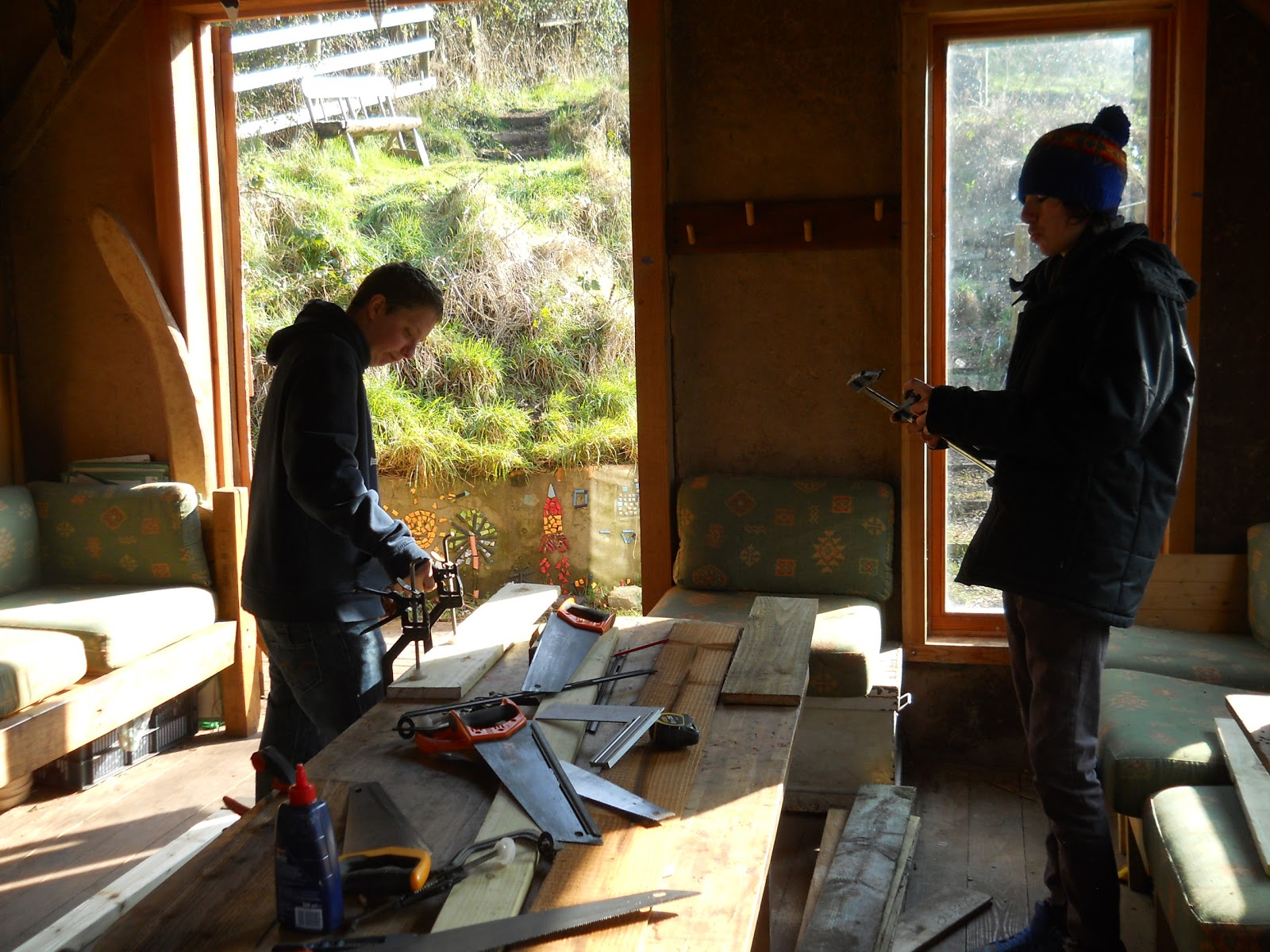
On Tuesdays, I work with four young people doing construction-type projects and have been doing so for a term. They're a good bunch and we get a lot done too! Three have been referred by their schools, whereas the fourth is now at college and volunteers to come down. He told me that since he started his college have been much happier with his work, which is great to hear.
We've worked on a few projects, including making doorframes for the roundhouse and also constructing a new window frame from larch timber (you can see that post here: http://carvingswithstories.blogspot.co.uk/2013/01/fitting-new-window-in-roundhouses.html)
The final project has been the biggest though; designing and building a strawbale urinal building from scratch.
For a while now, the only toilets at Boiling Wells have been the compost loos, but these don't really benefit from getting too wet so it's good for some wee to go elsewhere. However, going behind a tree obviously isn't a good option when children are running about the place, as they sometimes are!
There's another reason for the strawbales too. Apparently, urine is a great compost activator, being very nitrogen-rich. I've also read and heard that male urine is better for this than female, but I'm not sure why. Some say it's less acidic but I can't vouch for that. You can read about another place using straw soaked in urine as an activator here:
http://www.treehugger.com/lawn-garden/is-male-pee-better-than-female-pee-the-compost-conundrum.html
The group have constructed the building from timber. First, we assembled frames for the wall panels using halving joints. We then fixed on lapboards to clad the wall. The boards at the bottom are thicker to stop people kicking them out.
Then, yesterday, it was time to put it all together! We had help from my friend Simon and managed to get all the walls and the urinal trough made. Next week the roof will be fitted and, hopefully, a screen put in front of the door.
The urinal works by putting the strawbale in a kind of trough made of thick plastic sheet and open on one side with a space in the wall behind it. People wee on the strawbale and then, when it needs to be changed, the plastic can be lifted up so that the bale rolls out into a space behind the building. It can then be pulled out, put onto an adjacent compost heap and replaced with a fresh bale.
On Tuesdays, I work with four young people doing construction-type projects and have been doing so for a term. They're a good bunch and we get a lot done too! Three have been referred by their schools, whereas the fourth is now at college and volunteers to come down. He told me that since he started his college have been much happier with his work, which is great to hear.
We've worked on a few projects, including making doorframes for the roundhouse and also constructing a new window frame from larch timber (you can see that post here: http://carvingswithstories.blogspot.co.uk/2013/01/fitting-new-window-in-roundhouses.html)
The final project has been the biggest though; designing and building a strawbale urinal building from scratch.
For a while now, the only toilets at Boiling Wells have been the compost loos, but these don't really benefit from getting too wet so it's good for some wee to go elsewhere. However, going behind a tree obviously isn't a good option when children are running about the place, as they sometimes are!
There's another reason for the strawbales too. Apparently, urine is a great compost activator, being very nitrogen-rich. I've also read and heard that male urine is better for this than female, but I'm not sure why. Some say it's less acidic but I can't vouch for that. You can read about another place using straw soaked in urine as an activator here:
http://www.treehugger.com/lawn-garden/is-male-pee-better-than-female-pee-the-compost-conundrum.html
The group have constructed the building from timber. First, we assembled frames for the wall panels using halving joints. We then fixed on lapboards to clad the wall. The boards at the bottom are thicker to stop people kicking them out.
Then, yesterday, it was time to put it all together! We had help from my friend Simon and managed to get all the walls and the urinal trough made. Next week the roof will be fitted and, hopefully, a screen put in front of the door.
The urinal works by putting the strawbale in a kind of trough made of thick plastic sheet and open on one side with a space in the wall behind it. People wee on the strawbale and then, when it needs to be changed, the plastic can be lifted up so that the bale rolls out into a space behind the building. It can then be pulled out, put onto an adjacent compost heap and replaced with a fresh bale.
Fixing the panels to the supporting posts
Putting in noggins to fix the recycled plastic splash guard to
Digging the postholes
Putting the first wall up
Fitting the other walls
Ready for a strawbale!
Sunday, 6 January 2013
Lime rendering a strawbale wall- a few things learnt at the Boiling Wells roundhouse in St Werburghs, Bristol
A few of us farm staff are about to get on with sorting out the roundhouse at the St Werburgh's City Farm's Boiling Wells site, which has been looking decidedly sorry for itself of late. We will have help from some volunteers and young people and I'm really looking forward to getting it shipshape, so that we can really start using it properly.
I thought I'd write a bit here about what we learnt when lime rendering the construction's strawbale wall in October/November 2011.
The roundhouse was originally built by a group called 'Shift Bristol' and they put a lot of hard work into making it. They were advised initially by Tony Wrench, who has made his own roundhouse in Pembrokeshire (see www.thatroundhouse.info). Unfortunately, Tony couldn't be there for the whole build and time was really tight for the project, so inevitably some things didn't work out as they should and the roundhouse was left not quite finished.
Since a lot of the people who helped on the build have moved on, they won't get to learn what we found out by trying to finish the jobs off. In writing this, I hope that they and other people will be able to avoid some of the mistakes we encountered and it will help make their future lime rendering projects easier!!
How the strawbale walls were constructed
The strawbale wall only makes up about a third of the total wall area of the roundhouse. The rest comprises door spaces and walls made from cordwood and bottles held together in a cob matrix, with straw stuffed into the centre of the wall between the logs or bottles.
We have had some trouble with logs shrinking as they season and working themselves loose from the cob matrix, even falling out.
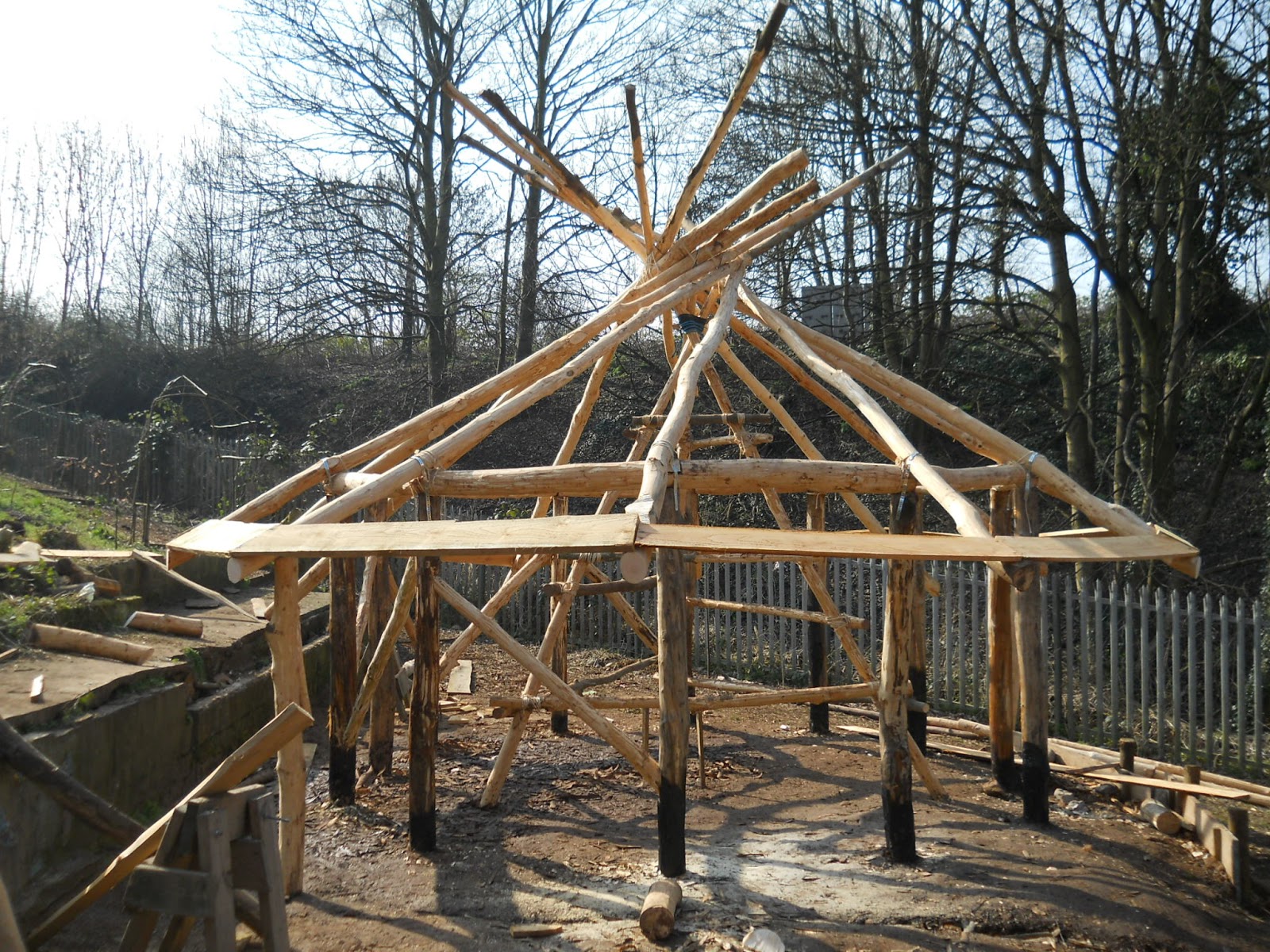
The walls aren't loadbearing - the weight of the roof is taken by a wooden 'henge' which is then filled in with strawbales etc. You can see the assembled henge frame and the rafters for the reciprocal roof below:
Applying render
Don't use metal staples etc. to key the render onto the wall, as the lime will corrode them.
Make sure you are wearing old clothes and sturdy rubber gloves and wear safety specs - you don't want this stuff in your eyes! Cover any cuts as lime will interfere with healing. We kept some clean water handy, in case any eyes or skin needed to be washed. Spread old tarpaulins on the floor to protect the ground underneath and to catch falling render, which can be added into the next mix.
First, moisten the wall slightly to help the render stick. Then, take handfuls of the render and push it into the straw walls with a kind of massaging, circular action to get it right in. The first layer will have bits of straw sticking out, but they can be covered by subsequent layers or trimmed later. After about a week the next layer can be applied.
While drying, protect the render from hot direct sun and, more importantly, from frost. In hot climates, hanging hessian in front of the render and then keeping it moist may help avoid problems caused by over- rapid drying.
Finally, paint over a couple of washes of lime putty mixed half and half with water to make a 'slip'. If you don't want the finish to look dazzling white, you can add a bit of acrylic paint. I used some yellow ochre from a small tube of artist's acrylic and it gave a very nice yellowish tone to the final finish.
I thought I'd write a bit here about what we learnt when lime rendering the construction's strawbale wall in October/November 2011.
The roundhouse was originally built by a group called 'Shift Bristol' and they put a lot of hard work into making it. They were advised initially by Tony Wrench, who has made his own roundhouse in Pembrokeshire (see www.thatroundhouse.info). Unfortunately, Tony couldn't be there for the whole build and time was really tight for the project, so inevitably some things didn't work out as they should and the roundhouse was left not quite finished.
Since a lot of the people who helped on the build have moved on, they won't get to learn what we found out by trying to finish the jobs off. In writing this, I hope that they and other people will be able to avoid some of the mistakes we encountered and it will help make their future lime rendering projects easier!!
How the strawbale walls were constructed
The strawbale wall only makes up about a third of the total wall area of the roundhouse. The rest comprises door spaces and walls made from cordwood and bottles held together in a cob matrix, with straw stuffed into the centre of the wall between the logs or bottles.
The walls aren't loadbearing - the weight of the roof is taken by a wooden 'henge' which is then filled in with strawbales etc. You can see the assembled henge frame and the rafters for the reciprocal roof below:
The base of each wall section is an old railway sleeper laid flat on the ground. It's hard to tell if there is a membrane on top of this, or if the treatment already in the sleeper is being used to prevent water travelling up from the ground into the wall itself (I wasn't around when the strawbale wall was built by the group). Strawbales have been put on top of this sleeper, with hazel spars pushed in and holding them together. When we came to render the wall, it already had a thin covering of smeared clay to prevent rats nesting in it (the site is on a terracotta-type clay and is in an urban area).
Why lime render?
We wanted to use lime render as it allows a certain amount of movement within the wall and also lets it 'breathe', important with an organic building material such as straw, whilst still being waterproof. Cement render would be too brittle and eventually crack as the strawbales moved slightly under it. Clay render was too soft and could be damaged easily when dry, as well as being susceptible to damage from rain.
Lime render also looks good but needs to be handled with caution. The mix is very caustic and can make your skin very sore. It's best kept out of your eyes too! Be careful not to let it sit around on any decorative wooden areas as it will bleach them.
How we'd do it next time...
I've got to thank Rik Lander at this point for giving us his help and advice. You can see the beautiful studio that Rik constructed at http://bristolgreenhouse.co.uk . The site also has a lot of useful links and advice on building using old tyres, hempcrete etc.
Strawbale tips
For more on how to build the strawbale wall itself, you'll need to check other sites. I can only give a few thoughts, as we took things on when the walls were already built...
First, make sure that the strawbales have the cut ends of the straw facing outwards. The long sides of the straws don't allow the render to grip to them very well, whereas the cut ends give a good key. If your wall is thinner than the length of a whole bale, you could cut the bales in half with a saw (or chainsaw) before setting them in place, but they may need some extra baling twine wrapped around each half first, to stop them falling apart. Cutting in half will also, of course, reduce their insulating properties.
When the wall is assembled, trim it to remove any overhangs and jutting bits using a chainsaw, old kitchen knife etc. but do it before you apply any clay render. It's frustrating work trying to get lime render to stick underneath an overhanging bit of bale, but not quite annoying enough to sacrifice a chainsaw blade on clay-covered walls. I don't know if the clay render made applying the lime render over it any easier, but it kept the rats out in the meantime.
The Lime render recipe that we used:
Each mix comprised:
2 buckets old render (a mix of 12 shovelfuls irregular grain sized (coarse to fine) sand, 2 shovelfuls lime putty and 4 handfuls of sawdust) I got this recipe online, but it just doesn't work. The render was far too brittle. However, we scraped it off the walls, broke it up a bit and put it back into the new mix.
You can do this with any old lime render (even after many months or even years!), put it into the new mix and it often works better than fresh-mixed stuff. If you want to revive a batch of just dried out old render to apply it, put it in the mixer with a tiny amount of water and it will be fine.
1 bag builder's sand (medium, regular-sized grains). For those in the UK, sand from Travis Perkins performed much better than that from Jewsons. Sand with very irregular grain sizes doesn't key together very well in my experience.
1 shovelful lime putty. Add a little at a time to ensure it mixes in.
1 bucketful of hydraulic lime powder (NHL 3.5). Lower numbered limes are better for rendering on straw as they are more flexible.
approx. half a bucketful straw, cut into 1 inch (2.5 cm) long pieces. Longer bits don't work well during application. The first layer of render applied needs straw in the mix to help it bind together, but the second layer onwards don't need it.
approx. 1 bucketful water. Add this in small amounts. Too much water will make the mix prone to cracking, you want enough to make it workable and no more.
***
Three of these mixes covered about 5 metres square (about 16 and a half square feet). Each layer was about half an inch (1.25 cm) thick.
Mixing the render
Get a cement mixer. Don't do it by hand unless you are a mixing machine with arms like treetrunks.
Top loading drum mixers are better than front loaders, as the render tends to bind together in an unmixed lump in front loading ones and putting halfbricks in didn't help sort that out either. It's very important that the render is evenly mixed with no lumps of sand or, especially, lime putty. Remember to check that it's mixed at the back of the mixer too...
Put a big board under the mixer to protect the ground from the harsh, alkaline render.
Be careful when adding the hydraulic lime dust. Don't inhale it and keep it out of your eyes. You may like to wear a dust mask, or fix a bit of plastic sheet over the mouth of the mixer with a bungee to stop too much coming out again when mixing.
The longer the render mixes for, the 'wetter' it becomes. Don't be tempted to add too much water early on, let it mix for a while then add in small amounts.
To see if the render is ready, check that there are no lumps, take a handful and chuck it at the rim of the mixer. It should feel workable, but not wet, and it should stick to the rim.
Don't use metal staples etc. to key the render onto the wall, as the lime will corrode them.
Make sure you are wearing old clothes and sturdy rubber gloves and wear safety specs - you don't want this stuff in your eyes! Cover any cuts as lime will interfere with healing. We kept some clean water handy, in case any eyes or skin needed to be washed. Spread old tarpaulins on the floor to protect the ground underneath and to catch falling render, which can be added into the next mix.
First, moisten the wall slightly to help the render stick. Then, take handfuls of the render and push it into the straw walls with a kind of massaging, circular action to get it right in. The first layer will have bits of straw sticking out, but they can be covered by subsequent layers or trimmed later. After about a week the next layer can be applied.
While drying, protect the render from hot direct sun and, more importantly, from frost. In hot climates, hanging hessian in front of the render and then keeping it moist may help avoid problems caused by over- rapid drying.
Finally, paint over a couple of washes of lime putty mixed half and half with water to make a 'slip'. If you don't want the finish to look dazzling white, you can add a bit of acrylic paint. I used some yellow ochre from a small tube of artist's acrylic and it gave a very nice yellowish tone to the final finish.
I hope that's useful to any readers thinking of using lime render. Ours has now been on the roundhouse wall for over a year and is still going strong. We haven't had any problems with cracking, flaking off etc. Good luck with your own projects!
Subscribe to:
Posts (Atom)