As well as this blog, I also have a website and Instagram page with lots more images of my work as well as a few more stories.
If you like woodcarvings, you might want to have a look.
Showing posts with label teaching. Show all posts

Monday, 25 April 2016

A very busy day teaching woodcarving in Bristol!

It's always interesting to see what different students want from tutored woodcarving sessions. Some people like to be shown a few particular techniques and then to get on with practising them with some guidance if needed, whereas others want to try as many different things as possible in the day.


Both are fun be a part of, of course. My last session of tuition was definitely the latter and it was the first taught session in my lovely new workshop. I really enjoyed using some tools again that I don't use that frequently and discussing how to use them too.

One great thing about teaching one-to-one is that learners can use some of the power tools that I'd sometimes be wary of bringing out with a group. When things go wrong with power tools they can go wrong very quickly, so I like to be able to keep a close eye on things. 


I wouldn't usually teach people to use certain tools such as chainsaws or Arbortechs in carving as they are potentially so dangerous to inexperienced users (or experienced ones!). Tools such as the scroll saw are a lot less aggressive and so I'm happy to use that occasionally. 


Katya wanted to make some wooden frames for embroidered pieces that she had produced.  First of all, I showed her how to use a panel saw (below) and a coping saw (first photo) properly. Cutting accurately by hand with a saw is a skill that anyone using wood should know. Electric saws are great, but occasionally only a hand saw can be used (when there's no electricity available, for example).


Katya was very happy with the piece that she produced using the scroll saw:


We also tried using a Dremel hand drill, an electric powered wood lathe and an electric drill.
It was the first time that Katya had used any of them but I think that by the end of the session, the scroll saw was still the favourite! She also kindly let me use her photos in this blog post.

Monday, 21 March 2016

Making insect hotels as a workshop at Southmead hospital

Insect hotels are basically compartments filled with things that insects like to hide in; dried plant stems, leaves, rotten wood etc.


I worked with Esther Coffin-Smith, the sustainability officer at Southmead hospital to give visitors, staff and patients at the hospital a chance to fill their own hotel and take it home with them.


The boxes were made in advance using exterior plywood and heavy-duty EDPM rubber. These materials were all recycled offcuts very kindly donated by the Bike Shed Company. To fill them, we had strips of recycled corrugated cardboard (which lacewings like to live in), rotten wood, bark, dried stems of cow parsley and hogweed (not hemlock), pieces of bamboo and leaves of London plane (Platanus x acerifolia). 


It was great fun to create the patterns of stems and other materials and we also had twenty-nine children from St Theresa's School join us to build their own hotels to take home.


At one point, someone began to play on a nearby piano which was a very nice addition! It's the first workshop that I've run that has had Ragtime music played as an accompaniment.


The boxes each had two holes drilled into the back, so that they can be hung up in a sunny spot to attract solitary bees or a shady place for other insects. 


Ideally, I would also have put metal wire mesh over the front of each box to prevent birds from pulling out the fillings looking for the insects hiding within. Obviously with large groups of children the cut metal could have caused injury, so it was thought best to leave it out of this workshop. A coat of exterior varnish on the outside of the boxes may have helped them last a bit longer outdoors as well. Thanks Esther for inviting me along for the day.

Thursday, 17 March 2016

Making carved wooden panels with braille on them for Southmead Hospital in Bristol: Part Two - Fresh Arts Festival and meeting the Bristol Braillists

After the initial process of research, my design for the wall-mounted sculpture in the Brunel building at Southmead hospital had been okayed and I now needed to assemble a panel to be carved at the Fresh Arts festival.

Since the timber originally earmarked for the project had vanished, I decided to buy some kiln-dried oak instead. Suitable locally grown wood wasn't available, so instead I did the next best thing and bought some that had been PEFC certified (indicating that it had come from sustainably and responsibly managed forests) from a local timber merchant.


The boards were joined and glued without using dowels or biscuits, as they can look awful if carved into by accident. Once the board had been sanded the design was drawn on and then it went with me in September 2015 to the Fresh Arts Festival.


Carving at 'Fresh Arts', with music provided by the 'Gasmen' choir. Photo by Ruth Sidgwick
The design was created to have plenty of straight lines and simple carving, so that passers-by could have a go and get stuck in with minimal carving experience. Several visitors and patients remarked to me that they found the carving process very relaxing and that it was 
a welcome activity at that time.

After the festival, I continued to carve the panel but was still undecided about using braille. Alan Michael Rayner had previously pointed out that there was more than one kind of braille and that, if I wished to use it, it was worth getting experienced advice.

One evening, sitting in the pub, I mentioned the project to my friend Steph. He reminded me that he was currently involved in a project to design a Kindle for blind people and then said that the group was meeting soon and that several braille users would be there. He invited me to join them. 

Perfect!

That was how I came to meet the Bristol Braillists, who provided a lot of helpful information and expertise during a very interesting evening indeed. It's very rare, I would imagine, that a sighted artist gets to sit with five blind people and to chat about how they interact with the world and how an artwork could be made more accessible for them.

One story from the evening stood out for me. I was told about a young woman, blind from birth, who was asked to draw a bus. She drew three straight lines. The first was the step, the second her route up the aisle of the bus and the third the pole that she held on to. The rest of the bus was irrelevant to her as she couldn't feel her way around it all.

I also found out that some blind people have a name for sighted people: 'light dependants'. Very true!

The braillists at the meeting came up with several good ideas and points. Hazel noted that someone who is blind may not have any reference for what is portrayed in a representational carving; a landscape has never been seen by some blind people. Dave thought that metal pins could be used to represent the braille dots - an idea that I later used. 


Later, when I had begun carving the main panel, Paul and Hazel Sullivan from the Braillists group very kindly came to my workshop and tried out the panel to check it for 'usability'. It was very interesting to hear their comments and Paul had typed out, on a braille typewriter, the wording that I wanted to use. This meant that I could drill straight through the dots on the printed card, so using it as a template.


I used brass jeweller's ball-head pins to make the braille dots, each snipped to length and then glued into an individually drilled and recessed hole - over 1600 pins!


Saturday, 30 January 2016

Carving workshops and making a bench for LinkAge in Lawrence Weston, Bristol with younger and older participants

Running workshops for LinkAge is always a lot of fun. They organise projects to try and get young and old people working together, encouraging communication between two groups that might not otherwise come into contact in a positive situation.


I've led several workshops in the west of Bristol for LinkAge previously and it was great to be asked to run these two days at Blaise Weston Court retirement home in Lawrence Weston.


Everything was set up in the main atrium of the building, so residents could drop in and have a go if they wanted to. There were two possible activities; making a simple, shallow relief carving or working together to make a bench from larch timber, to go in the garden of the home.


I hadn't run a session in this kind of environment before and noticed that many people having a go had mobility issues, which would perhaps make going to a venue elsewhere difficult and unappealing. It was great to see them getting stuck into the activity in a more convenient setting and some people commented that they really enjoyed using tools again, after a working life in a trade such as electrician.


Three young people from the local Gateway school were also helping to build the bench and they worked very hard, alongside one of the residents of the home, making a great job of the finished bench.


Everyone seemed very happy with how things went and I hope that the bench will be in the garden for a long time to come!


Wednesday, 30 December 2015

Teaching woodcarving at Nailsea school, near Bristol: carving a Green Man into a log of Ash wood

On the weekend before Christmas, I went back to Nailsea school to do some more woodcarving tuition. After teaching a very enjoyable session there previously, working with pupils at the school, I was looking forward to it!


woodcarving at Nailsea school

This session was a little different as all of the people attending were adults and the session was partially funded by a local community group; the Nailsea Community Trust. We also had to carve in the art room instead of the outdoor DEN space, as the rain was pouring down outside. 


However, the tables in that room were at just the right height to carve (carver's benches are generally higher than joiner's benches). The hot drinks and snacks were also on hand courtesy of Rebecca Hollingdale, who runs the DEN project at the school and who organised the session.

The Green Man is such an intriguing image, open to such varied interpretation, that I always enjoy watching people carve them. We were using logs of Ash (Fraxinus excelsior), sourced  by the DEN project from recent woodland management work. 


teaching woodcarving to adults

Ash is very pleasant to work with when freshly-cut and green, but can be tough work to carve by hand once seasoned. It is also not particularly durable outdoors, but that could be an attractive feature for some people I'm sure - the image of the Green Man returning to nature.


carving a green man in wood

After a brief safety talk and a few (hopefully) handy pointers about facial anatomy, the group started carving. Some people were quite happy to get stuck in, but others were more reluctant to start cutting in deeply. Sculpting a face can be quite daunting and I can completely understand that some people would feel a little nervousness and even frustration when setting out to do such a project. I've found that for many learners who feel a bit overwhelmed, the best thing to do is just to start carving, removing the outer bark at first to see where the process takes you.


carving ash wood

Once everyone was into the flow of things, one of the most rewarding things about the day was seeing everyone starting to create unique and expressive sculptures. All of the faces were very different and by the end everyone seemed very happy with the carvings that they had produced. 


Some people used the differently-coloured inner and outer bark layers against the pale ash wood to make some very interesting designs.


Some faces seemed to show someone who was relaxed, others were much more dynamic with expressive tool marks left on them:


It was great to see all of the faces put together at the end (apart from one, as the person who carved it had to go home a bit earlier). I'm sure you'll agree that they look very interesting together, showing a few different interpretations of the image of the Green Man.


green man woodcarving

Friday, 27 November 2015

Teaching wood carving lessons in Bristol and Nailsea, to individuals and schools

I've been teaching carving regularly for about nine years and really enjoy sharing the craft that I love with people who would like to learn the skills to make their own wood carvings. 


woodcarving lessons in schools

It isn't necessarily a one-way process either; it's always interesting to experience things through the eyes of someone who is new to carving. Often 'learners'  will come up with great ideas that I might not normally think of. Even after over twenty-one years of carving, new ways of imagining designs are always good to see.

In the last month, I've run two very different teaching sessions. The first was a session of individual tuition at my studio. One particularly enjoyable thing about individual tuition is that it means that the learner can practise with my own full set of professional carving tools, which wouldn't really be appropriate to use with larger groups of inexperienced carvers. I always use good quality, sharp tools when teaching anybody but with individuals, I can first make sure that they have the knowledge to safely use some of the particularly delicate tools in that set. The person attending can also have the entire session completely tailored around the particular information or skills that they want to learn more about.


sharpening chisel

I had worked with Rich before when he brought groups of disengaged young people to Boiling Wells, where I used to work part-time. He's been getting more and more interested in woodworking since then and wanted a few pointers about things that aren't necessarily taught in conventional carpentry or joinery courses, such as the uses of different kinds of native timbers.

Another subject that especially interested him was sharpening techniques. It strikes me that this is really best learned by actually being shown it, by some one who knows how to sharpen, and then practising it regularly. We covered everything from using different kinds of bench grinders to making an effective strop to hone blades until they are razor-sharp. By the end of the session, Rich not only knew how to sharpen using various types of sharpening device but also had his chisels and an axe honed again, to take back with him and use.

Later in November, I travelled over to Nailsea school to teach carving at the D.E.N. project. The school uses this area in its grounds to run forest school sessions and they are very interested in teaching students practical skills.


Nailsea school DEN

Throughout the afternoon, groups of up to five pupils came out to the small shelter in the D.E.N. area and carved oak plaques to take home with them. 


They could carve pretty much whatever they liked and it was fascinating seeing what designs were produced. I was particularly interested by how many chose themes to do with computers, such as items from Minecraft, which they reproduced using the very traditional techniques of wood carving. It was also interesting seeing the journey that some people had during the session, from initially being very frustrated with new, unfamiliar skills to finding more confidence and eventually making pieces that were nicely done and that they could feel happy with.


woodcarving tuition in Bristol

Miss Hollingdale, who invited me to run the session, really got into the carving too and I anticipate that it's going to be a regular feature at D.E.N. sessions from now on!

Bristol wood carving lessons

Friday, 30 October 2015

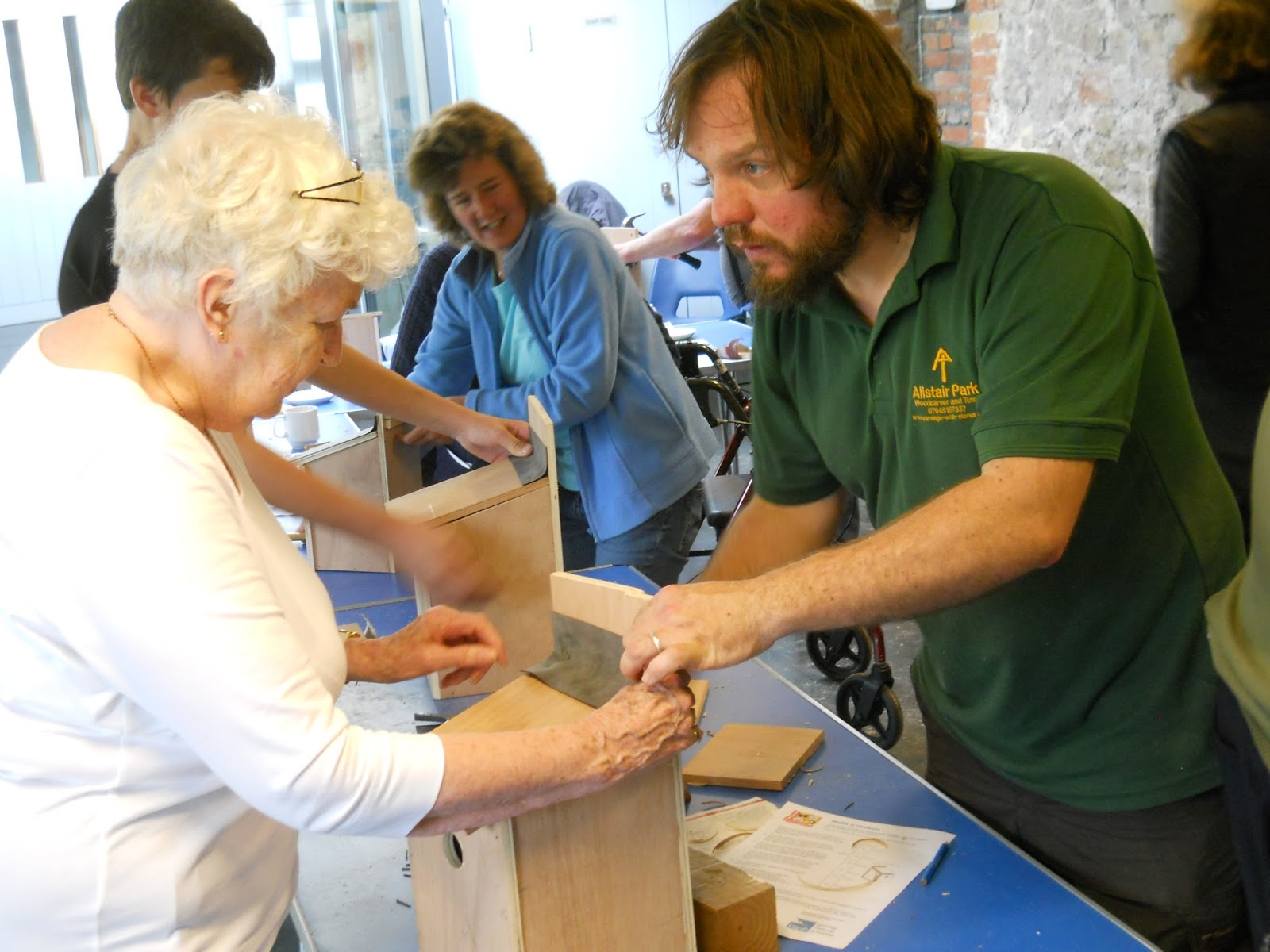
Running a workshop making nestboxes and insect hotels, for LinkAge in Shirehampton


LinkAge activity

I've run a few workshops for LinkAge before and they are always great fun. The organisation brings together younger and older people to work together on projects, giving a chance for communication that is often difficult in society. They also run activities more specifically for older people to get involved with, giving a chance for meeting new people and doing new things.

activities for older people


Previously, we have built benches and produced carved wooden plaques. This time, the theme was building nest boxes and insect hotels. In case you are wondering, an insect hotel is an object or area specifically designed for insects to be able to hide in and hibernate. They are often made particularly to help bees (such as bumble and solitary bees), which have been dropping dramatically in numbers recently.


It was nice to catch up with a few familiar faces again and also to meet some new folks. Some of the new participants were very, very nervous about using tools such as saws and hammers for the first time and were also surprised by how much noise such tools made. However, by the end of the session everyone was cutting and joining the wood without any assistance and produced some great boxes and hotels to take home!

making a nest box

It was great seeing people who were afraid to even pick up a saw at the start of the session cutting parts for their projects neatly, safely and efficiently by the end of it. I hope that they will now feel more confident to tackle similar practical tasks themselves in the future.

Saturday, 24 October 2015

Giving a talk about the new Downs bench to the Clifton and Hotwells Improvement Society in Bristol

Last Tuesday, The Clifton and Hotwells Improvement Society (CHIS) met for their Annual General Meeting. I was invited along to talk about the bench that they commissioned and which was installed on Clifton Down earlier this year.


Clifton and Hotwells Improvement society

After the society business was concluded, the chairman Brian introduced me and I spoke for a while about the different subjects carved on the bench and the stories around researching them. There was a slideshow of images to illustrate it.


As well as talking about these subjects, I gave a very brief demonstration of relief carving techniques and answered questions. 


demonstrating woodcarving

It seemed to go very well and several people came up afterwards and chatted about their different experiences of carving. I learnt a few interesting things too! Thank you to CHIS for commissioning me to make the bench and for inviting me to talk at their AGM. Thanks also to M. Shapland, who took the photos on this post.

Sunday, 11 October 2015

Pendant carving workshops at Wildfest 2015 on the Northern Slopes in Knowle West, Bristol

I've run these workshops at the two previous Wildfests on this site and they always go down really well. One of the great things about these events is the view here, from the Northern Slopes away across Bristol. 


Wildfest northern slopes bristol

I had brought along plenty of uncarved pendants made from locally sourced timbers such as sweet chestnut and oak. Visitors could draw on their own designs, carve them and then take them away for free.


It was certainly busy! There was a queue of people for most of the festival, waiting to try carving. I'm sure that most of them were giving it a go for the first time too. Children were especially keen, but there were also a few parents ready to give it a whirl:


One highlight for me occurred when a young pendant carver came up to the bench. I asked her what she would like to carve on her pendant. She looked at me and said "I'd like to carve a sculpture."

Fair enough! 

Working with LinkAge to teach younger and older people woodcarving in Shirehampton's Tithe Barn, in Bristol


LinkAge work to bring younger and older people together on projects, to promote communication between two groups that don't always get the chance to meet in such positive environments.

LinkAge shirehampton project

I've worked with LinkAge before, on a project to make a bench for Shirehampton in Bristol. It was a  pleasure to be invited back to work with them again for two days at Shirehampton's Tithe Barn. 
The young people who came all attend 'The Orb', which is associated with the local Oasis Academy Brightstowe school. 


The Orb particularly caters for students who aren't getting on well with conventional education. Chatting to some of them, it was very interesting to hear their thoughts on the normal classroom environment. They all enjoyed the opportunity that The Orb gave to be able to have a say in organising their studies to fit the way that they learn, rather than being forced into the normal routines of the classroom.

Eileen was also hard at work over the two days, creating a carved oak plaque for her garden.


I think that everyone attending learned quite a bit about woodworking. There was a choice: either making plaques from cedar or oak wood to take home or working on a bench for the garden at the barn.


Making the bench first involved cutting the oak legs to length using a bow saw - no mean feat!

using a bow saw

 The seat was then shaped, using a drawknife to round the edges.


It then needed to have holes drilled into it and to be carved with designs that had been drawn on, showing the barn and a design of cart special to the area.


Two of the young people also carved and assembled a plaque for The Orb using a bow saw off cut, as a nice surprise for the staff there.

the orb bristol

The bench came out really well and will last a long time, as it is made from durable oak and sweet chestnut timbers.


Thanks to Ricky, Susan and Laura at LinkAge and to everyone who came along for their hard work on the two sessions. I also had some very happy news on this project.

Ricky, who is one of the senior workers at LinkAge, told me that they felt that the previous benchmaking project that I'd led for them had gone so well that they were now using it as an example in funding applications and other important publicity work.

They had asked me to run some of these new sessions for them because it was particularly important that, as part of a major new project, they went well. They felt that I'd be able to help ensure that the new sessions were a success. I've got to say that it was very satisfying to hear how pleased they were with my work.