As well as this blog, I also have a website and Instagram page with lots more images of my work as well as a few more stories.
If you like woodcarvings, you might want to have a look.
Showing posts with label stone carvings. Show all posts

Thursday, 10 January 2019

Inuit stone carving - a detective story

inuit carving by pauloosie weetaluktuk

When I was much, much younger, long before I discovered carving, my father came into the room one day and gave me a stone sculpture of a person holding a sack. My great-aunt Mary had died and the small statue was passed on from her to me.

The Inuit figure had been brought back from Canada by my grandmother in about 1965. That was really all that was known about it. As I learnt more about carving generally, the sculpture interested and intrigued me more and more.


paulousie weetaluktuk sculpture carving

The weight and shape of the dark serpentine, veined with greenish tints and flecked with red, make it so pleasing to hold in one hand. It was clear that someone had worked the design around the shape of the original stone: the dents and depressions of that rock were still visible, albeit smoothed out. 


pauloosie weetaluktuk sculpture

On the base was carved the number 1760. I knew that it wouldn't be a date mark but was it a catalogue number?


Who had carved this mysterious sculpture and where? For years I didn't know. Even a trip to the Canadian Museum of History in Ottawa failed to turn up anything, with the resident expert being out on that day and subsequent email enquiries to him going unanswered. 

Reading books on the subject showed that the sculpture probably came from around the east coast of Hudson Bay but that was about it.


Paulosie Weetaluktuk


Then I learnt about disc numbers.

Disc numbers were used from 1941 to 1972 (or 1978 in Quebec) and were introduced to help various organisations (such as government agencies) to identify Inuit individuals. Before then people would have one name, given to them by elders. When missionaries arrived, many Inuit took Christian names but often altered them to make them sound more local: so Thomas might become Tumasi. 

After the Mounted Police census in the 1940s, identification numbers were assigned to each person and were often used as signatures by Inuit carvers in the 1950s and '60s. The numbers (preceded by an E for east or W for west) were also stamped onto discs which would be worn around the neck or sewn into a parka. This practice was phased out after surnames became officially adopted by Inuit in 1969. 


Image from: https://www.vice.com/en_ca/article/xd7ka4/the-little-known-history-of-how-the-canadian-government-made-inuit-wear-eskimo-tags

Using a site that traces Inuit artists by their disc numbers, I discovered that my carving had been made by Pauloosie (or Paulosie) Weetaluktuk. He was born in 1938, died in 2012 and lived at Inukjuak, a town on the east coast of Hudson Bay which was formerly known as Port Harrison. 

I haven't been able to find any photos of Pauloosie Weetaluktuk that show his face, but have found a presentation that he gave as a member of the 'local grocers' association' to the Royal Commission on Aboriginal Peoples in June 1992. It gives interesting glimpses of his life as a carver in a place very different to that in which I live.

He talked through a translator as he didn't read or understand English. The main topic was the high cost of living in such a remote place (he said that it was three or four times higher than in more southerly parts of Canada) and how that makes it difficult to survive there. The increases in taxes and high living costs mean that carvings 'do not make much money' any more and it is tough selling skins and handicrafts as there is 'hardly any value in them'.

Pauloosie Weetaluktuk said that: 'Our operating budget has to be very high these days. There are people who have never been employed in their lives, who have depended on carving and they were able hunters, but now that the price of carving has gone down, you just see them as men but they don't operate as men any more. They don't have anything to base their lives on or their manhood on.' 

Sometimes it can be easy to forget the hardships that the people who created a carving might have faced in making a living. This presentation cuts through any of that to show how tough supporting oneself was at that time and in that place. I wonder if things are any better there now? 

I wish that I could have met Pauloosie Weetaluktuk, creator of this beautiful sculpture that has meant a lot to me for a long time, and told him what I've just told you

Monday, 2 February 2015

Visiting the pretty village of Castle Combe; unnatural carvings, Hollywood locations and one of the oldest working clocks in Britain

Castle Combe is in the county of Wiltshire, on the edge of the Cotswold hills. It may be familiar to some of you even if you have never visited there, as its picturesque streets have been used as a location for many films and TV programmes including Doctor Doolittle, Stardust and War Horse.


The village looked particularly beautiful in the clear winter sunshine as we walked around with almost no one else there apart from the residents.


castle coombe


Of course, I couldn't resist dropping in to visit St Andrew's Church, just off the village square, to check out any carvings.

The church was originally built in the 13th century and later extended, with the nave built during the 14th century and the tower in the 16th. The church eventually fell into disrepair and a lot of work was subsequently done to it in the 19th century.


The gargoyles outside looked splendid in the clear winter light:


Inside, I noticed this (I assume) medieval carving...


If you look carefully at the bearded figure, it appears to be holding something - perhaps a rabbit?- as well as a crucifix. What looks like a rabbit's head is appearing between the man's legs. In the church guide, it says that the figure is giving birth to a demon.

I'm not sure about that explanation. A lot of medieval carvings do show unnatural things, often representing 'the world turned upside down' (you can see some of these in my post about Bristol cathedral). However, I think that this one is more likely to be a humorous warning against lust, with the associations that rabbits have! The guide also points out another light-hearted carving, of an unnatural beast situated right next to the church organ - perhaps the organ has itself been the source of many unnatural sounds over the years!


There are many other interesting carvings and paintings in the church. The chancel arch is beautifully carved:


In the wall off to one side, the tomb of Sir Walter de Dunstanville dates to 1270. According to a nearby sign, the fact that his feet rest on a lion and he is in the act of drawing his sword mean that he was killed in battle. His legs crossed at the knees mean that he went on two crusades. The figures below represent his children, including a priest, a man of letters, a farmer's wife and one woman who died in childbirth. The chainmail he wears is so well carved that the original mail can be identified as having come from smiths in Bristol.


The older carvings are not the only interesting ones. This scene of the Last Supper of Jesus and his disciples, based on the famous mural painted by Leonardo Da Vinci, hangs on one wall.


If you look carefully it becomes clear that it was carved in the Far East, not only because of the wood used and some design touches. All of the figures also have facial features from that region.


There are a few nice nineteenth century carvings dotted about in the choir stalls too.


It's not only the decorations that are of interest in this church. It houses what is probably one of the oldest working clocks in Europe.


There's no definite date of manufacture for the clock, but parts of it's design are similar to others known to have been made in the 15th century. It used to sit in the belltower but was moved down into the church in the 1980s. The clock doesn't have a face to tell the time, instead it chimes to let people know the hour.


If you would like to see it chime be warned that, despite many parts having been changed and replaced over the years, it is very old and doesn't keep modern time very accurately; we gave up waiting after about half an hour!


Monday, 1 September 2014

A strange Norman stone carving in St Nicholas' church, Combe St Nicholas, Somerset

combe st nicholas church

While visiting this church for a wedding, I noticed the strange carved stone capital on a pillar near the north entrance. Apparently, it is the only remnant of the Norman church that once stood on the site (although a round font dating to Saxon times is thought to be the oldest object in the church, surviving from the Saxon church building that was here before that).

green man combe st nicholas

It is an odd carved design and some people think that it represents the devil. I wonder why the medieval builders who rebuilt the church in the 13th century decided to keep this bit of stonework in particular? The pillar that it tops does not seem to hold up any arches, so it probably isn't structural. 

The way that the weird-looking head seems to sprout the paired 'snail track' lines out of its mouth reminds me a lot of 'green man' carvings, some of which have foliage coming from their mouths in a similar fashion. I wonder if this could be an example of such a design? According to 'The Company of the Green Man' website, this carving would seem to have been identified as such by Clive Hicks in his book 'The Green Man: A Field Guide'. 

The carving on the capital to its left looks to me like it could represent a crown.

If you are visiting the church, the oak screen in front of the altar is also worth a look. A plaque tells how it was first carved around 1480, then was taken down and moved in the 19th century before being repaired and returned to it's original position in 1921, when a memorial to the men of the parish who died in the First World War was also added to it.


Monday, 28 July 2014

The mysterious carved symbols on the kerbstones of London

kerbstone symbol

Whilst walking from Oxford Street through Soho in London, I saw this symbol carved into the kerbstone at my feet, then another further along the stone. The stones each side were not marked in such a way. At first they looked like stonemason's marks, cut to show that a certain number of kerbstones had been completed that day. But, in common with some other kerbs in the area, why two marks on a single stone?

London is not the only town or city in Britain to have such markings on its kerbs. There are apparently many in Glasgow too. No one seems to be exactly sure what they mean. Some say stonecutter's marks, showing either a certain number of kerbstones that had been laid within a particular time or a certain number shaped at the quarry. Some say that they mark surveying points, while others even say that they mark secret Masonic meeting places or are related to the Great Plague or local executions at Tyburn. These particular marks are also repeated on other stones in the area.

soho kerbstone symbols

My own feeling is that they are probably stonecutter's marks or road laying crew signs. Maybe two symbols show either the end of one cutter's work and the start of another's, or are the foreman's marks from a particular gang of workers either shaping or laying the stones. I wonder who they were and where the stones were quarried? A visit to the remains of the stone quarries on Dartmoor will show half-finished kerbstones lying around in the wild landscape. It must have been a tough life being a stonemason up there, are those weather-beaten quarries where these stones were originally shaped?

On New Oxford Street, these signs were all carved within a run of fifteen kerbstones, with whole streets nearby not showing a single one:


Although nearby Museum Street has a few symbols on display too, surely too close to each other to show the start and finish of a run being laid:


A week later, I was walking through Bristol and noticed these marks on the kerb of Gatton Road in St Werburghs, unlikely to be a centre for Masonic ritual in my opinion: 

bristol kerbstone symbol

The same marks appeared three times on stones within a run of fifteen. The D-shaped mark then appeared again about half a mile away, alone on High Street in Easton:


...and again on South Street in Southville, on the other side of the city. This time it was accompanied by a circular mark that I haven't seen elsewhere in Bristol, apart from on that street.


While walking down Western Road, between Hove and Brighton, more kerbstone marks could be seen. These were at Second Avenue in Hove:

brighton kerbstone symbols

further along Western Road towards Brighton, more cross-shaped marks could be seen:


before letters started to appear.


Further still towards Brighton and these 'N' shaped marks could be seen. They are a little different to the others, as they were clearly made using a modern stone cutting circular saw rather than cut by hand. They were accompanied by long saw cut marks running along the kerbstones for a few metres.


I wonder if these marks point to such symbols being a road maintenance crew's work, or if it was just a bored workman messing about. The cuts along the kerbstones are pretty haphazard and not very straight.

Peter Dolan has written two very interesting articles in Geoscientist, the magazine of The Geological Society, which I recommend reading if you are also intrigued by these enigmatic markings. His first, Kerbstone Conundrum, introduces the subject and includes a list of symbols that he has seen or heard of. The second, Kerbstone Markings 2, goes into more detail. Peter has told me by email:

'Suffice it to say at present that I am 90% sure that most of these markings do relate to utility services, but haven't followed it far enough to get independent, documented verification.'

I like the way that the exact meaning of these symbols is still somewhat mysterious and subject to debate, whilst some of them are being walked past by hundreds of people every day.

Wednesday, 16 July 2014

Revisiting the Green Man - a mysterious image from the past

The Green Man is a face that can be seen in many old churches and stately homes throughout northern Europe. The face has several basic forms, but is either made up of leaves, is sprouting leaves from eyes, ears and/or mouth or is sometimes simply a face peering out through vegetation, like these ones at St Mary Redcliffe in Bristol:


Mike Harding, in his Little book of the Green Man, points out that the name 'Green Man' was probably first used by Lady Raglan in 1939. We don't know what the medieval carvers who produced some of the finest examples would have called these faces.

We don't really know what they mean either, but the images are so powerful that they have persisted through time. They even, in many cases, escaped the stupid vandalism done to British church art by the Puritans.

In The Hidden World of Misericords, Dorothy and Henry Kraus suggest 'That so much underseat carving should have survived Protestant iconoclasm was no doubt due in large measure to the prevailingly secular subject matter'. These foliate faces are not obviously portraying Christian religious ideas either, which may be the reason that we can still appreciate so many of them today whether carved as misericords, roof bosses or elsewhere.

Hayman, in 'Church Misericords and Bench Ends' says that green men have 'often been misinterpreted as an indigenous pagan deity or as a spirit of nature. In fact green men represent sin and mortality.'

The Green Man also seems to hold a special fascination for carvers. In Understanding Woodcarving, John Foyle comments 'You may think we have enough of that fraternity around already. And, yes, the woodcarving world is certainly not short of pre-Christian sylvan dieties, or foliate men as they are sometimes called'. But the design is so strange and its origins so mysterious that carvers keep returning to it. In The Green Man: The Pitkin Guide, Jeremy Harte says that 'The Green Man was always a carver's device, whether in wood or stone. It is rare to find him in jewellery, illuminated books or stained glass'. Master carver Chris Pye, for one, has spoken of his fascination with the subject.

Similar faces can be seen carved on temples in India and there are even green cats, lions and snakes. In St John's chapel in St Mary Redcliffe church in Bristol, there is an animal sprouting leaves from its mouth hidden amongst the medieval roof bosses.

Image from http://stmaryredcliffe.co.uk/files/2014/08/St-Mary-Redcliffe-NW-tower-vaulting-report-revised-assembled-reduced.pdf
As with many such images, it's a bit hard to tell what kind of animal it is: Mike Harding thinks it is a dog, Jerry Sampson (in an interesting architectural report on these bosses) thinks it is more like a cow. Here is a more recent green dog carved on the end of a pew in St Newlyn's church in Cornwall:


Many Green Man faces are quite obviously men, with beards etc. but I haven't heard of many carvings of a Green Woman. Jeremy Harte also makes this point; 
'The real Green Lady, with foliage sprouting from her face or mouth, is hardly ever seen (although there is one at Sampford Courtenay church in Devon). At Kings Nympton church, also in Devon, there is a series of heads: all the male ones are Green Men, but none of the female heads are Green Ladies.'  
I wonder why?

Recently, I've been reworking a green man face carved in oak for 'Mayfest' in Bristol. It was okay, but didn't look exactly how I wanted it to, so I decided to recarve the eyes, nose and mouth. It was an interesting challenge, carving some fairly deep detail into an oak board only 10mm (25/64 inch) thick without going through. Here's how the face now looks:

green man

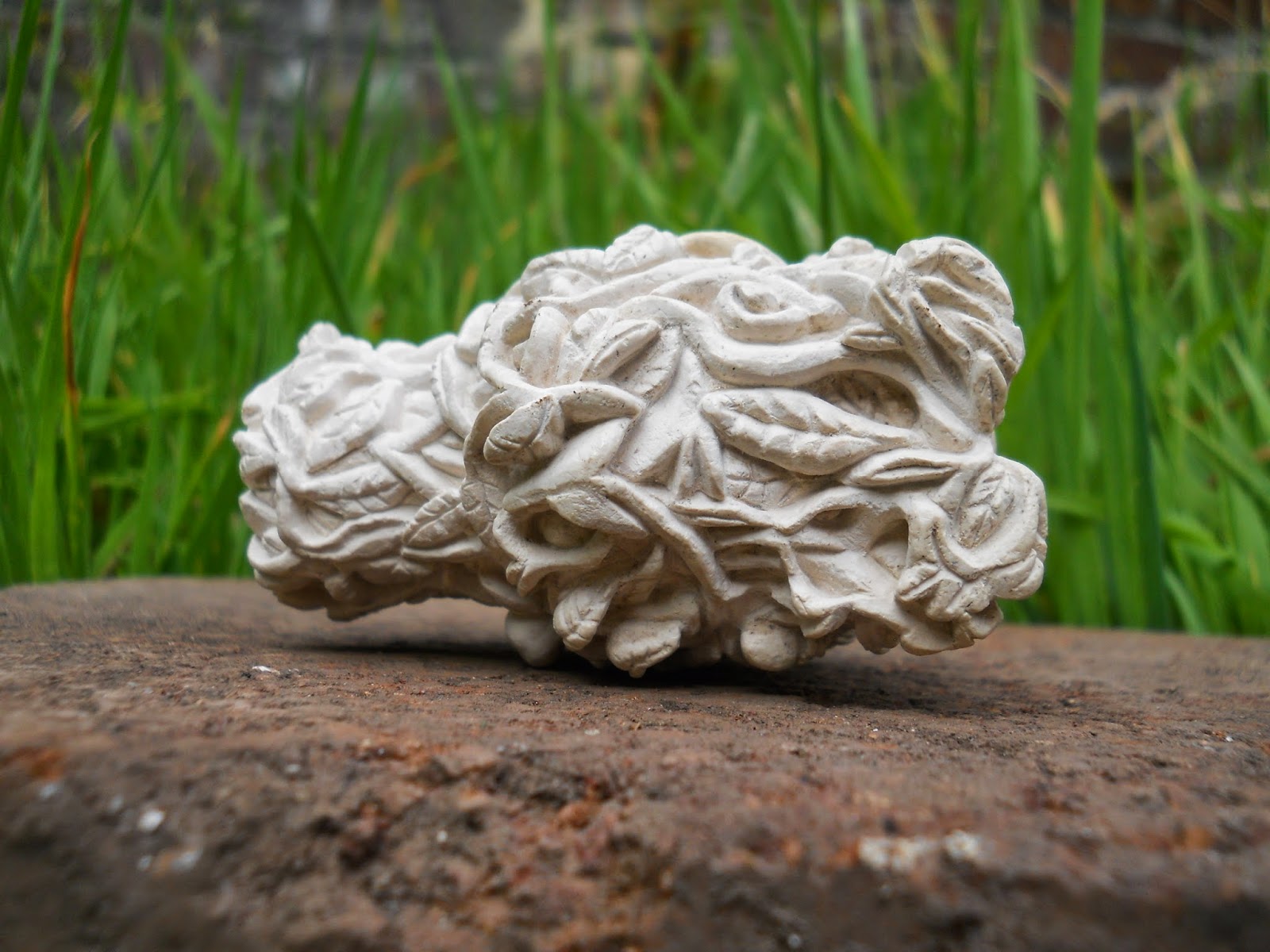
This green man's face was carved on-and-off over four years from 1998 to 2002. It is not made from wood, but instead from meerschaum, a kind of stone which is prized for use in making pipe bowls. The carving isn't finished, as it still needs to have finishing wax applied. I'd also like to carve a stem for it, probably from cherry wood.

meerschaum pipe bowl

meerschaum green man


My own favourite Green Man is one that can be found in Bamberg cathedral in Bavaria. It is possibly one of the most well-known Green Man designs and dates to around the mid-thirteenth century. Some friends have commented that they think that the face is scary and it certainly has something quite powerful about it. As Jeremy Harte says, 'often the most beautiful ones are the most sinister.'

Image from: http://www.gargoylesandgrotesques.com/index.php?p=1_6_Photos