As well as this blog, I also have a website and Instagram page with lots more images of my work as well as a few more stories.
If you like woodcarvings, you might want to have a look.
Showing posts with label stenz. Show all posts

Monday, 10 October 2016

When a journeyman goes home: a travelling 'naver' returns to Copenhagen

I've written before about the tradition of the German travelling journeymen. One post is a more general overview and the other a more detailed look at some of the traditions that come with this life. Another post talks about what some of the geselle (German journeyman) traditions mean to me, as a settled craftsperson in Britain.

Nat was the first person travelling in the tradition of the German guilds that I had met and talked to about it. Through him I also met several other people doing the same thing and I feel quite privileged to have had an opportunity to do so. Meeting journeymen travelling in the tradition is not that common an occurrence in Britain, even amongst craftspeople. Some of those that he put me in contact with I would now also call friends.


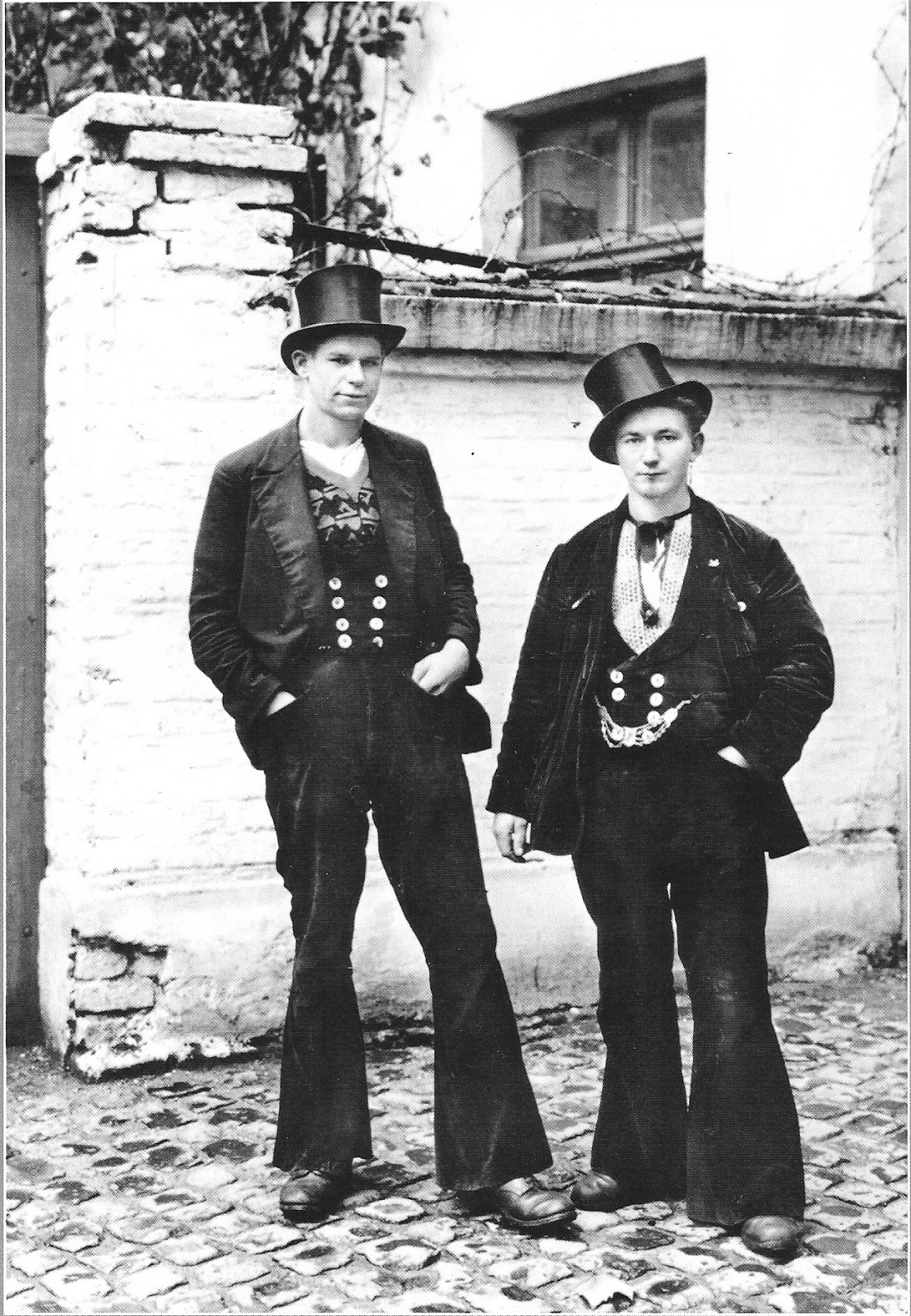
Journeymen in Berlin around 1900
Image from: 
http://denstoredanske.dk/Erhverv,_karriere_og_ledelse/Håndværk/Håndværk_generelt/naver

The normal length of travelling is three years and a long day. The long day is the part that lets someone keep going if they don't feel that it's time to stop yet. During their travels, journeymen carry a map with a circle marking an area with a fifty kilometre radius and their hometown at the centre. They are not allowed to go into that area for the whole of their time travelling in the tradition (unless there is an emergency, such as a member of their immediate family becoming seriously ill).

Nat himself is Danish and came into the tradition as a naver, which is the Danish equivalent of the German journeyman. Danish navers are not as frequently encountered as German gesellen and I was told that Nat was one of few Danish navers currently travelling at that point. He himself was travelling in the German tradition, having been introduced into the tradition by a German journeyman. 

After over five years, it was time for Nat to go home.

Having been notified in advance of the day and location, Nat's friends and family were gathering next to a town sign on a busy road just outside of Copenhagen. The weather was bright with some cloud and the first chill of autumn on the breeze. As the journeymen would be hitchhiking to the spot, times were very approximate - he would be there some time after 3.30pm.


I could feel the excitement build, with people crossing the highway to see as far as possible along it. It was great to have a chance to meet and chat with the others who were also waiting. Four journeymen arrived early, then headed back down the road to find the others so that they could all arrive together.

Eventually, at about 5pm, a group of around twenty figures wearing the distinctive clothes and carrying the spiral Stenz sticks of the gesellen came into view. All of the friends and family gathered on the other side of the sign. As they got closer, the cluster of journeymen separated into a line and, walking in single file, the line snaked around and back on itself. 
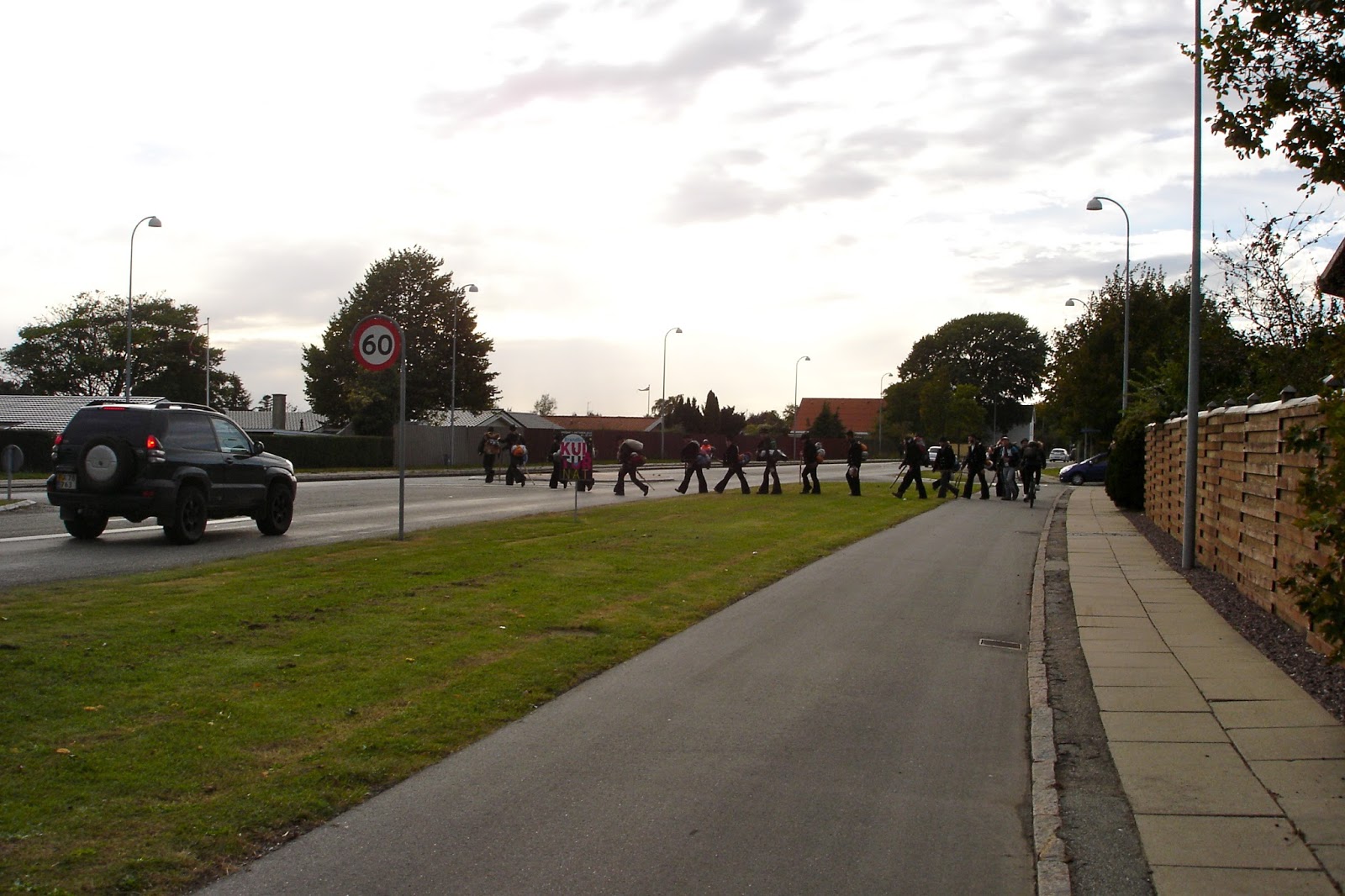


It wound up alleyways and across the road, before finally gathering on an island in the middle of the carriageway. There, a few words were said between them, there was a cheer and Nat drained the last of a bottle.

The group approached the other side of the sign from the waiting friends and family. Not all of the people in it were currently journeymen, some I knew had already finished their own travels but had put on their wandering clothes again for this day

They then formed two lines with their stenz sticks held between them. 


Nat climbed up onto this 'ladder' and clambered up to the sign. He then climbed back over, his journeying years done. I knew that in his pocket, in accordance with tradition, would be five euros: the same amount that he left with.


There was still one more thing to do while we were there. When he left, Nat's friends and family had put letters for him into a bottle which was then sealed and buried at a certain depth five paces from the sign. Traditionally, Nat would dig the hole to bury it and his family would try to throw handfuls of earth back in to show that they didn't want him to go, while his journeymen friends defended the hole from being refilled.

There were a few toots on car horns from passing motorists as the spade was brought out and Nat started to dig to retrieve the bottle, with some journeyman songs being sung at the same time.


Eventually, other friends took over the work to give him a chance to talk to those who had come to see him.


After a while, it was realised that the bottle wasn't there! The sign must have been moved in the meantime. So any rubbish was gathered up to be taken away and the hole was carefully refilled before everyone went off into Copenhagen to celebrate Nat's homecoming.

The next day, there was another party, although everyone seemed a little more subdued after the drinking of the night before (together with the partying that had gone on before they arrived at the sign). All of the journeymen got up on a stage in front of the family and friends and short speeches were made before some traditional travelling songs were sung. It was simple but also quite moving.


Nat's family had brought clothes with them, which he changed into from his travelling clothes while the songs continued. Then there was a quiz. All of the stenz sticks were put into the middle and Nat had to guess whose stick each one was. Not easy with so many travelling companions there!

naver homecoming

It was great to catch up with old friends at the party, as well as meeting new ones. 

I hope that these posts allow English-speaking people who haven't met journeymen travelling in the German tradition to learn a bit more about it. It would be good to think that they might open a few extra doors to those travelling in the UK and elsewhere, where the traditions are less well known and understood than in continental Europe.

And, of course, good luck to Nat for his next adventures!


Wednesday, 18 June 2014

Chatting with Nat and Leo: more about journeymen travelling in the German tradition


journeymen in the German tradition

I spent some time recently with Nat and Leo, journeymen travelling in the traditional way that originated in Germany (travelling carpenters in the tradition are sometimes called 'zimmermen'). The tradition of the travelling journeyman has pretty much died out in Britain and only the name 'journeyman' gives a clue as to its origins. I  know that many people are, like me, from countries without such a system in place and are very interested in what it involves. I'd like to share with you my interpretation of what was said when we chatted about their experiences.

Clothes

When walking around town, the appearance of the journeymen got a lot of attention and several people came up and asked for photos with them, which was always met politely. They both noted that it was always appreciated when people asked them if they minded being photographed beforehand. Many people also wished to try on their hats which was met with an equally polite request please not to do so. 

The journeyman's appearance is very traditional and marks them out as people travelling for a particular reason, which must have helped in places suspicious of new faces as potential tramps or vagabonds. The coat, waistcoat and bell-bottomed trousers are very well made from tough materials and the designs are based on traditional carpenter's clothing in Germany. The bell-bottomed trousers originally stopped sawdust from going into the wearer's boots. One explanation given for the double zip is that ship's carpenters would have them to make heavy, waterlogged trousers easier to remove quickly if the worker went into the water accidentally. Many of the dress codes were formalised in the 1930s and even later, so older photos of journeymen may show slightly different styles of trouser etc. ( as in this photo from 1928).

It was a surprise to feel how heavy the coats were! The openings of the pockets are edged with leather and these details are important as these clothes must be comfortable and will get hard wear every day for the duration of the journeyman's travels; traditionally three years and a day, although this can vary between different clubs. 

Nat's corduroy clothing is black, the traditional colour for a woodworker, with red seams inside the trousers. His belt buckle is decorated with a square and dividers, showing that he is a cabinet maker and joiner.  He was wearing smart black trainers, but he explained that his boots had recently worn out and he needed this footwear only until he could buy new ones. Nat also said that his clothing caused some confusion when travelling in Jamaica, where the local police wear black trousers with red seams. He needed to explain fairly quickly to certain people on the street that he wasn't a wandering undercover cop when they saw the red seams inside his black trousers.

Different trades traditionally wear clothing in different colours: tailors wear red, woodworkers black, metalworkers blue and stone workers grey for example. Some particular trades or clubs may also wear particular combinations of colours to identify themselves, or for certain events.

Leo's is blue/grey and his belt buckle has a cog-like design, showing that he is a metalworker (his particular speciality being working on bike frames - an unusual trade for a journeyman). They wear shirts with collars tucked inside and no neckties, to show that they are free journeymen who are not tied to one of the six traditional 'guilds'. The word 'Guild' is probably the expression used most frequently to describe these groups in English but both Nat and Leo preferred the word 'club' as being more accurate in their opinion. Different 'clubs' have slightly different rules; for instance, some admit women to travel in the tradition but some don't. They pointed out that, although the rules and dress code are traditional, the original medieval guilds died out a long time ago (their existence has been threatened more recently too: travelling in this way was also banned by the Nazis because of suspected links to communism and some journeymen at that time were sent to concentration camps).

Some Other Things Carried Whilst Travelling

Apart from the traditional pack, both Nat and Leo would have had a Stenz: a distinctive twisted wooden walking stick that shows that they are journeymen. I didn't see the full-size ones because it isn't really practical to carry one at all times. On a Saturday night in the centre of a large European city, wandering around carrying a big wooden stick could quite easily get someone in a lot of trouble! However, Nat and Leo both had a smaller representation of theirs that they kept in their waistcoat pockets, while the larger version was left at the place where they were staying.

Both wear simple earrings in their left earlobes which were pierced with a nail before leaving to travel, in the traditional way. The earrings were not the elaborate ones showing insignia for their professions but were much simpler in design.


They also had a Wanderbuch each, a journal in which people who they worked for could write something at the time of their departure. You can see it wrapped in cloth and clipped to Nat's belt loop in the photo above. It serves as a record of their travels, an aid to memory and would also be stamped at the town hall in each place that they visited, to prove that they had fulfilled the conditions of their journeyman travels. Free journeymen and members of certain clubs may also get their journals filled in by people that they have stayed with but not worked for.

They would go to the town hall with their pack and Stenz on departing from each place and recite a traditional speech in German before getting the stamp. Unfortunately, Bristol isn't used to travelling journeymen and the town hall didn't have such a stamp!

Their belongings are wrapped in square cloths, called 'Charlies'. This is short for 'Charlottenberger'. The origin of the name was explained to me as dating from the time of the plague. As the Black Death swept across Europe, travelling journeymen entering the town of Charlottenberg were given cloths to wrap their belongings in, as these were easier to keep clean and so prevent the disease from spreading. 

One thing that neither of them carries is a mobile phone or other electronic communications device. I suppose that not having one must give less distraction from existing in the present and in the place where you are, as well as being one less valuable thing to worry about losing or getting stolen. It must also particularly help to give focus on travelling in the early days of the journey, when the temptation for friends and family to contact someone undertaking their journeyman years must be very strong. It did, however, make organising meeting up quite tricky occasionally! 

Travelling in the Tradition

Nat and Leo set out as journeymen separately and were travelling together for a bit before inevitably heading their separate ways. Both had been travelling for longer than the minimum three years and a day by this point. I asked Nat how he would know when the time came to finish his wandering years.
Was there a set point, or was it up to him?

He said that he would travel 'in the tradition' until he knew that it was time to stop. He had already travelled to Japan, Canada, Jamaica and around Europe. Perhaps he would decide to settle because he needed a permanent workshop, perhaps for another reason. Some journeymen continue to travel around after finishing their Wandergeselle years, they just don't do it following some of the ways of the tradition.

Traditionally, a journeyman could apprentice themselves to a master craftsman and would study with them until they were ready to make a 'master piece'. If this was good enough, they would be accepted as a master craftsman and only then did they have the right to open their own workshop. Nowadays, many people do not follow this route as it is very expensive and the power of the guilds to enforce it has diminished.

Leo had travelled around Europe and to Jamaica, where he could explore the reggae music that he likes a lot. He said that it took a year of travelling before he really started to understand what the rules governing behaviour, dress and other aspects of the life of a travelling journeyman actually meant.

The traditional dress and rules were very, very important to both Nat and Leo. They did seem to mark them out and got a lot of attention. The life of a travelling journeyman doesn't seem like it is always an easy one and the reputation earned by previous visiting journeymen is vital when trying to find work and contacts in a new town. Both Nat and Leo understood how important their behaviour was to those who might follow them along this path. One particularly important trait is honesty and keeping your word, which seems like a good point of view for any serious craftsperson.

When two journeymen drink together, they don't clink glasses together in the way that is common in Europe. This tradition began as a way of exchanging a little of the liquid in each cup, to prove that there was no poison added to either of them. Journeymen don't need to prove their honour to each other and so they look at each other and tap the drinking vessels against the table instead.


People travelling in the tradition aren't allowed to own their own transport and traditionally they would travel by foot or hitchhike to the next destination.

Setting out to Travel

Nat is Danish and was introduced to travelling in the tradition by a German journeyman. He had to learn about what the tradition meant before setting out and also had to learn more of the language, since this tradition is a German one. Only one of the six clubs has connections to Denmark and Nat felt that travelling as a free journeyman felt like the right path for him, so that was the route he chose.

When they set out, each of them carried five euros (it was originally five deutschmarks in pre-euro days). They must return home after their travels with the same amount, no more. They have to fund themselves on their travels by finding work and must be unmarried, childless and debt-free when they start out. They cannot use the tradition to run away from responsibilities at home.

When they set out, Nat and Leo climbed over the signs for their hometowns and cannot return within 50km of them for three years and a day (unless there are certain specific reasons, like an immediate relative becoming dangerously ill). When they complete their travels, they will climb over the signs again to show that the wandering has ended. When Nat set out, the person who had introduced him to the tradition came with him for a while to ensure that he understood what he needed to do. 
(I was there when Nat finished his journeyman years and have written about it here.)

 It may be worth saying here that the clubs maintaining the tradition of the travelling journeyman are definitely not secret societies and have no particular religious or political agendas that I'm aware of. One drunken person on the street did ask loudly if Nat and Leo were Jewish- I suppose that he mistook their clothes and hats for those worn by an orthodox Jew! Other journeymen have told me that the same thing has happened to them.

Paragraph Eleven

§11 Section Eleven

I had seen this on various items that the journeymen had with them and wondered what it meant. 

It was explained to me that a long time ago laws were passed prohibiting journeymen from meeting unless for a celebration (with drinking). At this time, it was not uncommon for confrontations between different guilds to occur and so this may have been an attempt to prevent such trouble. The specific section allowing gatherings with drinking for celebrations was paragraph(shown using §, the symbol for 'section' or 'paragraph') eleven. 

Nowadays, §11 on display shows travelling journeymen that they are welcome.


More information

If you are interested in this subject, there is more about the tradition of the travelling journeyman as well as some links to other online resources on another post, which you can go to by clicking on this link.

It was great meeting Nat and Leo and thanks to them for sharing their time and knowledge with me. Thanks also to Timon, Steifen, Viktor, Erdmann, Hansen, Jul, Achim, Arnold and Ryki for doing the same.

Safe travels to all of you.


Tuesday, 18 June 2013

The European woodworking guilds and the journeymen

(Image from 'The Mortice and Tenon, Spring 2013)

This photograph is on the back cover of the most recent edition of 'The Mortice and Tenon', which is the quarterly journal of the Carpenters' Fellowship.
These are journeymen carpenters in Germany and the picture was taken in 1928 by August Sander. Journeymen carpenters still wear almost identical outfits today with justified pride and can be identified by them.

Some other trades, such as builders and metalworkers, also have a tradition of travelling journeymen. They often wear similar clothes to those of carpenters and may belong to the same travelling 'clubs'. Details such as the colour of the fabric and designs on the belt buckles will differ from those of woodworking trades. Some journeymen also wear different clothes to the ones shown above, such as breeches and knee-high boots.

Image by A.Stemmer from https://commons.wikimedia.org/wiki/File:Gesellen1.jpg
The tradition of the journeyman carpenter is a very long, very interesting and very well respected one in Europe. In Germany, once a carpenter has completed their professional training, they must travel for three years and a day and are forbidden to work within 50 km (about 30 miles) of their home town or the place that they did their apprenticeship. These rules may vary slightly between different clubs.

If you'd like to see what happens when a travelling journeyman goes home, I've written about it in another post. Some join a guild or society and will usually follow it's strict code of conduct (Schacht).  

Others do not join a particular group, but are free-journeymen. They also observe the same codes of conduct, but are not bound to attend meetings and to observe other obligations that members of a journeyman society might do.

(Image from www.flyingshavings.co.uk)

The carpenter journeymen of Germany are sometimes called 'Zimmermen' and can be easily recognised by the way that they dress and certain traditional objects that they carry. Like the two carpenters above, woodworking members of a 'guild' or club will often wear a black and white three-piece suit with, sometimes, an identifying tie. The blue ties worn by the two men above show that they are members of the 'Roland's Brothers' club, which was officially founded in 1891. The red ties worn by the men shaking hands in the photo above this one show that they are members of the 'Free Brothers' club, which was founded in 1910. These clubs are two of the older ones, the oldest and one of the most traditional of the clubs being the 'Righteous Brothers'. None of these clubs will admit female members.

A journal (Wanderbuch) is carried which the bearer must not fill in. Those that they work with will fill it with notes but the journeyman will collect stamps from officials (at post offices for example) to show where they have been.

They wear their hat (usually a black one) at all times when travelling and will carry a cloth bag holding their possessions and a cane (the Stenz) made from a twisted branch.  I have seen photos of journeymen working in the baking heat of a workshop in Zanzibar but still wearing their black hats, black waistcoats and trousers. They are justly proud of what this dress code means and the tradition that they carry. Free journeymen will wear a white shirt with the collar tucked inside, but the rest of the outfit may be chosen at will.

The wide-brimmed hat (similar to that worn by the men on the right in the two photos immediately above) is usually worn by someone in their first year of travelling. The wide brim would come in useful if someone was working above you and generating sawdust, as it stopped the sawdust getting into your eyes. However, such a large hat can be a bit more difficult to travel with and so more experienced journeymen wear smaller hats, which are also much more practical.


If you look carefully at the left ear of the man on the right of the top photograph, you can just see a long earring hanging from it. This earring is called the Ohrhänger and is worn with pride, always in the left ear. Sometimes, it will show the tools associated with the wearer's craft. In the case of the carpenters, this could include tools that a carpenter uses - perhaps a pair of compasses, a saw, a carpenter's axe or a hewing axe. Other possible symbols include a hexagram (symbolising the geometry of carpentry) and two plumb bobs. One society, named Axt und Kelle, wear earrings showing an axe, a builder's trowel and the rising sun.

The earrings serve several purposes. They identify the wearer as a trained carpenter and they could be used in the worst case to pay for their funeral if they died whilst travelling. If the wearer should bring the guild into disrepute by bad workmanship or behaviour, the earring can be forcibly torn out leaving a jagged scar and identifying them as a Schlitzohr. How is the ear pierced for the earring? With a hammer, a nail, a block of wood and large amounts of alcohol of course.

Journeymen don't wear plastic buttons on their clothes. Instead, they are usually made from mother-of-pearl; a material with some value. These buttons could therefore be used in payment and as collateral if the wearer has no money.

In France, the Compagnons de devoir are trade guilds. They are also very old, dating back to medieval times, but have different traditions to the German ones. The two systems were apparently closer in form to each other before the French system was reformed in the 1950s.  The French guilds teach around communal houses which are strictly governed by 'The Rule'. Like German guilds, high standards of moral and professional conduct are expected to be followed. Travel is also important in acquiring knowledge and skills.

It seems sad that in Britain, the tradition of the carpentry guilds has been lost to some extent. They were particularly important in medieval times as tradesmen would travel around Europe working on large building projects. However, in Britain the dissolution of the monasteries and the joyless actions of the puritans probably meant that work was too hard to find to sustain the guilds in the same way as those in mainland Europe.

There are the livery companies of carpenters, of turners and of joiners based in London, the 'Worshipful Companies', but their good work is mainly in helping trainees financially by awards rather than by networks and practical training. Of course, many guild journeymen from Europe still travel to the UK, like the two gentlemen in the more recent photo above, and the Carpenters' Fellowship has strong links to the carpenter's guilds in both France and Germany.

(Image from http://the189.com/design/art/constantin-brancusi-artist-and-sculptor/)

I was intrigued to read that some believe that Constantin Brancusi, one of the most influential sculptors of the twentieth century, came through a guild system. He left his home in Romania in 1904 and travelled to Paris but there is little record of him until he turned up there. Pierre Cabanne, in his book on Brancusi,  believes that this journey may have seen the young woodworker helped and given shelter by the guild, which he could have been in contact with whilst studying and working in the town of Craiova. It's interesting to think that the ancient guild system in Europe could have profoundly influenced sculpture in this way even into the present day.

This is a very brief look at the European carpenter's guilds and their journeyman traditions. If you are interested, why not check out these sites:

There is a lot more about journeymen travelling in the German tradition on this blog post. It was written after hanging out with Nat and Leo, who were 'travelling in the tradition' at the time.

You can read more about German journeymen on Robin Wood's blog here:
http://greenwood-carving.blogspot.co.uk/2010/07/german-journeyman.html

There is also an interesting Wikipedia page about them:
http://en.wikipedia.org/wiki/Journeyman

There is information about the German and French guilds here:
http://www.en.charpentiers.culture.fr/thepeople/compagons/thecarpentersguildingermany

The Carpenter's Fellowship website can be found here:
http://www.carpentersfellowship.co.uk/