As well as this blog, I also have a website and Instagram page with lots more images of my work as well as a few more stories.
If you like woodcarvings, you might want to have a look.
Showing posts with label tuition. Show all posts

Thursday, 17 July 2014

What's been going on recently? Carved oak signs, teaching woodcarving in Bristol and secret jobs!

There's been a mix of different work keeping me busy recently. I've worked on a couple of commissions lettercutting in oak :


Here's another house plaque, carved in oak for someone who is very keen on the 'Star Wars' films. It was fun carving the ewok in relief!


There's also been a commission carving 'rope' for the skilled furniture maker Jim Sharples.  Jim is working on an oak stand for the ship's bell from HMS Cornwall and wanted some carved 'rope' wrapped around the top crosspiece, to give a suitably nautical look to the finished piece. Getting it all laid out correctly was a bit of a puzzle, but I'm happy with the results. This bell stand may well end up in the Maritime Museum, which is a nice thought.


A pleasant Friday was also spent teaching Matt relief carving in oak. He spent the afternoon at my studio and got to use my own woodcarving gouges and chisels, which is something that I can only really do when working with small numbers of people, as some of the tools (such as the hook skew) are very fragile. We covered using a handsaw, a block plane and a V tool, some relief carving techniques, sharpening tools effectively and laying out a design onto the wood from a paper copy. Matt carved a chinook helicopter and seemed to really enjoy learning some of the skills that are an important part of this craft.


I have also been working on a couple of jobs that I can't talk about! One was for a client in mainland Europe and I have undertaken not to discuss it online (for good reasons; it's nothing illegal either, I promise!). I will say that it was very interesting though. Another project has been one of the most interesting that I've worked on and that will be posted about in the near future, so watch this space.

Sometimes, I have a big project on and can't discuss it until the finished carvings are unveiled or given to the person that they are meant for. It doesn't seem right to spoil the surprise of a gift by posting about it here and sometimes commercial clients need to keep things under wraps until a grand unveiling or promotion is completed.

Occasionally, a client will also ask me not to write about a job on my blog, for various reasons. Perhaps they wish to keep it personal to them or they need it to be anonymous. Needless to say, I always honour such requests.

So if you see gaps in the blog, don't think that I've stopped carving or blogging. Just wait and see what the next few posts bring!


Friday, 27 June 2014

Celebrating the Braishfield Oak: Running carving workshops at Braishfield School in Hampshire

Braishfield primary school is in the rural village of Braishfield in Hampshire. A large old oak tree used to grow in its playground and was the symbol of the school and of the village.


Unfortunately the tree became infected with honey fungus and was going to die, so the difficult decision was made to cut it down before it became dangerous.

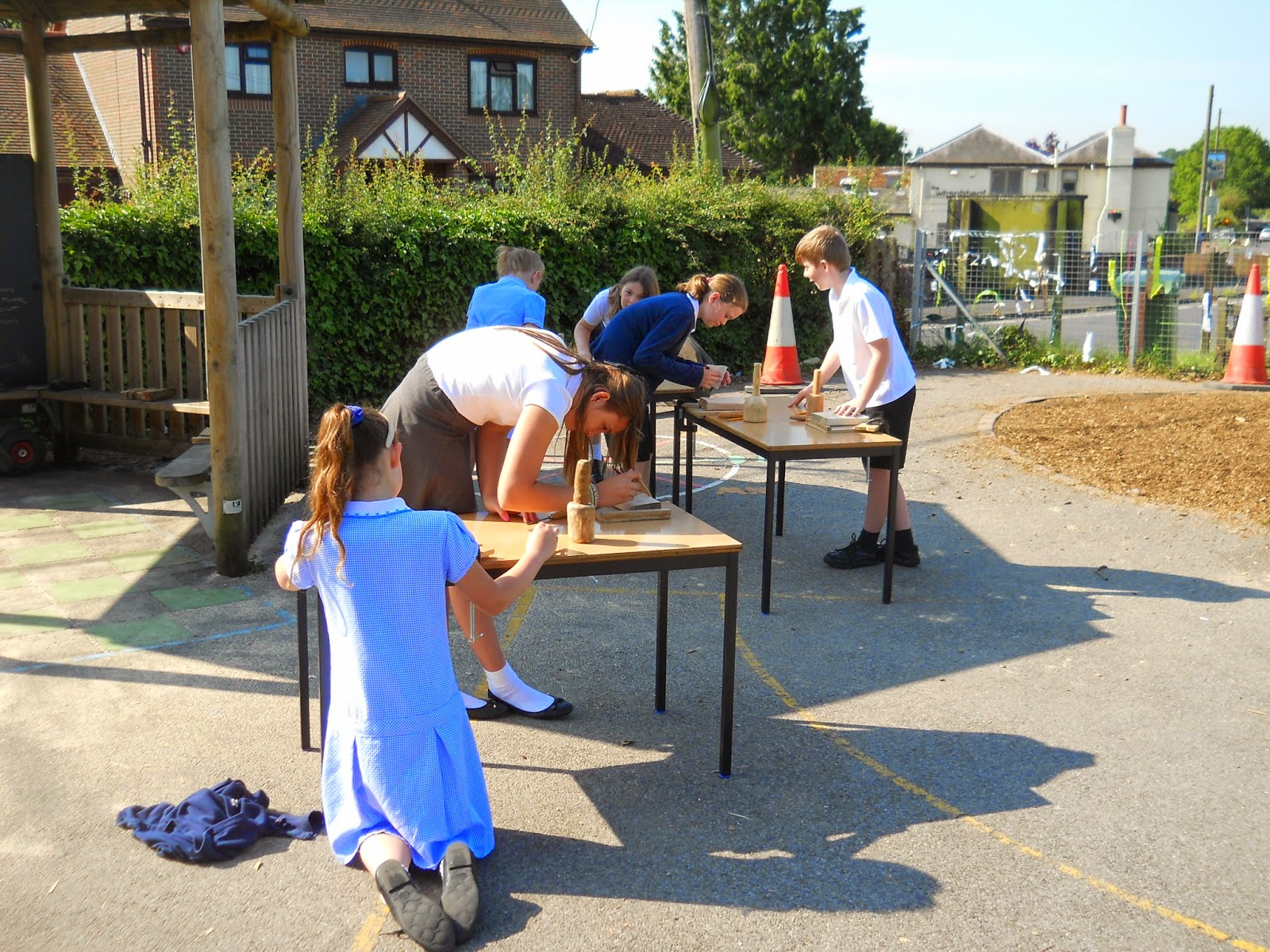
The school wanted to give the children a way of remembering the tree and so they decided to get me in to run carving workshops, using pieces of timber from the old oak to carve on.


The children could not only learn about carving but also take home their bits of wood as mementos. I spent a day cleaving parts of the oak into lumps, which were then sanded to remove splinters and make them easier to carve on.


Nearly sixty pupils at the school, aged between five and ten years old, then got the chance to try woodcarving over the next couple of days.


The weather was hot and sunny and everyone seemed to have a great time. Even the teachers and school staff got to try out their carving skills!


Thanks to the school for inviting me over and for a very enjoyable few days in Hampshire.


Monday, 31 March 2014

Teaching carving for a stag do at my studio


On Saturday, four folks on a stag do came to my studio to do some carving. It was a lovely sunny day and it felt great to be back doing some woodcarving tuition again.


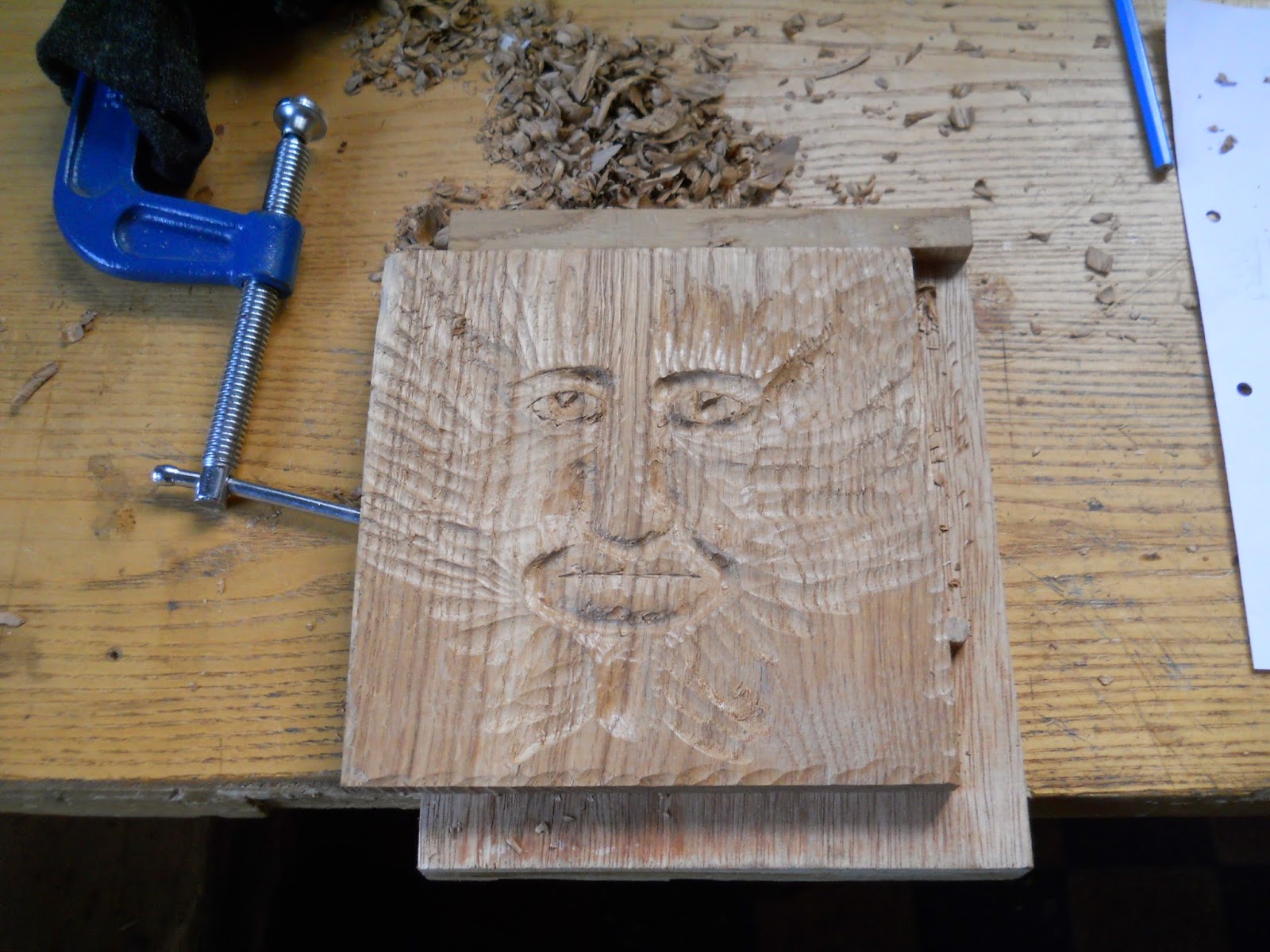
Garry and Hamon decided to carve faces in relief onto pieces of oak. They used a variety of gouges and chisels to create them and the finished pieces were very dynamic. We all felt that they worked well.


Pete and Lorraine chose to carve spoons from fruit woods (plum and cherry). This gave them the chance to use a mallet and froe, drawknife, hook knife, three kinds of fixed-blade and whittling knives, three types of small axe (Scandinavian-style hatchet, Kentish pattern and Swedish Carving) and spoon-bit gouges.

Pete really enjoyed using the Kentish pattern axe and Lorraine the drawknife. They both agreed that spoonbit (short bent) gouges worked far better for them than hook knives when hollowing out the spoon bowls.


It's great giving people the chance to try a range of tools to see for themselves how certain ones just feel better when working than others. Providing all of the tools on offer are of good quality, the most comfortable to use can sometimes really just depend on the user.

When I bought my carving axe, the sales advisor recommended that I hold all of the dozen available ones there to see which felt right for me. It was a real surprise to discover how different they all felt, even though they were all handmade by the same people to the same design.

Everyone got well into their carving and seemed very happy with what they made. Once the carving had finished, we ended the session with a little nip of homemade blackberry whiskey for the non-drivers. A lovely afternoon!

Friday, 13 December 2013

One-to-one tutoring at my studio


Will came over for another afternoon of one-to-one woodcarving tuition. They have been very enjoyable (after all, talking about woodcarving is one of my favourite things!) and he has sent me an email saying how much he has enjoyed them too.


The last session was quite heavy on facts about tools and techniques, so it was great that this one was much more 'hands-on'. He got to use my Gransfors-Bruks Swedish carving axe to learn about axe techniques whilst roughing out the design for a lovespoon in a block of well-seasoned cherry wood. Cherry is one of my favourite carving timbers and hopefully the spoon will look great when it is finished.


I'm very glad that these tuition sessions have gone so well and would be happy to consider similar ones after this. Good luck to Will with his carving in the future as well.

.....Update on the 4th June 2014......

Will has carried on with his lovespoon and completed it. He sent me some images and I thought that that you might like to see how it turned out:


Monday, 9 December 2013

Birthday woodcarving class! Teaching at my studio in Bristol

At the weekend, my studio was being used as a teaching venue again. One of the visitors was enjoying a carving session as a treat for her birthday, so we got on with carving some bowls as well as a house sign.


It was a great way to spend a Sunday and everyone seemed to enjoy it. Thanks to Paloma for taking the photos as well.

Friday, 6 December 2013

Teaching woodcarving at Shirehampton with LinkAge and also at my studio


Things have been moving along nicely in Shirehampton where I've been working with LinkAge and the Wild City Project, to create a bench that will be installed in a local nature reserve. The volunteers are a mix of older and younger people and everyone has been working hard to make the seat, which will hopefully be finished next week.


It will be carved to commemorate the horses and mules that were trained on the site to be sent to the battlefields of World War One.


The next day, Will came to my studio and we spent a great afternoon chatting about woodcarving. He's interested in possibly pursuing it as a career and so was keen to find out more about tools, techniques etc.


I haven't done a lot of one-to-one tuition at my studio as it is a real, working, vibrant, shared workshop and so can be a little noisy at times, although the folks sharing with me are very understanding about working around teaching sessions. However, the session with Will seemed to go very well indeed and so I'd like to do more of this kind of tuition in the future.

The great thing about one-on-one tuition is that it can be tailored more to the learner and what they want to do. They can also use my own personal tool set, so get to learn more about the differences between tool makes and shapes and what they can do with them. For example, Will is using a Ray Gonzalez hook skew below, a tool which is very delicate and so isn't always appropriate to include in a tool set for teaching a group. If you'd like to find out more about tuition, you can get my contact address via my website's contact page.


... and I'm looking forward to working with everyone again next week!

Friday, 1 March 2013

Teaching woodcarving- Some thoughts about courses and tutorials in Bristol and beyond


About a month ago I was reading one of Chris Pye's interesting e-bulletins (you can go to his website by clicking on this link). He made some thought-provoking comments about woodcarving tutorial videos on Youtube:

"This arguably doesn't need saying but it's important: just because you see something filmed doesn't mean it's something worth watching; or that the techniques you see are worth emulating. Observe carefully. Test things out.
It's very easy to upload video clips to Youtube and, while there's a lot of good stuff to be seen, you need discretion in what you watch or, rather, what you take on board as a technique."


It reminded me of something that I've been thinking about for a while - how can you tell in advance whether a woodcarving tutor (or, indeed, a tutor in any other craft) is any good?

A few months ago, I dropped in on an open workshop being conducted by someone who had set themselves up as a woodcarving tutor. They run courses for paying customers at their studio as well as running workshops elsewhere, including in the town centre. They seemed like a nice person and all was fine until they held up a 'V' tool and told me that they had no idea what it was or what it was for. 
For anyone else who doesn't know, this is a 'V' tool (sometimes also called a parting tool). They also come with a 90 degree or 45 degree angle and get their name from the 'V' shaped cross section of the blade:

Image from http://www.ashleyilestoolstore.co.uk/carving-tools/carving-gouges-chisels/v-tool
'V' tools are used for many different things in woodcarving, but some of the principal ones are in some styles of lettercutting, carving fur or hair and when roughing out the design of a relief carving. They are pretty fundamental pieces of kit and seeing this person say this was a bit like a professional car mechanic holding up an adjustable wrench and asking me what it was for! They then told me that at that time they were giving students what they knew to be poorly-seasoned oak to carve. Such timber would be quite likely to split if kept in a centrally-heated room.

At first what I'd heard didn't bother me - well done to the tutor for getting workshops running - but as time went on, it bothered me more and more. The tutor seemed to be teaching people who were paying them to learn woodcarving, when they didn't seem to know that much about it either. 

There is obviously no certification scheme to show that someone running a carving course has the experience and skill to make a good teacher. With the range of disciplines that woodcarving covers, everything from ecclesiastical restoration work to fine art sculpture to whittled caricature carvings, perhaps this something that is unlikely to change!

Chipping away at a piece of wood is a wonderful and (sometimes!) relaxing thing as any carver knows. Giving people the chance to try it is great, without them having to buy the expensive kit only to perhaps find out that carving isn't for them. Everyone has to start somewhere! But it's also potentially dangerous and accidents can happen very fast. If a carving tutor has little experience, there must be an obvious concern that students could get injured.

There are well respected courses about, such as the City and Guilds courses in woodcarving taught in London. However, a good woodcarver isn't necessarily a good teacher. I've met some fantastic carvers who just didn't have the disposition to take on students (or the inclination for that matter).


Word-of-mouth could be a good guide, but if the person telling you that a carving course is good has no experience of anything else, how can you trust that they actually learnt anything worth learning? As the proverb says; 'In the country of the blind, the one-eyed man is king'. 

But then why should technique be worth taking the time to learn? The highly skilled carver Guy Reid has said something that makes sense to me:
"The ability to master technique enables one to be free to express something beyond just technical skill. From this basis of technical mastership comes the freedom of self-expression."

It should be said that even two experienced and well-respected woodcarvers and teachers can differ completely in their opinions and teachings. One example that comes to mind is in the use of metal stonecarver's 'dummy' mallets to carve wood:


A Dummy Mallet
(Image from www.johnnealbooks.com) 

 Ian Norbury has written (in 'Fundamentals of Figure Carving'):

"The mallet I now use is in fact a stone mason's mallet made from an alloy of lead and zinc... Its advantages are the conveniently small size to weight ratio and its density. There is very little bounce back when it strikes the gouge, thus it does not waste energy rebounding up through your arm, which is injurious to the joints. The metal does not damage the handles any more than a hardwood mallet, indeed the chisel handles dent the metal."

Michael Painter, however, writes in 'Woodcarving' magazine (Jan/Feb 2013):

"One of my tallest soap boxes arises at the use of metal mallets!...why would you want to hit the wooden handle of a chisel with a piece of unforgiving metal? These mallets, also called dummies, derive from the stone carving profession and haven't any place in a woodworking environment."

Both very experienced and well-respected carvers and teachers. (For what it's worth, I sometimes use a dummy mallet in woodcarving and find it very useful. I wouldn't use it exclusively though, wooden mallets give a softer and more delicate blow to the gouge which suits some cuts better in my experience).


No one could honestly be able to claim that they have the definitive knowledge of a subject as complex, internationally practised and ancient as woodcarving. Would anyone want to? A great and wonderful part of woodcarving for me is the knowledge that there is always more to learn.

Someone accepting money to teach using sharp and specialised woodcarving tools does seem to me to need a certain level of knowledge and responsibility however. What should that level be and how can it be demonstrated? 

Looking at their previous work online or elsewhere is an obvious starting point; I'd look for someone who is making and showing work regularly that you would like to be able to make yourself. If someone isn't making their own work that often or showing much of it online then they might be worth treating with some caution, although if you are reading this blog then I probably don't need to point these things out to you! 

I don't have many quick answers I'm afraid. It just feels like some carving tuition I'm seeing around doesn't come from particularly experienced carvers...

Perhaps it's worth searching for good tutorials in books - not the same as actually doing some carving, but a good lead into this great pastime. I'd recommend those by Chris Pye and Dick Onians myself. 

For those wishing to learn about woodcarving in Bristol, you could do worse than contacting the West Country Woodcarvers. They meet in Downend and are a group of carving enthusiasts with some very skilled members. Their website can be found at http://www.andyjh.dsl.pipex.com/westcountrywoodcarvers/index.htm

Right, time to pack the soapbox away and get on with some carving!