As well as this blog, I also have a website and Instagram page with lots more images of my work as well as a few more stories.
If you like woodcarvings, you might want to have a look.
Showing posts with label animal carvings. Show all posts

Monday, 21 May 2018

Making the Jackie Collins Woman of the Year award for Jacqueline Gold, the boss of Ann Summers


Each year, for the last three years, I've been honoured to be asked to carve this award. It is presented annually by the cancer charity Penny Brohn UK to a woman who is particularly inspiring: not only because of their professional or charity work but also because they have spoken publicly about their fight with cancer.

The recipient in 2018 was Jacqueline Gold, who is the chief executive of Ann Summers. This company sell lingerie and other items to spice up people's love lives, from shops in town centres all over the UK. 

Each award is specially designed for the person who will receive it and this year's was no exception. The charity contacted Ms Gold's Personal Assistant, who told them what things she likes, then that information was relayed to me and informed the first design ideas. 

I used some Lawson Cypress timber (known as Port Orford cedar in the US) from Bristol, as the charity's headquarters are just up the road from the place where the tree grew.


I find that this wood is often easier to carve using power tools than hand tools. No matter how sharp the gouges or chisels, the timber will tear a bit whereas cutting discs and abrasives fitted to power tools give a good finish quickly.


The final design was a rabbit, which was inspired by one of Ann Summers' most famous products. I feel that that the sculpture echoes it in a subtle and fun way. The serene-looking bunny has certainly been a hit at the workshops around my studio and apparently among the staff at Penny Brohn UK. I hope that Jacquline Gold likes it too.


There is a box in the back of the rabbit, suitable for holding small items such as keys, change or batteries. The lid is held on using rare earth magnets and has a really satisfying 'thunk' noise when it closes!


Here's a photo of Jacqueline Gold receiving her award:

Photo credit: Andre Regini

Friday, 22 December 2017

Demonstrating relief carving techniques at a sign maker's trade fair - SignLink Live 2017

SignLink Live 2017

I've done many things as a woodcarver over the last twenty three years but one thing I've never tried is demonstrating at a trade fair. The chance to do so came in October with an invitation to carve at SignLink Live in Telford.


The stand was part of an area called 'Craftsman's Corner', where traditional skills related to sign making were demonstrated amongst all the vinyl cutting machines and other modern machinery associated with the trade. 

I used the opportunity to produce a charming commissioned piece that was requested just before the show began - a relief carving of a kitten in oak.


wood carving of a kitten


Apart from me, there were four other craftspeople showing their skills: Simon, of Nefarious Pinstriping, was doing pinstriping - a very exacting and skilful craft where precise lines and other designs are applied to surfaces. It is particularly associated with owners of motorbikes and hot rods.


nefarious pin striping


pin striping

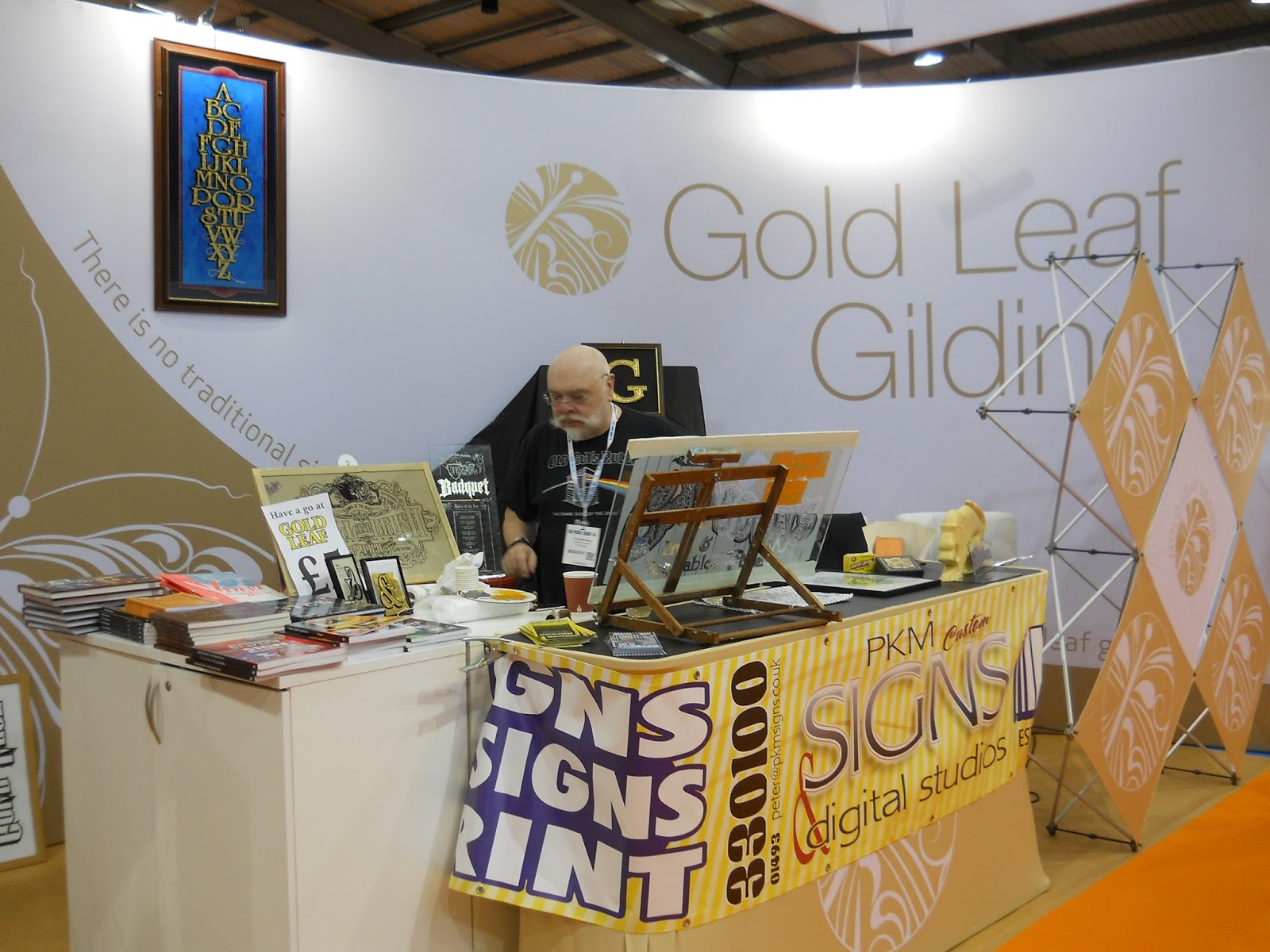
Pete, of PKM signs, demonstrated gilding techniques. I couldn't resist buying a copy of Mctaggart's 'Practical Gilding' from him!


Pkm signs gilding

On the fourth stand, Neil of H signs and Tim of Merlin Signs demonstrated traditional sign painting techniques. It was very interesting talking to them about which paints they prefer to use. One useful tip that they mentioned was to undercoat with aluminium oxide as it lasts the longest.


Tim of Merlin Signs at SignLink 2017

Neil Horne of H signs

It was great fun chatting with these folks, as well as interested people passing by. Quite a few visitors were keen to get pointers for their own hobby carving and I was happy to help! They also came along with their own tips and interesting ideas too, so it wasn't all one-way conversation by any means.

Many people also said how much they enjoyed having the contrast there between the modern advanced technology of sign making and the slower, precise ways of the older crafts. I hope to be able to participate in next year's planned 'Sign Show' in Birmingham. If you are in the sign trade, I may see you there!


Thursday, 26 October 2017

Carving a kestrel and a nuthatch for 'Woodland Arts'


'Woodland Arts' was a small, two day exhibition held on a piece of woodland next to the Clifton Suspension Bridge in Bristol during October 2017. I was invited by the organisers to show some work in it. I like the opportunity to create work for exhibitions, as it allows ideas to be explored that may not have been suited to previous commissions.

I hadn't carved a bird sculpture for a long time, so decided to make a nuthatch. I'd thought of carving one before as I think that they are particularly elegant birds and also interesting, as they are the only British bird that regularly moves headfirst down tree trunks as well as up them. 

There were a lot of offcuts of European larch around my workshop, produced by other businesses there. This wood is durable outdoors and has beautiful ring markings, but is quite tricky to carve with hand tools. I find abrasive discs, burrs and wheels work more efficiently on it, usually mounted on angle grinders.


carving wood using power tools

The action of the discs also gave the sculptures a smoother, more abstract feel that I like a lot. I did consider painting the carvings, but the smoothness seemed to suit a finishing oil better.


After carving in some simple detailing, I fitted a beak and eyes made from small offcuts of greenheart timber. This wood is a piece of Bristol's maritime history. The greenheart was given to me by furniture maker Jim Sharples and was originally part of a tree trunk fitted to the top of the nineteenth century North Junction lock gates. These gates formed the connection between Bristol's harbour and the Avon Gorge, from which ships headed out to sea. When the gates were replaced a few years ago, Jim was asked to make a bench to go next to the Mshed museum in Bristol and had some trimmings left over, which he kindly gave to me. The dark wood was perfect to depict a small bird's beady eyes.


bird wood carving sculpture

After several coats of finishing oil, I mounted a picture hanger on the back of the sculpture, so that the piece could be hung with its beak pointing down - as a real nuthatch moves down a tree. These timbers are durable outdoors, so the sculpture could end up hung on a real tree. I particularly like the grain pattern that loops like contours around the head.


nuthatch sculpture British bird

After making the nuthatch, I fancied making another bird. So I looked for another suitable bit of larch...


larch sculpture log

This piece was to become a falcon. Until I had started roughing out the block, cutting away chunks with a bandsaw, I wan't completely sure if it would be a merlin or a kestrel. 


roughing out sculpture

Eventually I decided on a kestrel as, like the nuthatch, it lives in that area. The body was also shaped using angle grinders fitted with mini arbortech blades or abrasive discs. Again, I really liked the slightly abstracted form and the contour lines winding around the finished body, especially at the bottom of the belly.


Bird sculpture roughed out

As well as greenheart wood, this sculpture uses a piece of  pale-coloured hornbeam wood in the beak. It originally came from a tree that  grew in the grounds of Southmead hospital in Bristol, which had to be removed during building work. The kestrel looks like it has been to hospital itself in this photo, taken when the glue holding the eyes in was still drying.


bird sculpture

I was very happy with this sculpture too and it got a lot of attention at the exhibition.


kestrel bird sculpture 

The show had a good mix of work, including a picture by Lord Bath. He owns Longleat house and was the patron of the show. I won't show an image of his picture here though, as this blog has people of all ages reading it! Thanks to Jasmine who curated the show and Topper, who organised it, for asking me to be part of Woodland Arts.


Wednesday, 26 April 2017

Carving or painting? The emblem of the Hull City Tigers made using woodcarving techniques, wood bleach and stain

hull city tigers

This piece was commissioned as a surprise gift for some fans of the Hull City football (or soccer for readers in the US!) team.

At first, I considered carving the emblem in relief but felt that it would lose something if made too different from the two-dimensional version. The tiger was carved with a Dremel rotary tool and some traditional gouges instead. 

The Dremel gave texture to the fur and more definition to areas like the mouth.


It still didn't jump out enough, so I decided to use stain and bleach to 'paint' the design too. This would hopefully allow the oak timber to show through without covering it over, in the way that paint often can.

The stain was Colron dark oak. This is suitable for indoor use - many exterior dark oak stains such as 'Rustins quick dry' can be very thick and obscure wood grain details. I particularly liked the way that this stain could be painted over to give a deeper tone - similar to watercolour paints.

Next, the bleaching. There are several kinds of wood bleach on the market. Some (such as Liberon wood bleacher) are oxalic acid and are good for removing iron stain and watermarks from wood, but they don't actually lighten it much (if at all). 

Chlorine bleaches (as in domestic bleach) don't seem to do much to oak timber either.

I used Rustin's two part bleach. The two chemicals that are mixed in it are caustic soda and hydrogen peroxide - neither of them particularly friendly. If you use this stuff, read the advice on the label carefully and follow it! 

It certainly did lighten the wood nicely and didn't spread out too much either. If you'd like to try bleaching wood, there's some useful tips on the ukworkshop forum.


hull city emblem

A few coats of Danish oil to complete it and the plaque was finished!


Monday, 2 January 2017

Carving a scene featuring a canoe from the North American pioneer days


This picture, slightly larger than an A4 sheet of paper in size, was commissioned as a gift. The recipient loves his canoe and so the person who commissioned me to make it wanted the panel to show a canoe being used in a historical setting, as well as an otter and a heron (which were favourites of the person receiving the present).

Luckily the grey heron that is commonly seen along European waterways has a North American cousin, the great blue heron, which looks similar apart from being slightly bigger.  

The oak panel was carved using a mix of traditional tools and a Dremel hand drill. The drill was used to give the texturing effects to the woodlands in the background.


The mountain man and his Algonquin friend/guide look more surprised than overjoyed to see the heron take flight. Maybe they are carefully watching to see exactly what disturbed it? 

I think that the picture has the feel of a 'Boy's Own' style illustration from the 1940s or 50s, which is perfect! I'm also very pleased with the way that the grain of the wood adds to the feel of movement in the image.


I'm also happy to let you know that Kirsty, who commissioned the carving, was very pleased with it. She wrote on my Facebook page to say:

'I'm extremely honoured and happy to have commissioned this beautiful plaque. You're a hugely talented fella, Alistair. The whole process, from conception to passing it over to the delighted recipient, was wonderful x'

Thursday, 17 March 2016

A pagan ritual knife handle, carved in oak with a Viking-style wolf's head decoration


It was really enjoyable to do some carving with my Opinel knife recently, when commissioned to make a new handle for a pagan ritual blade.  The oak came from a tree that originally grew near Nether Stowey, on the Quantock hills in Somerset.


The Norse-style wolf's head at the end was modelled on an example that the person who commissioned me already had on some jewellery, although I adapted it for the carving. I wanted it to have the look of an object that might have been carved by a Viking carver and to be very comfortable to hold, as well as beautiful. 


The end of the handle is drilled to fit a 10mm (0.39") tang. 


This image shows the handle against a tracing of the rest of the knife, so that you can get an idea of the scale:


I must admit that I liked the appearance of the carved handle before any finish had been applied. The patina of use would have looked good on it...


...but the finishing gave it a more 'antique' style. A woodworker in the neighbouring workshop said that it looks like it was finished at least ten years ago, rather than two days ago. For the finish, I used pure tung oil (extracted from a kind of nut) and then a mixture of natural waxes. Using natural finishes seemed more appropriate for this particular carving.


I really like the thought that this piece has another, deeper meaning to its new owner than the purely decorative. I hope that you have enjoyed seeing it too.

Wednesday, 16 March 2016

Carving a rabbit onto a wooden bench

This elm bench seat had already been made by Alex Arthur at the Woodworks Project in Bath. He suggested to the client that I could carve the design that they wanted on it.


I didn't want to make the lettering too deep, so carved a textured surface inside a double border. This catches the light so that the letters read easily from any angle. All of the carving here was done using traditional hand tools.


It was a nice surprise when the person commissioning the bench asked if I could also produce a simple, quick carving of a rabbit on there, peeping out from behind a log. The rabbit needed to look cute, but still fairly realistic. I'm very happy with the result as the young rabbit looks out from behind the old log with a bluebell growing nearby.


Friday, 13 November 2015

Fishes for St Monica

The St Monica Trust run retirement homes and specialist care for older people. They have a large site on Cote Lane, by the Downs in Bristol.


st monica trust cote lane

I've worked with the Trust before and did some presentations about carving there earlier this year. It was great to be asked recently by one of the residents if I could help with a project.

St Monica Trust was originally founded to cater particularly for people who followed the doctrine of the Church of England (although they now accept people of other faiths, or none) and that Church is still very important to many residents. The chapel at Cote Lane is an impressive sight.


st monica trust chapel

Peter is a retired architect, a resident at Cote Lane and a keen woodworker. He was interested in making two collection plates, using their fine on-site wood workshop, to donate to the chapel. 

Collection (or Offertory) plates are passed around at services and those attending can donate money to go towards the upkeep of the church, or various good causes.

Peter planned to turn the plates from spalted beech wood and to then insert discs turned from rosewood into the bases of them. The beechwood plates were pretty much finished when he came around and looked very nice indeed. 


The part that I could help with was carving identical designs into both of the rosewood discs, which were about 100mm (4") in diameter. The carved areas would later be filled with a mixture of resin and metal dust to form a striking finish. I had some previous experience with this technique (which has been used by other makers, including the late Tim Stead), and this meant that Peter and I could discuss how to go about it. I also mentioned to him about the hazards of breathing in the fine metal powder and the fumes given off by some resins when curing, which can both be very harmful.

The elegant design shows three interlocking fishes and was originally created by David Saxon, a retired architect who is also a resident at St Monica Trust.


David Saxon Ichthys design

Fish are a symbol that Christians have used since the early days of their religion to identify it and themselves. You may wonder why:


ΙΧΘΥΣ (Ichthys) is an acrostic (a word made up of the first letters of several words) that is made up from the first letters of the Greek words "Ίησοῦς Χριστός, Θεοῦ Υἱός, Σωτήρ". These translate into English as "Jesus Christ, Son of God, Saviour". In Greek, Ichthys means 'fish'. 
There is also a miracle mentioned in the Bible where Jesus feeds large numbers of people with a small number of loaves and fishes. Some of the first disciples of Jesus to be mentioned were also fishermen.

Carving the discs

To get two identical designs carved by hand onto each disc, I first printed out the design and glued it onto the surfaces with spray mount, then cut straight through into the wood. 


The discs had round blocks underneath, to fix them into the dishes. These could be held in a clamp made up of a bench hook holding two pieces of thick plywood with semi-circles cut out of them and a strip of rubber inserted to give more traction.


I needed to make the fine lines wider, to prevent them breaking. The eyes also broke off a couple of times during carving, so circular plugs were cut out of the round blocks (which would be cut down and then hidden when glued into the plates) to carefully replace them. The grain of the wood made it almost impossible to completely avoid some breakage of the very fine and fragile details during carving but this was easily worked around with some thought.


Once the discs had been carved using traditional hand tools, a Dremel rotary tool was used to clean up recesses and to put some texture onto the floor of the head areas. This looks pleasingly like scales, but will be covered with the metal and resin mix and provide a key.

ichthys design

When Peter saw them, he was very pleased but requested lines to be cut that also clearly defined the backs of the fishes. I was happy to do the carving there and then, so gave him a cup of tea while he waited. These lines also suggested carving the head area to run into them, which both us very agreed looked very nice too and made the carved designs appear more lively.


Wood carving of fish

A few weeks later, the completed plates were on show at St Monica Trust, together with other work made by the residents, as part of an Open Day. I went up to see them.


This image shows the display in the wood workshop watched over by David Saxon, who created the fish design originally. I thought that Peter had done a great job of the plates and I'm very happy to have been able to contribute to the project. 

Collection plates

Image courtesy of Peter Caird