As well as this blog, I also have a website and Instagram page with lots more images of my work as well as a few more stories.
If you like woodcarvings, you might want to have a look.
Showing posts with label Bristol. Show all posts

Thursday, 9 March 2023

Documenting the hidden world of the bell ringers: making a peal board


Peal board at st James church Mangotsfield

What is a peal board?

Well, before this commission in 2022 I'd never heard of one either. Making it gave a chance to see a tiny glimpse of something that most people outside of bell ringing never see. In this post we go up the stairs in the church tower, through a small door and into the bell loft to have a glimpse at the hidden world of the bell ringers.


Bell ringing ropes hanging in the bell loft of St James' church, Mangotsfield

Bells are traditionally rung to call people to worship in Christian churches in Britain. Ringing developed from the use of a single bell to several, which are rung in complicated patterns that require a lot of skill from all participants to play accurately. Each ringer in the tower will play a single bell by pulling on a rope to make it swing, so that the sound fits in with the pattern being played.

A peal board is a wooden panel made to record special sessions of bell ringing. These sessions may last for two or more hours and are done very occasionally to commemorate particular events or people, usually having a close connection to that church or bell ringing group. The board shows information such as who rang the peal, what pattern was rung and who or what was being commemorated amongst other things.

The commissioned board was made from a solid oak panel fitted into an oak frame and will be hung alongside others in the bell loft, where the ropes used in ringing hang down from the bells above. You can see some other boards and bell ropes in the picture above, along with images of previous bell ringers and Tower Captains (head bell ringers) associated with the church of St James, in Mangotsfield on the edge of Bristol.


bell ringers rules


I was commissioned by Jon, the Tower Captain at St James, to make this peal board. He also very kindly showed me around the bell tower there. 


St James church, Mangotsfield, Bristol


The tower dates back to the fourteenth century, the spire was added in the nineteenth century but the bells are more recent. They were first cast in 1922 but were taken down and recast in 1992 at John Taylor and Co in Loughborough. 

To have a look at them, we climbed up a ladder from the bell loft and then through a hatch. Next came a clamber up and through the steel frame that houses the eight bells. This frame is unusual in that it sits at an angle in the tower in order to fit.


Bells in St James church, Mangotsfield, Bristol


After going out through another small door, we had a fine view from the tower over the surrounding houses to the Gloucestershire countryside beyond.


Mangotsfield, Bristol

The oldest peal board in St James goes back to 1922, when the bells were first installed, although some in other churches are apparently much older. The one I made will be there for as long as bells are rung in the tower and I'm sure that, given its particular interest to certain people, would be a collector's item after that. It occurred to me that these peal boards are important documents of the history of ringing in that bell tower. 


Woodcarver painting carved design


I wanted to carve and paint part of the design to record this so, after discussions with Jon, the frame now features an image of the actual tenor bell which hangs above it, along with bell ropes and sallies (the wider, colourful grips on the ropes) in the colours of the ones presently in the church. There is text painted on the reverse of the frame recording who made the board and where it was originally hung.


  Text on reverse of peal board


I wonder who will be surprised, after taking down the panel perhaps hundreds of years from now, to see this text. What will the world around them look like by then?

Friday, 11 March 2022

'New Beginnings' - collaborating with artist Luke Jerram on his new sculpture in Bristol


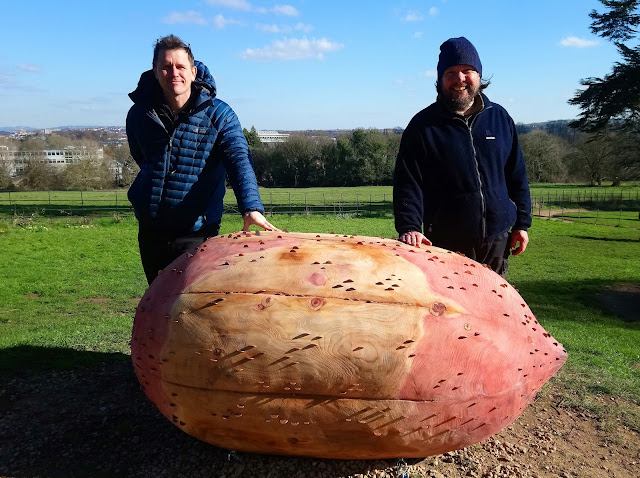
Luke Jerram sculpture New Beginnings

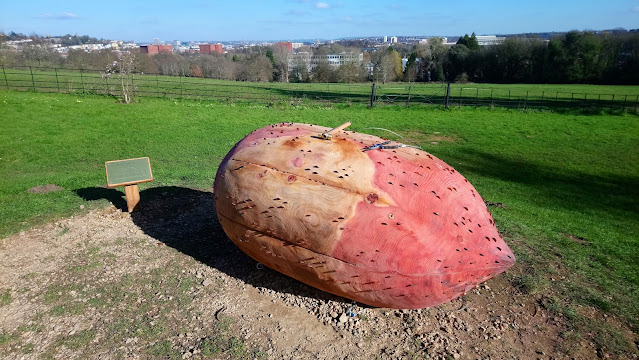
Luke Jerram is a Bristol-based artist (on the left in the photo above) whose work is known around the world. So it was very exciting to be invited to collaborate with him in the making of a new experimental sculpture, which is called 'New Beginnings' and is now installed at Ashton Court in Bristol.


The sculpture was carved from locally-sourced sequoia wood, which was then carved and assembled at my workshop next to the Ashton Court estate. Visitors are invited to use the pliers and hammer provided to add their own small-denomination coins to the sculpture and to make a wish while tapping them in.

Luke says that "I love idea of a seed: as a capsule of information and an object of potential that contains everything inside, a plant needs to grow. I hope the public enjoy interacting with this new sculpture and it acts as a capsule for their hopes, dreams and imagination!"

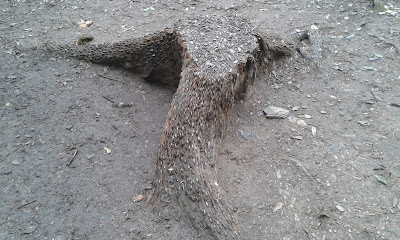
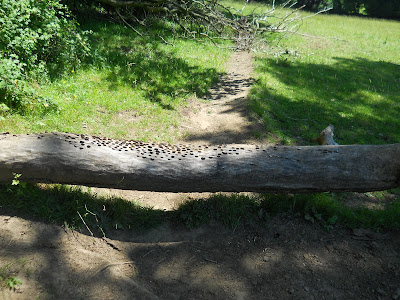
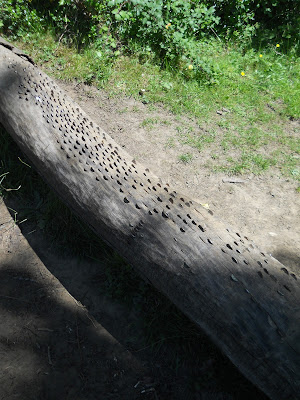
The project, which is hoped to be the first in a series, was inspired by 'wishing trees': these are trees or stumps (usually dead) which have coins pushed or knocked into them for luck. The tradition is thought to be at least a couple of hundred years old. Here is an example from Portmeirion in Wales:

wishing tree portmeirion

...and another from near the village of Uley, on the edge of the Cotswolds:

uley bury wishing tree


wishing tree ally


I'm looking forward to seeing how the sculpture changes over time as more coins are added! If you are in Bristol you could visit the beautiful estate, which is open to the public and free, then add your own coin and wish if you'd like to.

Monday, 3 December 2018

Woody street art in Bristol

Bristol has a lot of interesting street art away from the Banksy pieces that many people know and the large works done for Upfest in Southville. 

Easton, in the east of the city, has a lot of stuff by less well-known artists scattered through its alleyways and corners. These two pieces have appeared on walls around Bellevue Road. 

Bristol street art

Bristol street art


I like them, especially as to my eye they bring together woodworking and street art!

Saturday, 17 November 2018

Green men and a bowing crow - 'In the Downbelow'

I went into the crypt under the church of St John on the Wall in Bristol today, to see 'In the Downbelow', the latest exhibition by the sculptor and model maker Tom Astley


st john on the wall crypt

The crypt dates back to the early 14th century and one of the highlights of the place, for me, was the collection of carved green man faces on the roof bosses. They are quite low down compared to most churches and cathedrals, so can be easily studied from floor level.


st john on the wall green men

This one has a fine set on teeth on show!


The crypt is very atmospheric and had inspired Tom to create some artworks especially to display in this space. It was interesting to see his new pieces, showing the distinctive style that he's developed.

This sculpture is entitled 'Plague doctor' and was based on the physicians, with their strange beaked masks, who tended to victims of the Black Death.


plague doctor tom Astley

The sculpture 'Lady of Letters' came about because a tomb effigy of a wealthy noblewoman in the crypt shows her writing kit tied to her waist.


This 'Lord of Misrule' has a paper crown and would take over his duties during the Festival of St Stephen. The tradition lasted in Britain until the sixteenth century. Other images based on the idea can be seen amongst the misericords in Bristol Cathedral.

lord of misrule Tom Astley

The final sculpture in the exhibition was inspired by the green men carved overhead.


green man tom Astley

You might agree that the darkly atmospheric artworks fit perfectly in the vaulted stone space of the crypt. 

'In the Downbelow' runs from the 17th to the 30th November and is open Tuesday to Saturday, 11am until 6pm.

Wednesday, 12 September 2018

Spoon carving at Boiling Wells in Bristol, with the Boiling Wellness group


In July, I got the welcome chance to return to Boiling Wells in St Werburghs to teach spoon carving. 


After four and a half years working there, funding cuts meant that I was made redundant in 2014. I had been back a couple of times to teach since then and it is always good to see the place develop and grow.


This time, I was spoon carving with the 'Boiling wellness' group. It was great to be back in the nature reserve, carving wood with enthusiastic volunteers. We had a lot of fun and everyone got the chance to try a range of woodworking tools, some of which they might not have come across otherwise.


Doing spoon carving sessions with groups is always interesting as people come up with such a range of designs and styles when given the chance to do so. Once they had got the hang of using the tools safely, there was plenty of room for creativity to come out; working with the grain patterns in the wood for example. I hope that people have had the chance to finish their spoons with the techniques we discussed and that they all enjoyed the day as much as I did!


Monday, 27 November 2017

Making playground instruments for St Werburghs Community Centre in Bristol, using locally grown timber and some reclaimed materials

Recently, one idea that has interested me is making sculptures that can be played as instruments. This linked nicely into a recent commission. A community centre in Bristol wanted instruments to go in their new garden next to the M32 motorway.

playground instruments bristol

The spaces where the instruments were to be installed weren't big, being between already existing planters. This limited the amount of keys, chime bars etc. that could be used in each one . After chatting with the director of the centre I designed and made them some playable structures that we felt also looked good.


The reddish-coloured woods, used for the xylophone keys amongst other things, are sepele and utile. These are both timbers from trees that grow in West Africa. I tend to only use reclaimed tropical woods in my work and these were no exception, having been bearers for timber deliveries to a local company which are usually destined for burning. The posts and other timbers are European Larch; a durable locally-grown timber. 


metallophone and xylophone

One particularly enjoyable part of making these was turning the 'rattle poles' on my Myford lathe, for the last instrument played in the video.


wooden playground instruments

They are quite big pieces and it was a fun challenge to turn them evenly and for both of them to be as similar as possible.


wood turning on a Myford Lathe

I had help from volunteers during the installation, which made the job a lot easier! Everyone was very happy with the new instruments, including me (as you can probably tell by the big smile at the end of the video).

Thursday, 26 October 2017

Carving a kestrel and a nuthatch for 'Woodland Arts'


'Woodland Arts' was a small, two day exhibition held on a piece of woodland next to the Clifton Suspension Bridge in Bristol during October 2017. I was invited by the organisers to show some work in it. I like the opportunity to create work for exhibitions, as it allows ideas to be explored that may not have been suited to previous commissions.

I hadn't carved a bird sculpture for a long time, so decided to make a nuthatch. I'd thought of carving one before as I think that they are particularly elegant birds and also interesting, as they are the only British bird that regularly moves headfirst down tree trunks as well as up them. 

There were a lot of offcuts of European larch around my workshop, produced by other businesses there. This wood is durable outdoors and has beautiful ring markings, but is quite tricky to carve with hand tools. I find abrasive discs, burrs and wheels work more efficiently on it, usually mounted on angle grinders.


carving wood using power tools

The action of the discs also gave the sculptures a smoother, more abstract feel that I like a lot. I did consider painting the carvings, but the smoothness seemed to suit a finishing oil better.


After carving in some simple detailing, I fitted a beak and eyes made from small offcuts of greenheart timber. This wood is a piece of Bristol's maritime history. The greenheart was given to me by furniture maker Jim Sharples and was originally part of a tree trunk fitted to the top of the nineteenth century North Junction lock gates. These gates formed the connection between Bristol's harbour and the Avon Gorge, from which ships headed out to sea. When the gates were replaced a few years ago, Jim was asked to make a bench to go next to the Mshed museum in Bristol and had some trimmings left over, which he kindly gave to me. The dark wood was perfect to depict a small bird's beady eyes.


bird wood carving sculpture

After several coats of finishing oil, I mounted a picture hanger on the back of the sculpture, so that the piece could be hung with its beak pointing down - as a real nuthatch moves down a tree. These timbers are durable outdoors, so the sculpture could end up hung on a real tree. I particularly like the grain pattern that loops like contours around the head.


nuthatch sculpture British bird

After making the nuthatch, I fancied making another bird. So I looked for another suitable bit of larch...


larch sculpture log

This piece was to become a falcon. Until I had started roughing out the block, cutting away chunks with a bandsaw, I wan't completely sure if it would be a merlin or a kestrel. 


roughing out sculpture

Eventually I decided on a kestrel as, like the nuthatch, it lives in that area. The body was also shaped using angle grinders fitted with mini arbortech blades or abrasive discs. Again, I really liked the slightly abstracted form and the contour lines winding around the finished body, especially at the bottom of the belly.


Bird sculpture roughed out

As well as greenheart wood, this sculpture uses a piece of  pale-coloured hornbeam wood in the beak. It originally came from a tree that  grew in the grounds of Southmead hospital in Bristol, which had to be removed during building work. The kestrel looks like it has been to hospital itself in this photo, taken when the glue holding the eyes in was still drying.


bird sculpture

I was very happy with this sculpture too and it got a lot of attention at the exhibition.


kestrel bird sculpture 

The show had a good mix of work, including a picture by Lord Bath. He owns Longleat house and was the patron of the show. I won't show an image of his picture here though, as this blog has people of all ages reading it! Thanks to Jasmine who curated the show and Topper, who organised it, for asking me to be part of Woodland Arts.


Tuesday, 4 July 2017

Bristol street art 2016-2017


When I'm out and about, pedalling around Bristol on my bike, there's always a lot of great street art to see. Here's a few pieces that I've seen fairly recently and particularly liked. Some go back a while and have long been painted over. I hope that you enjoy seeing them too!


These artworks (including the one above) were painted as part of the 'Upfest 2016' street art festival in Southville, Bristol. The next one is happening at the end of this month, when many of the bigger pieces will be covered over by other work.

This amazing painting was done by the Spanish duo Pichi and Avo.


bristol street art upfest

Dale Grimshaw, who painted this, was originally from Lancashire but is now based in London.


bristol upfest street art

I cycle past this one, by Gamma Gallery, all the time when going to and from my workshop. The billboard sometimes changes and the different adverts seem to make the whole piece next to them read differently.


This one is near to the Gamma Gallery artwork above:


Not all of the bits of street art that caught my eye were the big, impressive ones though...


bristol graffiti

There are also pieces popping up all the time in hidden corners, like under bridges.


Or even in hollow trees, like this one in Ashton Court:


I liked this, painted last Hallowe'en near the M32. It's been covered over by other stuff for a long time now.

bristol funny graffiti

There are also nice pieces in Easton, on the other side of Bristol. This one is by Sepr, a local artist:

sepr street art

And this lovebird is by Kid 30 (aka Smallkid), who is based in the Midlands:

kid 30 street art bristol

These last two were done with the permission of the people living in the houses. They really brighten up a dingy alleyway/road as well.