As well as this blog, I also have a website and Instagram page with lots more images of my work as well as a few more stories.
If you like woodcarvings, you might want to have a look.
Showing posts with label decorative carving. Show all posts

Wednesday, 5 October 2016

Passau: the beautiful baroque city where three rivers meet

St Stephan's Dom, Passau

Passau is a city in Bavaria, in the south-east of Germany. It is not far from the borders with Austria and the Czech Republic. 

The city has a long history and it stands on the strategically important junction between three large rivers: the Donau (known in many countries as the Danube), the Inn and the Ilz. These rivers join at a point called the drei flüsse eck (three rivers corner) at the end of the promontory on which the old town stands. From there, the river becomes the Donau (Danube).


Danube (Donau) at Passau

The town is first mentioned in Roman times and was the residence of a bishop from 739 CE. Bishops became the rulers of the small independent city state of Passau in the 13th century. The town was devastated by fire in 1662 and was rebuilt shortly after, using designs by Italian masters, in the baroque style. Passau became part of Bavaria in 1803 and the baroque had a big influence on Bavarian architecture, even through to the nineteenth century palaces of King Ludwig II.

The most impressive example of this baroque architecture in Passau has to be the Cathedral of St Stephen, in the centre of the old town and surrounded by cobbled alleyways and courtyards. It was designed by Carlo Lurago, with stucco work by Giovanni Battista Carlone and frescos by Carpoforo Tencalla. The overall effect can be seen in the first image above and in these below: the floor and lower parts of the pillars of the nave are fairly sedate, rising overhead to a tumult of colour and form.


The cathedral also houses the Europe's largest cathedral organ.


Passau cathedral organ

Even though most of the decorative sculpture is made from stucco (which is a mixture of lime, sand, water and sometimes a binding agent such as horsehair) there is some carving in wood. The organ has carved and gilded decoration and there is a large crucifix and some smaller statues. 

Perhaps the most impressive woodcarving is on the pulpit, which was constructed from carved and gilded lime wood. Designed by Vienna-based Antonio Beduzzi, with figures carved in the workshops of Lorenzo Mattielli, it was made between 1722 and 1726:


This cathedral replaced an earlier, medieval, one which was destroyed in the fire of 1662. Now, one of the few remaining identifiable pieces of the original cathedral is a carving that has become a symbol of the town and is displayed nearby - a large face carved in stone and now known as 'Der Passauer Tölpell'.


As well as the incredible work in the Dom, more beautifully-made pieces could be seen in many of the streets and alleyways around the old town. Some were statues..


...but more impressive to me were the stunning doors leading into many of the houses and courtyards. 


I wonder if these also date to the mid-late seventeenth century?


Sunday, 19 June 2016

Timber-framed houses along Friar Street in Worcester- wonky buildings, planning using geometry and the daisy wheel

Worcester has quite a few surviving timber-framed buildings and many of them can be found along Friar Street, in the city centre. Halfway along the street is Greyfriars, which was built in 1480 as a merchant's house and has been in the care of the National Trust since 1966: 


Not as old (but also looking great) is the facade of this pub on the corner of the street.


One thing that I noticed was how wonky the jettied first floors on some of the buildings were...


The building in the lower photo shown above makes me wonder if the builders got hold of the longest suitable piece of oak that they could find to support the front wall of the first floor and then built the rest around it. The slope on the first floor of the building in the photo above it makes me wonder if they had just been on the ciders beforehand!


When these timber-framed buildings were constructed, timber didn't usually come in regular sizes. Since everything had to be cut, split or hewn by hand, carpenters would make use of what they had available and so if a beam was a bit uneven, that would just be accounted for when building around it. 

I went to a very interesting talk by Laurie Smith a while ago. He is an expert on the geometrical methods that builders used to plan constructions throughout much of history. 


When factors such as irregular sizes of materials meant that exact measurements using units such as inches were not as useful in planning a construction, things were laid out using geometry.


Laurie Smith showed us how proportions and angles were worked out using simple geometrical techniques, meaning that they could be planned using just a ruler, a pair of compasses and a scribe (such as a piece of chalk). 

At one point, he remarked that he enjoyed looking at old buildings and working out how they had been altered from their original form over time. This could be done by a knowledge of the use of geometry in planning. He could tell if a gable had been removed or rooms added because they didn't follow the patterns that were easy to spot if one has the knowledge of these procedures.

One reminder of these planning techniques that can be seen in some old buildings is a 'daisy wheel', like this one from Court Farm at Himbleton in Worcestershire:


Image from: http://www.explorethepast.co.uk/2014/10/averting-evil-evidence-from.html

Some believe that these daisy wheels were used to ward off evil in old buildings. Laurie Smith said to me that he hadn't delved into that possible side of their history, but that they certainly were an example of a design used in planning geometry as well.

A pub on Friar Street called 'The Cardinal's Hat' proclaims that it is 'Worcester's Oldest Inn'.  


Apparently there has been a pub on the site since the fourteenth century, when the inn catered to pilgrims and visitors to the nearby Friary (which ended with the Dissolution of the Monasteries by Henry VIII). The current building dates to the mid-seventeenth century and I took a moment to check out the carvings in the spandrels around the front door. These are over a window to one side:


These carvings are over the main entrance. I wonder if the letters 'D' and 'CB' refer to the pub's owners at the time, the carvers or to something else?


Saturday, 5 March 2016

The King Charles House in Worcester; a warning in a pub and a fleeing king

On a recent visit to Worcester, I went into the King Charles House on New Street. The timber-framed building looks like an old and historic pub, although it has had many uses over the years and was only recently sympathetically restored to its former glory.


A sign next to the entrance relates how the future King Charles the Second, after being defeated by Oliver Cromwell's forces at the Battle of Worcester, fled from this pub into exile in mainland Europe. The tale of his escape is pretty gripping in itself. He was eventually invited back to Britain and crowned king in the 'Restoration' of 1660, after the death of Cromwell.


The dour, joyless Puritanism promoted by Cromwell and his followers disapproved of such sinful activities as gambling, music, dancing and drinking ale so it must have been a great relief for many when the far more relaxed and fun-loving king was back. Many British pubs were opened in this time and some are still around today; the names reflecting Charles' history. Examples are the Royal Oak (from the tree he hid in while being hunted at Boscobel House) and the Black Boy, which has nothing to do with racial meanings but instead refers to Charles the Second's nickname due to his black hair.

The over mantle above the fireplace in the pub is well worth a look. It is dated 1634 on one panel, which suggests that it was carved during the reign of Charles the First. He was the father of Charles the Second and was executed in 1649 after losing the Civil War to Cromwell's forces.


The carved panels show some exuberant green men along the top, together with warnings of the perils of gambling and other vices. I like the central panel in particular. It shows Satan, carrying his pitchfork, bursting in on some men gambling (perhaps on the Sabbath?). One man desperately tries to hide under the table.


Another panel, dated 1634, shows Satan catching some drunkards by surprise.


These seem like pretty hypocritical things to have on display in a tavern, but I'd suggest that there might be a joke being played here. 

This carved date was during Charles the First's reign, when tensions with Cromwells' Parliament were increasing. The panels seem to show good old tedious religious warnings against immoral behaviour; however the people shown are wearing clothes more like those worn by Puritans than the extravagant fashions favoured by many Royalists.


Given that Charles the Second chose to hide at this tavern after his defeat in battle, I wonder if a sly jab is being directed here by Royalist owners at Cromwell's zealous followers and their hypocrisy?

Monday, 6 April 2015

Saxon and modern stone carvings at the ancient church of St Laurence in Bradford-on-Avon

In the small town of Bradford-on-Avon, in the west of the county of Wiltshire, is one of the oldest churches in Britain. Despite evidence of subsequent alterations, some of them also ancient, it has been described as one of the most characteristic examples of a Saxon church in the country.


St Laurence's is certainly not a big building, but it contains some beautiful fragments of Saxon stone carving.
Image from http://en.wikipedia.org/wiki/File:St_Laurence%27s_Church.JPG
The church was mentioned as standing in 1120 CE (or AD, if you prefer) by the twelfth century historian William of Malmsbury. He thought that it was built in the time of St Adhelm (in 709 CE) although other evidence suggests that it dates to the early eleventh century. However, it may have replaced an earlier wooden structure.  It was surrounded by other buildings and used for other purposes, before being 'rediscovered' in the nineteenth century.


The space inside, containing three rooms linked by surprisingly narrow archways, is not large but it is high with small windows. It gives the stone-built chapel a distinctive feel, not showy but not humble either. The walls may have once been plastered and painted, perhaps also draped with hangings. In Saxon times, surrounded by timber buildings, a stone building of this size in a small town must have been pretty grand in itself.


Fragments of Saxon carved stone are dotted throughout. There are two carved angels high up on one wall, which may well have once been part of a larger sculptural frieze:

Image from http://history.wiltshire.gov.uk/community/getimage.php?id=321
The altar is made up of several bits of Saxon stonecarving found in the area. The richness of the carvings found in its vicinity has led to the suggestion that the chapel may once have held relics of a saint. The church's website says that;

'A charter of King Æthelred granted Bradford to the nuns of Shaftesbury in 1001, and the church’s architecture suggests it was built for the nuns early in the eleventh century. St Laurence’s is a characteristic Anglo-Saxon building: tall and narrow with small windows. The extent and richness of its decoration, however, are rare, perhaps suggesting it was designed partly for the relics of Æthelred’s brother Edward the Martyr, which were housed with the nuns at Shaftesbury.'

saxon stone carvings

In 2012, the sculptor John Maine installed a three-part piece in the chapel above the altar. I think that it looks perfect in the setting and complements it well. At the top is a ring of Doulting stone carved by Maine. Below that is a piece of fossilised tree trunk thought to be about 150 million years old and below that is a fragment from a Saxon carved cross.


Bradford-on-Avon has several other interesting buildings, including a tithe barn and an interesting old town bridge with a building on it that was used as a cell for a while. Unfortunately I couldn't get photos of them during my visit but it's nice to be able to share this one with you.

Monday, 1 September 2014

A strange Norman stone carving in St Nicholas' church, Combe St Nicholas, Somerset

combe st nicholas church

While visiting this church for a wedding, I noticed the strange carved stone capital on a pillar near the north entrance. Apparently, it is the only remnant of the Norman church that once stood on the site (although a round font dating to Saxon times is thought to be the oldest object in the church, surviving from the Saxon church building that was here before that).

green man combe st nicholas

It is an odd carved design and some people think that it represents the devil. I wonder why the medieval builders who rebuilt the church in the 13th century decided to keep this bit of stonework in particular? The pillar that it tops does not seem to hold up any arches, so it probably isn't structural. 

The way that the weird-looking head seems to sprout the paired 'snail track' lines out of its mouth reminds me a lot of 'green man' carvings, some of which have foliage coming from their mouths in a similar fashion. I wonder if this could be an example of such a design? According to 'The Company of the Green Man' website, this carving would seem to have been identified as such by Clive Hicks in his book 'The Green Man: A Field Guide'. 

The carving on the capital to its left looks to me like it could represent a crown.

If you are visiting the church, the oak screen in front of the altar is also worth a look. A plaque tells how it was first carved around 1480, then was taken down and moved in the 19th century before being repaired and returned to it's original position in 1921, when a memorial to the men of the parish who died in the First World War was also added to it.


Thursday, 17 July 2014

What's been going on recently? Carved oak signs, teaching woodcarving in Bristol and secret jobs!

There's been a mix of different work keeping me busy recently. I've worked on a couple of commissions lettercutting in oak :


Here's another house plaque, carved in oak for someone who is very keen on the 'Star Wars' films. It was fun carving the ewok in relief!


There's also been a commission carving 'rope' for the skilled furniture maker Jim Sharples.  Jim is working on an oak stand for the ship's bell from HMS Cornwall and wanted some carved 'rope' wrapped around the top crosspiece, to give a suitably nautical look to the finished piece. Getting it all laid out correctly was a bit of a puzzle, but I'm happy with the results. This bell stand may well end up in the Maritime Museum, which is a nice thought.


A pleasant Friday was also spent teaching Matt relief carving in oak. He spent the afternoon at my studio and got to use my own woodcarving gouges and chisels, which is something that I can only really do when working with small numbers of people, as some of the tools (such as the hook skew) are very fragile. We covered using a handsaw, a block plane and a V tool, some relief carving techniques, sharpening tools effectively and laying out a design onto the wood from a paper copy. Matt carved a chinook helicopter and seemed to really enjoy learning some of the skills that are an important part of this craft.


I have also been working on a couple of jobs that I can't talk about! One was for a client in mainland Europe and I have undertaken not to discuss it online (for good reasons; it's nothing illegal either, I promise!). I will say that it was very interesting though. Another project has been one of the most interesting that I've worked on and that will be posted about in the near future, so watch this space.

Sometimes, I have a big project on and can't discuss it until the finished carvings are unveiled or given to the person that they are meant for. It doesn't seem right to spoil the surprise of a gift by posting about it here and sometimes commercial clients need to keep things under wraps until a grand unveiling or promotion is completed.

Occasionally, a client will also ask me not to write about a job on my blog, for various reasons. Perhaps they wish to keep it personal to them or they need it to be anonymous. Needless to say, I always honour such requests.

So if you see gaps in the blog, don't think that I've stopped carving or blogging. Just wait and see what the next few posts bring!


Wednesday, 16 July 2014

Revisiting the Green Man - a mysterious image from the past

The Green Man is a face that can be seen in many old churches and stately homes throughout northern Europe. The face has several basic forms, but is either made up of leaves, is sprouting leaves from eyes, ears and/or mouth or is sometimes simply a face peering out through vegetation, like these ones at St Mary Redcliffe in Bristol:


Mike Harding, in his Little book of the Green Man, points out that the name 'Green Man' was probably first used by Lady Raglan in 1939. We don't know what the medieval carvers who produced some of the finest examples would have called these faces.

We don't really know what they mean either, but the images are so powerful that they have persisted through time. They even, in many cases, escaped the stupid vandalism done to British church art by the Puritans.

In The Hidden World of Misericords, Dorothy and Henry Kraus suggest 'That so much underseat carving should have survived Protestant iconoclasm was no doubt due in large measure to the prevailingly secular subject matter'. These foliate faces are not obviously portraying Christian religious ideas either, which may be the reason that we can still appreciate so many of them today whether carved as misericords, roof bosses or elsewhere.

Hayman, in 'Church Misericords and Bench Ends' says that green men have 'often been misinterpreted as an indigenous pagan deity or as a spirit of nature. In fact green men represent sin and mortality.'

The Green Man also seems to hold a special fascination for carvers. In Understanding Woodcarving, John Foyle comments 'You may think we have enough of that fraternity around already. And, yes, the woodcarving world is certainly not short of pre-Christian sylvan dieties, or foliate men as they are sometimes called'. But the design is so strange and its origins so mysterious that carvers keep returning to it. In The Green Man: The Pitkin Guide, Jeremy Harte says that 'The Green Man was always a carver's device, whether in wood or stone. It is rare to find him in jewellery, illuminated books or stained glass'. Master carver Chris Pye, for one, has spoken of his fascination with the subject.

Similar faces can be seen carved on temples in India and there are even green cats, lions and snakes. In St John's chapel in St Mary Redcliffe church in Bristol, there is an animal sprouting leaves from its mouth hidden amongst the medieval roof bosses.

Image from http://stmaryredcliffe.co.uk/files/2014/08/St-Mary-Redcliffe-NW-tower-vaulting-report-revised-assembled-reduced.pdf
As with many such images, it's a bit hard to tell what kind of animal it is: Mike Harding thinks it is a dog, Jerry Sampson (in an interesting architectural report on these bosses) thinks it is more like a cow. Here is a more recent green dog carved on the end of a pew in St Newlyn's church in Cornwall:


Many Green Man faces are quite obviously men, with beards etc. but I haven't heard of many carvings of a Green Woman. Jeremy Harte also makes this point; 
'The real Green Lady, with foliage sprouting from her face or mouth, is hardly ever seen (although there is one at Sampford Courtenay church in Devon). At Kings Nympton church, also in Devon, there is a series of heads: all the male ones are Green Men, but none of the female heads are Green Ladies.'  
I wonder why?

Recently, I've been reworking a green man face carved in oak for 'Mayfest' in Bristol. It was okay, but didn't look exactly how I wanted it to, so I decided to recarve the eyes, nose and mouth. It was an interesting challenge, carving some fairly deep detail into an oak board only 10mm (25/64 inch) thick without going through. Here's how the face now looks:

green man

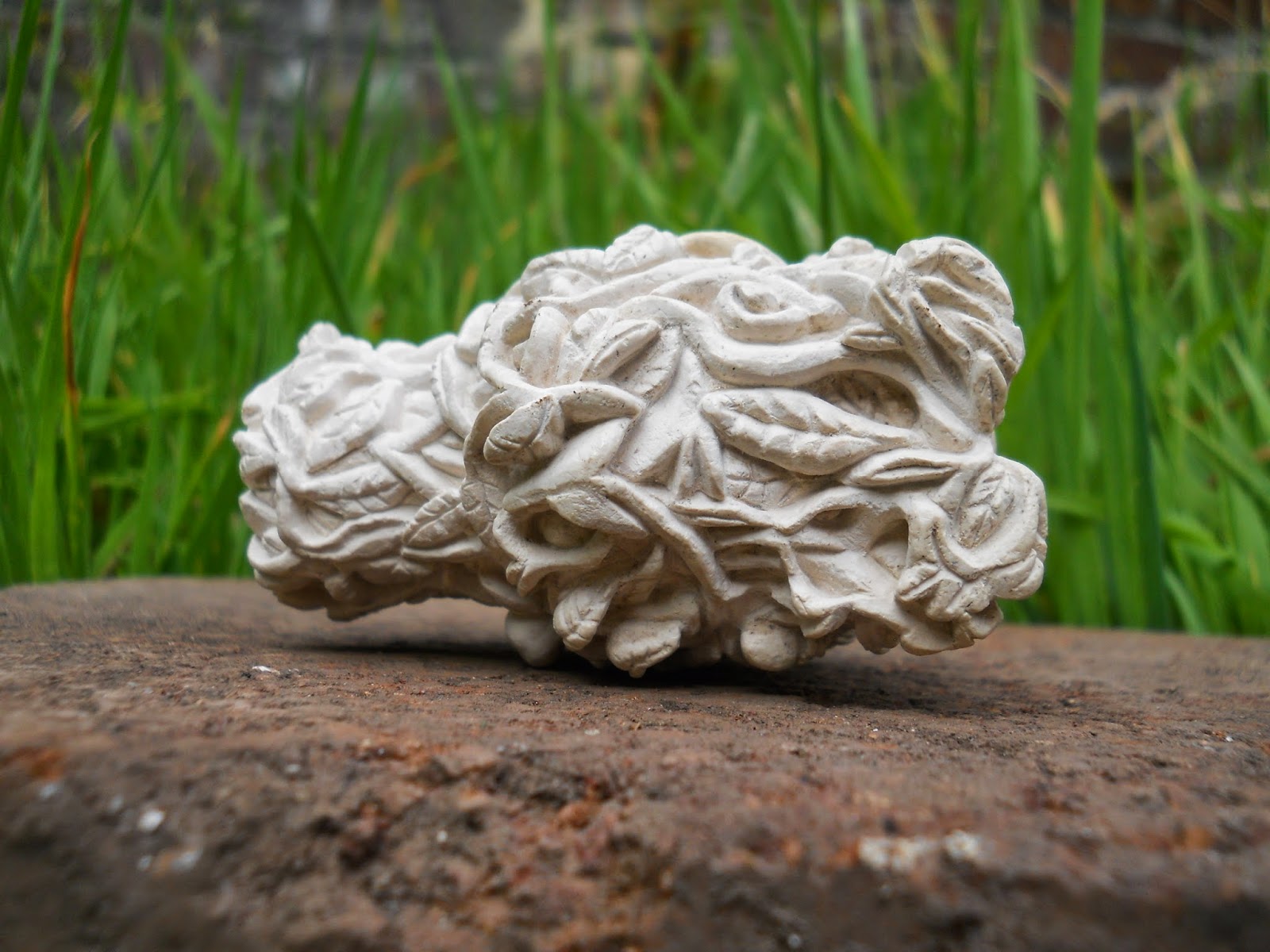
This green man's face was carved on-and-off over four years from 1998 to 2002. It is not made from wood, but instead from meerschaum, a kind of stone which is prized for use in making pipe bowls. The carving isn't finished, as it still needs to have finishing wax applied. I'd also like to carve a stem for it, probably from cherry wood.

meerschaum pipe bowl

meerschaum green man


My own favourite Green Man is one that can be found in Bamberg cathedral in Bavaria. It is possibly one of the most well-known Green Man designs and dates to around the mid-thirteenth century. Some friends have commented that they think that the face is scary and it certainly has something quite powerful about it. As Jeremy Harte says, 'often the most beautiful ones are the most sinister.'

Image from: http://www.gargoylesandgrotesques.com/index.php?p=1_6_Photos