As well as this blog, I also have a website and Instagram page with lots more images of my work as well as a few more stories.
If you like woodcarvings, you might want to have a look.
Showing posts with label green man. Show all posts

Saturday, 17 November 2018

Green men and a bowing crow - 'In the Downbelow'

I went into the crypt under the church of St John on the Wall in Bristol today, to see 'In the Downbelow', the latest exhibition by the sculptor and model maker Tom Astley


st john on the wall crypt

The crypt dates back to the early 14th century and one of the highlights of the place, for me, was the collection of carved green man faces on the roof bosses. They are quite low down compared to most churches and cathedrals, so can be easily studied from floor level.


st john on the wall green men

This one has a fine set on teeth on show!


The crypt is very atmospheric and had inspired Tom to create some artworks especially to display in this space. It was interesting to see his new pieces, showing the distinctive style that he's developed.

This sculpture is entitled 'Plague doctor' and was based on the physicians, with their strange beaked masks, who tended to victims of the Black Death.


plague doctor tom Astley

The sculpture 'Lady of Letters' came about because a tomb effigy of a wealthy noblewoman in the crypt shows her writing kit tied to her waist.


This 'Lord of Misrule' has a paper crown and would take over his duties during the Festival of St Stephen. The tradition lasted in Britain until the sixteenth century. Other images based on the idea can be seen amongst the misericords in Bristol Cathedral.

lord of misrule Tom Astley

The final sculpture in the exhibition was inspired by the green men carved overhead.


green man tom Astley

You might agree that the darkly atmospheric artworks fit perfectly in the vaulted stone space of the crypt. 

'In the Downbelow' runs from the 17th to the 30th November and is open Tuesday to Saturday, 11am until 6pm.

Wednesday, 30 December 2015

Teaching woodcarving at Nailsea school, near Bristol: carving a Green Man into a log of Ash wood

On the weekend before Christmas, I went back to Nailsea school to do some more woodcarving tuition. After teaching a very enjoyable session there previously, working with pupils at the school, I was looking forward to it!


woodcarving at Nailsea school

This session was a little different as all of the people attending were adults and the session was partially funded by a local community group; the Nailsea Community Trust. We also had to carve in the art room instead of the outdoor DEN space, as the rain was pouring down outside. 


However, the tables in that room were at just the right height to carve (carver's benches are generally higher than joiner's benches). The hot drinks and snacks were also on hand courtesy of Rebecca Hollingdale, who runs the DEN project at the school and who organised the session.

The Green Man is such an intriguing image, open to such varied interpretation, that I always enjoy watching people carve them. We were using logs of Ash (Fraxinus excelsior), sourced  by the DEN project from recent woodland management work. 


teaching woodcarving to adults

Ash is very pleasant to work with when freshly-cut and green, but can be tough work to carve by hand once seasoned. It is also not particularly durable outdoors, but that could be an attractive feature for some people I'm sure - the image of the Green Man returning to nature.


carving a green man in wood

After a brief safety talk and a few (hopefully) handy pointers about facial anatomy, the group started carving. Some people were quite happy to get stuck in, but others were more reluctant to start cutting in deeply. Sculpting a face can be quite daunting and I can completely understand that some people would feel a little nervousness and even frustration when setting out to do such a project. I've found that for many learners who feel a bit overwhelmed, the best thing to do is just to start carving, removing the outer bark at first to see where the process takes you.


carving ash wood

Once everyone was into the flow of things, one of the most rewarding things about the day was seeing everyone starting to create unique and expressive sculptures. All of the faces were very different and by the end everyone seemed very happy with the carvings that they had produced. 


Some people used the differently-coloured inner and outer bark layers against the pale ash wood to make some very interesting designs.


Some faces seemed to show someone who was relaxed, others were much more dynamic with expressive tool marks left on them:


It was great to see all of the faces put together at the end (apart from one, as the person who carved it had to go home a bit earlier). I'm sure you'll agree that they look very interesting together, showing a few different interpretations of the image of the Green Man.


green man woodcarving

Monday, 1 September 2014

A strange Norman stone carving in St Nicholas' church, Combe St Nicholas, Somerset

combe st nicholas church

While visiting this church for a wedding, I noticed the strange carved stone capital on a pillar near the north entrance. Apparently, it is the only remnant of the Norman church that once stood on the site (although a round font dating to Saxon times is thought to be the oldest object in the church, surviving from the Saxon church building that was here before that).

green man combe st nicholas

It is an odd carved design and some people think that it represents the devil. I wonder why the medieval builders who rebuilt the church in the 13th century decided to keep this bit of stonework in particular? The pillar that it tops does not seem to hold up any arches, so it probably isn't structural. 

The way that the weird-looking head seems to sprout the paired 'snail track' lines out of its mouth reminds me a lot of 'green man' carvings, some of which have foliage coming from their mouths in a similar fashion. I wonder if this could be an example of such a design? According to 'The Company of the Green Man' website, this carving would seem to have been identified as such by Clive Hicks in his book 'The Green Man: A Field Guide'. 

The carving on the capital to its left looks to me like it could represent a crown.

If you are visiting the church, the oak screen in front of the altar is also worth a look. A plaque tells how it was first carved around 1480, then was taken down and moved in the 19th century before being repaired and returned to it's original position in 1921, when a memorial to the men of the parish who died in the First World War was also added to it.


Wednesday, 16 July 2014

Revisiting the Green Man - a mysterious image from the past

The Green Man is a face that can be seen in many old churches and stately homes throughout northern Europe. The face has several basic forms, but is either made up of leaves, is sprouting leaves from eyes, ears and/or mouth or is sometimes simply a face peering out through vegetation, like these ones at St Mary Redcliffe in Bristol:


Mike Harding, in his Little book of the Green Man, points out that the name 'Green Man' was probably first used by Lady Raglan in 1939. We don't know what the medieval carvers who produced some of the finest examples would have called these faces.

We don't really know what they mean either, but the images are so powerful that they have persisted through time. They even, in many cases, escaped the stupid vandalism done to British church art by the Puritans.

In The Hidden World of Misericords, Dorothy and Henry Kraus suggest 'That so much underseat carving should have survived Protestant iconoclasm was no doubt due in large measure to the prevailingly secular subject matter'. These foliate faces are not obviously portraying Christian religious ideas either, which may be the reason that we can still appreciate so many of them today whether carved as misericords, roof bosses or elsewhere.

Hayman, in 'Church Misericords and Bench Ends' says that green men have 'often been misinterpreted as an indigenous pagan deity or as a spirit of nature. In fact green men represent sin and mortality.'

The Green Man also seems to hold a special fascination for carvers. In Understanding Woodcarving, John Foyle comments 'You may think we have enough of that fraternity around already. And, yes, the woodcarving world is certainly not short of pre-Christian sylvan dieties, or foliate men as they are sometimes called'. But the design is so strange and its origins so mysterious that carvers keep returning to it. In The Green Man: The Pitkin Guide, Jeremy Harte says that 'The Green Man was always a carver's device, whether in wood or stone. It is rare to find him in jewellery, illuminated books or stained glass'. Master carver Chris Pye, for one, has spoken of his fascination with the subject.

Similar faces can be seen carved on temples in India and there are even green cats, lions and snakes. In St John's chapel in St Mary Redcliffe church in Bristol, there is an animal sprouting leaves from its mouth hidden amongst the medieval roof bosses.

Image from http://stmaryredcliffe.co.uk/files/2014/08/St-Mary-Redcliffe-NW-tower-vaulting-report-revised-assembled-reduced.pdf
As with many such images, it's a bit hard to tell what kind of animal it is: Mike Harding thinks it is a dog, Jerry Sampson (in an interesting architectural report on these bosses) thinks it is more like a cow. Here is a more recent green dog carved on the end of a pew in St Newlyn's church in Cornwall:


Many Green Man faces are quite obviously men, with beards etc. but I haven't heard of many carvings of a Green Woman. Jeremy Harte also makes this point; 
'The real Green Lady, with foliage sprouting from her face or mouth, is hardly ever seen (although there is one at Sampford Courtenay church in Devon). At Kings Nympton church, also in Devon, there is a series of heads: all the male ones are Green Men, but none of the female heads are Green Ladies.'  
I wonder why?

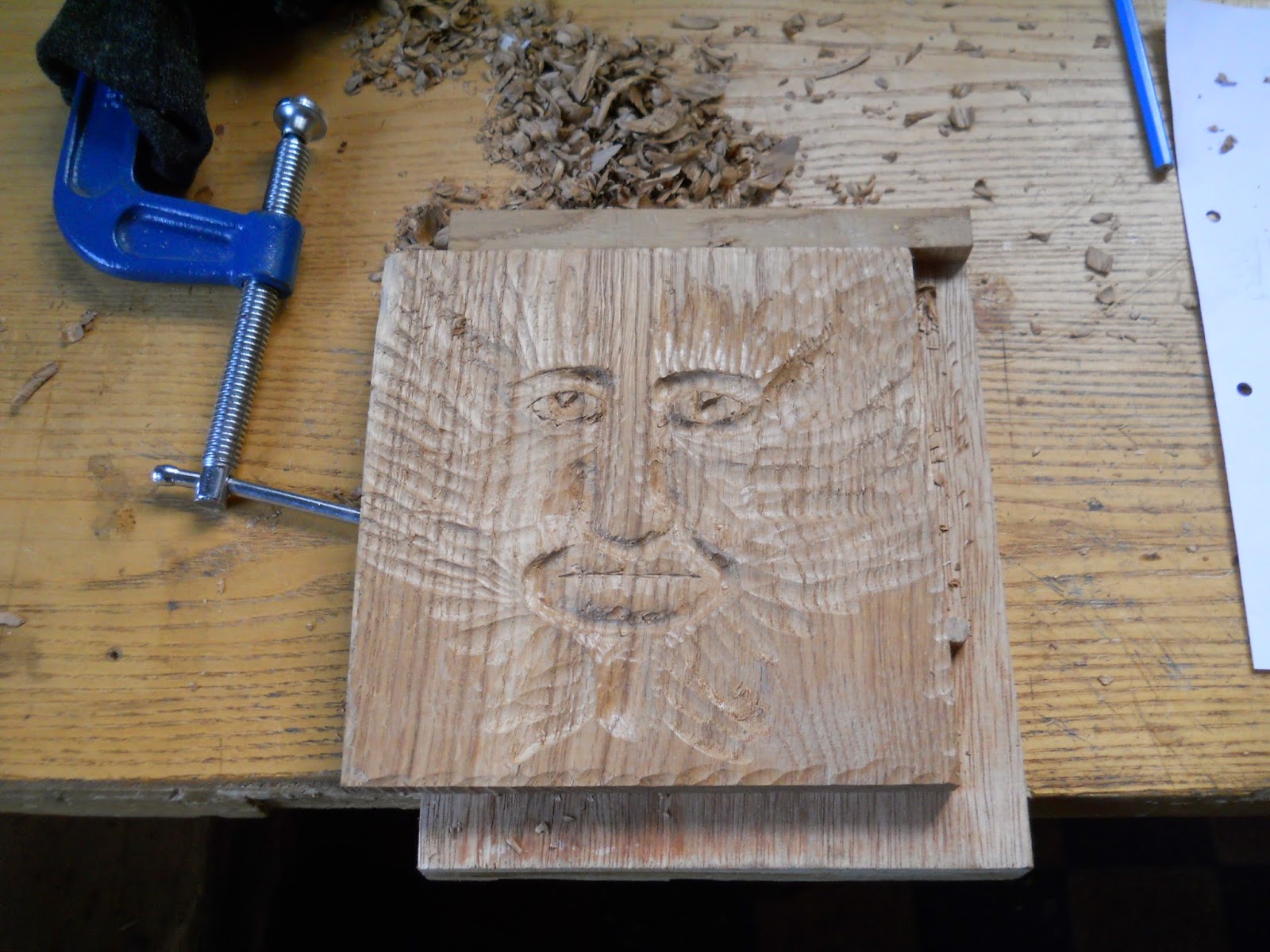
Recently, I've been reworking a green man face carved in oak for 'Mayfest' in Bristol. It was okay, but didn't look exactly how I wanted it to, so I decided to recarve the eyes, nose and mouth. It was an interesting challenge, carving some fairly deep detail into an oak board only 10mm (25/64 inch) thick without going through. Here's how the face now looks:

green man

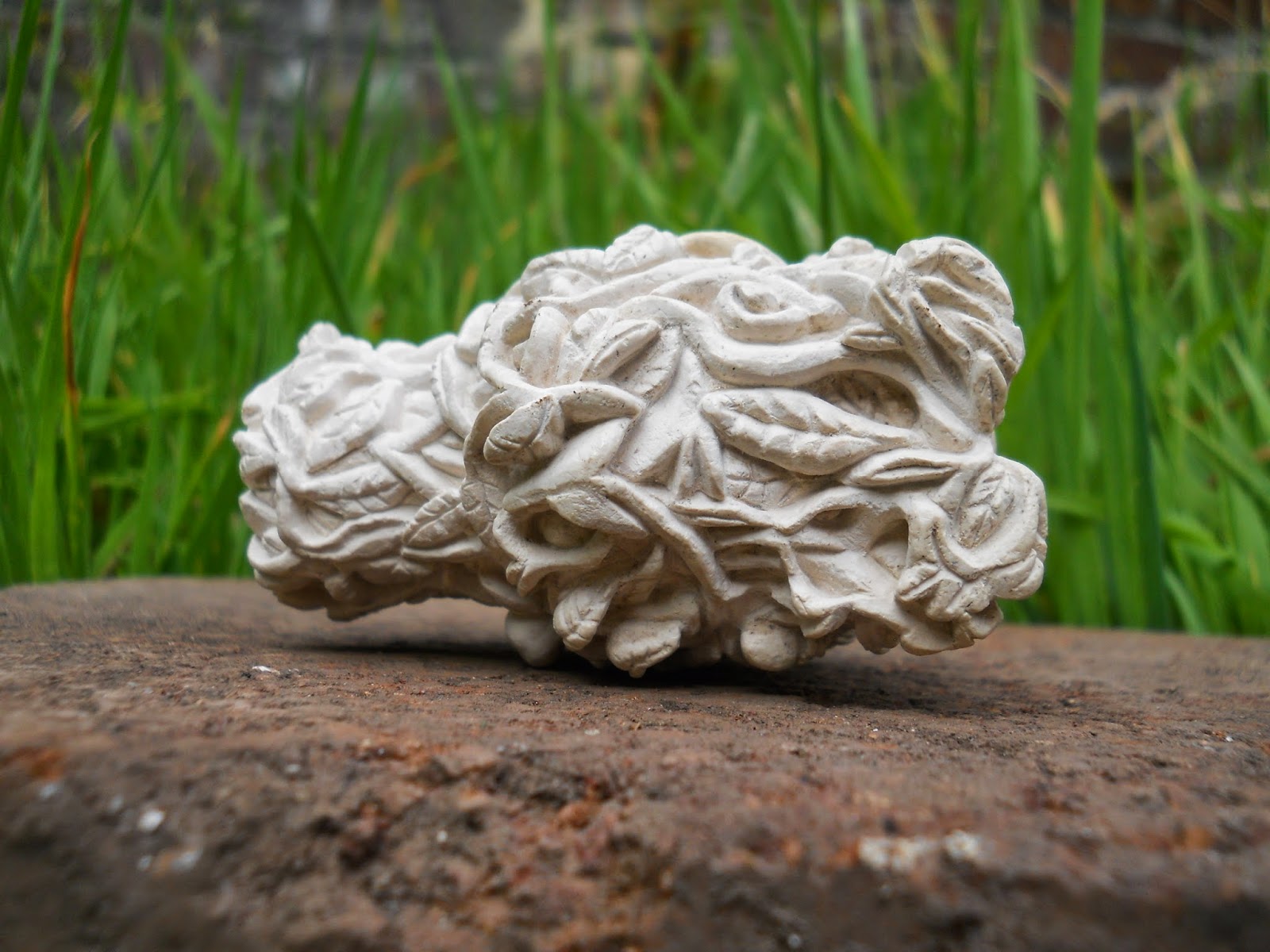
This green man's face was carved on-and-off over four years from 1998 to 2002. It is not made from wood, but instead from meerschaum, a kind of stone which is prized for use in making pipe bowls. The carving isn't finished, as it still needs to have finishing wax applied. I'd also like to carve a stem for it, probably from cherry wood.

meerschaum pipe bowl

meerschaum green man


My own favourite Green Man is one that can be found in Bamberg cathedral in Bavaria. It is possibly one of the most well-known Green Man designs and dates to around the mid-thirteenth century. Some friends have commented that they think that the face is scary and it certainly has something quite powerful about it. As Jeremy Harte says, 'often the most beautiful ones are the most sinister.'

Image from: http://www.gargoylesandgrotesques.com/index.php?p=1_6_Photos


Sunday, 4 May 2014

Demonstrating carving a Green Man from wood at 'Mayfest' on the Gloucester Road in Bristol


It was a beautiful sunny day yesterday and I spent it sitting on the pavement on the Gloucester Road in Bristol, carving a green man out of oak and chatting to passers-by.


A lot of younger spectators in particular were very keen to see how the carvings were done and there was a very jolly atmosphere, with the local shops putting out tables on the side of the road. In the afternoon, a morris group (see the comments below) came past with a huge 'Jack-in-the-Green', a foliage-covered effigy used since ancient times to celebrate the return of summer.


The green man plaque also turned out well and a finishing coat of furniture wax brought out the beauty of the oak grain pattern nicely. It will now go on show at Room 212 gallery on the Gloucester Road. 


After writing this, I reworked the Green Man carving a bit and you can see how it currently looks by visiting this post, which has some images of other Green Man carvings as well.

Monday, 31 March 2014

Teaching carving for a stag do at my studio


On Saturday, four folks on a stag do came to my studio to do some carving. It was a lovely sunny day and it felt great to be back doing some woodcarving tuition again.


Garry and Hamon decided to carve faces in relief onto pieces of oak. They used a variety of gouges and chisels to create them and the finished pieces were very dynamic. We all felt that they worked well.


Pete and Lorraine chose to carve spoons from fruit woods (plum and cherry). This gave them the chance to use a mallet and froe, drawknife, hook knife, three kinds of fixed-blade and whittling knives, three types of small axe (Scandinavian-style hatchet, Kentish pattern and Swedish Carving) and spoon-bit gouges.

Pete really enjoyed using the Kentish pattern axe and Lorraine the drawknife. They both agreed that spoonbit (short bent) gouges worked far better for them than hook knives when hollowing out the spoon bowls.


It's great giving people the chance to try a range of tools to see for themselves how certain ones just feel better when working than others. Providing all of the tools on offer are of good quality, the most comfortable to use can sometimes really just depend on the user.

When I bought my carving axe, the sales advisor recommended that I hold all of the dozen available ones there to see which felt right for me. It was a real surprise to discover how different they all felt, even though they were all handmade by the same people to the same design.

Everyone got well into their carving and seemed very happy with what they made. Once the carving had finished, we ended the session with a little nip of homemade blackberry whiskey for the non-drivers. A lovely afternoon!

Sunday, 24 November 2013

The Lord Mayor's Chapel, St Mark's Church in Bristol. Could you guess when these misericords were carved?


This church is in the centre of Bristol, next to the Council House. It's quite appropriate, as it is apparently the only municipally-owned church in the country.

The church was built in the thirteenth century to serve the Hospital of St Mark, which was founded by Maurice de Gaunt. It was a monastic hospital and for over three hundred years it gave food and care to one hundred poor people a day.

When Henry VIII broke up most of the monasteries during the Dissolution in the sixteenth century, the Hospital was surrendered and the Bristol Corporation (the city council) bought the lands belonging to it in 1541. It was used by various local schools and was granted to French Hugenot refugees as a place of worship in 1687.


In 1722, it became the official place of worship for the Mayor of Bristol and the Council and it has remained so to the present day. This was in part because of a dispute with the Cathedral, which faces the Lord Mayor's Chapel across College Green. In 1788, the Mayor got his own back by allowing John Wesley to preach in the chapel when the Bishop of Bristol had forbidden Wesley from preaching in any of the city's churches.

There are several interesting things kept at the Chapel, including the ceremonial swords of the Bristol Corporation. Unfortunately, one of the most interesting chapels had building work going on due to repairs to the church organ, so it's stone memorials couldn't be photographed. Helpfully, the interesting features of the chapel have information boards near them.


These stone corbels date to the thirteenth century and would have jutted out from the walls to hold up the roof. They may have been used as infill in the walls later, or were taken out during restoration work in the nineteenth century. Nearby are some medieval wall paintings on display, moved from elsewhere in the chapel.


The oak choir stalls have some beautifully carved misericords under the seats and carved faces as bench ends. Many of the faces are of Green Men. Here are a few:


How old do you think these carvings are?

Well, although they look quite medieval, they were actually carved far more recently. The choir stalls were only installed in 1888! The crispness of the carving does give the game away a little. They don't show much wear and the finish is much more precise than is usual with medieval carving (I suppose that reflects the advances in the making of carving tools during the nineteenth century). The expressions and the foliage carving are wonderful all the same.

If you would like more information, the Chapel website can be found by clicking here. It is usually open 10am-12pm and 1pm-4pm from Wednesday to Sunday, but it's worth checking before you visit by calling the Lord Mayors Office on 0117 903 1450.