As well as this blog, I also have a website and Instagram page with lots more images of my work as well as a few more stories.
If you like woodcarvings, you might want to have a look.
Showing posts with label sacred carving. Show all posts

Wednesday, 5 October 2016

Passau: the beautiful baroque city where three rivers meet

St Stephan's Dom, Passau

Passau is a city in Bavaria, in the south-east of Germany. It is not far from the borders with Austria and the Czech Republic. 

The city has a long history and it stands on the strategically important junction between three large rivers: the Donau (known in many countries as the Danube), the Inn and the Ilz. These rivers join at a point called the drei flüsse eck (three rivers corner) at the end of the promontory on which the old town stands. From there, the river becomes the Donau (Danube).


Danube (Donau) at Passau

The town is first mentioned in Roman times and was the residence of a bishop from 739 CE. Bishops became the rulers of the small independent city state of Passau in the 13th century. The town was devastated by fire in 1662 and was rebuilt shortly after, using designs by Italian masters, in the baroque style. Passau became part of Bavaria in 1803 and the baroque had a big influence on Bavarian architecture, even through to the nineteenth century palaces of King Ludwig II.

The most impressive example of this baroque architecture in Passau has to be the Cathedral of St Stephen, in the centre of the old town and surrounded by cobbled alleyways and courtyards. It was designed by Carlo Lurago, with stucco work by Giovanni Battista Carlone and frescos by Carpoforo Tencalla. The overall effect can be seen in the first image above and in these below: the floor and lower parts of the pillars of the nave are fairly sedate, rising overhead to a tumult of colour and form.


The cathedral also houses the Europe's largest cathedral organ.


Passau cathedral organ

Even though most of the decorative sculpture is made from stucco (which is a mixture of lime, sand, water and sometimes a binding agent such as horsehair) there is some carving in wood. The organ has carved and gilded decoration and there is a large crucifix and some smaller statues. 

Perhaps the most impressive woodcarving is on the pulpit, which was constructed from carved and gilded lime wood. Designed by Vienna-based Antonio Beduzzi, with figures carved in the workshops of Lorenzo Mattielli, it was made between 1722 and 1726:


This cathedral replaced an earlier, medieval, one which was destroyed in the fire of 1662. Now, one of the few remaining identifiable pieces of the original cathedral is a carving that has become a symbol of the town and is displayed nearby - a large face carved in stone and now known as 'Der Passauer Tölpell'.


As well as the incredible work in the Dom, more beautifully-made pieces could be seen in many of the streets and alleyways around the old town. Some were statues..


...but more impressive to me were the stunning doors leading into many of the houses and courtyards. 


I wonder if these also date to the mid-late seventeenth century?


Saturday, 24 September 2016

The woodcarving tradition of the Ammergauer Alps: visiting Oberammergau and Hans-Joachim Seitfudem's studio in Bad Kohlgrub

oberammergau woodcarvings

The town of Oberammergau is in Bavaria, the most south-easterly state in Germany, not far from the border with Austria. It is famous for the Passion Play, which depicts the suffering and death of Jesus and has been staged there every ten years since 1634. 

The town and the area around it are also renowned for the woodcarving tradition that predates the first performance of the play. In 1508, the Florentine statesman Francesco Vettori visited Oberammergau and described it as a 'very healthy but poor village, where most of the inhabitants were fine woodcarvers. The villagers were famous for carving crucifixes and different scenes inside a walnut shell.' These kinds of sculptures are still produced today; this example was carved by Joachim Seitfudem:


carving in a walnut shell by Joachim Seitfudem


In the 18th century, the woodcarvers from this area would travel around Europe carrying a distinctive type of rack called a 'Kraxe', on which they carried carvings for sale. 


Kraxentrager statue

The peddler, called a 'kraxenträger', is a figure whose hard work and resilience is still celebrated in the area today, both in public statues and in sculptures by contemporary carvers.


Oberammergau kraxenträger

Kraxenträger


Carvings made in Oberammergau can still be seen in many places outside of the area, even in Britain. This nineteenth-century crucifixion scene in the church of St Carantoc, near Newquay in Cornwall, is an example of a piece made by carvers based there.


There are quite a few shops selling woodcarvings in Oberammergau and I visited several of them. It was interesting to see that certain figures and subjects came up again and again. The kraxenträger is one, as is the crucifixion of Jesus, St George slaying the dragon, St Hubertus (who is associated with hunters) and of course Nativity scenes, amongst others. Another secular subject that particularly interested me were the many figures of morris dancers, taken from famous original versions which were carved in 1480 by the Munich-based sculptor Erasmus Grasser.


Erasmus Grasser morris dancer

In one shop, the staff were happy to explain about the process of making the carvings. 


They said that their sculptures were still carved in Oberammergau, however the pressure of producing enough to satisfy demand at a reasonable price meant that most were now made using a pantograph (a copying machine) rather than by hand. A bronze master figure was produced and used to create other figures, which could be scaled up or down by setting the machine differently. Such devices have been in use for centuries and, in a world of computer controlled processes, machines working from a metal master figure are quite traditional in themselves. Once carved, the figures would be checked and finished with wax or painted by hand. 

I have been told, by another local carver, that German law also says that if a sculpture has had at least ten percent of the work done by hand, it can be sold as 'hand carved'. 

Some larger figures will be roughly shaped using a computer-controlled routing device and then carved by hand over a period of two or three days to speed things up. To be honest, this seems fair enough to me in a commercial context. Most carvers would use machinery, such as a bandsaw, to roughly shape a sculpture nowadays and the hand carving would still require a lot of skill to execute well.

The same person told me that some of this carving work is sometimes also done outside of Germany, in countries such as Rumania, then sold by retailers in this area as locally-made. I don't believe that the shop shown above does this but apparently some other, less honest, places do. 


I saw three kinds of wood being used to produce carvings. Larger ones and hand-carved small figures were produced using timber from the lime or linden tree (Tilia sp.), as it is soft and easily worked. Smaller carvings, especially those made by using a pantograph, were also often made from the harder timber of sycamore (Acer pseudoplatanus), which is called 'Ahorn' in German. Traditionally, this would usually be sourced from the South Tyrol region of Italy, but nowadays it sometimes had to be bought in from further afield. In one shop, a small number of carvings were made from pine or larch timber. This didn't seem to be a common practice although I did see an interesting grave marker, also carved from softwood, in a graveyard in the nearby village of Bad Kohlgrub.


Bavarian carved wooden grave marker

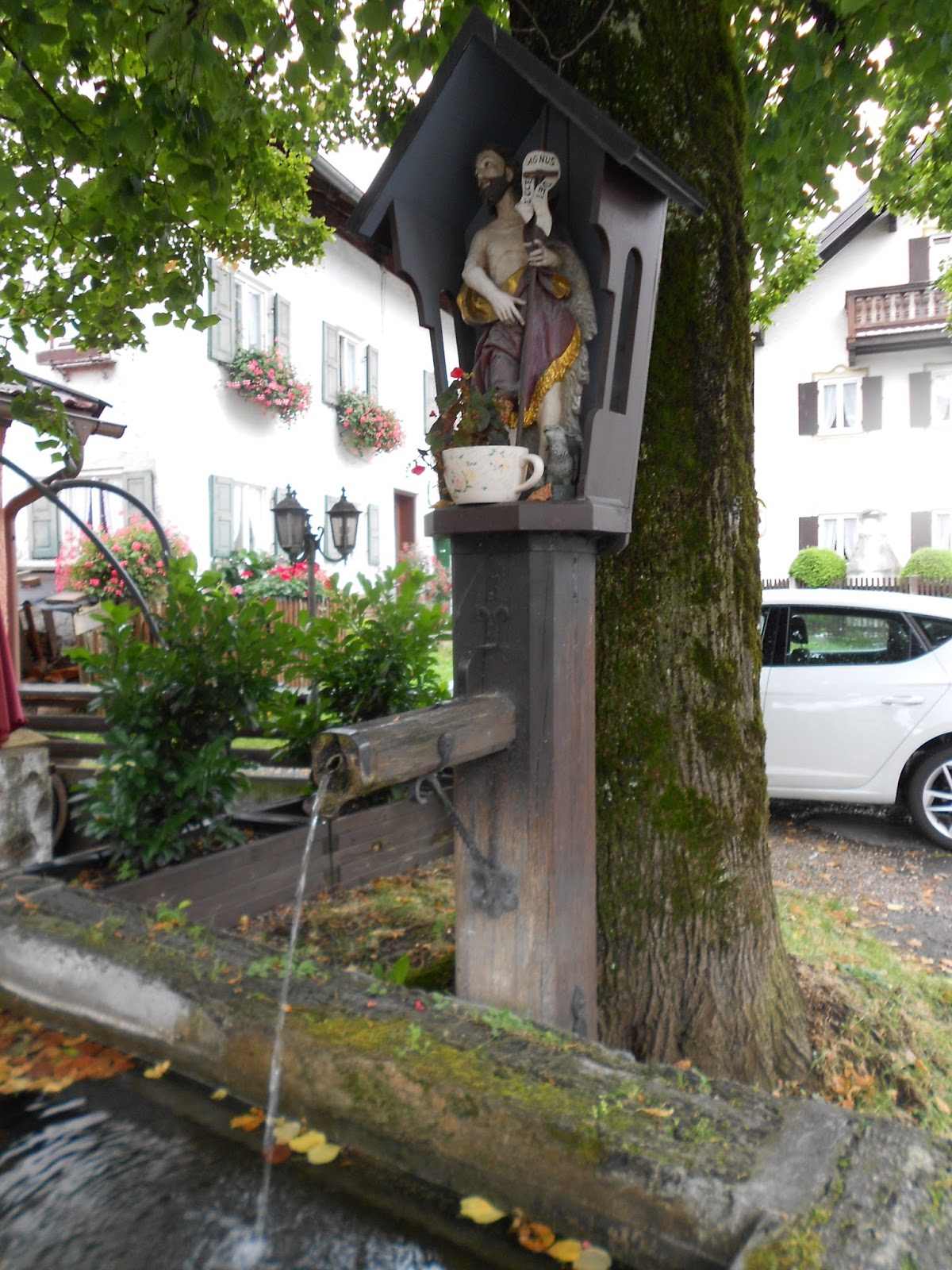
This region is quite staunchly Catholic and many woodcarvings of saints, Jesus or Mary his mother could be seen on local shrines or around important features such as springs of drinking water.


Bavarian woodcarving

To make the wooden carvings ready to be placed outdoors, they are coated with layers of a special compound made from three different kinds of powdered chalk, one of which is Champagne chalk from France. The number of coats used varies between three and seven, with each layer being allowed to dry and then carefully sanded before the next is applied, so that the finer details of the carving aren't obscured. The figure can then be painted and gilded.


The village of Bad Kohlgrub is not far from Oberammergau. One of the most respected local woodcarvers lives and works here; Hans-Joachim Seitfudem. This is his shop:


Hans-Joachim Seitfudem's shop

I was in the village to celebrate the wedding of his son, Joachim, who is also a woodcarver. Jo kindly explained a lot about his father's work, as Hans-Joachim is friendly but speaks very little English and my knowledge of German is not much better.


Unlike the larger woodcarving outlets in Oberammergau, Hans-Joachim does the majority of his carving by hand using linden timber and does not use replicating machines. He is an extraordinarily quick and skilled worker, having explained to Jo that a carver must be fast to make a living.


I was very interested to notice that, even though all his work is done by hand, two sculptures of the same subject would be almost identical. 


There wasn't much in the way of reference material visible around the work area, so I suppose that this must come from familiarity with and repetition of the carving process over decades of work and knowledge passed on from master to pupil. All of the other carvers that I spoke with in the area knew of Hans-Joachim and respected his work very highly.


Smaller figures would have hands and sometimes forearms carved separately, then glued to the rest of the figure using a dowel for strength. This meant that the wood grain could run along both the legs and the hands, making them stronger and less likely to snap.


Hans-Joachim is one of the last master carvers in the area to have had apprentices. It is very expensive for a master woodcarver to train an apprentice, so most young people who wish to learn the trade nowadays go to a carving school. The majority of them are not from the local area, coming instead from other places to study because of the reputation that Oberammergau has. However, it was said to me that the quality cannot be expected to be the same: learning from a real master being far superior.

I did notice that the work of younger carvers that I saw in Oberammergau was often technically excellent, but that attempts to produce their own style often seemed to lack self confidence. Many would emulate other styles and it led me to wonder if the strong tradition of the area held them back from really exploring new forms of expression in woodcarving. At the same time, carving has been around for thousands and thousands of years and has been practised all over the world. It can be a struggle for any carver to find new approaches to it.

Thanks to Jo, Hans-Joachim, Toni and to all of the carvers of the Ammergau Alps who shared their knowledge with me. 

Wednesday, 24 June 2015

Visiting Pennant Melangell, an ancient Welsh church in what is an even older sacred site

'It's difficult to know what it is about this shrine and this valley that appeals so much. Is it the simple story of a good woman? Is it the fact that people feel that praying to her can bring about results? Is it simply the glorious, unspoilt setting that instantly transports us back, almost, to her time here because it is relatively unchanged?
Whatever the reason - and I guess it must be a combination of all those factors - there's no denying this place has an incredible appeal. It's one of the places that's moved me most. I didn't expect shrines to really get under my skin at all but this place has been described as one of Britain's holiest places and I, for one, am inclined to agree'

Ifor ap Glyn, presenting 'Shrines', an episode of the BBC documentary 'Pagans and Pilgrims; Britain's Holiest Places'

pennant melangell church

Pennant Melangell is a small church located at the top of the Tanat valley near Llangynog in Wales, on the edge of the Snowdonia National Park. Parts of the current building are 800 years old, although there has apparently been a church here for 1200 years and the circular wall around the graveyard hints that it was built on a Bronze Age site that is far, far older. Excavations in the last ten years have found evidence of these earlier burials.

Many early churches were built on sacred pagan sites. If people attached special sacred significance to a place, it was easier to put a church there and change its focus than to stop them visiting it, a fact that was officially recognised by Pope Gregory in 601AD.

Perhaps there are still-living witnesses to the pre-Christian site at Pennant Melangell - huge, ancient yew trees that grow around the edge of the churchyard. It's almost impossible to accurately age very old yew trees because of the way that they grow, but it isn't hard to imagine that these could well have been here from the time that the earliest church was built, if not before.


This is the only church dedicated to Saint Melangell. She was a princess in the 7th century, who escaped from an unwanted marriage proposal in Ireland to live as a hermit in the valley. One day, a prince named Brochwel Ysgithrog was hunting hares when one ran under the skirt of Melangell. The pursuing hounds ran away howling. The prince was so impressed that he gave Melangell the valley, to keep as a place of sanctuary. This story is portrayed in woodcarvings on a screen in the church, which were carved in 1450.


The church was recently in such disrepair that there were plans to take off the roof and let it go to ruin. Luckily, the local diocese and people didn't support that, so it has been restored and is now a very beautiful sanctuary space.

People have come here for centuries to pray at Melangell's shrine for help with their problems. As Ifor ap Glyn points out, ' There's no denying the emotional energy that you can feel channeling through the place. There's the pain but also hope. It's very moving'.

Even if (like me) it isn't a Christian faith that brings you there, there is definitely something special about Pennant Melangell.


Pilgrims have left offerings around the building; including the ancient, faded marks of shoes carved onto gravestones outside and more recent carvings of hares in stone, by Meical Watts, which are displayed around the walls.


The shrine was destroyed during the Reformation, but was rebuilt when the church was restored in 1958 using original pieces that were found in the walls of the church buildings. During the more recent restoration begun in 1988, the shrine was moved from the small room known as Cell-y-Bedd to its current location. Some bits are missing and are marked by plain concrete ('honest repair'), but the shrine is pretty much the same as it was before, raised up on columns so that people can pray and leave offerings beneath the remains of the saint. It is thought to be the oldest example of a Romanesque shrine in Northern Europe and is the only one to survive in Britain.


Next to it is a fragment of a very old wall painting that has been preserved. It was probably painted before the thirteenth century.


During the restoration twenty-five years ago, the bones of a woman from about the time that Melangell lived were discovered beneath a large stone in the floor of a small, semi circular room on the Eastern end of the church, along with a second grave.


This room, known as Cell-y-Bedd, was built in the 18th century and rebuilt in 12th century style during the restoration begun in 1988. ap Glyn notes that it was built on semi-circular footings of an apse that were much older. Early Christian churches also used this semi-circular area in their layout, so the room could have been the rebuilding of an original, much older feature. The bones have now been placed in the rebuilt shrine.

There are many other curiosities at Pennant Melangell, including a wooden candelabra from 1733, a 12th century font and the 'Giant's Rib', a huge bone displayed against on one wall. It looks like a whale rib, but one story relates that it was found in Melangell's tomb, another (probably more reliably) says that it was found 'on the mountain between Bala and Pennant Melangell'. What would a huge rib bone be doing on a Welsh mountainside with no rocks there that could possibly hold such remains as fossils? You can make up your own tales about that one...


Monday, 6 April 2015

Saxon and modern stone carvings at the ancient church of St Laurence in Bradford-on-Avon

In the small town of Bradford-on-Avon, in the west of the county of Wiltshire, is one of the oldest churches in Britain. Despite evidence of subsequent alterations, some of them also ancient, it has been described as one of the most characteristic examples of a Saxon church in the country.


St Laurence's is certainly not a big building, but it contains some beautiful fragments of Saxon stone carving.
Image from http://en.wikipedia.org/wiki/File:St_Laurence%27s_Church.JPG
The church was mentioned as standing in 1120 CE (or AD, if you prefer) by the twelfth century historian William of Malmsbury. He thought that it was built in the time of St Adhelm (in 709 CE) although other evidence suggests that it dates to the early eleventh century. However, it may have replaced an earlier wooden structure.  It was surrounded by other buildings and used for other purposes, before being 'rediscovered' in the nineteenth century.


The space inside, containing three rooms linked by surprisingly narrow archways, is not large but it is high with small windows. It gives the stone-built chapel a distinctive feel, not showy but not humble either. The walls may have once been plastered and painted, perhaps also draped with hangings. In Saxon times, surrounded by timber buildings, a stone building of this size in a small town must have been pretty grand in itself.


Fragments of Saxon carved stone are dotted throughout. There are two carved angels high up on one wall, which may well have once been part of a larger sculptural frieze:

Image from http://history.wiltshire.gov.uk/community/getimage.php?id=321
The altar is made up of several bits of Saxon stonecarving found in the area. The richness of the carvings found in its vicinity has led to the suggestion that the chapel may once have held relics of a saint. The church's website says that;

'A charter of King Æthelred granted Bradford to the nuns of Shaftesbury in 1001, and the church’s architecture suggests it was built for the nuns early in the eleventh century. St Laurence’s is a characteristic Anglo-Saxon building: tall and narrow with small windows. The extent and richness of its decoration, however, are rare, perhaps suggesting it was designed partly for the relics of Æthelred’s brother Edward the Martyr, which were housed with the nuns at Shaftesbury.'

saxon stone carvings

In 2012, the sculptor John Maine installed a three-part piece in the chapel above the altar. I think that it looks perfect in the setting and complements it well. At the top is a ring of Doulting stone carved by Maine. Below that is a piece of fossilised tree trunk thought to be about 150 million years old and below that is a fragment from a Saxon carved cross.


Bradford-on-Avon has several other interesting buildings, including a tithe barn and an interesting old town bridge with a building on it that was used as a cell for a while. Unfortunately I couldn't get photos of them during my visit but it's nice to be able to share this one with you.

Monday, 1 September 2014

A strange Norman stone carving in St Nicholas' church, Combe St Nicholas, Somerset

combe st nicholas church

While visiting this church for a wedding, I noticed the strange carved stone capital on a pillar near the north entrance. Apparently, it is the only remnant of the Norman church that once stood on the site (although a round font dating to Saxon times is thought to be the oldest object in the church, surviving from the Saxon church building that was here before that).

green man combe st nicholas

It is an odd carved design and some people think that it represents the devil. I wonder why the medieval builders who rebuilt the church in the 13th century decided to keep this bit of stonework in particular? The pillar that it tops does not seem to hold up any arches, so it probably isn't structural. 

The way that the weird-looking head seems to sprout the paired 'snail track' lines out of its mouth reminds me a lot of 'green man' carvings, some of which have foliage coming from their mouths in a similar fashion. I wonder if this could be an example of such a design? According to 'The Company of the Green Man' website, this carving would seem to have been identified as such by Clive Hicks in his book 'The Green Man: A Field Guide'. 

The carving on the capital to its left looks to me like it could represent a crown.

If you are visiting the church, the oak screen in front of the altar is also worth a look. A plaque tells how it was first carved around 1480, then was taken down and moved in the 19th century before being repaired and returned to it's original position in 1921, when a memorial to the men of the parish who died in the First World War was also added to it.