As well as this blog, I also have a website and Instagram page with lots more images of my work as well as a few more stories.
If you like woodcarvings, you might want to have a look.
Showing posts with label memorials. Show all posts

Wednesday, 16 March 2016

Carving a rabbit onto a wooden bench

This elm bench seat had already been made by Alex Arthur at the Woodworks Project in Bath. He suggested to the client that I could carve the design that they wanted on it.


I didn't want to make the lettering too deep, so carved a textured surface inside a double border. This catches the light so that the letters read easily from any angle. All of the carving here was done using traditional hand tools.


It was a nice surprise when the person commissioning the bench asked if I could also produce a simple, quick carving of a rabbit on there, peeping out from behind a log. The rabbit needed to look cute, but still fairly realistic. I'm very happy with the result as the young rabbit looks out from behind the old log with a bluebell growing nearby.


Tuesday, 8 April 2014

A Carved Inscription on Sue Darlison's 'Bridget's Smile' bench


Today, I went over to 'The Limes', a day centre for people with Alzheimer's in Bristol, to carve an inscription on a bench designed and made by Sue Darlison.

Sue is a very talented local designer maker as well as the curator of the 'Inspired' exhibitions, which have previously included some well-known exhibitors such as John Makepeace and David Colwell of Trannon furniture.

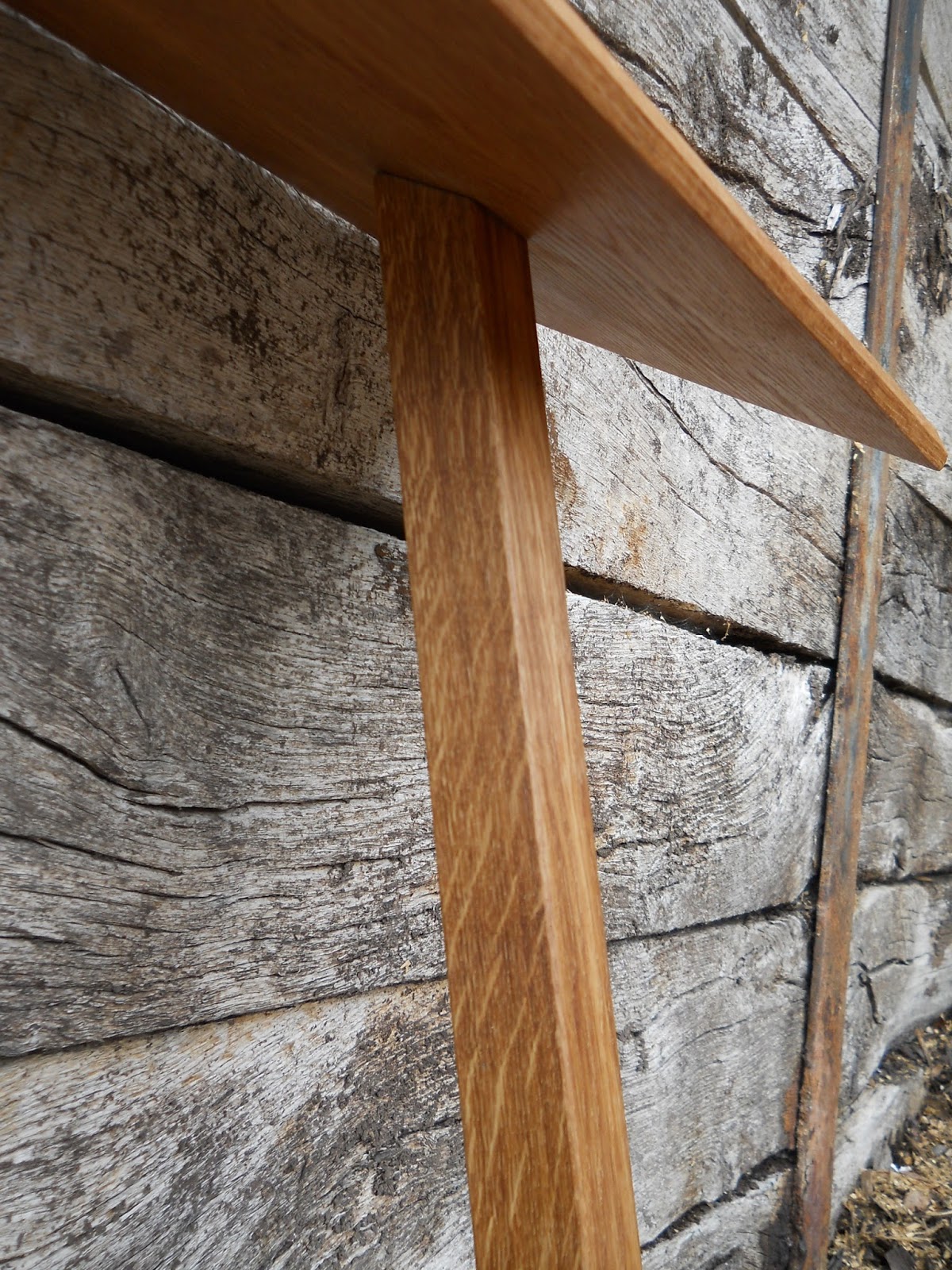
The bench is called 'Bridget's Smile,' as it was inspired by the smile of a lady who used to attend the centre. The seat and backrest are Cedar of Lebanon and the legs and backrest supports are Oak, all of which came from the local area.


I used a Dremel hand drill with a rotary burr to cut the letters, as it seemed to give a better effect with this font and also worked on the cedarwood more efficiently than hand tools, even very sharp ones.


The cedar gave a lovely smooth and polished finish when the lettering was finished, which can be hard to achieve when working on many other types of softwoods. Sue and I are sure that Bridget would approve.


Friday, 20 December 2013

'Bridget's Smile'- a sculptural bench by Sue Darlison

sue darlison

Sue Darlison is a bespoke furniture maker, tutor and exhibition organiser based in Bristol. Today, I helped to take over a bench that she has recently made. It is now installed at 'The Limes', a local centre for people with dementia, and was commissioned by someone in memory of his wife Bridget who attended the centre.


The bench is made from Cedar of Lebanon and Oak. The shape was inspired by Bridget's smile, which seems a particularly lovely way to be remembered. In the New Year I have been asked to carve the words 'Bridget's Smile' onto it and then it will stay in the garden of the centre, for visitors and clients to enjoy.

Saturday, 28 September 2013

Some ancient stone carvings and structures in Cornwall: mysterious stone chambers, circles, pavements and labyrinths

Although my trip to Cornwall included visiting a few churches to look at the carvings and stories within them, these weren't the only carvings and man-made structures that I'd like to write about here. Some were far, far older.

Perhaps the oldest structure was Trethevy quoit on Bodmin Moor. This is a dolmen, a chamber made from huge stones thought to date to the end of the Neolithic (Late Stone Age), about 5,500 years ago. There are a few in Britain, some having shown evidence of burials within them but they may have also had other purposes such as territorial markers. No one really knows with certainty the original purpose of these chambers, but they are also found as far away as Korea and India.


On the same side of the moor one can find the Hurlers, a row of three (or possibly four) stone circles and outlying stones, which may date to the Bronze Age or may be older. They lie in a SSW-NNE alignment.


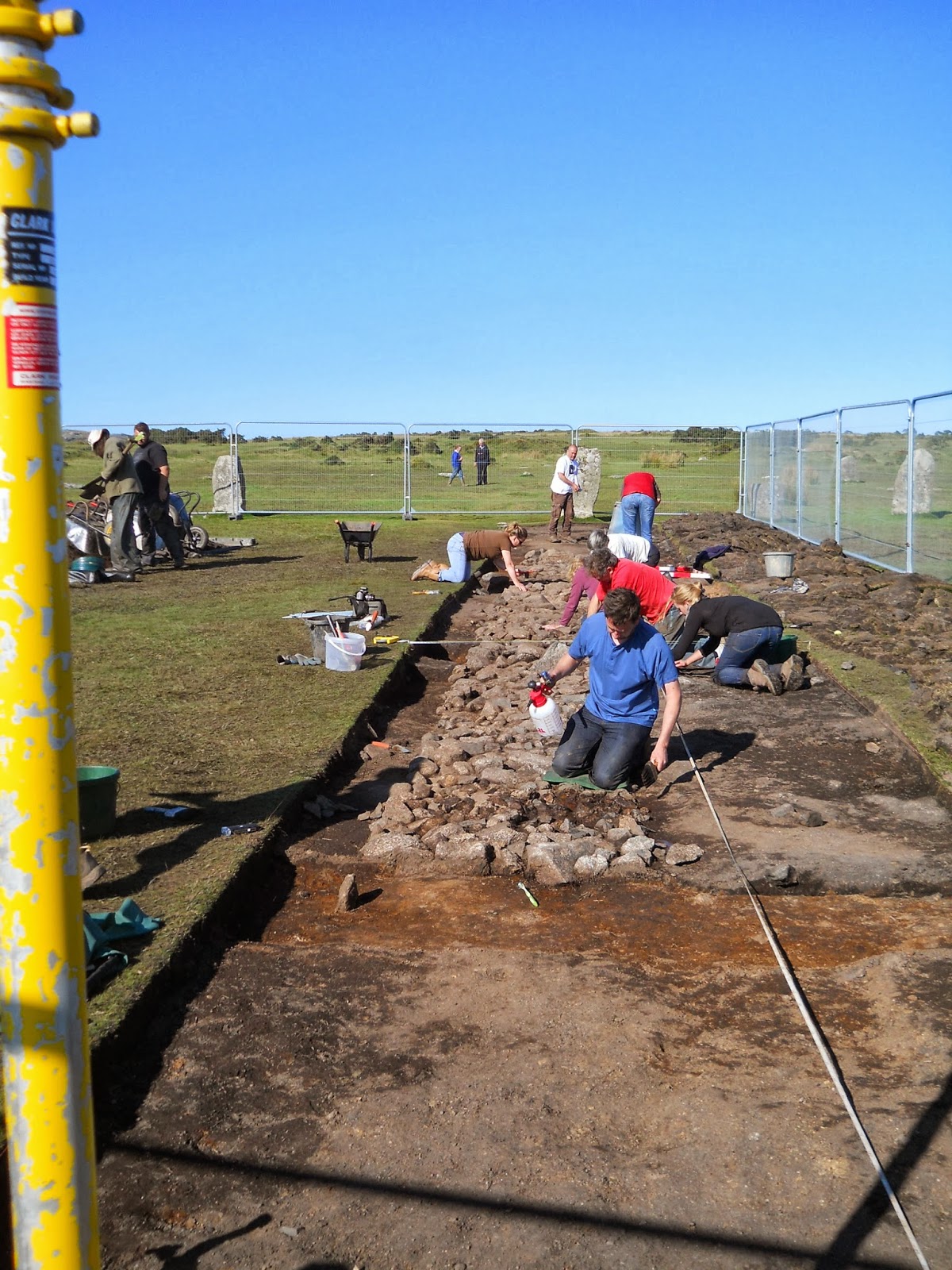
We were very lucky to visit them whilst an excavation was taking place to uncover a 'pavement' of white quartz stones, which appears to link two of the circles and runs in the same orientation. The quartz structure has only been uncovered in modern times once before, in 1938, and will be covered over again once the project is completed. The local community was assisting with the dig, which was tied in to a study of the astronomical orientations of the site that is being conducted by the Roseland Observatory. It's interesting to think what the Hurlers must once have looked like. The stones in the circles show evidence of having been hammered to shape and the pavement of quartz must have glowed and twinkled in certain light conditions.


On the north coast of Cornwall lies another mysterious site that may date to the Bronze Age. The walk to this one began at Tintagel, a site closely linked with legends of King Arthur.


The castle ruins that can be seen today are comparatively recent, having been built in the 13th century by Richard, Earl of Cornwall. There is archaeological evidence for much older use of the headland though, going back to Romano-British times. However, no traces of an actual settlement on the site then have so far been found, although evidence for early trade with Mediterranean societies has been discovered here.

After a walk of about two hours along the beautiful coastline, past Bossiney Haven...


... one arrives at  Rocky Valley.


The river is followed upstream for a while...


... to a ruined watermill.


On a rockface behind the mill ruins are carved two of the most intriguing carvings that I know of. They are surrounded by offerings tied to trees and scratched into stones, which have then been lodged into cracks in the rock. A plaque nearby notes that they are 'probably of the early Bronze Age (1800 - 1400 BC)'. In truth, they are almost impossible to date. They are two labyrinths.


This design is a unicursal maze. There are no dead-ends or branches, just a single path travelling into the centre then out again. The design is ancient, a square version having been found on a clay tablet from the Mycenaean palace at Pylos, which was destroyed by fire around 1200 BC.

Stone carvings that may be more recent, although still very old, can be seen back on Bodmin moor. One is the Longstone, or Long Tom; a cross carved in granite. Some people believe that this is an example of the Christianisation of an ancient menhir (standing stone). Rather than destroy the pagan relic a cross might have been carved onto it, perhaps because it was too useful as a wayside marker on the inhospitable moor to be taken down or because of some other particular importance to local people. 


Another nearby monument of carved granite is certainly Christian, albeit still very old. It is called King Doniert's Stone but is actually two granite bases for crosses, which have interesting Celtic knotwork and an inscription carved into them.

The inscription says in Latin 'Doniert Progavit Pro Anima', which translates as 'Doniert ordered (this cross) for (the good of) his soul'. Doniert is thought to be King Durngarth of Cornwall, who drowned in the river Fowey around AD 875. 


The stones are decorated with carvings of late 9th century style and sockets carved into the tops of the stones may once have held separate parts of the monument; perhaps wooden cross heads?
An underground passage cut into the hard granite begins about 8 metres (26.25 feet) from the stones and terminates below them in a cross-shaped chamber. The relationship between the stones and the passageway and chamber is unknown. 
As with most, if not all, of the ancient carvings and man-made structures in the county, this Cornish monument leaves the visitor considering questions to which we will probably never know the answers.


Friday, 6 September 2013

Two recent lettercutting projects; an elm breadboard and an oak memorial


I was contacted by a client who wanted a breadboard with a carved inscription, made from seasoned oak. Oak is actually not a great wood to use for chopping boards, as it can split easily and contains a lot of tannins that could taint food. I suggested elm instead and am very happy with how the board now looks:


It has been finished with olive oil that has been slightly warmed, so that it penetrates the wood more deeply and doesn't sit on the surface going sticky. The surface was then buffed to a satiny sheen.


Another recent commission involved carving and constructing an oak memorial. It is to be sited in a natural cemetery and so it was important that no metal or stone was used in the construction (eg. metal screws). The sign is joined using glue and dowels instead and the board is finished with durable tung oil. A separate stake was provided, at the client's request, to make a pilot hole into which this stake could be pushed without damaging it.


Thursday, 22 August 2013

Three interesting church buildings on the Isle of Wight: an old church, a newer church and a church that isn't a church

Being a woodcarver with an interest in old buildings, I naturally like to pop my head through the door of churches when passing by to see if there are any interesting carvings or architectural features to be seen.

The Isle of Wight, off the south coast of England, has many old churches but these three were particularly interesting, as I hope you'll agree.

St Mary the Virgin in Brading


This church is the oldest of the three, and the site is thought to be an ancient place of worship going back to at least 680 AD. The nave of the present church dates to 1180 AD.

The tower is interesting, as it is built on four supports (piers) in front of the entrance doorway and is one of only four churches in Britain to have that arrangement. The access to the tower is via wooden steps next to the entrance door.

The most interesting things inside, for me, were the carved wood and stone memorials on the tombs. One of the chapels is called the Oglander chapel and houses the tombs of members of the Oglander family, who were  the local gentry for 800 years from 1160 and lived at nearby Nunwell. Here are some of their memorials:


This tomb commemorates Sir Oliver Oglander and dates to 1536.  It shows his family (with him on the right kneeling) and would originally have been painted to look more realistic. It still shows remnants of the original paintwork in nooks and crannies of the carving.


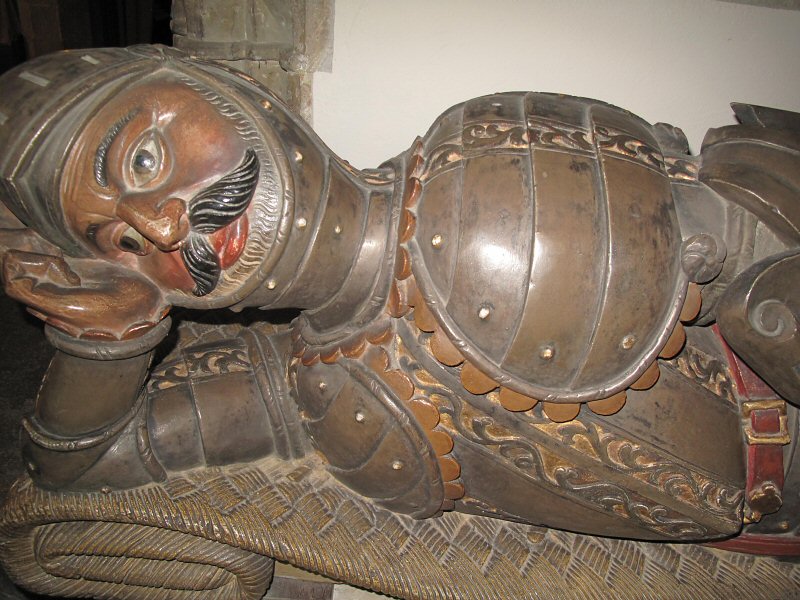
These two carved and painted oak figures commemorate Sir John Oglander, who died in 1655 aged 70, and his son George who has the small effigy in the alcove above. The armour represents that of the 14th Century so was well out of date by the seventeenth century. The crossed legs were thought, in that time, to indicate a knight who had been a crusader. Sir John was obviously quite a romantic and saw himself as a crusading knight.

Image from http://www.thegentry.org.uk/oglander_photos11.html

He was a staunch supporter of Charles I and tried to help him when the king was imprisoned at Carisbrooke castle on the island, even to the point where friends had to warn him off before he got into serious trouble. He was also a keen diarist and would, at times of high emotion, write entries in his own blood. It seems appropriate that would have his memorial looking the way that it does.


This oak effigy represents Wlliam Oglander, the father of John. He died in about 1609 and his son had this memorial put on his stone tomb.


This very grand tomb houses the remains of Henry Oglander, who died in 1874. It was designed in 1897 in the Arts and Crafts Jacobean style by J C Powell. Henry Pegson carved the two small angels at the front.

In another part of the church is the memorial to Elizabeth Rollo, who died in 1875. It is very Victorian and very melancholy (which suits something as sad as the death of a child I suppose), and is beautifully carved in white marble.


St Agnes in Freshwater Bay


This is the only thatched church on the island and was built is 1908 to designs by Isaac Jones. The land was donated by Hallam who was the son of Alfred, Lord Tennyson the famous poet.


There is a date stone on the vestry wall saying 1622, but this came from a derelict farmhouse nearby on Hooke Hill. Stone from the ruin was used to build this church.


I couldn't stay long here unfortunately, as some people were rehearsing for a wedding that day. A shame, as there were some very nice-looking Edwardian carvings on the rood screen. The whole building had a 'cosy' feel to it, in pleasant contrast to some churches that can feel very cold and austere, with stone tombs of the wealthy dead lining their walls.


St Helens near St Helens Duver


The church was built in the early 12th century and this tower dates to about 1220. In 1703, the church ceased to be used and the tower was bricked up. It is now a seamark, with a white-painted brick wall the height of the old tower facing seawards to give a marker for ships.


The sea off the village of St Helens is important for shipping, with the large commercial and naval port of Portsmouth almost within sight of this old tower. Lord Nelson stepped onto the deck of HMS Victory offshore from here, on the St Helens Roads, to sail to the Battle of Trafalgar. So where did the rest of the church go?

All over the world. Sailors would take pieces of the ruin (called 'Holy Stones') to rub down the wooden decks of their vessels to clean them. Maybe they also thought that these stones would bring them luck on their voyages. 


Saturday, 29 December 2012

Carved Oak plaque for Bristol's Castle Lodge freemasons

I completed a carved oak plaque a few weeks ago for someone who wished to commemorate his grandfather, who was an important freemason in Bristol. The plaque is made from recycled oak and was carved freehand, using a Dremel hand drill for the lettering and traditional hand tools to carve the square and compasses (the traditional symbol of the freemasons).

The lettering was in a font which I haven't carved before and so was an interesting challenge. Designing the square and compasses symbol was too. Symbolism is very important to masons and I had to do some careful research so as not to include, or leave out, anything in the design that would make it incorrect.

The plaque will be displayed in the Castle Lodge on Park Street in the centre of Bristol. It's interesting putting my name and mark on the back of a plaque going to somewhere like this lodge. The plaque may still be there long after I'm gone and, when it is next taken down from the wall, I wonder what legacy of it's maker will still remain?


Tuesday, 25 September 2012

Memorial plaque for Bailey's Court school

I went to Bailey's Court primary school in Bradley Stoke, Bristol, today to install the oak plaque which I was asked to make to commemorate a boy who went there called Ryan.
Some of the children helped me to fix it onto a log which had been set into the ground there. It is next to a beautiful bog garden and pond (which had a frog in it!). I also had the chance to meet Ryan's mum. It was great to hear that she and everyone else liked the plaque very much. I'm sure that Ryan would also have loved the garden that has been created in his memory.


Baileys Court primary school have a website, which you can see by clicking here