As well as this blog, I also have a website and Instagram page with lots more images of my work as well as a few more stories.
If you like woodcarvings, you might want to have a look.
Showing posts with label granite. Show all posts

Wednesday, 13 May 2015

Elm furniture at YHA Dartmoor (previously known as Bellever Youth Hostel)

  'A fire was burning in the common room, where there were specially made wooden seats.'

Pat Packham, A Holiday in South West England, 5 August 1958 mentioned in the historical listing of 2001, collected by John Martin, YHA Volunteer archivist

The youth hostel in Bellever Forest lies right in the middle of the Dartmoor National Park. Since 2012 it's been called YHA Dartmoor and is the main hostel in the area.


The hostel is one of the earliest ones that is still in use. It opened in 1934 but was originally a barn that was part of the Duke of Cornwall's Model Farm, which was owned by the Prince of Wales.

Bellever forest consists mainly of conifers surrounded by the wild, open moorland dotted with granite tors and prehistoric dwellings and monuments.


However the small village of Postbridge is not too far away, with a shop and the famous clapper bridge.


On arriving at the hostel, one thing that stood out was how cosy it felt, compared to some hostels that I have visited in the past. The building has thick stone walls against the Dartmoor weather, which can sometimes be very fierce. The common room had a great granite fireplace and comfy chairs.


The other things that I immediately noticed were some of the other items of furniture that were in the hostel. The pieces had obviously been made using one-off or small batch production methods using slabs of English elm and, in the case of the two armchairs in the common room, handmade iron nails with the heads left faceted.


Elm is a traditional wood used in furniture making, as boards of elm are less prone to splitting than many other kinds of timber. Unfortunately, since the late 1960's large elms in Britain are very rare thanks to the arrival of Dutch Elm Disease. It would seem likely that this furniture dates to at least the 1970's, although I suspect that it could be older judging by the quote at the start of this post.


There were more benches in the games room in another part of the hostel. I love the way that the pegs holding the bench together are extended into legs in the design above and the large armrests on the design below.


While these settles would fit perfectly in many country pubs:


 This table is so robust that I wouldn't be at all surprised if it was made for the newly-opened hostel in the thirties:


The entire table top is made up of a single slab of elm, like every piece of timber used in making these pieces of furniture:


I also noticed tables made in a similar way from even larger pieces of elm in the pub in Postbridge. Perhaps they all came from the workshop of the same local maker?

Sadly, there is no information that I can find about where the furniture came from. Garry Hayman, longtime manager of the hostel who now works at YHA Swanage, mentioned seeing an old postcard of the common room that looked hand drawn. He thought that the two settles shown above could be seen on it and also said that it was entirely possible that the furniture was brought into the hostel when it opened in the thirties.

So the origin of the elm furniture will probably remain a mystery. The designs were all simple, practical but also comfortable and seemed to fit the place and its rugged moorland location perfectly.


Wednesday, 4 March 2015

Making a carved wooden brooch with a celtic design, to be worn as a kiltpin

A kiltpin is traditionally worn pinned to one corner of the front of a kilt. It's not supposed to go through both of the layers of material underneath, as this would make the kilt move badly and could possibly damage the material. Instead it is more of a decoration on the kilt's apron (the flat, unpleated part worn to the front).

The origin of wearing a kiltpin is thought to go back to Queen Victoria using a hat pin to secure her kilted skirt on a windy day. I had made a sgian dubh (the knife carried in one's sock -called the 'hose'- with a kilt) and wanted to make a matching kiltpin to go with it. Obviously, it had to be carved too!


The kiltpin is 50mm (2") in diameter. The yellowish wood is box (Buxus sempervirens) wood, which I picked up whilst out walking in Gloucestershire. Box is a native tree in Britain and a traditional use for the timber is in wood engraving plates. It was the ideal wood for the kiltpin as it is very tough but carves well and can take a good finish. You can see the piece of found wood with the sanded start of the kiltpin in this picture:


It is inlaid with laburnum from the garden of the house that I grew up in - the same wood used to make the handle and sheath of the sgian dubh. Apparently my father would hang a hammock from this tree for my mother to rest in when she was pregnant with me.

There are also three pieces of solid silver inlay and the central setting is a piece of microgranite that originally came from Ailsa Craig. This interesting stone is also set into the end of the sgian dubh and you can read more about it here.

The boxwood was sanded to shape to begin with. The stone to go in the centre was then ground to shape with diamond burrs and polished.


Once the position of the stone setting was known, marked and hollowed out then the rest of the design could be drawn on with a pencil...


... before being carefully carved using my Opinel lock knife. No tricks for that part of the process, just a lot of practice and a sharp blade! The holes for the silver inlay were drilled and then the stone and silver were fixed in with two-part epoxy.


The pin on the back was fixed on using epoxy and three small brass rivets to give extra security.


Here's the kiltpin with the sgian dubh. If you are interested, I would consider commissions to make similar ones. Now I'm looking forward to seeing the knife and pin being worn with the kilt!

sgian dubh and kiltpin


Monday, 28 July 2014

The mysterious carved symbols on the kerbstones of London

kerbstone symbol

Whilst walking from Oxford Street through Soho in London, I saw this symbol carved into the kerbstone at my feet, then another further along the stone. The stones each side were not marked in such a way. At first they looked like stonemason's marks, cut to show that a certain number of kerbstones had been completed that day. But, in common with some other kerbs in the area, why two marks on a single stone?

London is not the only town or city in Britain to have such markings on its kerbs. There are apparently many in Glasgow too. No one seems to be exactly sure what they mean. Some say stonecutter's marks, showing either a certain number of kerbstones that had been laid within a particular time or a certain number shaped at the quarry. Some say that they mark surveying points, while others even say that they mark secret Masonic meeting places or are related to the Great Plague or local executions at Tyburn. These particular marks are also repeated on other stones in the area.

soho kerbstone symbols

My own feeling is that they are probably stonecutter's marks or road laying crew signs. Maybe two symbols show either the end of one cutter's work and the start of another's, or are the foreman's marks from a particular gang of workers either shaping or laying the stones. I wonder who they were and where the stones were quarried? A visit to the remains of the stone quarries on Dartmoor will show half-finished kerbstones lying around in the wild landscape. It must have been a tough life being a stonemason up there, are those weather-beaten quarries where these stones were originally shaped?

On New Oxford Street, these signs were all carved within a run of fifteen kerbstones, with whole streets nearby not showing a single one:


Although nearby Museum Street has a few symbols on display too, surely too close to each other to show the start and finish of a run being laid:


A week later, I was walking through Bristol and noticed these marks on the kerb of Gatton Road in St Werburghs, unlikely to be a centre for Masonic ritual in my opinion: 

bristol kerbstone symbol

The same marks appeared three times on stones within a run of fifteen. The D-shaped mark then appeared again about half a mile away, alone on High Street in Easton:


...and again on South Street in Southville, on the other side of the city. This time it was accompanied by a circular mark that I haven't seen elsewhere in Bristol, apart from on that street.


While walking down Western Road, between Hove and Brighton, more kerbstone marks could be seen. These were at Second Avenue in Hove:

brighton kerbstone symbols

further along Western Road towards Brighton, more cross-shaped marks could be seen:


before letters started to appear.


Further still towards Brighton and these 'N' shaped marks could be seen. They are a little different to the others, as they were clearly made using a modern stone cutting circular saw rather than cut by hand. They were accompanied by long saw cut marks running along the kerbstones for a few metres.


I wonder if these marks point to such symbols being a road maintenance crew's work, or if it was just a bored workman messing about. The cuts along the kerbstones are pretty haphazard and not very straight.

Peter Dolan has written two very interesting articles in Geoscientist, the magazine of The Geological Society, which I recommend reading if you are also intrigued by these enigmatic markings. His first, Kerbstone Conundrum, introduces the subject and includes a list of symbols that he has seen or heard of. The second, Kerbstone Markings 2, goes into more detail. Peter has told me by email:

'Suffice it to say at present that I am 90% sure that most of these markings do relate to utility services, but haven't followed it far enough to get independent, documented verification.'

I like the way that the exact meaning of these symbols is still somewhat mysterious and subject to debate, whilst some of them are being walked past by hundreds of people every day.

Saturday, 28 September 2013

Some ancient stone carvings and structures in Cornwall: mysterious stone chambers, circles, pavements and labyrinths

Although my trip to Cornwall included visiting a few churches to look at the carvings and stories within them, these weren't the only carvings and man-made structures that I'd like to write about here. Some were far, far older.

Perhaps the oldest structure was Trethevy quoit on Bodmin Moor. This is a dolmen, a chamber made from huge stones thought to date to the end of the Neolithic (Late Stone Age), about 5,500 years ago. There are a few in Britain, some having shown evidence of burials within them but they may have also had other purposes such as territorial markers. No one really knows with certainty the original purpose of these chambers, but they are also found as far away as Korea and India.


On the same side of the moor one can find the Hurlers, a row of three (or possibly four) stone circles and outlying stones, which may date to the Bronze Age or may be older. They lie in a SSW-NNE alignment.


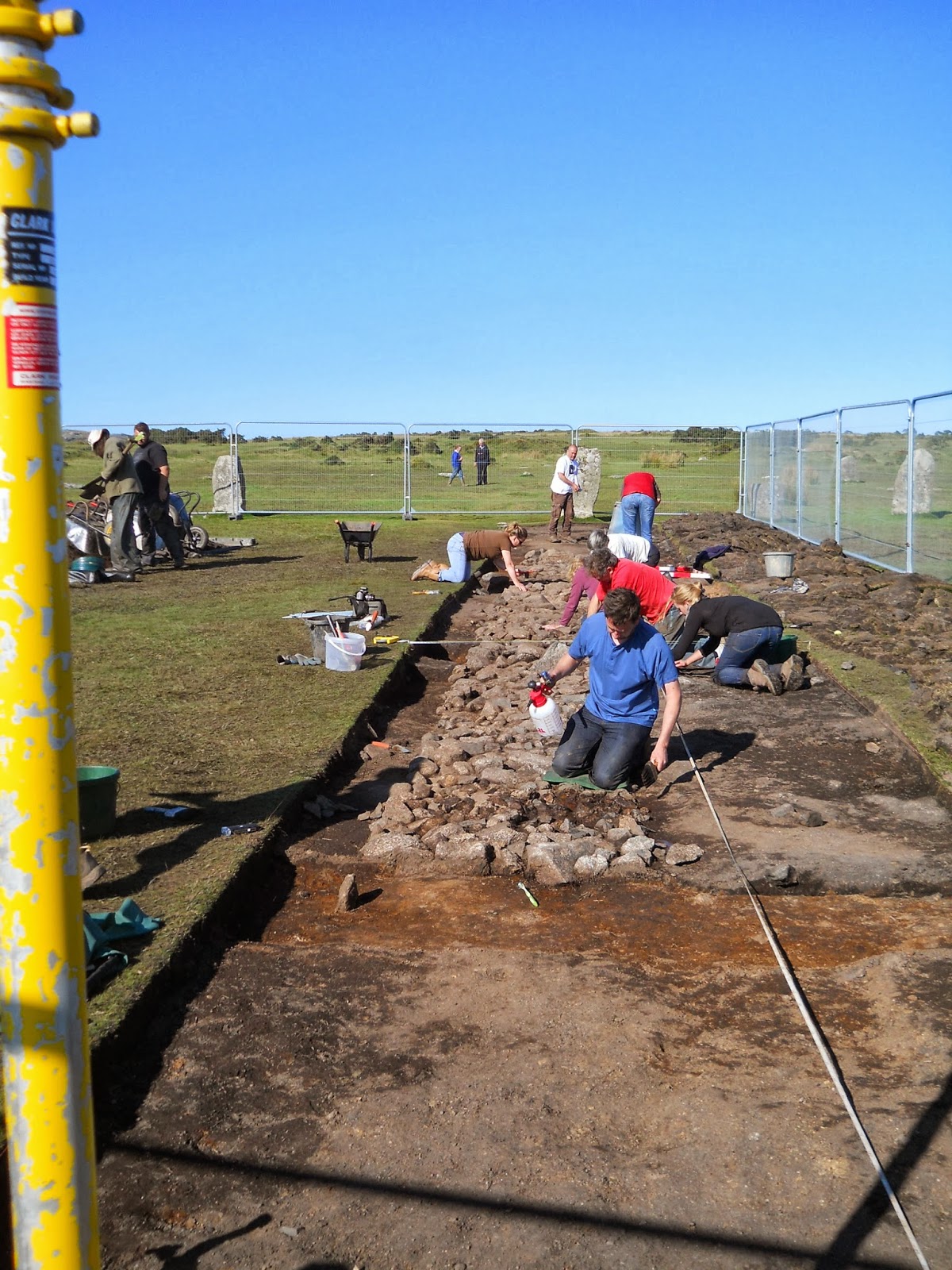
We were very lucky to visit them whilst an excavation was taking place to uncover a 'pavement' of white quartz stones, which appears to link two of the circles and runs in the same orientation. The quartz structure has only been uncovered in modern times once before, in 1938, and will be covered over again once the project is completed. The local community was assisting with the dig, which was tied in to a study of the astronomical orientations of the site that is being conducted by the Roseland Observatory. It's interesting to think what the Hurlers must once have looked like. The stones in the circles show evidence of having been hammered to shape and the pavement of quartz must have glowed and twinkled in certain light conditions.


On the north coast of Cornwall lies another mysterious site that may date to the Bronze Age. The walk to this one began at Tintagel, a site closely linked with legends of King Arthur.


The castle ruins that can be seen today are comparatively recent, having been built in the 13th century by Richard, Earl of Cornwall. There is archaeological evidence for much older use of the headland though, going back to Romano-British times. However, no traces of an actual settlement on the site then have so far been found, although evidence for early trade with Mediterranean societies has been discovered here.

After a walk of about two hours along the beautiful coastline, past Bossiney Haven...


... one arrives at  Rocky Valley.


The river is followed upstream for a while...


... to a ruined watermill.


On a rockface behind the mill ruins are carved two of the most intriguing carvings that I know of. They are surrounded by offerings tied to trees and scratched into stones, which have then been lodged into cracks in the rock. A plaque nearby notes that they are 'probably of the early Bronze Age (1800 - 1400 BC)'. In truth, they are almost impossible to date. They are two labyrinths.


This design is a unicursal maze. There are no dead-ends or branches, just a single path travelling into the centre then out again. The design is ancient, a square version having been found on a clay tablet from the Mycenaean palace at Pylos, which was destroyed by fire around 1200 BC.

Stone carvings that may be more recent, although still very old, can be seen back on Bodmin moor. One is the Longstone, or Long Tom; a cross carved in granite. Some people believe that this is an example of the Christianisation of an ancient menhir (standing stone). Rather than destroy the pagan relic a cross might have been carved onto it, perhaps because it was too useful as a wayside marker on the inhospitable moor to be taken down or because of some other particular importance to local people. 


Another nearby monument of carved granite is certainly Christian, albeit still very old. It is called King Doniert's Stone but is actually two granite bases for crosses, which have interesting Celtic knotwork and an inscription carved into them.

The inscription says in Latin 'Doniert Progavit Pro Anima', which translates as 'Doniert ordered (this cross) for (the good of) his soul'. Doniert is thought to be King Durngarth of Cornwall, who drowned in the river Fowey around AD 875. 


The stones are decorated with carvings of late 9th century style and sockets carved into the tops of the stones may once have held separate parts of the monument; perhaps wooden cross heads?
An underground passage cut into the hard granite begins about 8 metres (26.25 feet) from the stones and terminates below them in a cross-shaped chamber. The relationship between the stones and the passageway and chamber is unknown. 
As with most, if not all, of the ancient carvings and man-made structures in the county, this Cornish monument leaves the visitor considering questions to which we will probably never know the answers.