As well as this blog, I also have a website and Instagram page with lots more images of my work as well as a few more stories.
If you like woodcarvings, you might want to have a look.
Showing posts with label victorian carving. Show all posts

Sunday, 24 November 2013

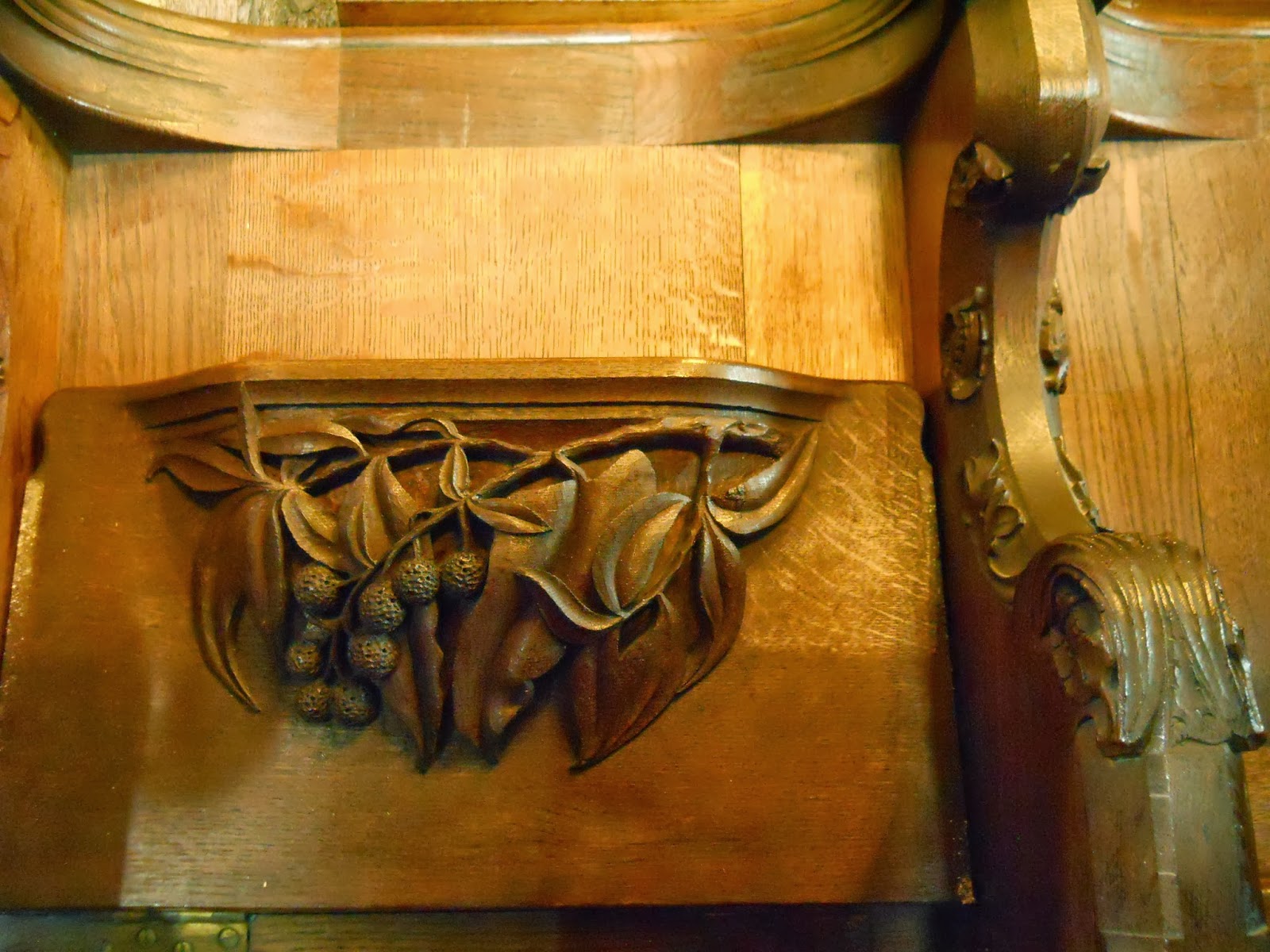
The Lord Mayor's Chapel, St Mark's Church in Bristol. Could you guess when these misericords were carved?


This church is in the centre of Bristol, next to the Council House. It's quite appropriate, as it is apparently the only municipally-owned church in the country.

The church was built in the thirteenth century to serve the Hospital of St Mark, which was founded by Maurice de Gaunt. It was a monastic hospital and for over three hundred years it gave food and care to one hundred poor people a day.

When Henry VIII broke up most of the monasteries during the Dissolution in the sixteenth century, the Hospital was surrendered and the Bristol Corporation (the city council) bought the lands belonging to it in 1541. It was used by various local schools and was granted to French Hugenot refugees as a place of worship in 1687.


In 1722, it became the official place of worship for the Mayor of Bristol and the Council and it has remained so to the present day. This was in part because of a dispute with the Cathedral, which faces the Lord Mayor's Chapel across College Green. In 1788, the Mayor got his own back by allowing John Wesley to preach in the chapel when the Bishop of Bristol had forbidden Wesley from preaching in any of the city's churches.

There are several interesting things kept at the Chapel, including the ceremonial swords of the Bristol Corporation. Unfortunately, one of the most interesting chapels had building work going on due to repairs to the church organ, so it's stone memorials couldn't be photographed. Helpfully, the interesting features of the chapel have information boards near them.


These stone corbels date to the thirteenth century and would have jutted out from the walls to hold up the roof. They may have been used as infill in the walls later, or were taken out during restoration work in the nineteenth century. Nearby are some medieval wall paintings on display, moved from elsewhere in the chapel.


The oak choir stalls have some beautifully carved misericords under the seats and carved faces as bench ends. Many of the faces are of Green Men. Here are a few:


How old do you think these carvings are?

Well, although they look quite medieval, they were actually carved far more recently. The choir stalls were only installed in 1888! The crispness of the carving does give the game away a little. They don't show much wear and the finish is much more precise than is usual with medieval carving (I suppose that reflects the advances in the making of carving tools during the nineteenth century). The expressions and the foliage carving are wonderful all the same.

If you would like more information, the Chapel website can be found by clicking here. It is usually open 10am-12pm and 1pm-4pm from Wednesday to Sunday, but it's worth checking before you visit by calling the Lord Mayors Office on 0117 903 1450.

Saturday, 28 September 2013

St Carantoc's church in Crantock, near Newquay in Cornwall. My introduction to the extraordinary carving work of Ms. Violet Pinwill, as well as the nefarious deeds of William Tinney of West Pentire


St Carantoc's in situated in the small village of Crantock in Cornwall. There has been a church on the site since one was founded there by Carantoc in about the 5th century. He was the eldest son of a Welsh chieftain and had given up his succession, studied under St Patrick in Ireland and is reputed to have sailed from there to this area in a coracle.

The church is basically of Norman design, although there has been much rebuilding; the tower, nave and many other parts were rebuilt in the 15th century after the previous tower had become neglected and collapsed (bringing down much of the church with it). The South Porch dates to the 17th century.

St Carantoc's was the centre for a college of priests after being granted a charter by King Edward the Confessor. This made it quite powerful and the mother church for a large area around it. The Eastern end of the building is higher and wider than the Western end (as you can see in the picture above) because the monks of the college worshipped in one end whereas the poorer parishioners used the other. I'm sure that you can guess who got which end!

The college of priests was disbanded during the Reformation in the 16th century and the building gradually fell into disrepair, with the Puritans no doubt helping the process along. There were some attempts at restoring it in the 18th century, although they were fairly shoddy.


The current state of repair is basically down to one man: George Metford Parsons, who became vicar there in 1894 and remained vicar until his death in 1924. He campaigned for funds to renovate the building in 1897 and by 1907 the work was done and pretty much paid for. The architect for the renovation was Edmund Harold Sedding and he did a very good job, with any surviving pieces of high-quality older woodwork being incorporated into the newly restored church furniture or being displayed in an arrangement at the back of the church. Fifteen new stained glass windows were also installed at the time.


Sedding was buried in the churchyard at St Carantoc's after his death.

My first reaction on entering the church was amazement at the unexpectedly high quality of the woodcarving to be seen. The rood screen and choir stalls in particular are stunningly well executed.


Under the choir seats are misericords, for clergy to rest against during masses. The ones in St Carantoc's are based on plant designs and were carved, like most of the other work in these photos, by a company led by Ms. Violet Pinwill. They had finished installing the carved work by 1907.


Pinwill and Sedding worked together on other church restorations, including St Winnow's in Cornwall.

(One piece of work in the church that was carved elsewhere is the crucifixion scene on the rood screen, which was produced by some of the famous woodcarvers of Oberammergau in Bavaria and mounted atop the screen afterwards.)

This was the first time that I had knowingly come across Violet Pinwill's work. She sounds like she was a very remarkable person.

Image from search.ancestry.com
Violet was the daughter of Reverend Edmund Pinwill. When he became vicar of the rundown church at Ermington in Devon, woodcarvers were hired to restore the woodwork there. Mrs Pinwill encouraged her daughters to be taught the craft by the carvers and Violet, together with her sisters Mary and Ethel, carved and assembled the pulpit in a room in the vicarage. Thanks to Helen Wilson for getting in touch and correcting the misspelling of Ethel's name as 'Esther' in the Ermington website and elsewhere. The link through Dr. Wilson's name will take you to her website, where you can find out more about the Pinwill sisters.

They decided to go into business and formed the company Rashleigh Pinwill, basing themselves in Plymouth in Devon. The company specialised in supplying carvings based on natural forms to churches in Devon and Cornwall. When Mary and then Ethel left, after some time, Violet continued to head the company under the name V. Pinwill Carvers. She employed several male carvers but also executed a lot of the carved work herself.

Violet Pinwill died in Plymouth in 1957, aged 83. She left carvings in wood and stone in over 100 churches in Devon and Cornwall, including Truro cathedral. It may be worth remembering that the Pinwill sisters formed and led this highly successful company of woodcarvers at a time when women in Britain were not even allowed to vote.

Ed Hall, maker of trade union banners, noted in the programme for the Dismaland exhibition that he particularly likes banners made by the Suffragettes. He makes an interesting point about women working at this time in British history:

'The interesting thing about the Suffragettes is that one or two of them, including Sylvia Pankhurst, were artists in their own right - women were excluded from many professions but there was no bar to them joining the arts so some of the Suffragette banners were professionally made.'


Behind the church is a small roofed structure containing a woodcarving in oak by Davey and Bushell, who were based in Bristol. The panel was carved sometime between 1900 and 1919.
It accompanies the old stocks for Crantock and relates the tale of the last man to be held in them.


The carved story reads like this:

'The last man in Crantock stocks (circa. 1817) was William Tinney of West Pentire, a smuggler's son and a vagabond. He robbed, with violence, a widow woman of Cubert parish and was placed, to abide justice, in Crantock stocks, then standing in the church tower. By negligence or design he was insufficiently secured and shortly afterwards appeared on the top of the tower. He had cut the rope from the tenor bell and by this he lowered himself to the nave roof. Climbing to the eastern gable of the choir and sliding down it, he dropped to the churchyard grass and in the sympathetic view of certain village worthies bolted, got off to sea and was never brought to justice or seen in the neighbourhood again.
This record was taken down in April 1896 by George Metford Parsons, vicar, from the testimony of Richard Chegwhidden of Crantock, he being then 88 years of age and well remembering as a witness the events described.'


The poem under this scene reads:

' I paid my price for finding out,
Nor ever grudged the price I paid,
But sat in clink without my boots,
Admiring how the world was made.'

Thursday, 22 August 2013

Three interesting church buildings on the Isle of Wight: an old church, a newer church and a church that isn't a church

Being a woodcarver with an interest in old buildings, I naturally like to pop my head through the door of churches when passing by to see if there are any interesting carvings or architectural features to be seen.

The Isle of Wight, off the south coast of England, has many old churches but these three were particularly interesting, as I hope you'll agree.

St Mary the Virgin in Brading


This church is the oldest of the three, and the site is thought to be an ancient place of worship going back to at least 680 AD. The nave of the present church dates to 1180 AD.

The tower is interesting, as it is built on four supports (piers) in front of the entrance doorway and is one of only four churches in Britain to have that arrangement. The access to the tower is via wooden steps next to the entrance door.

The most interesting things inside, for me, were the carved wood and stone memorials on the tombs. One of the chapels is called the Oglander chapel and houses the tombs of members of the Oglander family, who were  the local gentry for 800 years from 1160 and lived at nearby Nunwell. Here are some of their memorials:


This tomb commemorates Sir Oliver Oglander and dates to 1536.  It shows his family (with him on the right kneeling) and would originally have been painted to look more realistic. It still shows remnants of the original paintwork in nooks and crannies of the carving.


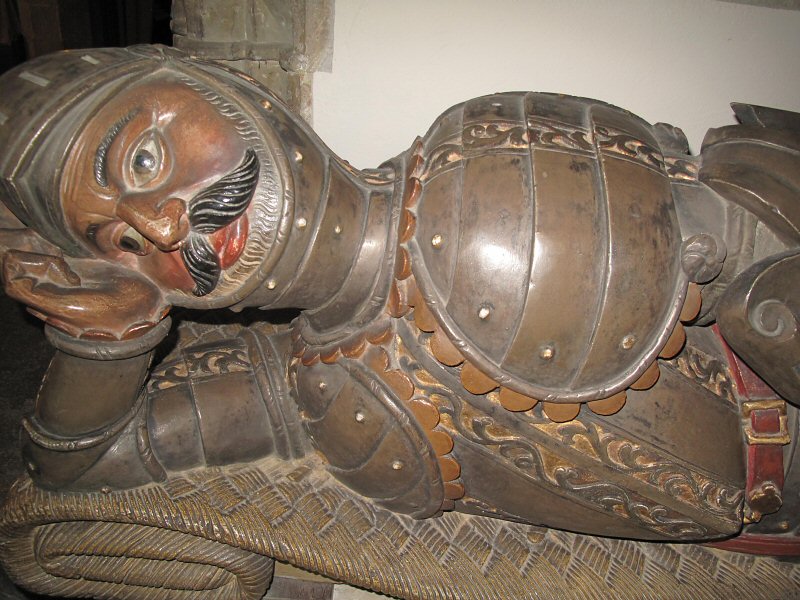
These two carved and painted oak figures commemorate Sir John Oglander, who died in 1655 aged 70, and his son George who has the small effigy in the alcove above. The armour represents that of the 14th Century so was well out of date by the seventeenth century. The crossed legs were thought, in that time, to indicate a knight who had been a crusader. Sir John was obviously quite a romantic and saw himself as a crusading knight.

Image from http://www.thegentry.org.uk/oglander_photos11.html

He was a staunch supporter of Charles I and tried to help him when the king was imprisoned at Carisbrooke castle on the island, even to the point where friends had to warn him off before he got into serious trouble. He was also a keen diarist and would, at times of high emotion, write entries in his own blood. It seems appropriate that would have his memorial looking the way that it does.


This oak effigy represents Wlliam Oglander, the father of John. He died in about 1609 and his son had this memorial put on his stone tomb.


This very grand tomb houses the remains of Henry Oglander, who died in 1874. It was designed in 1897 in the Arts and Crafts Jacobean style by J C Powell. Henry Pegson carved the two small angels at the front.

In another part of the church is the memorial to Elizabeth Rollo, who died in 1875. It is very Victorian and very melancholy (which suits something as sad as the death of a child I suppose), and is beautifully carved in white marble.


St Agnes in Freshwater Bay


This is the only thatched church on the island and was built is 1908 to designs by Isaac Jones. The land was donated by Hallam who was the son of Alfred, Lord Tennyson the famous poet.


There is a date stone on the vestry wall saying 1622, but this came from a derelict farmhouse nearby on Hooke Hill. Stone from the ruin was used to build this church.


I couldn't stay long here unfortunately, as some people were rehearsing for a wedding that day. A shame, as there were some very nice-looking Edwardian carvings on the rood screen. The whole building had a 'cosy' feel to it, in pleasant contrast to some churches that can feel very cold and austere, with stone tombs of the wealthy dead lining their walls.


St Helens near St Helens Duver


The church was built in the early 12th century and this tower dates to about 1220. In 1703, the church ceased to be used and the tower was bricked up. It is now a seamark, with a white-painted brick wall the height of the old tower facing seawards to give a marker for ships.


The sea off the village of St Helens is important for shipping, with the large commercial and naval port of Portsmouth almost within sight of this old tower. Lord Nelson stepped onto the deck of HMS Victory offshore from here, on the St Helens Roads, to sail to the Battle of Trafalgar. So where did the rest of the church go?

All over the world. Sailors would take pieces of the ruin (called 'Holy Stones') to rub down the wooden decks of their vessels to clean them. Maybe they also thought that these stones would bring them luck on their voyages.