As well as this blog, I also have a website and Instagram page with lots more images of my work as well as a few more stories.
If you like woodcarvings, you might want to have a look.
Showing posts with label public sculpture. Show all posts

Friday, 11 March 2022

'New Beginnings' - collaborating with artist Luke Jerram on his new sculpture in Bristol


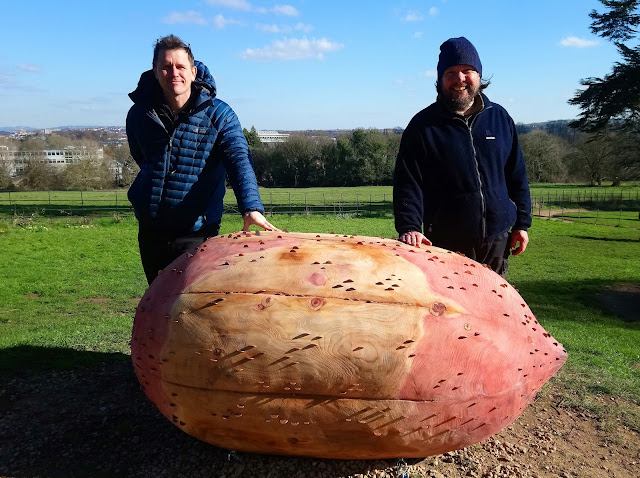
Luke Jerram sculpture New Beginnings

Luke Jerram is a Bristol-based artist (on the left in the photo above) whose work is known around the world. So it was very exciting to be invited to collaborate with him in the making of a new experimental sculpture, which is called 'New Beginnings' and is now installed at Ashton Court in Bristol.


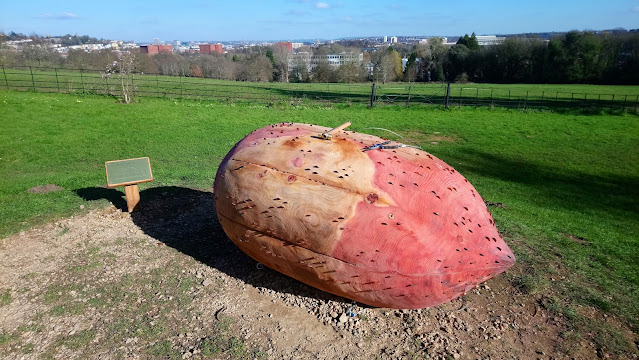
The sculpture was carved from locally-sourced sequoia wood, which was then carved and assembled at my workshop next to the Ashton Court estate. Visitors are invited to use the pliers and hammer provided to add their own small-denomination coins to the sculpture and to make a wish while tapping them in.

Luke says that "I love idea of a seed: as a capsule of information and an object of potential that contains everything inside, a plant needs to grow. I hope the public enjoy interacting with this new sculpture and it acts as a capsule for their hopes, dreams and imagination!"

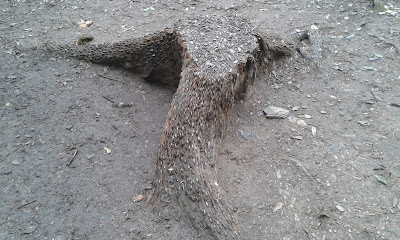
The project, which is hoped to be the first in a series, was inspired by 'wishing trees': these are trees or stumps (usually dead) which have coins pushed or knocked into them for luck. The tradition is thought to be at least a couple of hundred years old. Here is an example from Portmeirion in Wales:

wishing tree portmeirion

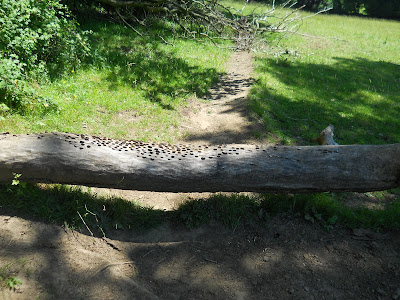
...and another from near the village of Uley, on the edge of the Cotswolds:

uley bury wishing tree


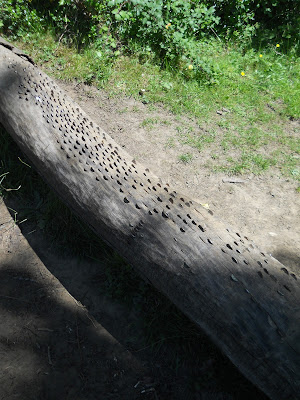
wishing tree ally


I'm looking forward to seeing how the sculpture changes over time as more coins are added! If you are in Bristol you could visit the beautiful estate, which is open to the public and free, then add your own coin and wish if you'd like to.

Wednesday, 1 February 2017

A drum stool with a difference! Making carved wooden drums as seats

The story of this project begins last summer...

I had been invited to make some carvings for Gwalia farm near Machynlleth in North Wales, in return for a stay there at their stunning 'Cabin by the Lake'. This beautiful spot has a private lake, canoe and wood-fired hot tub.


Gwalia cabin by the Lake

Luckily, an oak tree on the farm had just dropped a large branch and so there was plenty of timber to carve!


The cabin was missing some nice seating around the fire, so by the end of the week I'd carved an owl stool...

carved wooden owl stool

As well as a stool with a carving of a Natterer's bat (as a few of them were flying around the cabin at dusk).The second stool also had slits cut into it, to make bars which made a note when struck. They are a bit similar to a West African 'krin' drum:


Natterer's bat carving in oak wood

Krin drum


I really liked the drum idea and showed a few people when back in Bristol. Jono at Touchwood Play realised that the drum stools would work very well in a new project that they were working on. After making a couple more examples to refine the idea, I was commissioned to make six of the stools.

First there was a trip out to Backwell, near Bristol, to look at the oak timber available. It had to be of a certain diameter to make a good stool. Once the logs were back at my workshop, the hard work began!


Bower Ashton woodyard

Firstly, the logs were cut to size, the bark removed using a mallet and chisel and then the stools were smoothed to remove tool marks. I used a chainsaw to cut the bars into the logs.


chainsaw carving

The bars then needed to be sanded and cleaned up, which took a lot of time. Once that had been done, I carved two rows of ridges onto each stool, to make an effect a little bit similar to an instrument called a 'guiro'.


krin drum stools

The drums still needed sticks to play them with. These were turned from locally-grown hornbeam timber. Hornbeam is a very tough wood, traditionally used to make butcher's chopping blocks and the teeth for large cogs, such as in mill workings. It was perfect for this job.


woodturning on an electric lathe

The sticks were chained onto the drums using good-quality stainless steel chain (as stainless steel doesn't react with and discolour oak, unlike normal iron or steel). There was also a hole drilled into each drum to hold the sticks when not in use. The chain is attached halfway along the stick to avoid it making a dangerous looping foot snare when stored in its holder.


The drums just needed a few coats of finishing oil and they were done. Using a tuning app on a phone, we also managed to find out what notes the different bars made. There was a surprising range! Quite a few were A or B, but one played three C notes with an octave between each. Others played Gs and Fs. You can hear them on this Youtube video:


I'd like to refine the tuning methods on future drums, although the tuning on these drums will probably change a bit over time anyway, as the wood dries.  

I did notice that small cracks in the oak, formed during seasoning, didn't seem to affect the sound much at all.


The drums will eventually be mounted in a circle onto a wooden platform in a play tower. They will be fixed down using large screws, so that they can't fall over or be thrown and injure anyone. To allow them to resonate and make a good sound, there will be rubber feet under each one. I've placed wooden sticks under them in these photos to allow a good resonance when playing them in the workshop.


carved wooden drum

Thursday, 17 March 2016

Making carved wooden panels with braille on them for Southmead Hospital in Bristol: an artwork for blind and partially-sighted people as well as those who have good vision. Part One - first steps in researching

I have to say that this project has been one of the most interesting that I've been lucky enough to be commissioned to do.

Ruth Sidgwick, arts organiser for the North Bristol NHS Trust, contacted me in April 2015. Some large plane trees were due to be removed from the grounds of the hospital at Southmead in Bristol and Ruth wondered if the wood could be used for a sculptural project to be permanently installed in the Brunel building there.


As part of the project, two day-long workshops, which I would oversee, would also take place at the hospital. During the 'Fresh Arts Festival', patients, staff and visitors to the hospital would get the chance to learn some carving skills and contribute to the final sculpture.

The artwork also needed to include or reference some words and phrases that had been selected by patients at the hospital, who were members of the writing and knitting groups, as being important to them.

Well, it didn't start off exactly as planned. Timber from a previously felled tree that had been stored at the hospital for the project had disappeared in the meantime!

While talking about what would be carved for the sculpture with Ruth, I looked at the other artworks that were already installed in the Brunel building. There were a lot of very interesting pieces but they were nearly all either flat paintings, behind glass or high up in the air. It occurred to me that there wasn't a lot for people who were blind or partially-sighted and that there must be quite a few such visitors and patients at the hospital.


So began the journey. As someone with pretty good vision, it was important to me that the sculpture shouldn't just be a gesture, but should really try and engage those with partial or no eyesight. Looking online for ideas didn't turn up much though. It seemed like there were no woodcarvings out there that were trying to do exactly what I wanted mine to. However, everyone seems to love the feel of wood and it seemed a great tactile material to use in this kind of project.


There were some restrictions on what could be done, as the hospital had strict guidelines to prevent potential sources of infection on the sculpture. It couldn't have any deeply carved cavities, for example. That also ruled out using textures such as fur.

First, I contacted the RNIB (the Royal National Institute of Blind People). Mark Croft, an advice worker there, sent a helpful list of organisations involved in making art more accessible to blind people. Helen Deevy, who works at one of them called The Art House,  passed on my contact details to a blind artist and sculptor in Wakefield named Alan Michael Rayner.

Alan has a lot of experience in producing his own woodcarvings and is a member of the West Riding Woodcarvers Association. He came up with many very interesting and useful suggestions for consideration. These included (amongst many others) using a thermo-formed plastic covering on the sculpture to prevent cross-contamination, methods of accessing audio descriptions that could be embedded into the sculpture and the pros and cons of using braille as part of the artwork. He also put me in touch with an organisation called Living Paintings.

Camilla Oldland at Living Paintings explained about the process of thermoforming plastic and we both felt it was probably impractical on a piece this size. She also pointed out that a large area can be difficult for a blind person to navigate around. Camilla suggested making a smaller 'orientation panel' to act as a guide to the larger one.

After talking with Ruth at the hospital, audio descriptions were also ruled out due to possible interference with medical equipment and procedures (as well as possible expense).

Thanks to the help of all these people, a design was starting to form in my mind. I sketched it out and sent it to the hospital for approval.


The next stage was to begin making the panels, but I didn't realise at this point that I was still to meet the Bristol Braillists...

Making carved wooden panels with braille on them for Southmead Hospital in Bristol: Part Two - Fresh Arts Festival and meeting the Bristol Braillists

After the initial process of research, my design for the wall-mounted sculpture in the Brunel building at Southmead hospital had been okayed and I now needed to assemble a panel to be carved at the Fresh Arts festival.

Since the timber originally earmarked for the project had vanished, I decided to buy some kiln-dried oak instead. Suitable locally grown wood wasn't available, so instead I did the next best thing and bought some that had been PEFC certified (indicating that it had come from sustainably and responsibly managed forests) from a local timber merchant.


The boards were joined and glued without using dowels or biscuits, as they can look awful if carved into by accident. Once the board had been sanded the design was drawn on and then it went with me in September 2015 to the Fresh Arts Festival.


Carving at 'Fresh Arts', with music provided by the 'Gasmen' choir. Photo by Ruth Sidgwick
The design was created to have plenty of straight lines and simple carving, so that passers-by could have a go and get stuck in with minimal carving experience. Several visitors and patients remarked to me that they found the carving process very relaxing and that it was 
a welcome activity at that time.

After the festival, I continued to carve the panel but was still undecided about using braille. Alan Michael Rayner had previously pointed out that there was more than one kind of braille and that, if I wished to use it, it was worth getting experienced advice.

One evening, sitting in the pub, I mentioned the project to my friend Steph. He reminded me that he was currently involved in a project to design a Kindle for blind people and then said that the group was meeting soon and that several braille users would be there. He invited me to join them. 

Perfect!

That was how I came to meet the Bristol Braillists, who provided a lot of helpful information and expertise during a very interesting evening indeed. It's very rare, I would imagine, that a sighted artist gets to sit with five blind people and to chat about how they interact with the world and how an artwork could be made more accessible for them.

One story from the evening stood out for me. I was told about a young woman, blind from birth, who was asked to draw a bus. She drew three straight lines. The first was the step, the second her route up the aisle of the bus and the third the pole that she held on to. The rest of the bus was irrelevant to her as she couldn't feel her way around it all.

I also found out that some blind people have a name for sighted people: 'light dependants'. Very true!

The braillists at the meeting came up with several good ideas and points. Hazel noted that someone who is blind may not have any reference for what is portrayed in a representational carving; a landscape has never been seen by some blind people. Dave thought that metal pins could be used to represent the braille dots - an idea that I later used. 


Later, when I had begun carving the main panel, Paul and Hazel Sullivan from the Braillists group very kindly came to my workshop and tried out the panel to check it for 'usability'. It was very interesting to hear their comments and Paul had typed out, on a braille typewriter, the wording that I wanted to use. This meant that I could drill straight through the dots on the printed card, so using it as a template.


I used brass jeweller's ball-head pins to make the braille dots, each snipped to length and then glued into an individually drilled and recessed hole - over 1600 pins!


Thursday, 1 October 2015

Helping to make the Meadow beautiful at Shambala festival 2015

Shambala festival 2015

The Shambala festival is held at a stately home called Kelmarsh Hall in Northamptonshire in the UK. Last year, I was asked to come along and make benches from sawmill waste boards, to be put in the Meadow field. I was delighted to be asked to come back this year to do it again.

Shambala festival

The Meadow is a lovely, calm corner of the festival where the healers practice their skills and Tribe of Doris hold music-related activities.

At the end of last year's event, some of the benches were hidden away in a very quiet area of the site and it was great to see that they had survived quite happily. The sturdy larch timbers showed very few signs of decay, even under a layer of moss!


I used the surface darkening of the wood on one bench to carve lighter patterns, which represented the sun and moon:


Under a tarpaulin shelter, in a peaceful spot under a large sycamore by a lake, it was fun to plan new benches for the field. We worked happily under there, even when the rain came down all day! Everything was made using only hand tools, apart from a cordless drill.


There weren't just benches to be made. Annette, who oversees the healing field, had a special request too.

Someone had asked before the festival if it would be possible to create an area in which he could propose to his unsuspecting girlfriend. A particularly beautiful large tent had been chosen in which to do it:


Now five small shrines were needed, to represent the elements of air, water, earth, fire and wood. I made them using slab wood and also tree branches that had been removed by estate workers just before the festival.


The small tables were put around the outside edge of the tent and decorated with relevant things (because of fire risks, candle-shaped lights were used instead of real flames). It felt like a real privilege to make these items to be part of such an important occasion for the two people, their families and friends.

...and she said yes!

I wasn't the only person working with wood in the Meadow. Len sorted out the structures needed around the campsite, as well as designing a covered seat that looked great with foliage draped over it.


Clyde and Nathan also made structures that helped to make the site look welcoming.


Nathan and I dismantled some older benches and he reused the useful boards in new benches that were sturdier and will hopefully last until next year too. They are at the front on the right in the picture below, with Clyde's fence visible behind:

festival benches

One new bench for this year was inspired by the straps that tied together the wood bundles when they were delivered. These straps were tough bands, stronger than the woven plastic ones that such bundles normally have securing them. I'd fancied making a suspended seat since the previous year and these straps would be useful. It was also nice to reuse such items from all around the site, instead of leaving them to be thrown away.

outdoor bench Shambala festival


All of the benches were designed to be comfortable and I liked the deckchair-like slump of this one, even if it was quite hard to get out of (like a traditional deckchair, when I think about it). All the more reason to stay sitting there and relax!

The straps turned out to be quite strong enough to take plenty of people sitting on the seat, even when Len jumped all over it to test it.

The final thing to be made was a gate to separate the public area and crew camping. Nathan and I reused the gates from last year. One had darkened on its top surface, so that was the night sky (with stars and a UFO carved on it) and the other was day. Between them, the rays of the rising sun were fixed on.


After all the building, it was time to go and party! Here's a few final images of the festival itself. Thanks to everyone for making it a great Shambala 2015. I hope to see you all again next year.

iron man sculpture Shambala 2015

dancing shambala 2015


dusk at the festival

shambala meadow

Shambala festival 2015


captain hot knives at Shambala