My name is Alistair Park and I'm a professional carver who is based in Bristol, England. I've been carving for over twenty-eight years and I also enjoy teaching my skills to people of all ages. You'll find posts here about all kinds of things to do with carving; the work that I do, the people that I meet and the things that I see which inspire me. Please feel free to comment on anything of interest, it'd be great to hear from you!
If you like woodcarvings, you might want to have a look.
Showing posts with label celtic carving. Show all posts
Thursday, 17 March 2016
A pagan ritual knife handle, carved in oak with a Viking-style wolf's head decoration
It was really enjoyable to do some carving with my Opinel knife recently, when commissioned to make a new handle for a pagan ritual blade. The oak came from a tree that originally grew near Nether Stowey, on the Quantock hills in Somerset.
The Norse-style wolf's head at the end was modelled on an example that the person who commissioned me already had on some jewellery, although I adapted it for the carving. I wanted it to have the look of an object that might have been carved by a Viking carver and to be very comfortable to hold, as well as beautiful.
The end of the handle is drilled to fit a 10mm (0.39") tang.
This image shows the handle against a tracing of the rest of the knife, so that you can get an idea of the scale:
I must admit that I liked the appearance of the carved handle before any finish had been applied. The patina of use would have looked good on it...
...but the finishing gave it a more 'antique' style. A woodworker in the neighbouring workshop said that it looks like it was finished at least ten years ago, rather than two days ago. For the finish, I used pure tung oil (extracted from a kind of nut) and then a mixture of natural waxes. Using natural finishes seemed more appropriate for this particular carving.
I really like the thought that this piece has another, deeper meaning to its new owner than the purely decorative. I hope that you have enjoyed seeing it too.
Monday, 4 May 2015
Carving a wooden kiltpin with a celtic design using a knife: part two
So.... I had carved a kiltpin that I thought was very beautiful.
After it had been completed, my kilt arrived in the post. I put the kilt on, attached the pin and...
It didn't quite work with the kilt outfit! The golden yellow colours of the kiltpin clashed with the colours of the kilt more than expected and the pin felt slightly too heavy hanging on the cloth. The round shape also felt a little odd and I realised that a longer, narrower shape was more suitable. The carving would make a stunning brooch, especially for a plaid, however it was not going to be my kiltpin. It was time to carve another one.
I decided to use the laburnum wood that was used in making the handle and sheath of the sgian dubh again, so that the two pieces would be linked and would look good worn together.
What to carve on it? One design that stood out was originally from the Book of Kells. It was reproduced in Courtney Davis' book 'Celtic and Old Norse Designs', published by Dover Publications.
The design could be easily adapted to work on the kiltpin. Although it looks a lot like a classic celtic knotwork pattern, in fact it isn't a single knot. If you look carefully, the two dragons run through an infinity symbol.
The kiltpin is 6cm (2⅜") long from top to bottom.
It was entirely carved using my trusty old number 10 Opinel lock knife, with which I originally taught myself whittling over twenty years ago, and was then lightly sanded with some sandpaper to finish it off.
The only parts that weren't produced with the knife are the tiny drilled holes into which silver wire or hand-carved dowels of reclaimed ebony and found plum timber were inserted to make the eyes, nostrils and neck patterns. The laburnum was first shaped whilst sitting on the Centenary bench that I made a few years ago and which is now installed in Leigh Woods.
The kiltpin was polished using beeswax polish at the end, which really brought out the grain patterns and colours. It has a bought brooch pin glued to it and then fixed on with brass rivets (made by cutting down two brass pins). The carved recess means that the pin doesn't hang too far off the surface of the cloth and roll from side to side.
After it had been completed, my kilt arrived in the post. I put the kilt on, attached the pin and...
It didn't quite work with the kilt outfit! The golden yellow colours of the kiltpin clashed with the colours of the kilt more than expected and the pin felt slightly too heavy hanging on the cloth. The round shape also felt a little odd and I realised that a longer, narrower shape was more suitable. The carving would make a stunning brooch, especially for a plaid, however it was not going to be my kiltpin. It was time to carve another one.
I decided to use the laburnum wood that was used in making the handle and sheath of the sgian dubh again, so that the two pieces would be linked and would look good worn together.
What to carve on it? One design that stood out was originally from the Book of Kells. It was reproduced in Courtney Davis' book 'Celtic and Old Norse Designs', published by Dover Publications.
The design could be easily adapted to work on the kiltpin. Although it looks a lot like a classic celtic knotwork pattern, in fact it isn't a single knot. If you look carefully, the two dragons run through an infinity symbol.
The kiltpin is 6cm (2⅜") long from top to bottom.
It was entirely carved using my trusty old number 10 Opinel lock knife, with which I originally taught myself whittling over twenty years ago, and was then lightly sanded with some sandpaper to finish it off.
The only parts that weren't produced with the knife are the tiny drilled holes into which silver wire or hand-carved dowels of reclaimed ebony and found plum timber were inserted to make the eyes, nostrils and neck patterns. The laburnum was first shaped whilst sitting on the Centenary bench that I made a few years ago and which is now installed in Leigh Woods.
The kiltpin was polished using beeswax polish at the end, which really brought out the grain patterns and colours. It has a bought brooch pin glued to it and then fixed on with brass rivets (made by cutting down two brass pins). The carved recess means that the pin doesn't hang too far off the surface of the cloth and roll from side to side.
Saturday, 28 September 2013
Some ancient stone carvings and structures in Cornwall: mysterious stone chambers, circles, pavements and labyrinths
Although my trip to Cornwall included visiting a few churches to look at the carvings and stories within them, these weren't the only carvings and man-made structures that I'd like to write about here. Some were far, far older.
Perhaps the oldest structure was Trethevy quoit on Bodmin Moor. This is a dolmen, a chamber made from huge stones thought to date to the end of the Neolithic (Late Stone Age), about 5,500 years ago. There are a few in Britain, some having shown evidence of burials within them but they may have also had other purposes such as territorial markers. No one really knows with certainty the original purpose of these chambers, but they are also found as far away as Korea and India.
On the same side of the moor one can find the Hurlers, a row of three (or possibly four) stone circles and outlying stones, which may date to the Bronze Age or may be older. They lie in a SSW-NNE alignment.
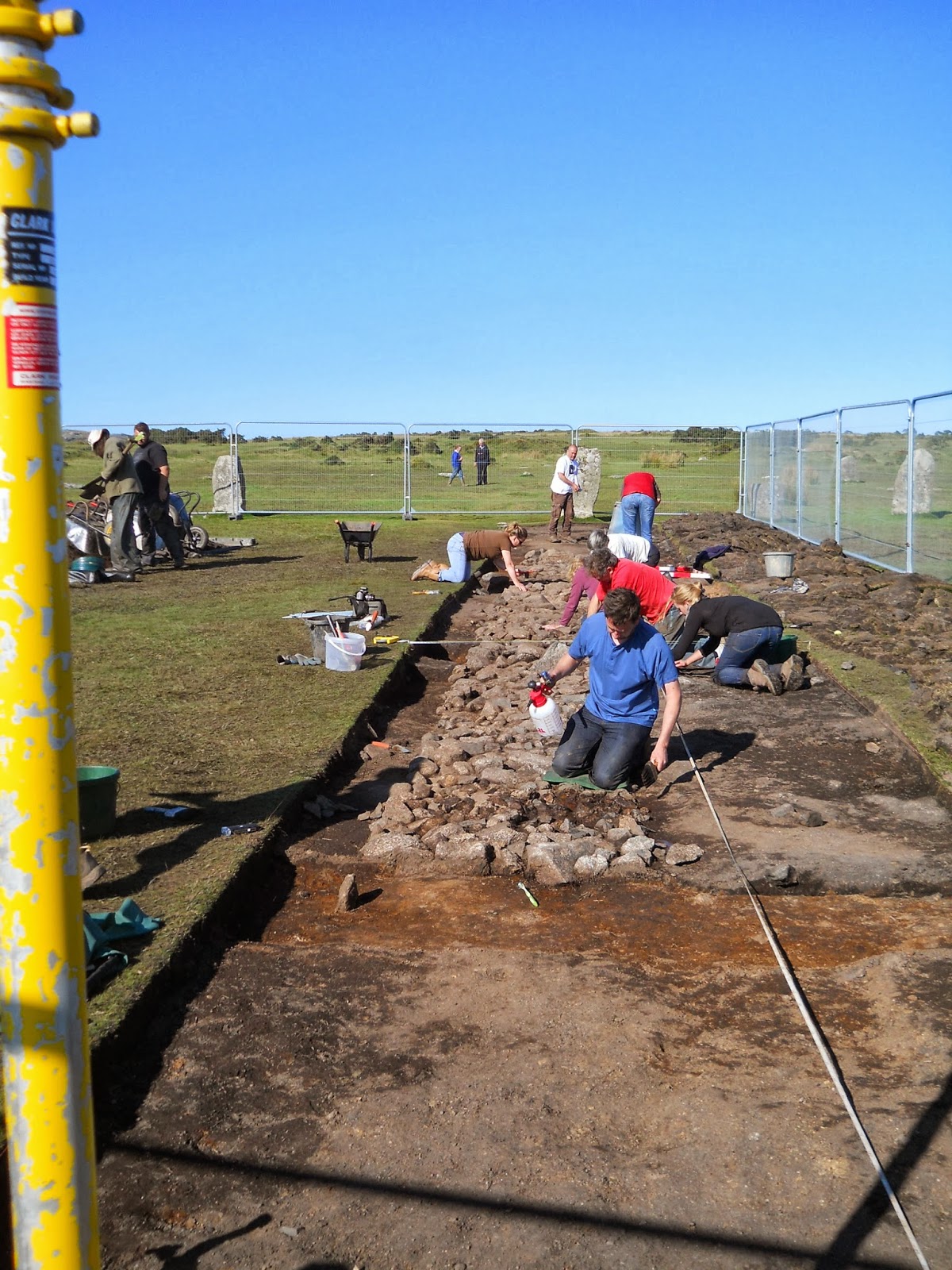
We were very lucky to visit them whilst an excavation was taking place to uncover a 'pavement' of white quartz stones, which appears to link two of the circles and runs in the same orientation. The quartz structure has only been uncovered in modern times once before, in 1938, and will be covered over again once the project is completed. The local community was assisting with the dig, which was tied in to a study of the astronomical orientations of the site that is being conducted by the Roseland Observatory. It's interesting to think what the Hurlers must once have looked like. The stones in the circles show evidence of having been hammered to shape and the pavement of quartz must have glowed and twinkled in certain light conditions.
On the north coast of Cornwall lies another mysterious site that may date to the Bronze Age. The walk to this one began at Tintagel, a site closely linked with legends of King Arthur.
Perhaps the oldest structure was Trethevy quoit on Bodmin Moor. This is a dolmen, a chamber made from huge stones thought to date to the end of the Neolithic (Late Stone Age), about 5,500 years ago. There are a few in Britain, some having shown evidence of burials within them but they may have also had other purposes such as territorial markers. No one really knows with certainty the original purpose of these chambers, but they are also found as far away as Korea and India.
On the same side of the moor one can find the Hurlers, a row of three (or possibly four) stone circles and outlying stones, which may date to the Bronze Age or may be older. They lie in a SSW-NNE alignment.
We were very lucky to visit them whilst an excavation was taking place to uncover a 'pavement' of white quartz stones, which appears to link two of the circles and runs in the same orientation. The quartz structure has only been uncovered in modern times once before, in 1938, and will be covered over again once the project is completed. The local community was assisting with the dig, which was tied in to a study of the astronomical orientations of the site that is being conducted by the Roseland Observatory. It's interesting to think what the Hurlers must once have looked like. The stones in the circles show evidence of having been hammered to shape and the pavement of quartz must have glowed and twinkled in certain light conditions.
The castle ruins that can be seen today are comparatively recent, having been built in the 13th century by Richard, Earl of Cornwall. There is archaeological evidence for much older use of the headland though, going back to Romano-British times. However, no traces of an actual settlement on the site then have so far been found, although evidence for early trade with Mediterranean societies has been discovered here.
After a walk of about two hours along the beautiful coastline, past Bossiney Haven...
... one arrives at Rocky Valley.
The river is followed upstream for a while...
... to a ruined watermill.
On a rockface behind the mill ruins are carved two of the most intriguing carvings that I know of. They are surrounded by offerings tied to trees and scratched into stones, which have then been lodged into cracks in the rock. A plaque nearby notes that they are 'probably of the early Bronze Age (1800 - 1400 BC)'. In truth, they are almost impossible to date. They are two labyrinths.
This design is a unicursal maze. There are no dead-ends or branches, just a single path travelling into the centre then out again. The design is ancient, a square version having been found on a clay tablet from the Mycenaean palace at Pylos, which was destroyed by fire around 1200 BC.
Stone carvings that may be more recent, although still very old, can be seen back on Bodmin moor. One is the Longstone, or Long Tom; a cross carved in granite. Some people believe that this is an example of the Christianisation of an ancient menhir (standing stone). Rather than destroy the pagan relic a cross might have been carved onto it, perhaps because it was too useful as a wayside marker on the inhospitable moor to be taken down or because of some other particular importance to local people.
Another nearby monument of carved granite is certainly Christian, albeit still very old. It is called King Doniert's Stone but is actually two granite bases for crosses, which have interesting Celtic knotwork and an inscription carved into them.
The inscription says in Latin 'Doniert Progavit Pro Anima', which translates as 'Doniert ordered (this cross) for (the good of) his soul'. Doniert is thought to be King Durngarth of Cornwall, who drowned in the river Fowey around AD 875.
The stones are decorated with carvings of late 9th century style and sockets carved into the tops of the stones may once have held separate parts of the monument; perhaps wooden cross heads?
An underground passage cut into the hard granite begins about 8 metres (26.25 feet) from the stones and terminates below them in a cross-shaped chamber. The relationship between the stones and the passageway and chamber is unknown.
As with most, if not all, of the ancient carvings and man-made structures in the county, this Cornish monument leaves the visitor considering questions to which we will probably never know the answers.
Labels:
ancient structures,
bodmin moor,
bronze age,
celtic carving,
cornwall,
crosses,
dolmens,
granite,
king arthur,
mazes,
memorials,
mysterious stone carvings,
neolithic,
stone carvings,
stone circles,
tintagel
Subscribe to:
Posts (Atom)