As well as this blog, I also have a website and Instagram page with lots more images of my work as well as a few more stories.
If you like woodcarvings, you might want to have a look.
Showing posts with label brading. Show all posts

Thursday, 22 August 2013

Brading, a historic town in the Isle of Wight. Carvings done with power tools. Punishment, torture and the secret of hewing timbers.


This town is on the eastern side of the island and is proud of its long history. It has a few surprising things still to be seen...

Much of the town was involved in smuggling at some point and with this background of illegal activities, it seems appropriate that the whipping post and stocks have been preserved in the Old Town Hall next to the twelfth- century church. The stocks are thought to date to the seventeenth or eighteenth century but there are records of stocks being used here in 1555 and the whipping post was last used in 1833. Why have the stocks got five holes? No one really knows, but one suggestion is that they were specially made to accommodate a regular offender who only had one leg!


At the other end of the street is a metal ring set into the ground. It is a bull ring, to which bulls were tied before being attacked by dogs and then slaughtered. This revolting 'sport' was justified by the belief that this made the meat better. It was thankfully stopped here in 1820.


Next to the ring is a sculpture of a bull which was made by Paul Sivell, a carver based on the island who specialises in using power tools:


He has also carved another sculpture to be seen by the car park next to the church.


Next to the old Town hall and the church is a very interesting building: the Rectory mansion, possibly the oldest building on the island. It lies on Roman foundations but was built in 1228 and some think that timbers from a previous Anglo-Saxon building on the spot were reused in its structure.


The building has a rather fine ship's figurehead on its corner, but I haven't been able to find out the story behind it.


Seeing some of the timbers that have been used in the Rectory house reminded me of chatting to my friend Nigel recently about timbers that he had found whilst renovating a seventeenth century building in Bristol.

Nigel said that when restoring an original doorway in the building, he noticed that only the sides that were facing outwards (and were therefore on show) were cut square. The other faces were left waney edged, as they had come from the tree but with the bark removed. They were hidden, facing into the wall.

Which makes a lot of sense. Hewing timber or sawing by hand to make it square are both long, hard and skilled processes, so why do it on the faces of timbers that don't need it? If there are no joints that require a flat surface to work, then don't bother cutting one. Some of the timbers in the Rectory mansion might also show evidence of this way of thinking.


As does this timber from Baddesley Clinton in Warwickshire:


Not lazy, just smart thinking!


Three interesting church buildings on the Isle of Wight: an old church, a newer church and a church that isn't a church

Being a woodcarver with an interest in old buildings, I naturally like to pop my head through the door of churches when passing by to see if there are any interesting carvings or architectural features to be seen.

The Isle of Wight, off the south coast of England, has many old churches but these three were particularly interesting, as I hope you'll agree.

St Mary the Virgin in Brading


This church is the oldest of the three, and the site is thought to be an ancient place of worship going back to at least 680 AD. The nave of the present church dates to 1180 AD.

The tower is interesting, as it is built on four supports (piers) in front of the entrance doorway and is one of only four churches in Britain to have that arrangement. The access to the tower is via wooden steps next to the entrance door.

The most interesting things inside, for me, were the carved wood and stone memorials on the tombs. One of the chapels is called the Oglander chapel and houses the tombs of members of the Oglander family, who were  the local gentry for 800 years from 1160 and lived at nearby Nunwell. Here are some of their memorials:


This tomb commemorates Sir Oliver Oglander and dates to 1536.  It shows his family (with him on the right kneeling) and would originally have been painted to look more realistic. It still shows remnants of the original paintwork in nooks and crannies of the carving.


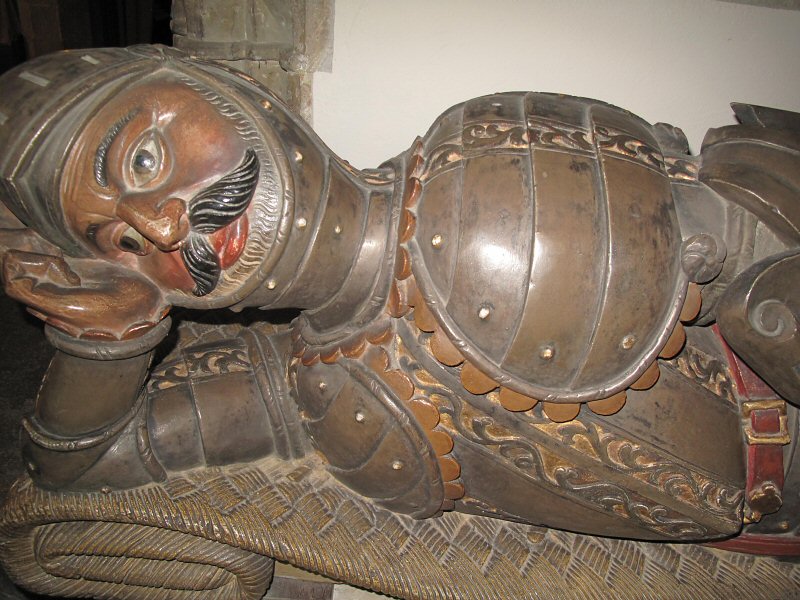
These two carved and painted oak figures commemorate Sir John Oglander, who died in 1655 aged 70, and his son George who has the small effigy in the alcove above. The armour represents that of the 14th Century so was well out of date by the seventeenth century. The crossed legs were thought, in that time, to indicate a knight who had been a crusader. Sir John was obviously quite a romantic and saw himself as a crusading knight.

Image from http://www.thegentry.org.uk/oglander_photos11.html

He was a staunch supporter of Charles I and tried to help him when the king was imprisoned at Carisbrooke castle on the island, even to the point where friends had to warn him off before he got into serious trouble. He was also a keen diarist and would, at times of high emotion, write entries in his own blood. It seems appropriate that would have his memorial looking the way that it does.


This oak effigy represents Wlliam Oglander, the father of John. He died in about 1609 and his son had this memorial put on his stone tomb.


This very grand tomb houses the remains of Henry Oglander, who died in 1874. It was designed in 1897 in the Arts and Crafts Jacobean style by J C Powell. Henry Pegson carved the two small angels at the front.

In another part of the church is the memorial to Elizabeth Rollo, who died in 1875. It is very Victorian and very melancholy (which suits something as sad as the death of a child I suppose), and is beautifully carved in white marble.


St Agnes in Freshwater Bay


This is the only thatched church on the island and was built is 1908 to designs by Isaac Jones. The land was donated by Hallam who was the son of Alfred, Lord Tennyson the famous poet.


There is a date stone on the vestry wall saying 1622, but this came from a derelict farmhouse nearby on Hooke Hill. Stone from the ruin was used to build this church.


I couldn't stay long here unfortunately, as some people were rehearsing for a wedding that day. A shame, as there were some very nice-looking Edwardian carvings on the rood screen. The whole building had a 'cosy' feel to it, in pleasant contrast to some churches that can feel very cold and austere, with stone tombs of the wealthy dead lining their walls.


St Helens near St Helens Duver


The church was built in the early 12th century and this tower dates to about 1220. In 1703, the church ceased to be used and the tower was bricked up. It is now a seamark, with a white-painted brick wall the height of the old tower facing seawards to give a marker for ships.


The sea off the village of St Helens is important for shipping, with the large commercial and naval port of Portsmouth almost within sight of this old tower. Lord Nelson stepped onto the deck of HMS Victory offshore from here, on the St Helens Roads, to sail to the Battle of Trafalgar. So where did the rest of the church go?

All over the world. Sailors would take pieces of the ruin (called 'Holy Stones') to rub down the wooden decks of their vessels to clean them. Maybe they also thought that these stones would bring them luck on their voyages.