As well as this blog, I also have a website and Instagram page with lots more images of my work as well as a few more stories.
If you like woodcarvings, you might want to have a look.
Showing posts with label norman. Show all posts

Monday, 1 September 2014

A strange Norman stone carving in St Nicholas' church, Combe St Nicholas, Somerset

combe st nicholas church

While visiting this church for a wedding, I noticed the strange carved stone capital on a pillar near the north entrance. Apparently, it is the only remnant of the Norman church that once stood on the site (although a round font dating to Saxon times is thought to be the oldest object in the church, surviving from the Saxon church building that was here before that).

green man combe st nicholas

It is an odd carved design and some people think that it represents the devil. I wonder why the medieval builders who rebuilt the church in the 13th century decided to keep this bit of stonework in particular? The pillar that it tops does not seem to hold up any arches, so it probably isn't structural. 

The way that the weird-looking head seems to sprout the paired 'snail track' lines out of its mouth reminds me a lot of 'green man' carvings, some of which have foliage coming from their mouths in a similar fashion. I wonder if this could be an example of such a design? According to 'The Company of the Green Man' website, this carving would seem to have been identified as such by Clive Hicks in his book 'The Green Man: A Field Guide'. 

The carving on the capital to its left looks to me like it could represent a crown.

If you are visiting the church, the oak screen in front of the altar is also worth a look. A plaque tells how it was first carved around 1480, then was taken down and moved in the 19th century before being repaired and returned to it's original position in 1921, when a memorial to the men of the parish who died in the First World War was also added to it.


Tuesday, 1 October 2013

St Petroc's in Bodmin, Cornwall: Deformed hands, magic trees, hidden beauty and a spire blown up by lightning

St Petroc's is the largest church in Cornwall apart from Truro cathedral.
Bodmin, the town in which this church stands, was the capital of Cornwall between 1835 and 1989. Originally a Welsh prince who studied Christianity in Ireland, St Petroc arrived here in about 530 AD and turned Bodmin into the religious centre of the West. He died in 564 AD.


Despite it's importance, Saint Petroc's doesn't have a lot of decorative carving on it's exterior. This is a feature that it shares with many other churches in the area. It makes sense when one considers that the storms in this area, exposed to weather coming straight in from the Atlantic Ocean, can be pretty fierce. The main local building materials around Bodmin are also granite and killas, both of which are very tough stones that are difficult and time-consuming to carve. 'Killas' is a Cornish term for sedimentary rocks that have been altered (metamorphosed) by heat and pressure from nearby igneous intrusions (hot molten rock forcing it's way upwards from deep inside the earth), an example being slate.

St Petroc took over running the Christian community in the area from St Guron, who had founded it in about 500 AD next to a holy well. The well is still there, covered by a small building which can be seen between the pillar and the church in the photo below. The actual spring is thought to rise underneath the church itself and to be carried to the 16th century wellhouse through conduit pipes:


The well flows out next to the road through these carved granite heads, with a plaque next to them saying 1545 AD


This would seem to be a good example of early Christian missionaries using pagan sacred places for their sites of worship. Many water sources were sacred to pagan people but also made handy spots for Christians to baptise converts, as well as allowing the special spiritual aura of these places to transfer to the new religion and make it easier for the local people to accept the new ideas..

Another example of the two religions mingling can be seen at the church in St Newlyn East, near Newquay in Cornwall. The church is dedicated to St Newlina. One story is that Newlina was a British princess of the 5th or 6th century AD. She is supposed to have come to Cornwall via Wales and Ireland to avoid an unwanted suitor. 


On reaching this spot, she put her staff into the ground and it magically sprouted into a fig tree, which still grows out of the church wall with no obvious means of sustenance. The tree is reputed to have magical powers:
"Upon it lays a dreadful curse,
Who plucks a leaf will need a hearse."


Another example of a magical sprouting staff is the Holy Thorn at Glastonbury in Somerset, supposed to have sprouted from a staff carried by Joseph of Arimathea. There is an obvious mix of Pagan tree worship and Christianity in these legends.

Eventually, the spurned suitor caught up with St Newlina and chopped her head off (she was obviously a good judge of character). A spring is supposed to have magically risen where the head fell; another example of the two religions meeting.

One of the most obvious treasures of St Petroc's is the incredible stone font. It is Norman in age, dating to the 12th century and somehow escaped the attention of both Henry VIII's forces during the Reformation and the Puritans. The font was recently moved to lie opposite the altar at the end of the pews along the main aisle, which is the position of the font at Crantock and where the one in St Newlyn's used to be.


The two angels heads with pupils carved into the eyes are said to represent good and evil. This font design seems to have been very popular in the area. All four churches that I visited on this trip had fonts from the same period that appeared to be influenced by the one at St Petroc's (which is the finest of all):

St Gomonda's in Roche


St Newlyn's in St Newlyn East. 
The legs and one of the angel's heads were replaced during restoration in 1883


St Crantoc's in Crantock
This has AD 1474 carved on it, probably to commemorate renovation work to the church in the 15th century


Mathy More

St Petroc's is remarkable, as it is one of very few churches from the time for which almost complete building records have survived. This gives some insight into the work of Mathy More, who was contracted to make and carve most of the wooden furniture for the new church in 1491. 

He imported the oak to be used from Wales, shipped here via the town of Wadebridge, and was paid £92 for the whole job. To give some idea of what that amounts to, building the entire church (on a separate contract) cost £196 7s 4d which in modern British money is about half a million pounds sterling.

Some of More's carving has survived, mainly incorporated as panels into newer structures such as the reredos screen behind the altar and also the pulpit. Here are some examples:


The reredos screen (you can see it in the last of the photos above, behind the altar, with some panels carved by Mathy More), hides the original one from the 19th century. The older screen is beautiful, with gilding and mosaics, but is hidden by the wooden screen as it needs some refurbishment. 


There are currently plans to renovate the nineteenth century reredos and move the wooden one to another part of the church.

St Petroc's contains one of the oddest lecterns that I've ever seen. It was pieced together from medieval misericords which don't look like the work of Mathy More. Perhaps they originally came from the Priory over the road?


One of the side panels (above) shows two figures that look like demons, with wings and animal-like back legs, turning away from something. Another panel shows a man with five fingers on his hand:


The church guide suggests that this could be a mistake by the carver or a record of his own affliction. I don't believe either myself; the hand is too obvious in the design to have been a mistake. In medieval times, an extra finger or toe was supposed to be the mark of a witch. Henry VIII's wife Anne Boleyn (whom he executed and who was unpopular at court) was popularly -and probably erroneously- said to have an extra finger. It's unlikely that the carver would advertise if he did have this problem.
The figure on the left looks like they are a member of the clergy or judiciary to me. The one on the right (with robes, cap and book), could be either another lawyer or a clergyman. I think that the panel was a dig at corrupt lawyers or clergy.

There are a couple of other interesting carvings in stone to be seen at St Petroc's. The tomb of Thomas Vyvian, penultimate Prior of Bodmin, is carved from Cataclewse stone which comes from Harlyn bay in North Cornwall.


The tomb had to be rescued at one point from the Priory duckpond, into which it had been thrown by Puritans during the Civil War.

The ceiling of the porch is a good example of a groin vault and is carved in Pentewan stone.


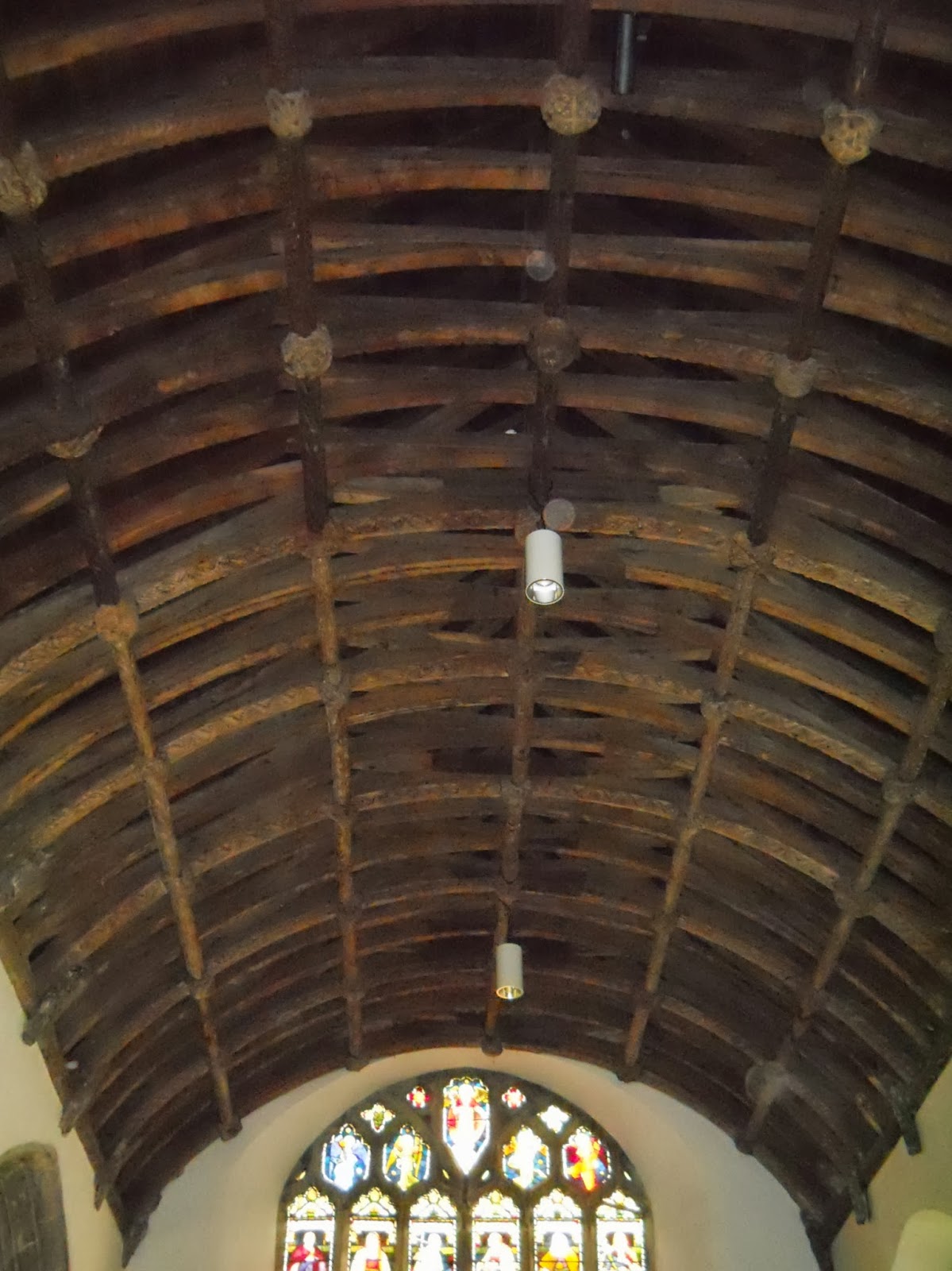
Groining is the term for the architectural feature made when two waggon (also known as cradle or barrel) roofs meet at right angles.. Waggon roofs are a feature of many Cornish churches. They are rounded over, like a wagon's cover. 

St Petroc's
Cornish churches often have the ceilings throughout at the same height (similar to 'hall churches', of which Bristol cathedral is an example). The pillars along the nave in St Petroc's and St Newlyn's are in the 'Cornish Perpendicular' style, which has relatively small capitals on the columns.

St Newlyn's.
Sometimes the ceilings are brightly painted, sometimes not.

St Petroc's

St Carantoc's
The roof of St Petroc's was largely demolished in 1699, when a bolt of lightning destroyed the 150-foot (45 m) tall spire. Only the roof in the Lady Chapel is original and has a carved boss showing the date of 1472.


There isn't really room here to write about other interesting things to be seen at St Petroc's; the reliquary casket, painted 16th century panels and carved stone memorials. It's very interesting to see the common features of Cornish church architecture in this area too.


Saturday, 28 September 2013

St Carantoc's church in Crantock, near Newquay in Cornwall. My introduction to the extraordinary carving work of Ms. Violet Pinwill, as well as the nefarious deeds of William Tinney of West Pentire


St Carantoc's in situated in the small village of Crantock in Cornwall. There has been a church on the site since one was founded there by Carantoc in about the 5th century. He was the eldest son of a Welsh chieftain and had given up his succession, studied under St Patrick in Ireland and is reputed to have sailed from there to this area in a coracle.

The church is basically of Norman design, although there has been much rebuilding; the tower, nave and many other parts were rebuilt in the 15th century after the previous tower had become neglected and collapsed (bringing down much of the church with it). The South Porch dates to the 17th century.

St Carantoc's was the centre for a college of priests after being granted a charter by King Edward the Confessor. This made it quite powerful and the mother church for a large area around it. The Eastern end of the building is higher and wider than the Western end (as you can see in the picture above) because the monks of the college worshipped in one end whereas the poorer parishioners used the other. I'm sure that you can guess who got which end!

The college of priests was disbanded during the Reformation in the 16th century and the building gradually fell into disrepair, with the Puritans no doubt helping the process along. There were some attempts at restoring it in the 18th century, although they were fairly shoddy.


The current state of repair is basically down to one man: George Metford Parsons, who became vicar there in 1894 and remained vicar until his death in 1924. He campaigned for funds to renovate the building in 1897 and by 1907 the work was done and pretty much paid for. The architect for the renovation was Edmund Harold Sedding and he did a very good job, with any surviving pieces of high-quality older woodwork being incorporated into the newly restored church furniture or being displayed in an arrangement at the back of the church. Fifteen new stained glass windows were also installed at the time.


Sedding was buried in the churchyard at St Carantoc's after his death.

My first reaction on entering the church was amazement at the unexpectedly high quality of the woodcarving to be seen. The rood screen and choir stalls in particular are stunningly well executed.


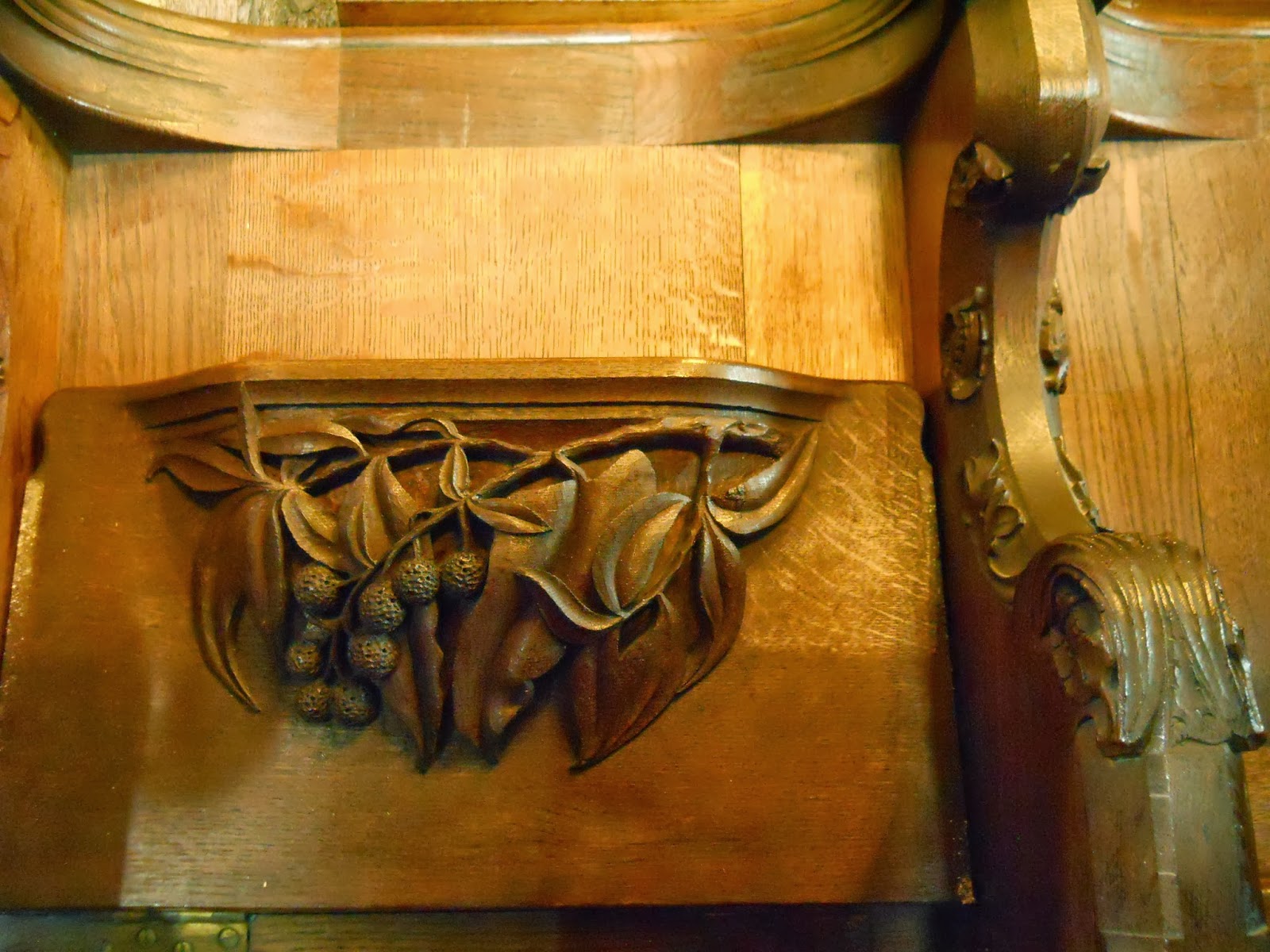
Under the choir seats are misericords, for clergy to rest against during masses. The ones in St Carantoc's are based on plant designs and were carved, like most of the other work in these photos, by a company led by Ms. Violet Pinwill. They had finished installing the carved work by 1907.


Pinwill and Sedding worked together on other church restorations, including St Winnow's in Cornwall.

(One piece of work in the church that was carved elsewhere is the crucifixion scene on the rood screen, which was produced by some of the famous woodcarvers of Oberammergau in Bavaria and mounted atop the screen afterwards.)

This was the first time that I had knowingly come across Violet Pinwill's work. She sounds like she was a very remarkable person.

Image from search.ancestry.com
Violet was the daughter of Reverend Edmund Pinwill. When he became vicar of the rundown church at Ermington in Devon, woodcarvers were hired to restore the woodwork there. Mrs Pinwill encouraged her daughters to be taught the craft by the carvers and Violet, together with her sisters Mary and Ethel, carved and assembled the pulpit in a room in the vicarage. Thanks to Helen Wilson for getting in touch and correcting the misspelling of Ethel's name as 'Esther' in the Ermington website and elsewhere. The link through Dr. Wilson's name will take you to her website, where you can find out more about the Pinwill sisters.

They decided to go into business and formed the company Rashleigh Pinwill, basing themselves in Plymouth in Devon. The company specialised in supplying carvings based on natural forms to churches in Devon and Cornwall. When Mary and then Ethel left, after some time, Violet continued to head the company under the name V. Pinwill Carvers. She employed several male carvers but also executed a lot of the carved work herself.

Violet Pinwill died in Plymouth in 1957, aged 83. She left carvings in wood and stone in over 100 churches in Devon and Cornwall, including Truro cathedral. It may be worth remembering that the Pinwill sisters formed and led this highly successful company of woodcarvers at a time when women in Britain were not even allowed to vote.

Ed Hall, maker of trade union banners, noted in the programme for the Dismaland exhibition that he particularly likes banners made by the Suffragettes. He makes an interesting point about women working at this time in British history:

'The interesting thing about the Suffragettes is that one or two of them, including Sylvia Pankhurst, were artists in their own right - women were excluded from many professions but there was no bar to them joining the arts so some of the Suffragette banners were professionally made.'


Behind the church is a small roofed structure containing a woodcarving in oak by Davey and Bushell, who were based in Bristol. The panel was carved sometime between 1900 and 1919.
It accompanies the old stocks for Crantock and relates the tale of the last man to be held in them.


The carved story reads like this:

'The last man in Crantock stocks (circa. 1817) was William Tinney of West Pentire, a smuggler's son and a vagabond. He robbed, with violence, a widow woman of Cubert parish and was placed, to abide justice, in Crantock stocks, then standing in the church tower. By negligence or design he was insufficiently secured and shortly afterwards appeared on the top of the tower. He had cut the rope from the tenor bell and by this he lowered himself to the nave roof. Climbing to the eastern gable of the choir and sliding down it, he dropped to the churchyard grass and in the sympathetic view of certain village worthies bolted, got off to sea and was never brought to justice or seen in the neighbourhood again.
This record was taken down in April 1896 by George Metford Parsons, vicar, from the testimony of Richard Chegwhidden of Crantock, he being then 88 years of age and well remembering as a witness the events described.'


The poem under this scene reads:

' I paid my price for finding out,
Nor ever grudged the price I paid,
But sat in clink without my boots,
Admiring how the world was made.'