As well as this blog, I also have a website and Instagram page with lots more images of my work as well as a few more stories.
If you like woodcarvings, you might want to have a look.
Showing posts with label ecclesiastical carving. Show all posts

Monday, 2 February 2015

Visiting the pretty village of Castle Combe; unnatural carvings, Hollywood locations and one of the oldest working clocks in Britain

Castle Combe is in the county of Wiltshire, on the edge of the Cotswold hills. It may be familiar to some of you even if you have never visited there, as its picturesque streets have been used as a location for many films and TV programmes including Doctor Doolittle, Stardust and War Horse.


The village looked particularly beautiful in the clear winter sunshine as we walked around with almost no one else there apart from the residents.


castle coombe


Of course, I couldn't resist dropping in to visit St Andrew's Church, just off the village square, to check out any carvings.

The church was originally built in the 13th century and later extended, with the nave built during the 14th century and the tower in the 16th. The church eventually fell into disrepair and a lot of work was subsequently done to it in the 19th century.


The gargoyles outside looked splendid in the clear winter light:


Inside, I noticed this (I assume) medieval carving...


If you look carefully at the bearded figure, it appears to be holding something - perhaps a rabbit?- as well as a crucifix. What looks like a rabbit's head is appearing between the man's legs. In the church guide, it says that the figure is giving birth to a demon.

I'm not sure about that explanation. A lot of medieval carvings do show unnatural things, often representing 'the world turned upside down' (you can see some of these in my post about Bristol cathedral). However, I think that this one is more likely to be a humorous warning against lust, with the associations that rabbits have! The guide also points out another light-hearted carving, of an unnatural beast situated right next to the church organ - perhaps the organ has itself been the source of many unnatural sounds over the years!


There are many other interesting carvings and paintings in the church. The chancel arch is beautifully carved:


In the wall off to one side, the tomb of Sir Walter de Dunstanville dates to 1270. According to a nearby sign, the fact that his feet rest on a lion and he is in the act of drawing his sword mean that he was killed in battle. His legs crossed at the knees mean that he went on two crusades. The figures below represent his children, including a priest, a man of letters, a farmer's wife and one woman who died in childbirth. The chainmail he wears is so well carved that the original mail can be identified as having come from smiths in Bristol.


The older carvings are not the only interesting ones. This scene of the Last Supper of Jesus and his disciples, based on the famous mural painted by Leonardo Da Vinci, hangs on one wall.


If you look carefully it becomes clear that it was carved in the Far East, not only because of the wood used and some design touches. All of the figures also have facial features from that region.


There are a few nice nineteenth century carvings dotted about in the choir stalls too.


It's not only the decorations that are of interest in this church. It houses what is probably one of the oldest working clocks in Europe.


There's no definite date of manufacture for the clock, but parts of it's design are similar to others known to have been made in the 15th century. It used to sit in the belltower but was moved down into the church in the 1980s. The clock doesn't have a face to tell the time, instead it chimes to let people know the hour.


If you would like to see it chime be warned that, despite many parts having been changed and replaced over the years, it is very old and doesn't keep modern time very accurately; we gave up waiting after about half an hour!


Friday, 20 December 2013

Spectacular carvings by Thomas Paty and John Michael Rysbrack in Redland Chapel, Bristol


Redland chapel is situated in a suburb of Bristol. It was opened in October 1743 and was commissioned by John Cossins as a private chapel for his family.


The chapel is very unusual as it is not dedicated to a particular saint, holy figure or the Christian Trinity. Some have speculated that this may have been largely because it was a private chapel but maybe also because Cossins was a freemason and symbols such as the eye of Osiris were apparently part of the original decoration. When built, it would have stood in a rural setting overlooking small villages, which are now suburbs of the city. These unusual carvings of young African faces look out over the view.


Why such unique subject matter? No one is sure, perhaps it was related to Bristol's unfortunate links to the slave trade, perhaps they were servants who have been immortalised watching over the family tomb below or perhaps it is simply that such portrayals were in vogue at the time.

Inside the chapel are the carvings that I had travelled here to see. Thomas Paty was an eighteenth century carver of stone and wood who was largely based in Bristol, where he worked with his sons John and William. Several local buildings contain sculpture by the Patys. Although the work looks similar to Grinling Gibbons' carving, Thomas Paty was born about eight years before Gibbons died so they were not working at the same time.

Image from:http://bristolgems.wordpress.com/2012/04/19/a-country-chapel-redland-parish-church/
Unfortunately, a large part of the carved work is obscured by an unfortunately-placed projection screen which is apparently prone to jamming when raised. It also covers a large oil painting of the Embalming of Christ by John Vanderbank. The painting is an eighteenth-century copy of an earlier one by Annibale Caracci, which hung in Houghton Hall in Norfolk before going into the collection of the Russian royal family, where it was destroyed in a fire. I only hope that the location of the projection screen can be changed or the jamming sorted out , as it seems like a terrible shame to hide such beautiful and important work behind this blank white obstruction, as you can see below...


The Baroque carvings are executed in limewood, contrasting beautifully against a dark oak background. They have recently been restored after years of woodworm damage as well as some vandalism during a break-in a few years ago. Much of the carving work in the restoration was done by Charles Oldham, who is based in nearby Frome.

It was certainly worth it, they are stunning. The restoration work has not filled in every worm hole, as you can see below, but particularly damaged parts were replaced and everything cleaned, apparently the cleaning material being saliva on cotton buds. I was told that saliva contains enzymes that make it more effective than water for the job.


The cover of the font below was stolen during the break-in and a replacement has been carved and gilded by Laurence Beckford


The 'Bristolgems' blog has some very interesting information about the chapel and about Paty himself.

Near the entrance are two marble busts carved by the noted carver John Michael Rysbrack, who was originally Flemish but based himself in London and was one of the pre-eminent portrait sculptors of the time. They depict John and William Innys, the brothers of John Cossins' wife Martha, in informal attire. Perhaps this was also the fashion during that period? 


The informality does seem a bit odd in a church, especially when the nearby busts of John and Martha Cossins (also by Rysbrack) are much more formal. 


The busts of the Cossins were made in 1734 and kept at their house until Martha's death in 1762. If the busts of her brothers were made at the same time and kept in the house, that could possibly explain their informality. Maybe Cossins and Martha preferred a more formal look?

Unfortunately, following the break-in the chapel now has to be locked outside of times of services. However, if you contact the chapel, they are happy to show people inside by appointment. Many thanks to Gill and Michael for taking time to show me around and chat about the beautiful work there.

Sunday, 24 November 2013

The Lord Mayor's Chapel, St Mark's Church in Bristol. Could you guess when these misericords were carved?


This church is in the centre of Bristol, next to the Council House. It's quite appropriate, as it is apparently the only municipally-owned church in the country.

The church was built in the thirteenth century to serve the Hospital of St Mark, which was founded by Maurice de Gaunt. It was a monastic hospital and for over three hundred years it gave food and care to one hundred poor people a day.

When Henry VIII broke up most of the monasteries during the Dissolution in the sixteenth century, the Hospital was surrendered and the Bristol Corporation (the city council) bought the lands belonging to it in 1541. It was used by various local schools and was granted to French Hugenot refugees as a place of worship in 1687.


In 1722, it became the official place of worship for the Mayor of Bristol and the Council and it has remained so to the present day. This was in part because of a dispute with the Cathedral, which faces the Lord Mayor's Chapel across College Green. In 1788, the Mayor got his own back by allowing John Wesley to preach in the chapel when the Bishop of Bristol had forbidden Wesley from preaching in any of the city's churches.

There are several interesting things kept at the Chapel, including the ceremonial swords of the Bristol Corporation. Unfortunately, one of the most interesting chapels had building work going on due to repairs to the church organ, so it's stone memorials couldn't be photographed. Helpfully, the interesting features of the chapel have information boards near them.


These stone corbels date to the thirteenth century and would have jutted out from the walls to hold up the roof. They may have been used as infill in the walls later, or were taken out during restoration work in the nineteenth century. Nearby are some medieval wall paintings on display, moved from elsewhere in the chapel.


The oak choir stalls have some beautifully carved misericords under the seats and carved faces as bench ends. Many of the faces are of Green Men. Here are a few:


How old do you think these carvings are?

Well, although they look quite medieval, they were actually carved far more recently. The choir stalls were only installed in 1888! The crispness of the carving does give the game away a little. They don't show much wear and the finish is much more precise than is usual with medieval carving (I suppose that reflects the advances in the making of carving tools during the nineteenth century). The expressions and the foliage carving are wonderful all the same.

If you would like more information, the Chapel website can be found by clicking here. It is usually open 10am-12pm and 1pm-4pm from Wednesday to Sunday, but it's worth checking before you visit by calling the Lord Mayors Office on 0117 903 1450.

Tuesday, 1 October 2013

St Petroc's in Bodmin, Cornwall: Deformed hands, magic trees, hidden beauty and a spire blown up by lightning

St Petroc's is the largest church in Cornwall apart from Truro cathedral.
Bodmin, the town in which this church stands, was the capital of Cornwall between 1835 and 1989. Originally a Welsh prince who studied Christianity in Ireland, St Petroc arrived here in about 530 AD and turned Bodmin into the religious centre of the West. He died in 564 AD.


Despite it's importance, Saint Petroc's doesn't have a lot of decorative carving on it's exterior. This is a feature that it shares with many other churches in the area. It makes sense when one considers that the storms in this area, exposed to weather coming straight in from the Atlantic Ocean, can be pretty fierce. The main local building materials around Bodmin are also granite and killas, both of which are very tough stones that are difficult and time-consuming to carve. 'Killas' is a Cornish term for sedimentary rocks that have been altered (metamorphosed) by heat and pressure from nearby igneous intrusions (hot molten rock forcing it's way upwards from deep inside the earth), an example being slate.

St Petroc took over running the Christian community in the area from St Guron, who had founded it in about 500 AD next to a holy well. The well is still there, covered by a small building which can be seen between the pillar and the church in the photo below. The actual spring is thought to rise underneath the church itself and to be carried to the 16th century wellhouse through conduit pipes:


The well flows out next to the road through these carved granite heads, with a plaque next to them saying 1545 AD


This would seem to be a good example of early Christian missionaries using pagan sacred places for their sites of worship. Many water sources were sacred to pagan people but also made handy spots for Christians to baptise converts, as well as allowing the special spiritual aura of these places to transfer to the new religion and make it easier for the local people to accept the new ideas..

Another example of the two religions mingling can be seen at the church in St Newlyn East, near Newquay in Cornwall. The church is dedicated to St Newlina. One story is that Newlina was a British princess of the 5th or 6th century AD. She is supposed to have come to Cornwall via Wales and Ireland to avoid an unwanted suitor. 


On reaching this spot, she put her staff into the ground and it magically sprouted into a fig tree, which still grows out of the church wall with no obvious means of sustenance. The tree is reputed to have magical powers:
"Upon it lays a dreadful curse,
Who plucks a leaf will need a hearse."


Another example of a magical sprouting staff is the Holy Thorn at Glastonbury in Somerset, supposed to have sprouted from a staff carried by Joseph of Arimathea. There is an obvious mix of Pagan tree worship and Christianity in these legends.

Eventually, the spurned suitor caught up with St Newlina and chopped her head off (she was obviously a good judge of character). A spring is supposed to have magically risen where the head fell; another example of the two religions meeting.

One of the most obvious treasures of St Petroc's is the incredible stone font. It is Norman in age, dating to the 12th century and somehow escaped the attention of both Henry VIII's forces during the Reformation and the Puritans. The font was recently moved to lie opposite the altar at the end of the pews along the main aisle, which is the position of the font at Crantock and where the one in St Newlyn's used to be.


The two angels heads with pupils carved into the eyes are said to represent good and evil. This font design seems to have been very popular in the area. All four churches that I visited on this trip had fonts from the same period that appeared to be influenced by the one at St Petroc's (which is the finest of all):

St Gomonda's in Roche


St Newlyn's in St Newlyn East. 
The legs and one of the angel's heads were replaced during restoration in 1883


St Crantoc's in Crantock
This has AD 1474 carved on it, probably to commemorate renovation work to the church in the 15th century


Mathy More

St Petroc's is remarkable, as it is one of very few churches from the time for which almost complete building records have survived. This gives some insight into the work of Mathy More, who was contracted to make and carve most of the wooden furniture for the new church in 1491. 

He imported the oak to be used from Wales, shipped here via the town of Wadebridge, and was paid £92 for the whole job. To give some idea of what that amounts to, building the entire church (on a separate contract) cost £196 7s 4d which in modern British money is about half a million pounds sterling.

Some of More's carving has survived, mainly incorporated as panels into newer structures such as the reredos screen behind the altar and also the pulpit. Here are some examples:


The reredos screen (you can see it in the last of the photos above, behind the altar, with some panels carved by Mathy More), hides the original one from the 19th century. The older screen is beautiful, with gilding and mosaics, but is hidden by the wooden screen as it needs some refurbishment. 


There are currently plans to renovate the nineteenth century reredos and move the wooden one to another part of the church.

St Petroc's contains one of the oddest lecterns that I've ever seen. It was pieced together from medieval misericords which don't look like the work of Mathy More. Perhaps they originally came from the Priory over the road?


One of the side panels (above) shows two figures that look like demons, with wings and animal-like back legs, turning away from something. Another panel shows a man with five fingers on his hand:


The church guide suggests that this could be a mistake by the carver or a record of his own affliction. I don't believe either myself; the hand is too obvious in the design to have been a mistake. In medieval times, an extra finger or toe was supposed to be the mark of a witch. Henry VIII's wife Anne Boleyn (whom he executed and who was unpopular at court) was popularly -and probably erroneously- said to have an extra finger. It's unlikely that the carver would advertise if he did have this problem.
The figure on the left looks like they are a member of the clergy or judiciary to me. The one on the right (with robes, cap and book), could be either another lawyer or a clergyman. I think that the panel was a dig at corrupt lawyers or clergy.

There are a couple of other interesting carvings in stone to be seen at St Petroc's. The tomb of Thomas Vyvian, penultimate Prior of Bodmin, is carved from Cataclewse stone which comes from Harlyn bay in North Cornwall.


The tomb had to be rescued at one point from the Priory duckpond, into which it had been thrown by Puritans during the Civil War.

The ceiling of the porch is a good example of a groin vault and is carved in Pentewan stone.


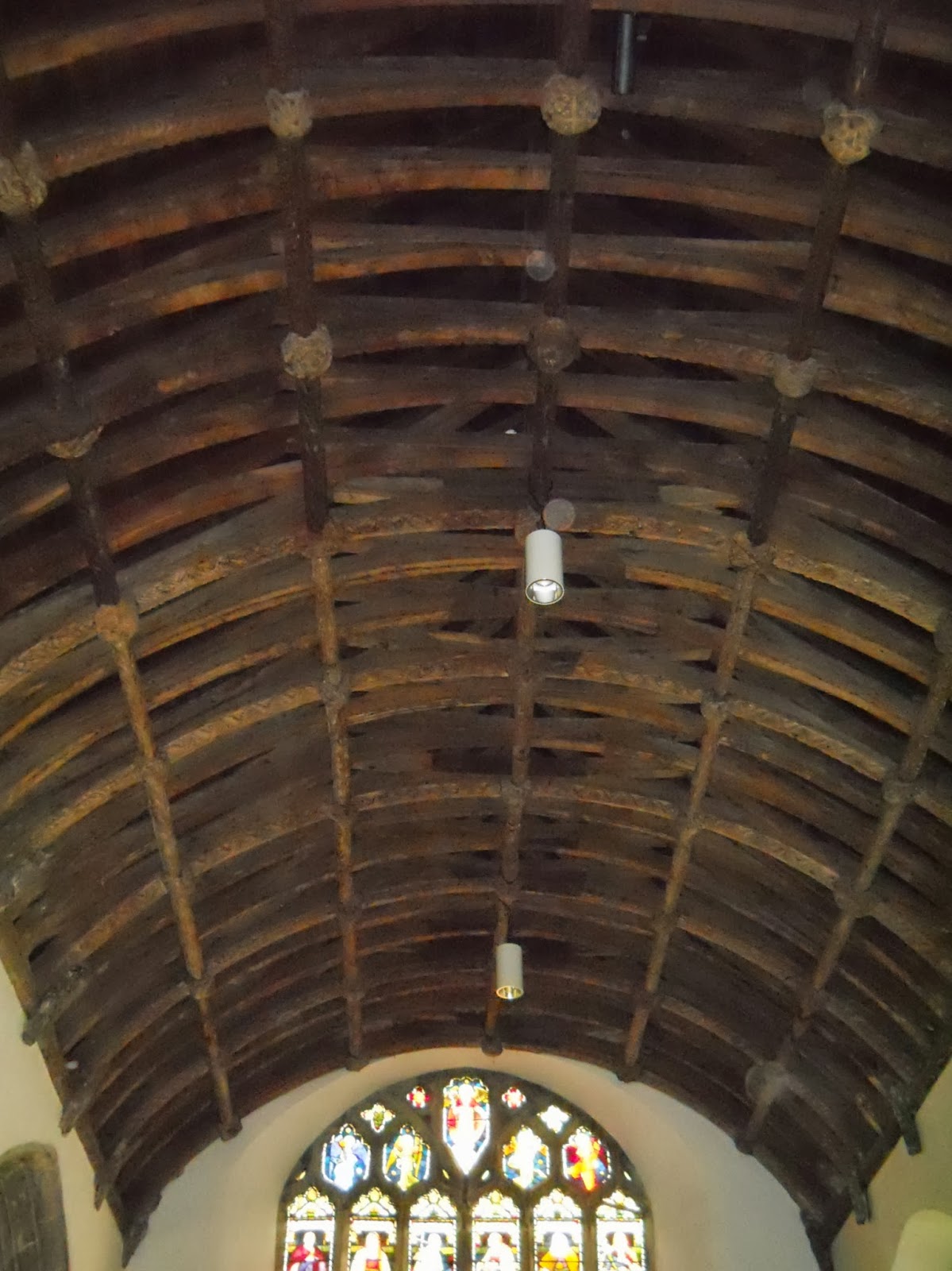
Groining is the term for the architectural feature made when two waggon (also known as cradle or barrel) roofs meet at right angles.. Waggon roofs are a feature of many Cornish churches. They are rounded over, like a wagon's cover. 

St Petroc's
Cornish churches often have the ceilings throughout at the same height (similar to 'hall churches', of which Bristol cathedral is an example). The pillars along the nave in St Petroc's and St Newlyn's are in the 'Cornish Perpendicular' style, which has relatively small capitals on the columns.

St Newlyn's.
Sometimes the ceilings are brightly painted, sometimes not.

St Petroc's

St Carantoc's
The roof of St Petroc's was largely demolished in 1699, when a bolt of lightning destroyed the 150-foot (45 m) tall spire. Only the roof in the Lady Chapel is original and has a carved boss showing the date of 1472.


There isn't really room here to write about other interesting things to be seen at St Petroc's; the reliquary casket, painted 16th century panels and carved stone memorials. It's very interesting to see the common features of Cornish church architecture in this area too.