As well as this blog, I also have a website and Instagram page with lots more images of my work as well as a few more stories.
If you like woodcarvings, you might want to have a look.
Showing posts with label misericords. Show all posts

Thursday, 24 March 2016

Travelling south of the two rivers to turn the world upside-down: Tilburg Carnaval 2016

Recently, I wrote about the medieval tradition of 'turning the world upside down' and the way that it is portrayed in many misericord carvings, such as this one in Bristol cathedral. 


The celebration of the 'Feast of Fools' was banned in England by Royal Proclamation in 1542 but in many other countries its spirit survives in the tradition of Carnival.

The Feast of Fools was celebrated on or around the 1st January, but Carnival occurs before the traditional period celebrated by many Christian denominations and known as known as Lent.  The word 'Carnival' means 'Farewell to the flesh', maybe because this was when all the meat had to be eaten before Lent.

Lent covers the period between Ash Wednesday and Easter and it commemorates the suffering, death and resurrection of Jesus as believed by Christians. During this time, believers will pray and fast or give up certain things such as meat or smoking. Non-Christians also sometimes use this period to try giving up things that they think are bad for them, such as alcohol. 


Image by R. Durrance 
The date varies as it is not set by a solar calendar, but Easter is on the first Sunday after the full moon which occurs on or most closely after the Spring Equinox (on the 21st March).The name 'Lent' comes from the Old English word 'Lencten' meaning 'Spring'. 

During Carnival, people have fun before the fasting and austerities of Lent, most people having heard of the famous Carnival in Rio de Janeiro. This year, I visited one in Tilburg, in the south of the Netherlands. It was very interesting to see the tradition of the 'world turned upside down' in practice.


Modern Carnival (or Carnaval if you are Dutch) is celebrated all over the world. Caribbean Carnivals are well-known (Bristol's Afro-Caribbean community and friends celebrate Carnival, based around the St Paul's area of the city) as are those in Latin countries. Apart from the one in Rio, another big example of these would be the Carnival in Santa Cruz de Tenerife.


Image from http://www.dawn.com/news/1089838
Although Tilburg Carnaval isn't anything like the grand scale of these ones, it was a lot of fun! Of course, to investigate the tradition of the 'world turned upside down', one should be properly dressed and accompanied by experienced researchers:


Although Rotterdam (which is north of the two rivers that cross the Netherlands) has a two-day Summer Carnival based on Latin-style ones, most people that I spoke to said that it was only south of the rivers that the older style of Dutch Carnaval happens. This may be because in this area, the provinces of Brabant and Limburg, there is a Catholic tradition as opposed to a Protestant one. Historically the Protestants, as in Britain, disliked such frivolity associated with religious festivals and suppressed it.


One thing that I noticed was how everyone was wearing certain colours. Each town has its own Carnaval colours and in Tilburg they are orange and green (which you can see on the scarf that I'm wearing above). Red and white are the colours of the province of Brabant. Happily, there didn't seem to be any kind of factionalism associated with wearing town colours; some people were wearing three or more different town's colours for each place they had been during Carnaval that year.

For the four-day duration of the event, the mayor hands over the keys of the town to the Prince of Carnaval who is responsible for the organisation and running of it. In 2016 this was Prince Robert the First, for his second year running. He parades through the town on the first day in his white and gold hat with big feathers, accompanied by his Council of Eleven in red and white hats.


For these four days, as in others nearby, the town takes on a different name. Tilburg is called 'Kruikestad' which means 'Bottletown'. The town adopts its Carnaval mascot. who is paraded through the street and given pride of place for four days:


At the opening ceremony, Prince Robert the First and his Council danced on stage and he even went up in a cherry picker to lead the dancing (brave man - many Carnaval parades were cancelled this year due to high winds).


I could see many traditions around Carnaval in the clothes and actions of the people around us and everyone seemed to respect it. Some people we met weren't bothered about going into town to celebrate it (they see it every year), however they all appreciated that it happens. 

Apart from the parade and the stage in the main square, a lot of celebrating takes place indoors in the bars and clubs - very sensible at this time of year! Those who can't get into town can watch local broadcasts of Carnaval music and interviews on the television.

The Carnaval parade in Tilburg isn't as big as some, but the floats are similar. Big caricatures of people or stories in the news lampoon their targets. It reminded me of the importance of the tradition. Not only is carnival a time for fun and letting off steam, it is also when those in power can be taken to task. 'The world turned upside down' gives a licence to poke fun at influential people who might well deserve it.


We were lucky to see it. Many other towns had their parades scheduled for the next day and had to cancel as the remnants of a storm passed over.

Another thing that was everywhere was the Carnaval music. It is very particular, not necessarily something I'd listen to at home every day but very positive and accessible to anyone. Especially when you are having a few beers to accompany it! 


One tune that stuck in my head was this one. It was made by people from Tilburg and is sung in local dialect apparently. The song is about deciding what to wear for Carnaval:


As you might be able to hear, it is fun music to drink to. In Tilburg, the local brew to do this with is Schrobbelèr, a herby-tasting liqueur.

Image from: https://www.mitra.nl/webshop/product/schrobbelèr/kruidenlikeur/83-bb-ed-e0-c5-eb-ff-ab

When you have had enough to drink, there is a traditional Carnaval salute too. You need to put your hand over your shoulder and say "Alaaf!' This word is also used in Köln (Cologne) in Germany during their Carnival. It can be handy when speaking becomes problematic...

Despite all the drinking though, I saw relatively few signs of trouble. Most people seemed to be local and seemed to respect the event. Many didn't believe that I was from Britain, until I said that my friend lived in the town and we were visiting him. I think that we could well have been the only British people in the town that weekend and it was great!


Thanks very much to our friends and the people of Tilburg for making us so welcome.


Alaaf!


Thursday, 10 December 2015

The fascinating and sometimes very rude sixteenth-century misericords in Bristol Cathedral

The collection of misericords in Bristol Cathedral date from 1515-1526 and were installed by order of Abbot Robert Elyot. The stalls around them date to the nineteenth century but the misericords are the original ones. 

In 'Church Woodcarvings: A West Country Study', JCD Smith says that the Bristol misericords are 'the newest set of medieval misericords of any size in the West Country' and that they are 'not renowned for the superlative quality of their carving but they are outstandingly interesting in their subject matter.'


Misericords are small ledges revealed when the seats in the choir stalls are tipped up. They were used by clergy to rest against whilst standing for long periods of time during Masses. The odd name comes
from the Latin words for 'pity' and 'heart'.

Many of the Bristol misericords illustrate tales of Reynard the Fox, a trickster peasant-hero figure. Stories about him were popular all over Europe, especially in Britain after William Caxton published a printed version in 1481. Some images are harder to decipher and may illustrate morality tales or sayings that have been lost over time.

Sadly, not all of the misericords can be easily seen by a visitor, due to some badly-placed brass rings holding the ends of ropes that stop anyone sitting on the seats. However, the designs have been replicated on embroidered cushion covers that rest on the seats, although some of the cushions have been moved around from their original places. Here are a few misericords that can be seen:


In this tale from Reynard the fox, Tybalt the cat has been sent to bring him to justice. He is tricked along the way into being trapped in the house of the priest's mistress. The priest's son has Tybalt on a leash whilst she belabours him with a broom, but Tybalt has the priest's testicles in his mouth. Checkmate.


Tybalt and the priest have another fight. Dame Dulok tries to pull the cat off the naked priest's back as Reynard the fox watches from a bush on the right. Some of the faces carved on the supporters to each side are so well executed that they make me wonder if they represent actual people - perhaps other builders or apprentices used as models, or clergy of the time? In 'The Hidden World of Misericords', Dorothy and Henry Kraus say that these side carvings are also sometimes called 'wing carvings' and that they are 'the most distinguishing stylistic feature of British misericords.'

In 'Church Misericords  and Bench Ends', Hayman notes that the carvings of Reynard's tales in Bristol  draw heavily on the first illustrated edition published in 1501, or perhaps a Netherlandish or German equivalent.


A monster with two heads drives three naked men. Richard Hayman, in his book 'Church Misericords and Bench Ends', says that this design was 'copied from a book of hours printed in about 1500 in Paris by Thielmann Kerver.'

While all this is going on, a man touches his nose with his tongue and a monkey plays a lute. Maybe having fun on the Sabbath got these unfortunate men in trouble.


Someone is in trouble for having a look in the cooking pot. Maybe this was to remind the clergy that married life has it's ups and downs?


In this strange and beautifully-carved tableau, a mermaid is held by a wyvern and an odd winged man who may be the Devil. The mermaid in church carvings usually represents the perils of lust. There is a clown on the supporter to the left and an ape holding a flask (of wine or urine?) on the right.


Two men holding a pig. The man on the right is holding what is often interpreted as intestines with a knife nearby, showing the hog is being slaughtered. This subject can also be seen on a misericord at the Church de La Trinité in Vendôme in France. 

I'd suggest that there is another possible interpretation, that the pig (which is obviously a sow and looks very alive) is in difficulties giving birth and the men are trying to assist. Two rabbits run in and out of holes under the bench that the sow is on.


The geese come to see the fox hanged, as two sorrowful human faces also look on.

Varty, in '"Reynard the Fox: Cultural Metamorphoses and social engagement in the Beast' says that although this scene is inspired by the Tales of Reynard, in the actual tales the fox is never executed. He points out that this scene was only depicted in England and this is one of two surviving images of it, the other being in Beverley Minster.

Hayman, In his book on 'Church Misericords and bench ends' says that the stories about Reynard inspired a separate tale of the fox bishop. In a satire on corrupt clergy, the fox bishop and his friends the apes dupe the local pigs and birds. However he eventually gets his comeuppance and the geese, in an act that turns the normal order on its head, hang the trickster. The whole story is illustrated on bench ends in the church at Brent Knoll in Somerset.


A tale from the Old Testament of the Bible. Samson is empowered by God to wrestle a lion and tear it apart with his bare hands. He carries the jawbone of an ass in his belt, with which he defeats an army single handed.
In George Jack's textbook 'Wood Carving: Design and Workmanship', first published in 1903, he shows illustrations of the two side figures of this misericord. Jack writes;

"The little jester just emerging from  flower..., is undoubtedly a true portrait, carved without the slightest attempt at exaggeration. The quiet humour which it evinces required only sympathy to perceive and skill to portray on the part of its carver. He had nothing to invent in the common acceptation of the word. The carving of the mendicant, which comes on the other side, is equally vivid in its truth to nature. It is so lifelike that we do not notice the humorous enjoyment of the artist in depicting the whining lips and closed eyes of the professional beggar. Observe the good manners of it all - the natural refinement of the artist who leaves his characters to make all the fun, without intrusion from himself other than to give the aid of his skill in representation."

I'm assuming that Jack (whose expression of personal opinions throughout seems unusually free for someone writing a textbook) had either not seen or chose to ignore the side figure shown four photos on from this one, for whom the expressions 'good manners' and 'natural refinement' don't necessarily seem to apply!


Two men wrestle naked with a thong or scarves wrapped around their necks, perhaps binding them together, while another man looks on and points towards the ground. In the original Greek Olympics, men wrestled naked.


An ape riding a horse (?) with a sack for a saddle, encounters a naked man wielding a stick who holds the mount's tail. Two rabbits in burrows below.


A man hunting a stag with his dog shoots it in it's flank. Perhaps refers to one of the Christian saints of hunting, Saint Hubertus or Saint Eustace?


A naked man fights off two beasts (demons?) with a sword. Look carefully at the figure on the supporter to the left. Medieval Christian carvings were a lot bawdier than later ones!! This isn't the only example of such a figure on a misericord. The is similar one one in the Cathedral of St Tugdual in Tréguier in France.

In 'Church Woodcarvings: A West Country Study', JCD Smith records that;
'After 1841, when restorations were carried out in the cathedral, there remained thirty misericords but, according to the records, several were removed at about this date. In a paper given to the Clifton Antiquarian Club in 1888, Robert Hall Warren listing the misericords which were in the cathedral before the restorations, stated that three of them were too indecent to be exposed to view or even mentioned. Presumably the dean and chapter at that time shared Mr Warren's opinion, which would explain their absence today. Tradition has it that they were burned.'


Satan comes out of the jaws of Hell to greet a woman who is leading in four apes on leashes. Apes obviously mean human sinners in these carvings. I wonder how the Theory of Evolution would have been received in those days!

This carving illustrates a tradition of the time, which said that maids who die unmarried would lead the souls of bachelors, like apes, into Hell. In 'Misericords: Medieval Life in English Woodcarving', Anderson mentions that this saying is alluded to in Shakespeare's plays 'The Taming of the Shrew' and 'Much Ado about Nothing' and points out that it became popular in the late sixteenth century. This is interesting, as the carvings were produced at an earlier date than that.


This is one of the most complex and beautifully-carved sets. JCD Smith says that the man is riding a muzzled bear and that the scene is a parody of the game of quintain. The book also points out that the simplified, 'crude' representations of trees are characteristic of these Bristol misericords.

In 'The Hidden World of Misericords', the Krauses talk about how many misericords show parodies of courtly pursuits as 'the posturings of the waning knight class were satirised in sham contests'.


A man riding a sow and a woman riding a goose or turkey look like they are having a mock joust. Although the bird is often referred to as a goose, some of the first turkeys seen in Britain were brought to Bristol by William Strickland and sold in the market there in 1526. That was the year in which the last of the misericords was carved and the turkeys must have caused quite a stir, so I think that the novel bird has been recorded by this carver. It certainly looks a lot more like a turkey than a goose!

Mike Harding has pointed out that many misericords celebrate the 'The world turned upside down'. On St Stephen's day, Lords of Misrule would be elected and the normal rules would be abandoned, which probably gave a welcome and necessary release to a society bound by so many legal and moral conventions. Although the 'Feast of Fools'  was not formally abolished in England until a Royal Proclamation in 1542, this celebration can still be seen today in the tradition of 'Carnival'.
The two green men on the supporters are also worth noting.


A snail, with its house on its back in a tied bundle, is encouraged to speed up by a man with a double-thonged whip as another man looks on. Knights and others in battle with snails are a surprisingly common theme in medieval art and there is a video by Vox Almanac on Youtube that considers some possible reasons, including that the snail is an allegorical depiction of the Lombards.

Sunday, 24 November 2013

The Lord Mayor's Chapel, St Mark's Church in Bristol. Could you guess when these misericords were carved?


This church is in the centre of Bristol, next to the Council House. It's quite appropriate, as it is apparently the only municipally-owned church in the country.

The church was built in the thirteenth century to serve the Hospital of St Mark, which was founded by Maurice de Gaunt. It was a monastic hospital and for over three hundred years it gave food and care to one hundred poor people a day.

When Henry VIII broke up most of the monasteries during the Dissolution in the sixteenth century, the Hospital was surrendered and the Bristol Corporation (the city council) bought the lands belonging to it in 1541. It was used by various local schools and was granted to French Hugenot refugees as a place of worship in 1687.


In 1722, it became the official place of worship for the Mayor of Bristol and the Council and it has remained so to the present day. This was in part because of a dispute with the Cathedral, which faces the Lord Mayor's Chapel across College Green. In 1788, the Mayor got his own back by allowing John Wesley to preach in the chapel when the Bishop of Bristol had forbidden Wesley from preaching in any of the city's churches.

There are several interesting things kept at the Chapel, including the ceremonial swords of the Bristol Corporation. Unfortunately, one of the most interesting chapels had building work going on due to repairs to the church organ, so it's stone memorials couldn't be photographed. Helpfully, the interesting features of the chapel have information boards near them.


These stone corbels date to the thirteenth century and would have jutted out from the walls to hold up the roof. They may have been used as infill in the walls later, or were taken out during restoration work in the nineteenth century. Nearby are some medieval wall paintings on display, moved from elsewhere in the chapel.


The oak choir stalls have some beautifully carved misericords under the seats and carved faces as bench ends. Many of the faces are of Green Men. Here are a few:


How old do you think these carvings are?

Well, although they look quite medieval, they were actually carved far more recently. The choir stalls were only installed in 1888! The crispness of the carving does give the game away a little. They don't show much wear and the finish is much more precise than is usual with medieval carving (I suppose that reflects the advances in the making of carving tools during the nineteenth century). The expressions and the foliage carving are wonderful all the same.

If you would like more information, the Chapel website can be found by clicking here. It is usually open 10am-12pm and 1pm-4pm from Wednesday to Sunday, but it's worth checking before you visit by calling the Lord Mayors Office on 0117 903 1450.

Tuesday, 1 October 2013

St Petroc's in Bodmin, Cornwall: Deformed hands, magic trees, hidden beauty and a spire blown up by lightning

St Petroc's is the largest church in Cornwall apart from Truro cathedral.
Bodmin, the town in which this church stands, was the capital of Cornwall between 1835 and 1989. Originally a Welsh prince who studied Christianity in Ireland, St Petroc arrived here in about 530 AD and turned Bodmin into the religious centre of the West. He died in 564 AD.


Despite it's importance, Saint Petroc's doesn't have a lot of decorative carving on it's exterior. This is a feature that it shares with many other churches in the area. It makes sense when one considers that the storms in this area, exposed to weather coming straight in from the Atlantic Ocean, can be pretty fierce. The main local building materials around Bodmin are also granite and killas, both of which are very tough stones that are difficult and time-consuming to carve. 'Killas' is a Cornish term for sedimentary rocks that have been altered (metamorphosed) by heat and pressure from nearby igneous intrusions (hot molten rock forcing it's way upwards from deep inside the earth), an example being slate.

St Petroc took over running the Christian community in the area from St Guron, who had founded it in about 500 AD next to a holy well. The well is still there, covered by a small building which can be seen between the pillar and the church in the photo below. The actual spring is thought to rise underneath the church itself and to be carried to the 16th century wellhouse through conduit pipes:


The well flows out next to the road through these carved granite heads, with a plaque next to them saying 1545 AD


This would seem to be a good example of early Christian missionaries using pagan sacred places for their sites of worship. Many water sources were sacred to pagan people but also made handy spots for Christians to baptise converts, as well as allowing the special spiritual aura of these places to transfer to the new religion and make it easier for the local people to accept the new ideas..

Another example of the two religions mingling can be seen at the church in St Newlyn East, near Newquay in Cornwall. The church is dedicated to St Newlina. One story is that Newlina was a British princess of the 5th or 6th century AD. She is supposed to have come to Cornwall via Wales and Ireland to avoid an unwanted suitor. 


On reaching this spot, she put her staff into the ground and it magically sprouted into a fig tree, which still grows out of the church wall with no obvious means of sustenance. The tree is reputed to have magical powers:
"Upon it lays a dreadful curse,
Who plucks a leaf will need a hearse."


Another example of a magical sprouting staff is the Holy Thorn at Glastonbury in Somerset, supposed to have sprouted from a staff carried by Joseph of Arimathea. There is an obvious mix of Pagan tree worship and Christianity in these legends.

Eventually, the spurned suitor caught up with St Newlina and chopped her head off (she was obviously a good judge of character). A spring is supposed to have magically risen where the head fell; another example of the two religions meeting.

One of the most obvious treasures of St Petroc's is the incredible stone font. It is Norman in age, dating to the 12th century and somehow escaped the attention of both Henry VIII's forces during the Reformation and the Puritans. The font was recently moved to lie opposite the altar at the end of the pews along the main aisle, which is the position of the font at Crantock and where the one in St Newlyn's used to be.


The two angels heads with pupils carved into the eyes are said to represent good and evil. This font design seems to have been very popular in the area. All four churches that I visited on this trip had fonts from the same period that appeared to be influenced by the one at St Petroc's (which is the finest of all):

St Gomonda's in Roche


St Newlyn's in St Newlyn East. 
The legs and one of the angel's heads were replaced during restoration in 1883


St Crantoc's in Crantock
This has AD 1474 carved on it, probably to commemorate renovation work to the church in the 15th century


Mathy More

St Petroc's is remarkable, as it is one of very few churches from the time for which almost complete building records have survived. This gives some insight into the work of Mathy More, who was contracted to make and carve most of the wooden furniture for the new church in 1491. 

He imported the oak to be used from Wales, shipped here via the town of Wadebridge, and was paid £92 for the whole job. To give some idea of what that amounts to, building the entire church (on a separate contract) cost £196 7s 4d which in modern British money is about half a million pounds sterling.

Some of More's carving has survived, mainly incorporated as panels into newer structures such as the reredos screen behind the altar and also the pulpit. Here are some examples:


The reredos screen (you can see it in the last of the photos above, behind the altar, with some panels carved by Mathy More), hides the original one from the 19th century. The older screen is beautiful, with gilding and mosaics, but is hidden by the wooden screen as it needs some refurbishment. 


There are currently plans to renovate the nineteenth century reredos and move the wooden one to another part of the church.

St Petroc's contains one of the oddest lecterns that I've ever seen. It was pieced together from medieval misericords which don't look like the work of Mathy More. Perhaps they originally came from the Priory over the road?


One of the side panels (above) shows two figures that look like demons, with wings and animal-like back legs, turning away from something. Another panel shows a man with five fingers on his hand:


The church guide suggests that this could be a mistake by the carver or a record of his own affliction. I don't believe either myself; the hand is too obvious in the design to have been a mistake. In medieval times, an extra finger or toe was supposed to be the mark of a witch. Henry VIII's wife Anne Boleyn (whom he executed and who was unpopular at court) was popularly -and probably erroneously- said to have an extra finger. It's unlikely that the carver would advertise if he did have this problem.
The figure on the left looks like they are a member of the clergy or judiciary to me. The one on the right (with robes, cap and book), could be either another lawyer or a clergyman. I think that the panel was a dig at corrupt lawyers or clergy.

There are a couple of other interesting carvings in stone to be seen at St Petroc's. The tomb of Thomas Vyvian, penultimate Prior of Bodmin, is carved from Cataclewse stone which comes from Harlyn bay in North Cornwall.


The tomb had to be rescued at one point from the Priory duckpond, into which it had been thrown by Puritans during the Civil War.

The ceiling of the porch is a good example of a groin vault and is carved in Pentewan stone.


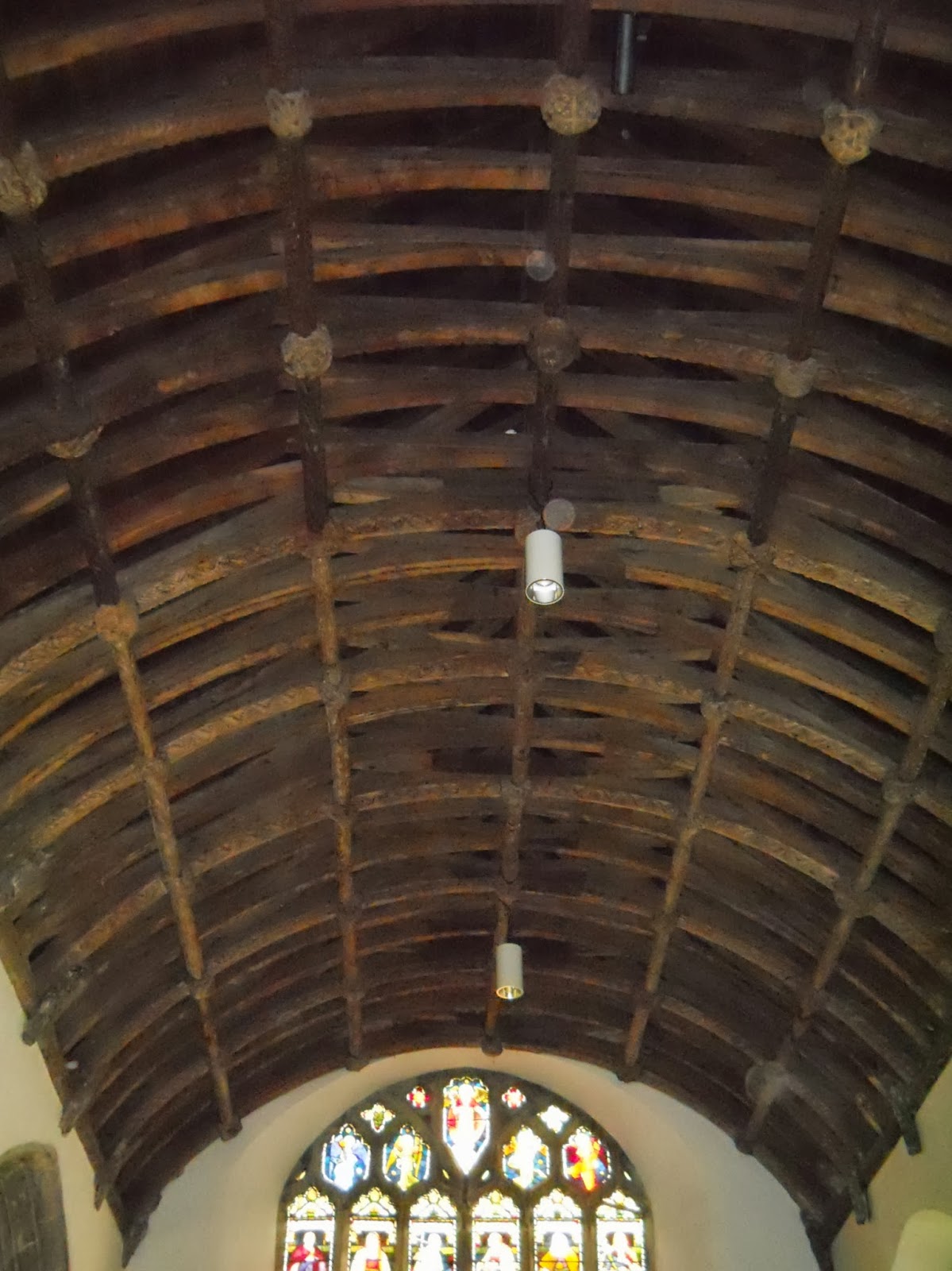
Groining is the term for the architectural feature made when two waggon (also known as cradle or barrel) roofs meet at right angles.. Waggon roofs are a feature of many Cornish churches. They are rounded over, like a wagon's cover. 

St Petroc's
Cornish churches often have the ceilings throughout at the same height (similar to 'hall churches', of which Bristol cathedral is an example). The pillars along the nave in St Petroc's and St Newlyn's are in the 'Cornish Perpendicular' style, which has relatively small capitals on the columns.

St Newlyn's.
Sometimes the ceilings are brightly painted, sometimes not.

St Petroc's

St Carantoc's
The roof of St Petroc's was largely demolished in 1699, when a bolt of lightning destroyed the 150-foot (45 m) tall spire. Only the roof in the Lady Chapel is original and has a carved boss showing the date of 1472.


There isn't really room here to write about other interesting things to be seen at St Petroc's; the reliquary casket, painted 16th century panels and carved stone memorials. It's very interesting to see the common features of Cornish church architecture in this area too.