As well as this blog, I also have a website and Instagram page with lots more images of my work as well as a few more stories.
If you like woodcarvings, you might want to have a look.
Showing posts with label cathedral. Show all posts

Tuesday, 7 February 2017

Exploring Bristol with Hazen Audel: craftsman and presenter of 'Primal Survivor' on the National Geographic channel

meeting Hazen Audel

Hazen Audel was in Bristol doing some work connected to the show that he presents, called 'Primal Survivor'.  As well as his television work, he is also a very keen craftsman, working particularly with metal and wood. 

A few weeks previously, I'd been running a woodcarving tutorial for Alex, who has worked with him on the series for Icon Films. He knew that Hazen would love finding out more about the handmade objects and historic buildings to be seen in the city and thought that it would be great if I could show him around.

I always enjoy meeting other makers, particularly those with an interest in woodworking, so was very happy to do it. In fact, the prospect of exploring the city that I know pretty well with someone who was seeing a lot of it for the first time (and who is also interested in making stuff) was really exciting!

First of all, we visited the Cathedral. The very first thing was an Anglo-Saxon sculpture that is around a thousand years old. We also got to see the misericords, including one which I believe shows one of the first turkeys ever brought back to Britain. Straightaway, Hazen noticed the beautiful, elaborate hand-forged iron gates and door hinges around the Cathedral; pointing out stunning constructions that I would almost certainly have just walked past if there on my own.

Next was a visit to the Central library to see the Grinling Gibbons overmantle. This had to be included on the itinerary. 


Grinling Gibbons oak carving


One of the librarians very kindly took time to show us the room in which the overmantle is kept and to point out some of the other treasures in there, such as this beautifully designed Arts and Crafts chair which neatly converts into steps to access high shelves.


Arts and Crafts chair

Next, we walked over to St Mary Redcliffe church to see the stone carvings and a whale rib that is reputed to be one of the first things ever brought back from the New World to Europe on John Cabot's ship. A bone seems a curious object to have been chosen but in those days such an object must have been like bringing back a chest full of gold: 
"There are huge whales there and no one is hunting them!"

I also pointed out the roof bosses under the tower. One shows a very rare image of a green man-like dog or cow. Nearby is another carving showing a man defecating! Medieval Christian attitudes to religious buildings were certainly very different to modern ones - see if you can spot both of them in the picture below:


St Mary Redcliffe

After a walk along King Street (which contains many 17th century buildings) and dropping in at Icon Film's offices, we stopped off at the Hatchet Inn for lunch.


Hazen Audel visits the Hatchet Inn  in Bristol

The Hatchet is reputed to have first got a license to sell alcohol in 1606, making it the oldest pub in Bristol. Before that it was Frogmore farm and monastery. Legend has it that the pub door has a layer of human skin from an executed felon, hidden under layers of paint and tar. If you are wondering about ghosts; well, I've had strange experiences in there before - but that's another story!

After finishing lunch, we headed up to Bristol Design. This second-hand tool shop is a must-see for anyone who loves working with tools and Hazen had been there before, so we had a chat about them and then headed on, stopping occasionally to look more closely at things of interest on the way, such as the Cafe Wall illusion.


Hazen Audel visits Bristol Design

After walking down Jacobs Wells Road, we headed over to my studio at Bower Ashton. This route gave a chance to look at the Hotwells area of Bristol, the Harbour and to see the Suspension Bridge spanning the Avon Gorge. 


Several of the members of the Forest of Avon Products cooperative who have workshops at the Bower Ashton Woodyard were about and chatted to Hazen about the wide variety of projects that they were working on.


After visiting my own workshop, the weather had taken a turn for the worse and it had been a long day so he got a taxi back to where he was staying in town.

All in all, it had been a very enjoyable day. It was great to spend time with Hazen and it also made me realise how, even though we packed in a lot of things, there was still so much we hadn't had the chance to see in Bristol in one day. When given the opportunity to explore the place that you live with fresh eyes, it quickly becomes apparent how much is taken for granted or passed by in ignorance each day. 

Wednesday, 5 October 2016

Passau: the beautiful baroque city where three rivers meet

St Stephan's Dom, Passau

Passau is a city in Bavaria, in the south-east of Germany. It is not far from the borders with Austria and the Czech Republic. 

The city has a long history and it stands on the strategically important junction between three large rivers: the Donau (known in many countries as the Danube), the Inn and the Ilz. These rivers join at a point called the drei flüsse eck (three rivers corner) at the end of the promontory on which the old town stands. From there, the river becomes the Donau (Danube).


Danube (Donau) at Passau

The town is first mentioned in Roman times and was the residence of a bishop from 739 CE. Bishops became the rulers of the small independent city state of Passau in the 13th century. The town was devastated by fire in 1662 and was rebuilt shortly after, using designs by Italian masters, in the baroque style. Passau became part of Bavaria in 1803 and the baroque had a big influence on Bavarian architecture, even through to the nineteenth century palaces of King Ludwig II.

The most impressive example of this baroque architecture in Passau has to be the Cathedral of St Stephen, in the centre of the old town and surrounded by cobbled alleyways and courtyards. It was designed by Carlo Lurago, with stucco work by Giovanni Battista Carlone and frescos by Carpoforo Tencalla. The overall effect can be seen in the first image above and in these below: the floor and lower parts of the pillars of the nave are fairly sedate, rising overhead to a tumult of colour and form.


The cathedral also houses the Europe's largest cathedral organ.


Passau cathedral organ

Even though most of the decorative sculpture is made from stucco (which is a mixture of lime, sand, water and sometimes a binding agent such as horsehair) there is some carving in wood. The organ has carved and gilded decoration and there is a large crucifix and some smaller statues. 

Perhaps the most impressive woodcarving is on the pulpit, which was constructed from carved and gilded lime wood. Designed by Vienna-based Antonio Beduzzi, with figures carved in the workshops of Lorenzo Mattielli, it was made between 1722 and 1726:


This cathedral replaced an earlier, medieval, one which was destroyed in the fire of 1662. Now, one of the few remaining identifiable pieces of the original cathedral is a carving that has become a symbol of the town and is displayed nearby - a large face carved in stone and now known as 'Der Passauer Tölpell'.


As well as the incredible work in the Dom, more beautifully-made pieces could be seen in many of the streets and alleyways around the old town. Some were statues..


...but more impressive to me were the stunning doors leading into many of the houses and courtyards. 


I wonder if these also date to the mid-late seventeenth century?


Thursday, 10 December 2015

The fascinating and sometimes very rude sixteenth-century misericords in Bristol Cathedral

The collection of misericords in Bristol Cathedral date from 1515-1526 and were installed by order of Abbot Robert Elyot. The stalls around them date to the nineteenth century but the misericords are the original ones. 

In 'Church Woodcarvings: A West Country Study', JCD Smith says that the Bristol misericords are 'the newest set of medieval misericords of any size in the West Country' and that they are 'not renowned for the superlative quality of their carving but they are outstandingly interesting in their subject matter.'


Misericords are small ledges revealed when the seats in the choir stalls are tipped up. They were used by clergy to rest against whilst standing for long periods of time during Masses. The odd name comes
from the Latin words for 'pity' and 'heart'.

Many of the Bristol misericords illustrate tales of Reynard the Fox, a trickster peasant-hero figure. Stories about him were popular all over Europe, especially in Britain after William Caxton published a printed version in 1481. Some images are harder to decipher and may illustrate morality tales or sayings that have been lost over time.

Sadly, not all of the misericords can be easily seen by a visitor, due to some badly-placed brass rings holding the ends of ropes that stop anyone sitting on the seats. However, the designs have been replicated on embroidered cushion covers that rest on the seats, although some of the cushions have been moved around from their original places. Here are a few misericords that can be seen:


In this tale from Reynard the fox, Tybalt the cat has been sent to bring him to justice. He is tricked along the way into being trapped in the house of the priest's mistress. The priest's son has Tybalt on a leash whilst she belabours him with a broom, but Tybalt has the priest's testicles in his mouth. Checkmate.


Tybalt and the priest have another fight. Dame Dulok tries to pull the cat off the naked priest's back as Reynard the fox watches from a bush on the right. Some of the faces carved on the supporters to each side are so well executed that they make me wonder if they represent actual people - perhaps other builders or apprentices used as models, or clergy of the time? In 'The Hidden World of Misericords', Dorothy and Henry Kraus say that these side carvings are also sometimes called 'wing carvings' and that they are 'the most distinguishing stylistic feature of British misericords.'

In 'Church Misericords  and Bench Ends', Hayman notes that the carvings of Reynard's tales in Bristol  draw heavily on the first illustrated edition published in 1501, or perhaps a Netherlandish or German equivalent.


A monster with two heads drives three naked men. Richard Hayman, in his book 'Church Misericords and Bench Ends', says that this design was 'copied from a book of hours printed in about 1500 in Paris by Thielmann Kerver.'

While all this is going on, a man touches his nose with his tongue and a monkey plays a lute. Maybe having fun on the Sabbath got these unfortunate men in trouble.


Someone is in trouble for having a look in the cooking pot. Maybe this was to remind the clergy that married life has it's ups and downs?


In this strange and beautifully-carved tableau, a mermaid is held by a wyvern and an odd winged man who may be the Devil. The mermaid in church carvings usually represents the perils of lust. There is a clown on the supporter to the left and an ape holding a flask (of wine or urine?) on the right.


Two men holding a pig. The man on the right is holding what is often interpreted as intestines with a knife nearby, showing the hog is being slaughtered. This subject can also be seen on a misericord at the Church de La Trinité in Vendôme in France. 

I'd suggest that there is another possible interpretation, that the pig (which is obviously a sow and looks very alive) is in difficulties giving birth and the men are trying to assist. Two rabbits run in and out of holes under the bench that the sow is on.


The geese come to see the fox hanged, as two sorrowful human faces also look on.

Varty, in '"Reynard the Fox: Cultural Metamorphoses and social engagement in the Beast' says that although this scene is inspired by the Tales of Reynard, in the actual tales the fox is never executed. He points out that this scene was only depicted in England and this is one of two surviving images of it, the other being in Beverley Minster.

Hayman, In his book on 'Church Misericords and bench ends' says that the stories about Reynard inspired a separate tale of the fox bishop. In a satire on corrupt clergy, the fox bishop and his friends the apes dupe the local pigs and birds. However he eventually gets his comeuppance and the geese, in an act that turns the normal order on its head, hang the trickster. The whole story is illustrated on bench ends in the church at Brent Knoll in Somerset.


A tale from the Old Testament of the Bible. Samson is empowered by God to wrestle a lion and tear it apart with his bare hands. He carries the jawbone of an ass in his belt, with which he defeats an army single handed.
In George Jack's textbook 'Wood Carving: Design and Workmanship', first published in 1903, he shows illustrations of the two side figures of this misericord. Jack writes;

"The little jester just emerging from  flower..., is undoubtedly a true portrait, carved without the slightest attempt at exaggeration. The quiet humour which it evinces required only sympathy to perceive and skill to portray on the part of its carver. He had nothing to invent in the common acceptation of the word. The carving of the mendicant, which comes on the other side, is equally vivid in its truth to nature. It is so lifelike that we do not notice the humorous enjoyment of the artist in depicting the whining lips and closed eyes of the professional beggar. Observe the good manners of it all - the natural refinement of the artist who leaves his characters to make all the fun, without intrusion from himself other than to give the aid of his skill in representation."

I'm assuming that Jack (whose expression of personal opinions throughout seems unusually free for someone writing a textbook) had either not seen or chose to ignore the side figure shown four photos on from this one, for whom the expressions 'good manners' and 'natural refinement' don't necessarily seem to apply!


Two men wrestle naked with a thong or scarves wrapped around their necks, perhaps binding them together, while another man looks on and points towards the ground. In the original Greek Olympics, men wrestled naked.


An ape riding a horse (?) with a sack for a saddle, encounters a naked man wielding a stick who holds the mount's tail. Two rabbits in burrows below.


A man hunting a stag with his dog shoots it in it's flank. Perhaps refers to one of the Christian saints of hunting, Saint Hubertus or Saint Eustace?


A naked man fights off two beasts (demons?) with a sword. Look carefully at the figure on the supporter to the left. Medieval Christian carvings were a lot bawdier than later ones!! This isn't the only example of such a figure on a misericord. The is similar one one in the Cathedral of St Tugdual in Tréguier in France.

In 'Church Woodcarvings: A West Country Study', JCD Smith records that;
'After 1841, when restorations were carried out in the cathedral, there remained thirty misericords but, according to the records, several were removed at about this date. In a paper given to the Clifton Antiquarian Club in 1888, Robert Hall Warren listing the misericords which were in the cathedral before the restorations, stated that three of them were too indecent to be exposed to view or even mentioned. Presumably the dean and chapter at that time shared Mr Warren's opinion, which would explain their absence today. Tradition has it that they were burned.'


Satan comes out of the jaws of Hell to greet a woman who is leading in four apes on leashes. Apes obviously mean human sinners in these carvings. I wonder how the Theory of Evolution would have been received in those days!

This carving illustrates a tradition of the time, which said that maids who die unmarried would lead the souls of bachelors, like apes, into Hell. In 'Misericords: Medieval Life in English Woodcarving', Anderson mentions that this saying is alluded to in Shakespeare's plays 'The Taming of the Shrew' and 'Much Ado about Nothing' and points out that it became popular in the late sixteenth century. This is interesting, as the carvings were produced at an earlier date than that.


This is one of the most complex and beautifully-carved sets. JCD Smith says that the man is riding a muzzled bear and that the scene is a parody of the game of quintain. The book also points out that the simplified, 'crude' representations of trees are characteristic of these Bristol misericords.

In 'The Hidden World of Misericords', the Krauses talk about how many misericords show parodies of courtly pursuits as 'the posturings of the waning knight class were satirised in sham contests'.


A man riding a sow and a woman riding a goose or turkey look like they are having a mock joust. Although the bird is often referred to as a goose, some of the first turkeys seen in Britain were brought to Bristol by William Strickland and sold in the market there in 1526. That was the year in which the last of the misericords was carved and the turkeys must have caused quite a stir, so I think that the novel bird has been recorded by this carver. It certainly looks a lot more like a turkey than a goose!

Mike Harding has pointed out that many misericords celebrate the 'The world turned upside down'. On St Stephen's day, Lords of Misrule would be elected and the normal rules would be abandoned, which probably gave a welcome and necessary release to a society bound by so many legal and moral conventions. Although the 'Feast of Fools'  was not formally abolished in England until a Royal Proclamation in 1542, this celebration can still be seen today in the tradition of 'Carnival'.
The two green men on the supporters are also worth noting.


A snail, with its house on its back in a tied bundle, is encouraged to speed up by a man with a double-thonged whip as another man looks on. Knights and others in battle with snails are a surprisingly common theme in medieval art and there is a video by Vox Almanac on Youtube that considers some possible reasons, including that the snail is an allegorical depiction of the Lombards.

Friday, 6 September 2013

Carvings from the last nine hundred years, Bread ovens, Starburst Memorials and grotesques in Bristol Cathedral


Isn't it funny how one can spend years living next to something incredible and yet never take time to see it properly?

Today I visited the Cathedral in the centre of Bristol for only the second time. The main purpose was to see the misericords there, but there were plenty of other things to see as well...

Bristol Cathedral started out as the Abbey of St Augustine, which was founded in about 1140 AD by Robert Fitzhardinge. A lot of the building has been altered since then, but one of the most interesting surviving original parts is the Chapterhouse, which dates to about 1160. This is decorated with beautiful Romanesque carvings and was where the economic and political areas of the abbey's life would have been discussed.


The site was used for worship before the abbey was built, however. During restoration work on the chapterhouse, a stone tablet from Anglo-Saxon times was discovered under the floor. This stone carving dates from just before the Norman Conquest (in 1066) and depicts the 'Harrowing of Hell', with Jesus going to hell to rescue mortal souls sent there. It's one of the most important pieces of Anglo-Saxon art ever found in Britain and is now on display in the Cathedral.


The Cathedral is one of the world's best examples of a medieval 'hall church'. This means that all of the ceilings in the main area of the building (the nave, aisles and quire) are at the same height. This makes the whole building feel 'lighter'. The ceiling vaulting in parts of the cathedral is incredible. Take a close look at this section of the South Choir Aisle shown below, which was built in 1298. The vaulting rises in pyramids off the stone bridges across the aisle:


This vaulting is between the nave and the quire:


The small Berkeley chapel comes off the main area and was the private chapel for the Berkeley family, the descendants of Robert Fitzhardinge. Next to it is a sacristy, where the priests and others would prepare for Masses. It has several interesting features. In the middle is a bread oven. Not what you'd expect within a cathedral but this is where the communion bread was baked.


The ceiling of the sacristy has more fine vaulting; this time 'skeletal', with the ribs of the vaulting not filled in:


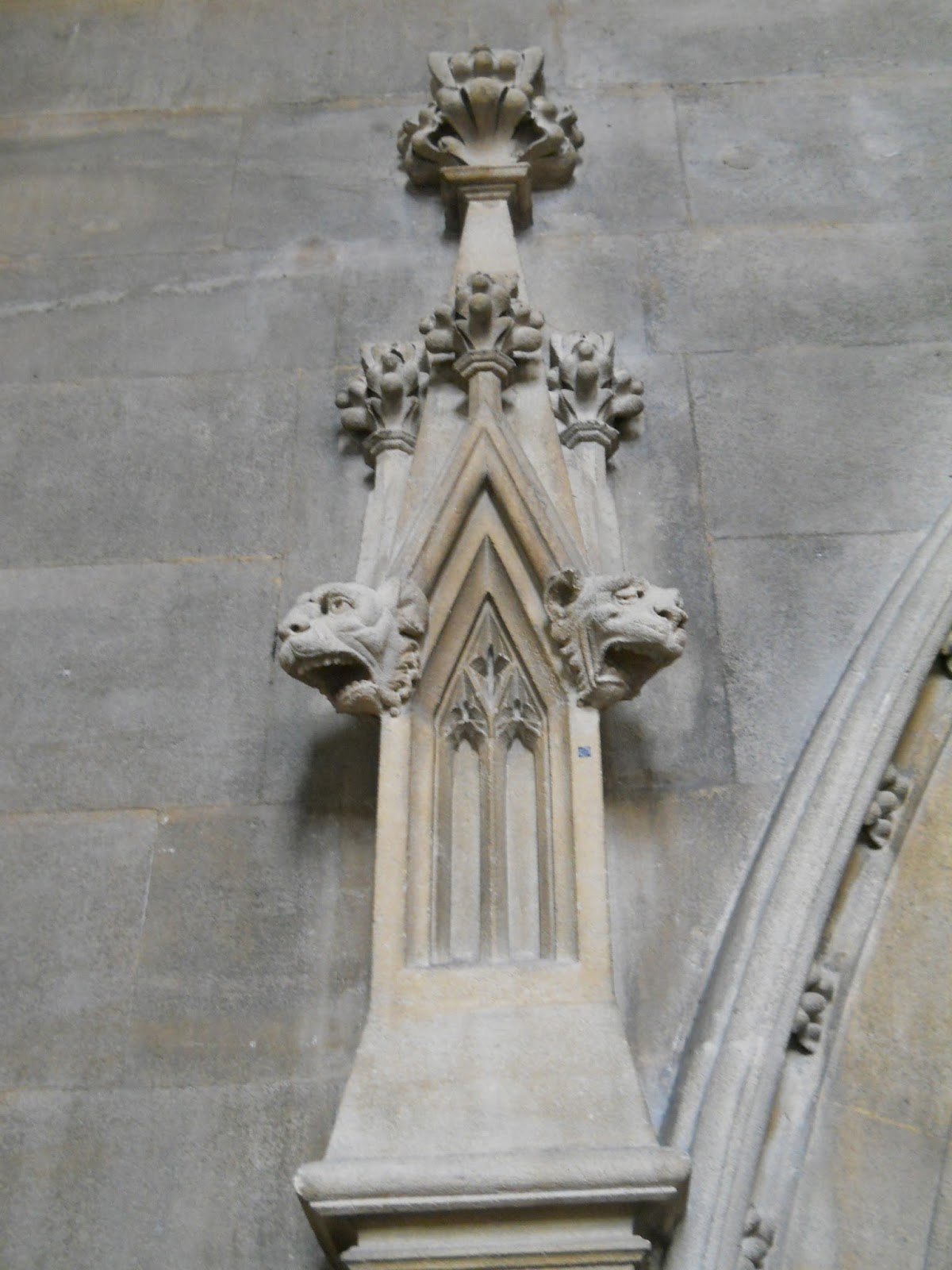
Up in one corner, overlooking the Bishop's crozier, is this slightly disturbing caricature. It isn't a waterspouting gargoyle. I wonder why her mouth is so wide open with it's tongue lolling out?


I love looking for the little characters hidden away in corners of these grand buildings by their carvers. Here's a few more to be seen in the Cathedral:


There are some beautiful examples of later carvings too, like this wonderful melancholy Victorian figure:


Like most old churches and cathedrals in Britain, this has had it's share of destruction wreaked upon it. One of the main causes of church demolition in this country, however, didn't have too much impact here. When Henry VIII broke up the Abbey in 1539 during the Dissolution of the Monasteries, the king decided that it would become one of his 'New Foundation' cathedrals. 

This was probably because Bristol's rich citizens lobbied him successfully. So the cathedral was simply rededicated, to the 'Holy and Undivided Trinity', then carried on with the building unscathed.  The medieval nave was in the process of being rebuilt at the time, but a new nave wasn't completed until G. E. Street designed one and it was constructed in 1868, although he retained and used the remaining medieval features sympathetically in the new structure. Perhaps the fact that the structure was being physically rebuilt on a large scale at the the time of the Dissolution gave Henry a more metaphorical reason to use it for his own plans?

Even though Henry didn't come in heavy-handed, the Puritans in the seventeenth century did. Some tombs still show the scars. See how all the faces on the praying knights at the bottom of this tomb from the early seventeenth century have been smashed off ( but not the face of the woman interred there):


In a chapel, one tomb commemorates how it was 'defac'd in the civil war':


Although other family members nearby seem to have got away fairly unscathed:


Unlike other religious buildings in Britain, the cathedral in Bristol was almost ransacked again in 1831, when rebuilding work was in progress. 

The cathedral's officers had voted against allowing most Bristolian people voting rights (only 6,000 out of a population of 104,000 had a vote at the time) and the angry mob were so incensed that they had to be held back by one of the staff at a doorway (you can bet he wasn't one of the officers that had helped cause the problem in the first place!) . The rioters did a lot of damage to the twelfth-century chapterhouse and it was during the renovation work afterwards that the Anglo-Saxon stone carving shown above was found, so some good came out of it in the end. 

Unfortunately, another example from history of the church being firmly on the side of the wealthy, the unpleasant and the corrupt.  I'm glad, however,  that the cathedral building and its beautiful artworks survived. Quite a few of the rioters didn't, but that's another story.

One end of the South Choir Aisle leads to the Eastern Lady Chapel. It was built in 1298 and has been restored many times, but is very colourful. Perhaps it gives an insight into how all cathedrals may have once looked, brightly painted and gilded?


In one wall is a recessed memorial, which is surrounded by an amazing starburst-shaped surround:


There are more like this along the South Choir Aisle:


The stone carvings in front of them are by Kevin Blockley, the Cathedral's archaeologist. He is based in Wales and was a fellow participant in the Bristol Festival of Stone. Many of the sculptures represent microscopic forms in nature, such as this one that he has carved from Iranian onyx:


As said before though, my main reason to visit was the collection of misericords, which date from 1515-1526 and were installed by order of Abbot Robert Elyot. There's plenty to say about them, so they are covered in another post which you can go to by following this link