As well as this blog, I also have a website and Instagram page with lots more images of my work as well as a few more stories.
If you like woodcarvings, you might want to have a look.
Showing posts with label ecclesiastical carvings. Show all posts

Monday, 6 April 2015

Saxon and modern stone carvings at the ancient church of St Laurence in Bradford-on-Avon

In the small town of Bradford-on-Avon, in the west of the county of Wiltshire, is one of the oldest churches in Britain. Despite evidence of subsequent alterations, some of them also ancient, it has been described as one of the most characteristic examples of a Saxon church in the country.


St Laurence's is certainly not a big building, but it contains some beautiful fragments of Saxon stone carving.
Image from http://en.wikipedia.org/wiki/File:St_Laurence%27s_Church.JPG
The church was mentioned as standing in 1120 CE (or AD, if you prefer) by the twelfth century historian William of Malmsbury. He thought that it was built in the time of St Adhelm (in 709 CE) although other evidence suggests that it dates to the early eleventh century. However, it may have replaced an earlier wooden structure.  It was surrounded by other buildings and used for other purposes, before being 'rediscovered' in the nineteenth century.


The space inside, containing three rooms linked by surprisingly narrow archways, is not large but it is high with small windows. It gives the stone-built chapel a distinctive feel, not showy but not humble either. The walls may have once been plastered and painted, perhaps also draped with hangings. In Saxon times, surrounded by timber buildings, a stone building of this size in a small town must have been pretty grand in itself.


Fragments of Saxon carved stone are dotted throughout. There are two carved angels high up on one wall, which may well have once been part of a larger sculptural frieze:

Image from http://history.wiltshire.gov.uk/community/getimage.php?id=321
The altar is made up of several bits of Saxon stonecarving found in the area. The richness of the carvings found in its vicinity has led to the suggestion that the chapel may once have held relics of a saint. The church's website says that;

'A charter of King Æthelred granted Bradford to the nuns of Shaftesbury in 1001, and the church’s architecture suggests it was built for the nuns early in the eleventh century. St Laurence’s is a characteristic Anglo-Saxon building: tall and narrow with small windows. The extent and richness of its decoration, however, are rare, perhaps suggesting it was designed partly for the relics of Æthelred’s brother Edward the Martyr, which were housed with the nuns at Shaftesbury.'

saxon stone carvings

In 2012, the sculptor John Maine installed a three-part piece in the chapel above the altar. I think that it looks perfect in the setting and complements it well. At the top is a ring of Doulting stone carved by Maine. Below that is a piece of fossilised tree trunk thought to be about 150 million years old and below that is a fragment from a Saxon carved cross.


Bradford-on-Avon has several other interesting buildings, including a tithe barn and an interesting old town bridge with a building on it that was used as a cell for a while. Unfortunately I couldn't get photos of them during my visit but it's nice to be able to share this one with you.

Friday, 6 September 2013

Carvings from the last nine hundred years, Bread ovens, Starburst Memorials and grotesques in Bristol Cathedral


Isn't it funny how one can spend years living next to something incredible and yet never take time to see it properly?

Today I visited the Cathedral in the centre of Bristol for only the second time. The main purpose was to see the misericords there, but there were plenty of other things to see as well...

Bristol Cathedral started out as the Abbey of St Augustine, which was founded in about 1140 AD by Robert Fitzhardinge. A lot of the building has been altered since then, but one of the most interesting surviving original parts is the Chapterhouse, which dates to about 1160. This is decorated with beautiful Romanesque carvings and was where the economic and political areas of the abbey's life would have been discussed.


The site was used for worship before the abbey was built, however. During restoration work on the chapterhouse, a stone tablet from Anglo-Saxon times was discovered under the floor. This stone carving dates from just before the Norman Conquest (in 1066) and depicts the 'Harrowing of Hell', with Jesus going to hell to rescue mortal souls sent there. It's one of the most important pieces of Anglo-Saxon art ever found in Britain and is now on display in the Cathedral.


The Cathedral is one of the world's best examples of a medieval 'hall church'. This means that all of the ceilings in the main area of the building (the nave, aisles and quire) are at the same height. This makes the whole building feel 'lighter'. The ceiling vaulting in parts of the cathedral is incredible. Take a close look at this section of the South Choir Aisle shown below, which was built in 1298. The vaulting rises in pyramids off the stone bridges across the aisle:


This vaulting is between the nave and the quire:


The small Berkeley chapel comes off the main area and was the private chapel for the Berkeley family, the descendants of Robert Fitzhardinge. Next to it is a sacristy, where the priests and others would prepare for Masses. It has several interesting features. In the middle is a bread oven. Not what you'd expect within a cathedral but this is where the communion bread was baked.


The ceiling of the sacristy has more fine vaulting; this time 'skeletal', with the ribs of the vaulting not filled in:


Up in one corner, overlooking the Bishop's crozier, is this slightly disturbing caricature. It isn't a waterspouting gargoyle. I wonder why her mouth is so wide open with it's tongue lolling out?


I love looking for the little characters hidden away in corners of these grand buildings by their carvers. Here's a few more to be seen in the Cathedral:


There are some beautiful examples of later carvings too, like this wonderful melancholy Victorian figure:


Like most old churches and cathedrals in Britain, this has had it's share of destruction wreaked upon it. One of the main causes of church demolition in this country, however, didn't have too much impact here. When Henry VIII broke up the Abbey in 1539 during the Dissolution of the Monasteries, the king decided that it would become one of his 'New Foundation' cathedrals. 

This was probably because Bristol's rich citizens lobbied him successfully. So the cathedral was simply rededicated, to the 'Holy and Undivided Trinity', then carried on with the building unscathed.  The medieval nave was in the process of being rebuilt at the time, but a new nave wasn't completed until G. E. Street designed one and it was constructed in 1868, although he retained and used the remaining medieval features sympathetically in the new structure. Perhaps the fact that the structure was being physically rebuilt on a large scale at the the time of the Dissolution gave Henry a more metaphorical reason to use it for his own plans?

Even though Henry didn't come in heavy-handed, the Puritans in the seventeenth century did. Some tombs still show the scars. See how all the faces on the praying knights at the bottom of this tomb from the early seventeenth century have been smashed off ( but not the face of the woman interred there):


In a chapel, one tomb commemorates how it was 'defac'd in the civil war':


Although other family members nearby seem to have got away fairly unscathed:


Unlike other religious buildings in Britain, the cathedral in Bristol was almost ransacked again in 1831, when rebuilding work was in progress. 

The cathedral's officers had voted against allowing most Bristolian people voting rights (only 6,000 out of a population of 104,000 had a vote at the time) and the angry mob were so incensed that they had to be held back by one of the staff at a doorway (you can bet he wasn't one of the officers that had helped cause the problem in the first place!) . The rioters did a lot of damage to the twelfth-century chapterhouse and it was during the renovation work afterwards that the Anglo-Saxon stone carving shown above was found, so some good came out of it in the end. 

Unfortunately, another example from history of the church being firmly on the side of the wealthy, the unpleasant and the corrupt.  I'm glad, however,  that the cathedral building and its beautiful artworks survived. Quite a few of the rioters didn't, but that's another story.

One end of the South Choir Aisle leads to the Eastern Lady Chapel. It was built in 1298 and has been restored many times, but is very colourful. Perhaps it gives an insight into how all cathedrals may have once looked, brightly painted and gilded?


In one wall is a recessed memorial, which is surrounded by an amazing starburst-shaped surround:


There are more like this along the South Choir Aisle:


The stone carvings in front of them are by Kevin Blockley, the Cathedral's archaeologist. He is based in Wales and was a fellow participant in the Bristol Festival of Stone. Many of the sculptures represent microscopic forms in nature, such as this one that he has carved from Iranian onyx:


As said before though, my main reason to visit was the collection of misericords, which date from 1515-1526 and were installed by order of Abbot Robert Elyot. There's plenty to say about them, so they are covered in another post which you can go to by following this link

Monday, 10 June 2013

Misericords and carvings in St Davids Cathedral, Pembrokeshire, Wales


St Davids Cathedral is tucked away in Britain's smallest city, St Davids in Pembrokeshire, which has a population of about 1,600 people.

There has been a church on the site since the sixth century. Work began on the present building in 1181 and the nave roof and ceiling were built between 1530 and 1540. It managed to avoid the worst of Henry VIII's destructive excesses during the Reformation, largely because it housed the remains of his ancestor Edmund Tudor, Earl of Richmond. However, Cromwell's parliamentarians destroyed much of it in 1648 (the same sad, familiar story as with many of Britain's greatest works of art that happened to be in places of worship) although it was restored in stages between 1793 and 1910.


I found it to have a 'cosier' feel than many of Britain's other cathedrals. It isn't as soaringly grand as some and the ceiling in the nave is made of wood, not stone. I really like the slightly humbler feel that I found there. The woodwork is pretty amazing as well!


The carved stones to the left and right date to the 10th or 11th century and the one in the centre is a patterned ring cross dating to the 9th or 10th century. They are kept in the gatehouse. William the Conqueror visited the church at St Davids in 1081 to pray and probably saw these stones.


These woodcarvings are next to the entrance into the nave. I'm guessing that they date to the renovations of the 19th or 20th century, but I don't know for sure.


This beautiful lantern ceiling is at the base of the tower and sits above the choir. The ceiling is medieval and the windows date to the 14th century. Nearby, standing over Edmund Tudor's tomb, is this painted ceiling which brightens up that part of the cathedral:


The wooden ceiling above the nave was carved from Irish oak in the 16th century and features carved pendants. The crucifix (or 'rood')  is a 20th century replacement of an earlier one.


One of my favourite parts of the cathedral are the carved wooden misericords in the choir stalls. These were carved in the late 15th century from oak. Dorothy and Henry Kraus, in their book 'The Hidden World of Misericords', comment on how many British misericords were produced during the fifteenth century and that they are notable for their precocity. At that time, the French or Belgian sets were inferior in quality to those being installed here.

The name 'misericord' comes from the Latin for mercy and they are little seats which allowed the clergy to rest whilst standing for long periods of time during services. According to the Krauses, there are 3500 catalogued misericords in churches, chapel, abbeys and cathedrals throughout Britain. The collection at St Davids is one of the larger ones.

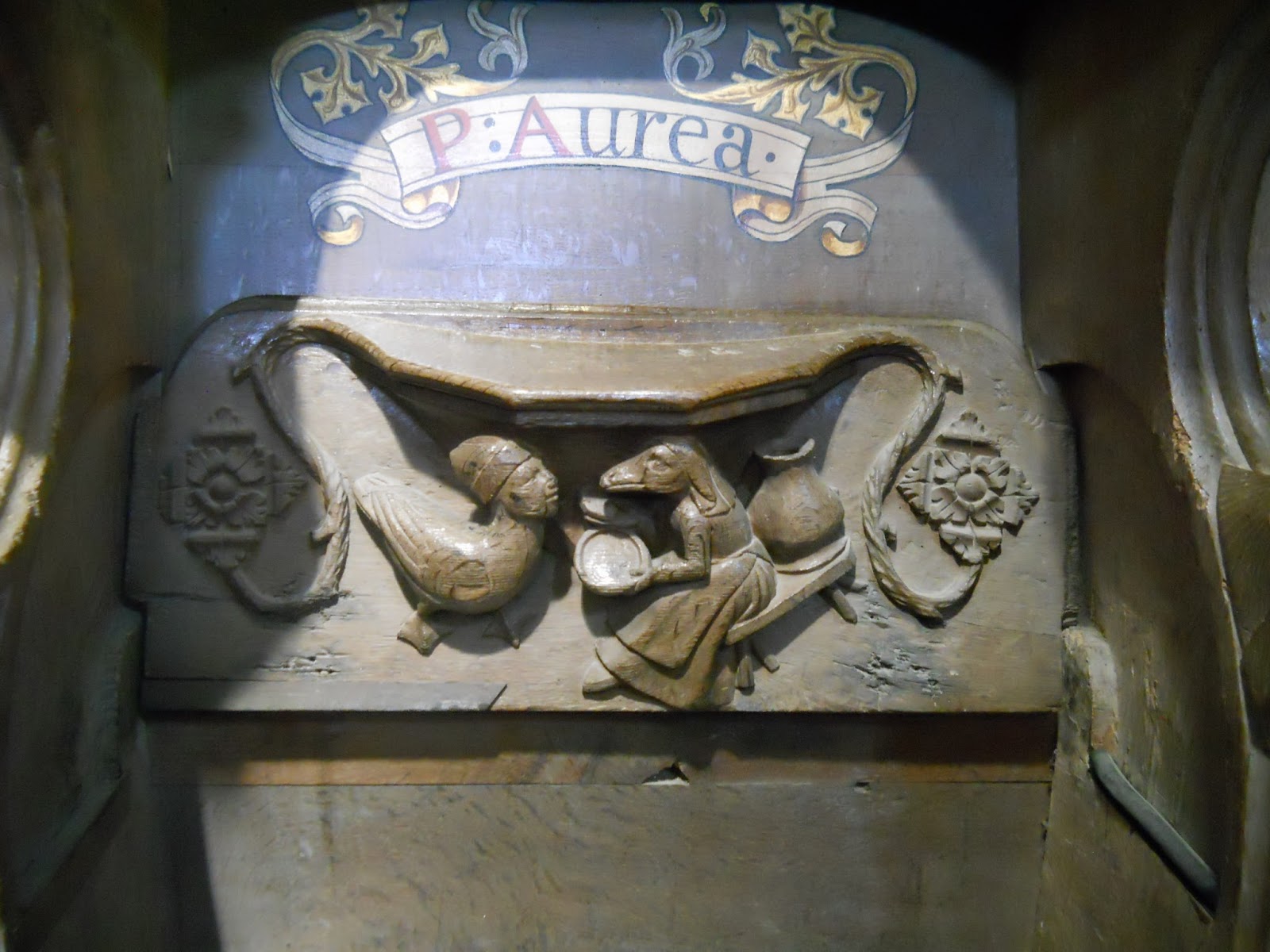
The seats fold back down, so the misericord carvings were rather hidden and medieval carvers could carve subjects that were not as reverential and religious as elsewhere in the cathedral. Instead, some carvings poke fun at the clergy or illustrate little moral tales. We don't know what some misericords illustrate, as the sayings or stories that inspired them have been lost, but they still give a fascinating glimpse into the minds of the medieval carvers who made them. 

The Krauses comment :
'That so much English underseat carving should have survived Protestant iconoclasm was no doubt due in large measure to the prevailingly secular subject matter.'

The lettering painted onto the backrests shows the names and offices of the medieval clergy who used those seats at one time.


Monday, 8 April 2013

Woodspring Priory and Tithe Barn. A medieval monastery converted into a Tudor house in North Somerset

Whilst delivering a super-kingsize bed recently (see the previous post!), I had the chance to visit Woodspring Priory. The original monastery on the site was founded in 1210 and housed monks belonging to the Victorine order of the Augustinian Canons. The land would originally have been on an island by the Severn Estuary (although I'm guessing that the ground inland would have been partially if not completely drained by the 13th century). The area is now a National Trust reserve called Middle Hope and is near Weston-super-Mare.


The founding patron of the Woodspring (or Worspring as it was then known) Priory was William de Courtenay. He was a grandson of Reginald FitzUrse, one of the murderers of Thomas à Becket. 

The founding of Woodspring Priory was probably a gesture of penance, especially as de Courtenay is thought by some to have brought his grandfather's remains to the monastery and reinterred them, possibly near the remains of some of the other murderers such as William de Tracey. 
There are regular archeological investigations in the surrounding fields as the grave has still not been found, although other stories claim that FitzUrse was buried in Jerusalem or in Ireland (after founding the MacMahon clan).

Woodspring was converted into a farmhouse in 1536, when king Henry VIII started to break up the monasteries in England during the Dissolution. The house was actually built into the old church. The large monastery windows were filled in with stone walls and smaller mullioned windows as part of this, to reduce their size. 

In 'Church Woodcarvings: A West Country Study', JCD Smith says that some of the misericords (carved wooden rests that folded away, for clergy to lean against during long services) that were originally in the Priory are thought to now be in the nearby church at Worle. They are beautifully carved and one shows a shield bearing the initials PRS, which probably stands for Prior Richard Sprynge who was prior of both Woodspring and Worle in 1443.


You can read more about the history of Woodspring by following this link:


It is interesting to walk around and see architectural features that have been removed or altered during that time, but it's also important to note that the buildings are on private land. The Priory is now owned by the Landmark Trust who hire it out as a place to stay, so their permission is needed to go into the grounds. There is a small museum onsite that the public can visit, but it has very irregular opening times. 
The 15th century Tithe barn is owned by the National Trust but is a working barn, used by the local farmer to store hay and machinery, Potential visitors should bear this in mind. Luckily, friends of mine live next door to the site and know the caretakers and the farmer, so we visited with them.

A carved figure holds a heraldic shield by a doorway into the garden
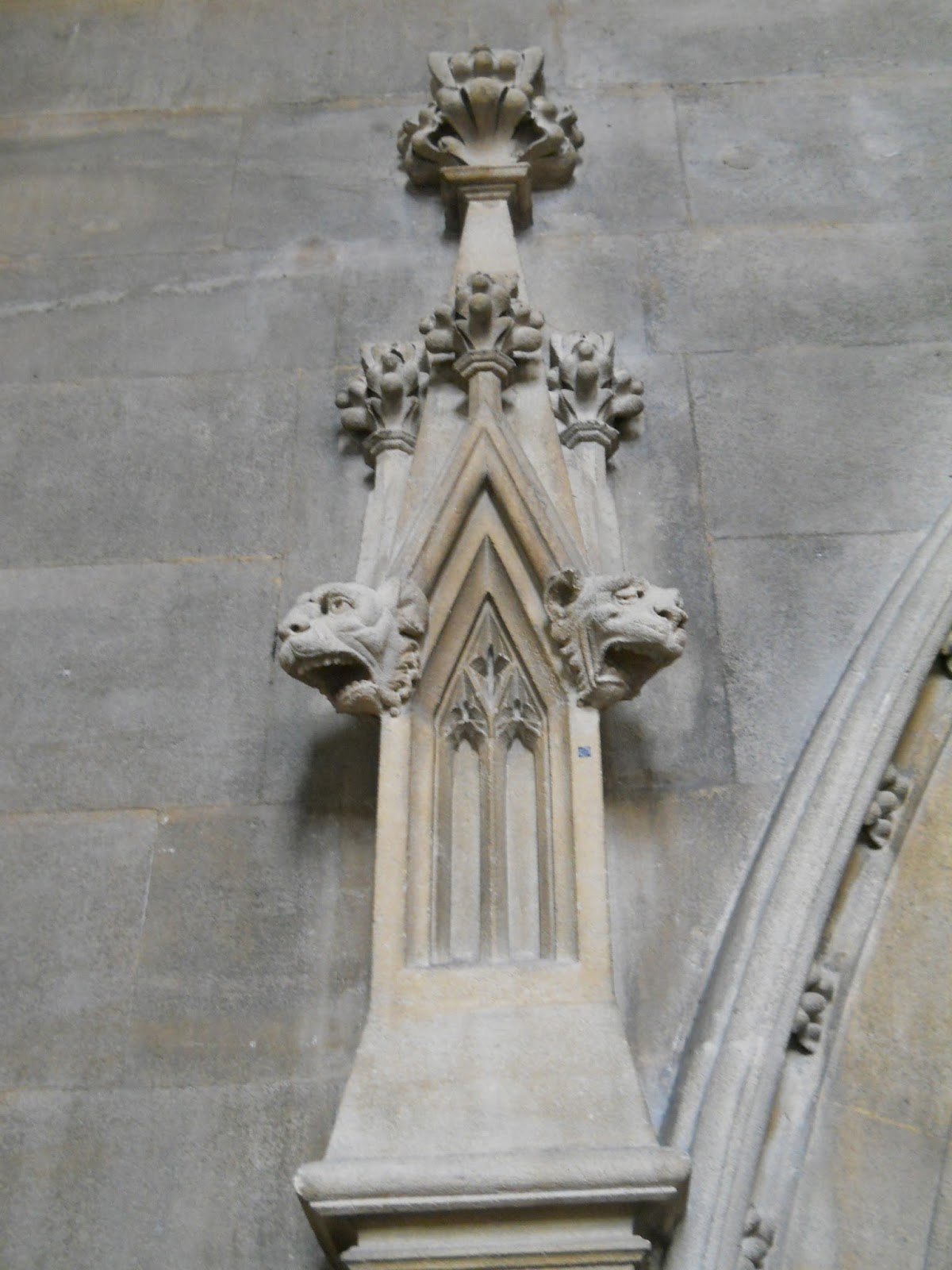
Corbels and Gargoyles run along a garden wall
The remains of a circular staircase can still be seen in the wall of the Infirmary


There are some interesting decorative woodcarvings inside the Priory, although I don't know if they were originally part of the Tudor house or not:


 The Tithe Barn


Next door to the Priory is the Tithe Barn, which has some beautiful timber work in it's roof, as does the Infirmary (which unfortunately I don't have photos of). It was built during the fifteenth century, when the monastery was at it's busiest.

Tithes were contributions to the church, usually a tenth of whatever the contributor had. This was often paid in a form that wasn't money, such as agricultural produce, so needed a big barn to hold it. My friends got married in the barn, hence the bales covered in red cloths, but it is still a working barn and usually holds hay and tractors.


If you would like to stay in or by Woodspring Priory and explore it further, my friends rent out a shepherd's hut next door. You can find out more by visiting their website:
The Landmark trust's website can be seen here: