As well as this blog, I also have a website and Instagram page with lots more images of my work as well as a few more stories.
If you like woodcarvings, you might want to have a look.

Thursday, 17 April 2014

Tout Quarry, Portland, Dorset. An open-air sculpture park full of artworks carved into the Portland and Purbeck limestones

tout quarry portland

Tout quarry is situated on the Isle of Portland in Dorset. Portland limestone is a very well-known building material and has been used in the construction of many iconic structures, including St Paul's Cathedral, the Tower of London and the British Museum in London and the UN building in New York.

Since 1983, the year after quarrying at Tout ended, stone carvers have made carvings there and many of them can be seen by visitors. The quarry is accessible for free at any time, so some of the early works have been vandalised or damaged, but there are over 70 that can be found by looking carefully around the network of quarry paths.


The quarry is now officially closed to new carvings being added to the rocks and is a nature reserve. Stone carving lessons are taught in a corner that has been set aside for tuition. We were lucky to visit on a beautiful sunny spring day and got some nice photos of some of the work at Tout. If you would like to visit the site, be aware that you will need some stout footwear as the ground is pretty uneven and also watch out for steep drops and falling rocks.  

I wish that it was possible to tell you who did every piece, but by the time we passed the information board above I was pretty lost myself!

still falling antony gormley

This is probably the most famous sculpture at Tout. It was carved by the well-known sculptor Antony Gormley and is called 'Still Falling'.


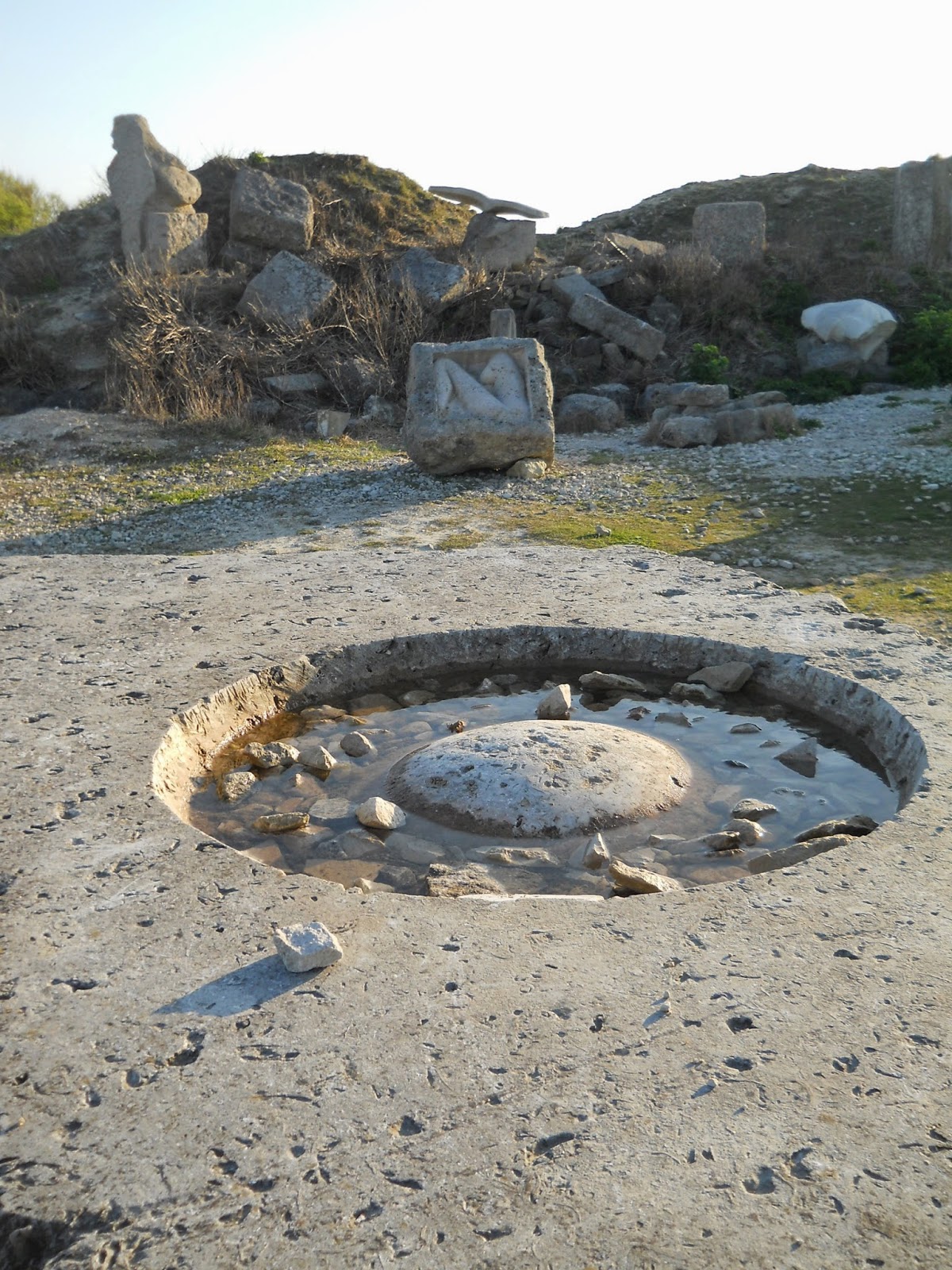
'Drinking Bowl' was carved by Jonathan Sells

'Fallen Fossil' by Stephen Marsden is one of my favourite sculptures at Tout...


...as are 'Ascent' by Joe Hamilton...


...and 'Window' by Justin Nicol, which really comes alive when the evening sun hits it.

Here are a few others that are hidden about the quarry. Many have been carved in secret, so the noticeboards won't tell you who made them.


A group of Dutch carvers called Groupe 85 come over every year and have special permission to work on some large sculptures in one corner of the quarry. 


This large sculpture of an octopus or kraken had traces of the crayon used to mark out the design still on it, so has been worked on fairly recently.

I hope that you have enjoyed this post, showing just a few of the many sculptures to be found whilst searching around Tout quarry. 


Balinese woodcarving tools

A friend recently returned from a trip to Bali and brought back some woodcarving tools that she purchased whilst there. Balinese woodcarvers are famous for their skill and the beauty of the work that they produce, so it's interesting to see the similarities and differences between these traditional carving tools and the European-style ones that I'm used to working with. Although this isn't the complete set, I thought it would be nice to share them with those of you who also have an interest in such things...


The chisels are designed to be mainly used with a small mallet (not shown, but similar to the one on the photo below) and are made from good-quality tool steel, without a wooden handle. The one on the right of the all-metal tools shown in the pictures is a flat chisel, the others have a slight sweep (curved cutting surface). They are tempered at the cutting end, so the edge is very sharp but the untempered steel behind it would give a bit of cushioning of blows and strength to the rest of the tool in use.

The gracefully shaped tool shown on the far right is very comfortable when held in the hand and is possibly the most unfamiliar-looking to a European carver. It functions a bit like a hook knife (or crooked knife). The blade is spear-shaped, with the point curled upwards. It also has a flat surface on one side and two cutting edges on the other, so that it can cut in either direction. This would be used to give a fine finish to the surface of a carving.

The axe is razor-sharp and feels great in use too. The haft (handle) looks as if it is made from Black Palm (also known as Black Palmyra) timber. This palm is commonly used throughout tropical Africa and Asia for a variety of purposes and the timber from the outer part of the main stem is dense and hard, becoming softer towards the centre. In this way, the palm is different from many other timbers that become denser towards the centre of the trunk.

Image by Jos Dielis from http://www.turisku.com/crafts/why-bali-handicraft/
As you can see from this photo, Balinese carvers tend to work sitting down and sometimes hold the wood being worked on between their feet. It's a method used all over the world but is quite different to the traditional European method, which involves standing at a bench or carving stand to work. I suppose that sitting on the floor wouldn't have been so appealing to medieval carvers in a cold, wet Northern European winter!

Tuesday, 8 April 2014

A Carved Inscription on Sue Darlison's 'Bridget's Smile' bench


Today, I went over to 'The Limes', a day centre for people with Alzheimer's in Bristol, to carve an inscription on a bench designed and made by Sue Darlison.

Sue is a very talented local designer maker as well as the curator of the 'Inspired' exhibitions, which have previously included some well-known exhibitors such as John Makepeace and David Colwell of Trannon furniture.

The bench is called 'Bridget's Smile,' as it was inspired by the smile of a lady who used to attend the centre. The seat and backrest are Cedar of Lebanon and the legs and backrest supports are Oak, all of which came from the local area.


I used a Dremel hand drill with a rotary burr to cut the letters, as it seemed to give a better effect with this font and also worked on the cedarwood more efficiently than hand tools, even very sharp ones.


The cedar gave a lovely smooth and polished finish when the lettering was finished, which can be hard to achieve when working on many other types of softwoods. Sue and I are sure that Bridget would approve.


Monday, 31 March 2014

Teaching carving for a stag do at my studio


On Saturday, four folks on a stag do came to my studio to do some carving. It was a lovely sunny day and it felt great to be back doing some woodcarving tuition again.


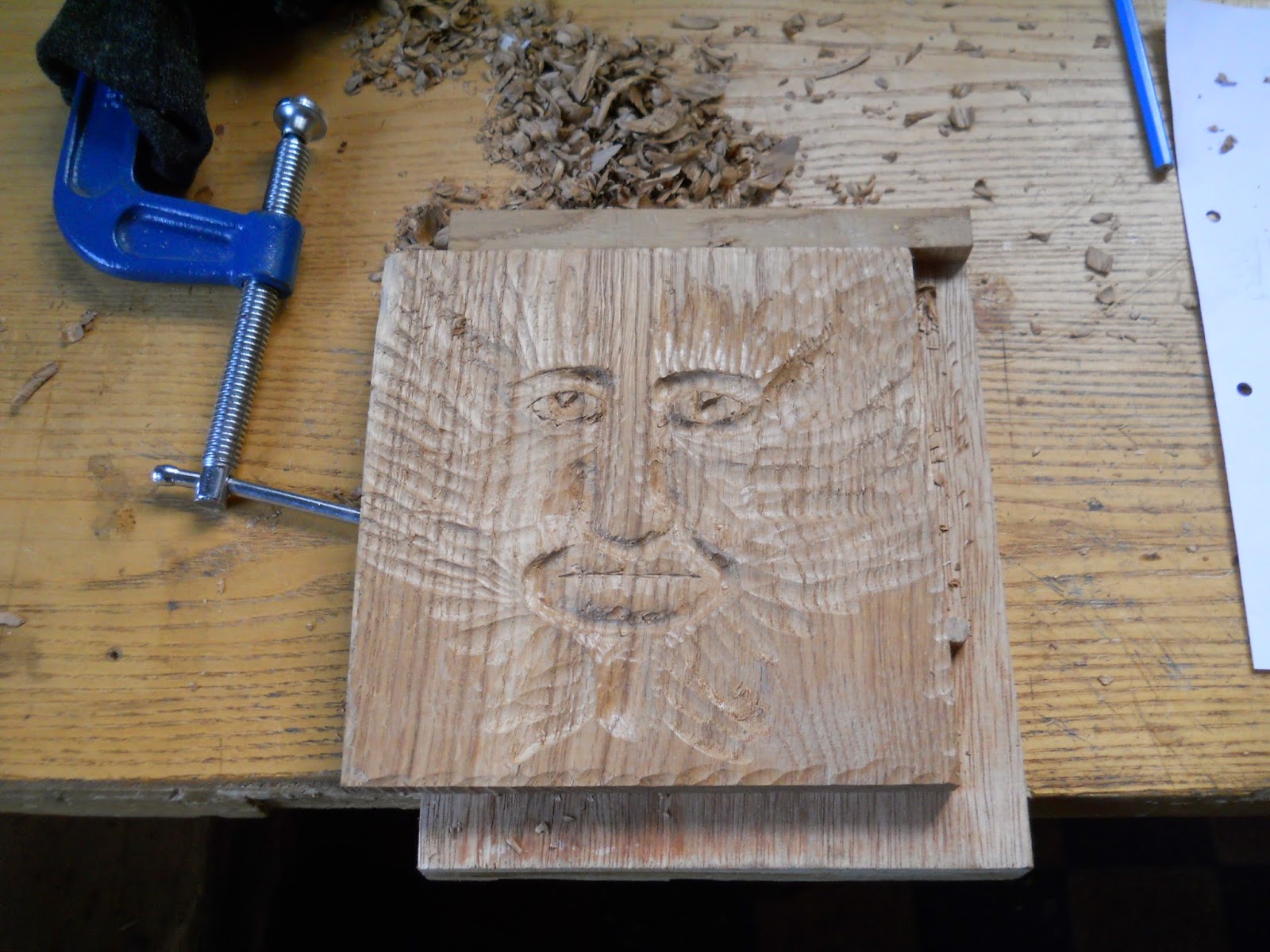
Garry and Hamon decided to carve faces in relief onto pieces of oak. They used a variety of gouges and chisels to create them and the finished pieces were very dynamic. We all felt that they worked well.


Pete and Lorraine chose to carve spoons from fruit woods (plum and cherry). This gave them the chance to use a mallet and froe, drawknife, hook knife, three kinds of fixed-blade and whittling knives, three types of small axe (Scandinavian-style hatchet, Kentish pattern and Swedish Carving) and spoon-bit gouges.

Pete really enjoyed using the Kentish pattern axe and Lorraine the drawknife. They both agreed that spoonbit (short bent) gouges worked far better for them than hook knives when hollowing out the spoon bowls.


It's great giving people the chance to try a range of tools to see for themselves how certain ones just feel better when working than others. Providing all of the tools on offer are of good quality, the most comfortable to use can sometimes really just depend on the user.

When I bought my carving axe, the sales advisor recommended that I hold all of the dozen available ones there to see which felt right for me. It was a real surprise to discover how different they all felt, even though they were all handmade by the same people to the same design.

Everyone got well into their carving and seemed very happy with what they made. Once the carving had finished, we ended the session with a little nip of homemade blackberry whiskey for the non-drivers. A lovely afternoon!

Friday, 28 March 2014

Last Day as Environmental Officer for Boiling Wells in St Werburghs, Bristol

Tuesday was my last day working as Environmental Officer at Boiling Wells in St Werburghs. I've been working there regularly in different roles for four and a half years, but now I have to go.

I must admit that I'll miss working there every week, Boiling Wells is a very special place. The last session went very well though. The group of volunteers who came to help worked hard with me on making some doors for the roundhouse on the site. Although we didn't have time to finish them, they will look great when done.


Maintaining the site will be left in the capable hands of Bill, the new Estates and Livestock manager for St Werburghs City Farm. Hopefully, I'll still be going down occasionally to help on certain projects.


If you'd like to know more about the site, here's a video that I made there a couple of years ago:


It seemed apt to be leaving at this time of year with a lot of the spring flowers, like these oxlips, just coming into bloom. Times of change, I wonder where the next adventure will lead...


Saturday, 8 March 2014

An atmospheric photo of my workshop

My friend Joe Williams is a talented photographer and got this shot of my workshop a few days ago. I really like it.


Friday, 28 February 2014

Sculptures that contrast carved areas with uncarved surfaces; The Idea emerging from the Uncarved Block


One of the most charged moments in producing many carvings, particularly when whittling a shape from a piece of rough timber, is the moment when the sculpture is cut away from the piece of wood from which it has been carved. Sometimes I have been really torn as to whether I should take that step, as the sculpted piece looks so right against the uncarved timber that it emerges from.


I want to talk, in this post, about a few other carvings in which original block to be carved is present in the final piece.

Perhaps some of the most famous examples are the unfinished marble sculptures by Michelangelo known as the 'Prisoners'. These were carved between 1525 and 1530. The one below is sometimes called the 'Awakening Prisoner', sometimes the 'Awakening Slave':

Image from:http://www.freethought-forum.com/forum/showthread.php?t=11589&garpg=7

It's not certain whether Michelangelo stopped working on them because the building project that they were intended for was reduced in scale (the tomb of Pope Julius II, which was never completed to the original designs). That is the the usual interpretation, but I wonder if he just decided that the sculptures expressed what he was looking for and left them at that. Michelangelo saw himself as freeing the image created in a sculpture from within the confines of the uncarved block and that is certainly the feeling that these marble sculptures get across.

According to Rick Steves (mentioned in http://thosecrazyschuberts.com);
'Michelangelo believed the sculptor was a tool of God, not creating but simply revealing the powerful and beautiful figures he put in the marble. Michelangelo’s job was to chip away the excess, to reveal. He needed to be in tune with God’s will, and whenever the spirit came upon him, Michelangelo worked in a frenzy, often for days on end without sleep.'

Another sculptor who used the shape of the rough, unfinished block in their final sculptures was Auguste Rodin. This sculpture, produced in 1898, is 'The Hand of God', sometimes known as 'Creation' or as 'The Hand of the Devil':


Image from:http://bycommonconsent.com/2011/05/08/religious-art-the-hand-of-god/


In common with a lot of famous sculptors, Rodin would have modelled the sculpture in clay and then one of his assistants would have carved it into the marble. However, Bernard Champigneulle wrote that  his use of uncarved areas in the design was influenced by Rodin's initial career as a stonecutter. He would have understood the 'exhilaration' that came from 'the tussle between man and recalcitrant matter, with the removal of stone which could never be replaced, with the contest between a hand-held tool and an inanimate block from which life was about to spring.' On possible influences for this design technique, Champigneulle noted that 'Rodin's visit to the unfinished tombs of San Lorenzo (partly designed by Michelangelo for the Medici family in Florence) had taught him that to leave some areas unfinished could enhance the impact of others. Where Michelangelo had left marble untouched because time did not permit him to complete his task, Rodin did so deliberately. The delicacy of his modelling benefited by this contrast, which displayed the sculptor's skill to even greater advantage.'

Gilles Néret says that 'Though accused of making excessive use of the unworked surface, Rodin was again far ahead of his time; he appealed to the imagination rather than to the roles of sculptural convention.' It was certainly a controversial technique and ruffled the feathers of the nineteenth-century art establishment.

Whilst chatting to Joachim Seitfudem (who carved the sculptures below), he noted that many traditional Bavarian limewood sculptures use the unworked surface of the log (with bark removed) to frame the carvings emerging from within. Jo's father is a master carver in Bavaria.


Giuseppe Penone is not specifically a woodcarver, but was one of the leading figures in the influential 'Arte Povera' movement that developed in Italy in about 1967. Artists associated with Arte Povera used inexpensive, often found, materials to make artworks. Penone was very interested in making sculptures that reconnected people to the natural environment and since the 1970's he has been making these sculptures, in which a growth ring inside a wooden beam is revealed by carefully cutting away the wood around it. 


This reveals an echo of  the tree at one point in its growth. In 'The 20th Century Art Book' published by Phaidon, each of these works is identified as 'an act of reclamation, an attempt to discover the natural shape of the tree within the man-made form.'


The resulting sculptures seem to me to share a lot in common with the others shown in this post and must be every bit as painstaking to produce. Sometimes, Penone would make the work in a gallery during the course of an exhibition.

Image: Sphilbrick from wikimedia.org

One piece of sculpture that really made an impression on me when I first saw it is 'Hinewai Calling from the Mist' by the New Zealand sculptor Paul Deans. The piece is carved from an old, found gatepost and illustrates a Maori legend about 'Uenuku and the Mist Girl', which you can read by clicking on this link to a previous post on this blog.


Image courtesy of Paul Deans


Apart from the great, dynamic use of contrast between the smoothly carved areas, areas of toolmarks and the rough, weathered original surface of the post, the way that the rough texture of the weathered timber is used to portray the thick mist around the face really appeals to me. 
Maskull Laserre, who is based in Montreal, Canada, carves delicate forms emerging from everyday objects. I like the way that he will use more than one object put together to form the timbers into which he carves. Maskull works mainly with power tools to get these delicate sculptures. Personally, I'd prefer to see some of the carved skeletal shapes sculpted to a smoother, finer, more bone-like finish so that they would stand out more clearly from the tool marks in the timber around them. That doesn't take away from the fact that it's a great idea and these pieces are getting a lot of well-deserved attention at the moment.


http://www.thisiscolossal.com/2013/01/maskull-lasserre/

Finally, here's another one of my sculptures from about 1998. It was carved from a weathered piece of beech wood found in Derbyshire's beautiful Peak District. At the time, I was interested in imagining a world where every detail could be synthetically created, down to stones and pieces of wood, so that they could also have 'intelligence' and interact with their environment.


So, sometimes areas of a sculpture might be left uncarved as part of the story that the sculptor is trying to convey, sometimes those areas frame carved areas and sometimes those areas are just the result of the project being unfinished. The narrative and aesthetic tension that Rodin tried to convey, between carved and uncarved surfaces, still seems to be an important reason for carvers including this contrast in a design. 
Perhaps another attraction for a carver is that the sculpture emerging from the block allows them to reveal another narrative, that of the work that went into producing such a carving, in a way that a completely finished sculpture might not show.
There is also something very compelling about seeing the carved work emerge from the block. It is like a glimpse of the making process, a way for the viewer to connect more closely with the hands of the maker.