As well as this blog, I also have a website and Instagram page with lots more images of my work as well as a few more stories.
If you like woodcarvings, you might want to have a look.
Showing posts with label Bavarian woodcarving. Show all posts

Saturday, 24 September 2016

The woodcarving tradition of the Ammergauer Alps: visiting Oberammergau and Hans-Joachim Seitfudem's studio in Bad Kohlgrub

oberammergau woodcarvings

The town of Oberammergau is in Bavaria, the most south-easterly state in Germany, not far from the border with Austria. It is famous for the Passion Play, which depicts the suffering and death of Jesus and has been staged there every ten years since 1634. 

The town and the area around it are also renowned for the woodcarving tradition that predates the first performance of the play. In 1508, the Florentine statesman Francesco Vettori visited Oberammergau and described it as a 'very healthy but poor village, where most of the inhabitants were fine woodcarvers. The villagers were famous for carving crucifixes and different scenes inside a walnut shell.' These kinds of sculptures are still produced today; this example was carved by Joachim Seitfudem:


carving in a walnut shell by Joachim Seitfudem


In the 18th century, the woodcarvers from this area would travel around Europe carrying a distinctive type of rack called a 'Kraxe', on which they carried carvings for sale. 


Kraxentrager statue

The peddler, called a 'kraxenträger', is a figure whose hard work and resilience is still celebrated in the area today, both in public statues and in sculptures by contemporary carvers.


Oberammergau kraxenträger

Kraxenträger


Carvings made in Oberammergau can still be seen in many places outside of the area, even in Britain. This nineteenth-century crucifixion scene in the church of St Carantoc, near Newquay in Cornwall, is an example of a piece made by carvers based there.


There are quite a few shops selling woodcarvings in Oberammergau and I visited several of them. It was interesting to see that certain figures and subjects came up again and again. The kraxenträger is one, as is the crucifixion of Jesus, St George slaying the dragon, St Hubertus (who is associated with hunters) and of course Nativity scenes, amongst others. Another secular subject that particularly interested me were the many figures of morris dancers, taken from famous original versions which were carved in 1480 by the Munich-based sculptor Erasmus Grasser.


Erasmus Grasser morris dancer

In one shop, the staff were happy to explain about the process of making the carvings. 


They said that their sculptures were still carved in Oberammergau, however the pressure of producing enough to satisfy demand at a reasonable price meant that most were now made using a pantograph (a copying machine) rather than by hand. A bronze master figure was produced and used to create other figures, which could be scaled up or down by setting the machine differently. Such devices have been in use for centuries and, in a world of computer controlled processes, machines working from a metal master figure are quite traditional in themselves. Once carved, the figures would be checked and finished with wax or painted by hand. 

I have been told, by another local carver, that German law also says that if a sculpture has had at least ten percent of the work done by hand, it can be sold as 'hand carved'. 

Some larger figures will be roughly shaped using a computer-controlled routing device and then carved by hand over a period of two or three days to speed things up. To be honest, this seems fair enough to me in a commercial context. Most carvers would use machinery, such as a bandsaw, to roughly shape a sculpture nowadays and the hand carving would still require a lot of skill to execute well.

The same person told me that some of this carving work is sometimes also done outside of Germany, in countries such as Rumania, then sold by retailers in this area as locally-made. I don't believe that the shop shown above does this but apparently some other, less honest, places do. 


I saw three kinds of wood being used to produce carvings. Larger ones and hand-carved small figures were produced using timber from the lime or linden tree (Tilia sp.), as it is soft and easily worked. Smaller carvings, especially those made by using a pantograph, were also often made from the harder timber of sycamore (Acer pseudoplatanus), which is called 'Ahorn' in German. Traditionally, this would usually be sourced from the South Tyrol region of Italy, but nowadays it sometimes had to be bought in from further afield. In one shop, a small number of carvings were made from pine or larch timber. This didn't seem to be a common practice although I did see an interesting grave marker, also carved from softwood, in a graveyard in the nearby village of Bad Kohlgrub.


Bavarian carved wooden grave marker

This region is quite staunchly Catholic and many woodcarvings of saints, Jesus or Mary his mother could be seen on local shrines or around important features such as springs of drinking water.
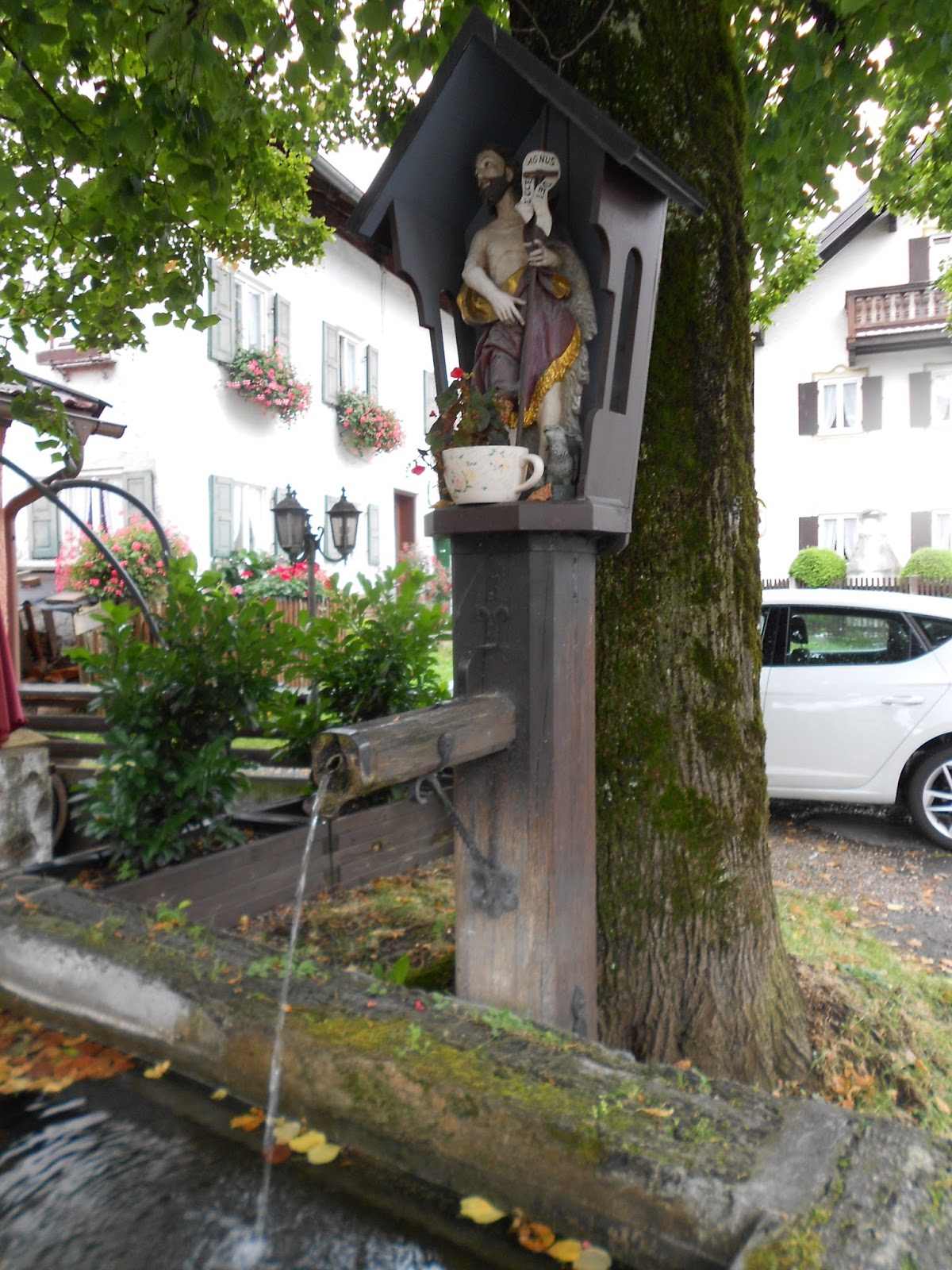

Bavarian woodcarving

To make the wooden carvings ready to be placed outdoors, they are coated with layers of a special compound made from three different kinds of powdered chalk, one of which is Champagne chalk from France. The number of coats used varies between three and seven, with each layer being allowed to dry and then carefully sanded before the next is applied, so that the finer details of the carving aren't obscured. The figure can then be painted and gilded.


The village of Bad Kohlgrub is not far from Oberammergau. One of the most respected local woodcarvers lives and works here; Hans-Joachim Seitfudem. This is his shop:


Hans-Joachim Seitfudem's shop

I was in the village to celebrate the wedding of his son, Joachim, who is also a woodcarver. Jo kindly explained a lot about his father's work, as Hans-Joachim is friendly but speaks very little English and my knowledge of German is not much better.


Unlike the larger woodcarving outlets in Oberammergau, Hans-Joachim does the majority of his carving by hand using linden timber and does not use replicating machines. He is an extraordinarily quick and skilled worker, having explained to Jo that a carver must be fast to make a living.


I was very interested to notice that, even though all his work is done by hand, two sculptures of the same subject would be almost identical. 


There wasn't much in the way of reference material visible around the work area, so I suppose that this must come from familiarity with and repetition of the carving process over decades of work and knowledge passed on from master to pupil. All of the other carvers that I spoke with in the area knew of Hans-Joachim and respected his work very highly.


Smaller figures would have hands and sometimes forearms carved separately, then glued to the rest of the figure using a dowel for strength. This meant that the wood grain could run along both the legs and the hands, making them stronger and less likely to snap.


Hans-Joachim is one of the last master carvers in the area to have had apprentices. It is very expensive for a master woodcarver to train an apprentice, so most young people who wish to learn the trade nowadays go to a carving school. The majority of them are not from the local area, coming instead from other places to study because of the reputation that Oberammergau has. However, it was said to me that the quality cannot be expected to be the same: learning from a real master being far superior.

I did notice that the work of younger carvers that I saw in Oberammergau was often technically excellent, but that attempts to produce their own style often seemed to lack self confidence. Many would emulate other styles and it led me to wonder if the strong tradition of the area held them back from really exploring new forms of expression in woodcarving. At the same time, carving has been around for thousands and thousands of years and has been practised all over the world. It can be a struggle for any carver to find new approaches to it.

Thanks to Jo, Hans-Joachim, Toni and to all of the carvers of the Ammergau Alps who shared their knowledge with me. 

Wednesday, 4 March 2015

Meeting Hans-Joachim Seitfudem, master woodcarver from Bavaria, at my studio

Yesterday, my friend Jo Seitfudem brought his father Hans-Joachim to visit me at my studio. It was great to meet him. Hans-Joachim is a master carver in Bavaria, with clients who have previously included the Vatican.

hans-joachim seitfudem

Although Hans-Joachim speaks very little English and my German is very poor, Jo could translate and his father was keen to look around the workshops at Bower Ashton and to see my woodcarving tools. It was easy to see that the wood dust and tools were getting him itching to do some carving himself! He also noted how he likes older British-made carving tools such as Addis and Herring Bros.


My Opinel carving knife felt too large in his hands though; Hans-Joachim said it felt 'dangerous' to him when he used it after his own, smaller carving knife. He also likes to have the cutting edges of his V-tools swept back from the tip, whereas Jo and I prefer them to be square to the tip. Carvers generally do seem to develop a strong preference for how their tools should be shaped. Many experienced carvers that I've met don't lend out their personal carving tools for this reason - breakages and bad resharpening can ruin friendships (although I don't know if Hans-Joachim feels that way).

Hans Joachim said some very kind things about the carvings on the bench for the Bristol Downs that I've been working on recently. He also liked the 'Predator bird' sculpture that he saw in my portfolio.


It was a very enjoyable afternoon and it was very interesting to hear what Hans-Joachim had to say thanks to Jo's translating. I just wish that my German language skills were better!

Friday, 28 February 2014

Sculptures that contrast carved areas with uncarved surfaces; The Idea emerging from the Uncarved Block


One of the most charged moments in producing many carvings, particularly when whittling a shape from a piece of rough timber, is the moment when the sculpture is cut away from the piece of wood from which it has been carved. Sometimes I have been really torn as to whether I should take that step, as the sculpted piece looks so right against the uncarved timber that it emerges from.


I want to talk, in this post, about a few other carvings in which original block to be carved is present in the final piece.

Perhaps some of the most famous examples are the unfinished marble sculptures by Michelangelo known as the 'Prisoners'. These were carved between 1525 and 1530. The one below is sometimes called the 'Awakening Prisoner', sometimes the 'Awakening Slave':

Image from:http://www.freethought-forum.com/forum/showthread.php?t=11589&garpg=7

It's not certain whether Michelangelo stopped working on them because the building project that they were intended for was reduced in scale (the tomb of Pope Julius II, which was never completed to the original designs). That is the the usual interpretation, but I wonder if he just decided that the sculptures expressed what he was looking for and left them at that. Michelangelo saw himself as freeing the image created in a sculpture from within the confines of the uncarved block and that is certainly the feeling that these marble sculptures get across.

According to Rick Steves (mentioned in http://thosecrazyschuberts.com);
'Michelangelo believed the sculptor was a tool of God, not creating but simply revealing the powerful and beautiful figures he put in the marble. Michelangelo’s job was to chip away the excess, to reveal. He needed to be in tune with God’s will, and whenever the spirit came upon him, Michelangelo worked in a frenzy, often for days on end without sleep.'

Another sculptor who used the shape of the rough, unfinished block in their final sculptures was Auguste Rodin. This sculpture, produced in 1898, is 'The Hand of God', sometimes known as 'Creation' or as 'The Hand of the Devil':


Image from:http://bycommonconsent.com/2011/05/08/religious-art-the-hand-of-god/


In common with a lot of famous sculptors, Rodin would have modelled the sculpture in clay and then one of his assistants would have carved it into the marble. However, Bernard Champigneulle wrote that  his use of uncarved areas in the design was influenced by Rodin's initial career as a stonecutter. He would have understood the 'exhilaration' that came from 'the tussle between man and recalcitrant matter, with the removal of stone which could never be replaced, with the contest between a hand-held tool and an inanimate block from which life was about to spring.' On possible influences for this design technique, Champigneulle noted that 'Rodin's visit to the unfinished tombs of San Lorenzo (partly designed by Michelangelo for the Medici family in Florence) had taught him that to leave some areas unfinished could enhance the impact of others. Where Michelangelo had left marble untouched because time did not permit him to complete his task, Rodin did so deliberately. The delicacy of his modelling benefited by this contrast, which displayed the sculptor's skill to even greater advantage.'

Gilles Néret says that 'Though accused of making excessive use of the unworked surface, Rodin was again far ahead of his time; he appealed to the imagination rather than to the roles of sculptural convention.' It was certainly a controversial technique and ruffled the feathers of the nineteenth-century art establishment.

Whilst chatting to Joachim Seitfudem (who carved the sculptures below), he noted that many traditional Bavarian limewood sculptures use the unworked surface of the log (with bark removed) to frame the carvings emerging from within. Jo's father is a master carver in Bavaria.


Giuseppe Penone is not specifically a woodcarver, but was one of the leading figures in the influential 'Arte Povera' movement that developed in Italy in about 1967. Artists associated with Arte Povera used inexpensive, often found, materials to make artworks. Penone was very interested in making sculptures that reconnected people to the natural environment and since the 1970's he has been making these sculptures, in which a growth ring inside a wooden beam is revealed by carefully cutting away the wood around it. 


This reveals an echo of  the tree at one point in its growth. In 'The 20th Century Art Book' published by Phaidon, each of these works is identified as 'an act of reclamation, an attempt to discover the natural shape of the tree within the man-made form.'


The resulting sculptures seem to me to share a lot in common with the others shown in this post and must be every bit as painstaking to produce. Sometimes, Penone would make the work in a gallery during the course of an exhibition.

Image: Sphilbrick from wikimedia.org

One piece of sculpture that really made an impression on me when I first saw it is 'Hinewai Calling from the Mist' by the New Zealand sculptor Paul Deans. The piece is carved from an old, found gatepost and illustrates a Maori legend about 'Uenuku and the Mist Girl', which you can read by clicking on this link to a previous post on this blog.


Image courtesy of Paul Deans


Apart from the great, dynamic use of contrast between the smoothly carved areas, areas of toolmarks and the rough, weathered original surface of the post, the way that the rough texture of the weathered timber is used to portray the thick mist around the face really appeals to me. 

Maskull Laserre, who is based in Montreal, Canada, carves delicate forms emerging from everyday objects. I like the way that he will use more than one object put together to form the timbers into which he carves. Maskull works mainly with power tools to get these delicate sculptures. Personally, I'd prefer to see some of the carved skeletal shapes sculpted to a smoother, finer, more bone-like finish so that they would stand out more clearly from the tool marks in the timber around them. That doesn't take away from the fact that it's a great idea and these pieces are getting a lot of well-deserved attention at the moment.


http://www.thisiscolossal.com/2013/01/maskull-lasserre/

Finally, here's another one of my sculptures from about 1998. It was carved from a weathered piece of beech wood found in Derbyshire's beautiful Peak District. At the time, I was interested in imagining a world where every detail could be synthetically created, down to stones and pieces of wood, so that they could also have 'intelligence' and interact with their environment.


So, sometimes areas of a sculpture might be left uncarved as part of the story that the sculptor is trying to convey, sometimes those areas frame carved areas and sometimes those areas are just the result of the project being unfinished. The narrative and aesthetic tension that Rodin tried to convey, between carved and uncarved surfaces, still seems to be an important reason for carvers including this contrast in a design. 
Perhaps another attraction for a carver is that the sculpture emerging from the block allows them to reveal another narrative, that of the work that went into producing such a carving, in a way that a completely finished sculpture might not show.
There is also something very compelling about seeing the carved work emerge from the block. It is like a glimpse of the making process, a way for the viewer to connect more closely with the hands of the maker. 

Saturday, 5 October 2013

Chatting with Joachim Seitfudem about the Bavarian woodcarving tradition (and lots of other stuff)

I dropped by today to visit Jo in his studio at The Island in the centre of Bristol. It was great to catch up with him and to see two panels that he has recently carved in the traditional Bavarian style. He learned much of his craft from his father Hans-Joachim Seitfudem, who is a master carver there.


Jo is currently making more contemporary-styled work but said that fancied carving the panels to make sure that he doesn't lose the skills that he learnt in Bavaria from his father.


They are both carved from lime (linden) wood. It's interesting to see how he gets the shapes on the relief panel by cutting planes into the timber; flat surfaces that add up to give the curved surfaces making up the design. He also much prefers a finish that shows the tool cuts, rather than one that is sanded. We agreed that the latter can look very 'plasticky' if done badly.


Jo noted that things tend to be in threes in Bavarian carving (see the three dogs in the panel). He also showed me a small figure that he carved under his father's guidance when he was about fifteen or sixteen years old. His dad gave his a small carving knife and told him to whittle it using that and no other tools. It seems like a good way to learn the importance of working with the wood without relying on your tools to do everything for you.


Against what the general advice to people looking for whittling knives seems to be, I noticed that the carving knife that Jo uses has a sharply curved bevel on both sides, so that it is almost sharpened to have two angles of bevel on each side. It was originally his father's. Usually, the advice in most articles or blogs is that the knife should have a single bevel, sloping from the back to the cutting edge.  My own knife is similar to his in that there is a second, steeper, bevel to the blade. The steep bevels mean that the knife travels naturally out of the cut towards the surface, rather than wanting to travel straight on into the timber. A knife with this steep bevel can do some pretty fine work too:


We also had an interesting chat about the guild system in Bavaria. Woodcarvers have a guild system there, like carpenters and many other traditional trades. The carvers can also follow a journeyman path, where they study with at least two master carvers before making a 'master piece' to become a master themselves (if the master piece is good enough). Traditionally, only master carvers could open a workshop so the quality of work in the trade was kept high. Jo said that he did not complete his training to master level, mainly because it is quite expensive (about 10,000 euros).

Guild journeyman carvers dress, like other wood-based trades, in black with a black hat. The earring that they wear in the left ear is of gold, with a small carving tool (gouge, mallet etc.) that they have carved from wood fixed to it. Like other woodworking  guilds the ear is pierced using a rusty nail, which the journeyman will then carry on them often in their hat band. We discussed how sad it is that the traditional skills have become more fractured in Britain, which does not have a guild system in the same way. There is a 'Guild of Master Carvers' in existence here, but it is a very different kind of thing.

Jo has a show in Bath at the 44AD gallery from the 7th to the 13th of October 2013. You can see some of his current work from a previous show here.

Thursday, 28 March 2013

Visiting Joachim Seitfudem's 'Zeitgeist' exhibition: a contemporary twist from a background of traditional Bavarian woodcarving

Today I visited an exhibition at a small pop-up gallery on College Green in Bristol called 'Zeitgeist'.
The exhibitor, Joachim Seitfudem, is a woodcarver from Bavaria who is now living in Bristol and whose father, Hans-Joachim Seitfudem, is a well-respected master carver in the Bavarian tradition.

It was very interesting talking to Joachim about how his father encouraged his carving from an early age. A lot of the woodcarving from that area depicts religious subjects, which isn't surprising when you consider that one of the main towns near the place that he grew up in is Oberammergau, famed for it's Christian passion plays (theatre re-enacting the suffering and death of Jesus).

A work in progress in the corner of the exhibition

In Britain, the religious upheavals following the Reformation during the 16th and 17th centuries mean that there isn't a continuous heritage of ecclesiastical carving. A lot of older church carvings were also deliberately destroyed by the Puritans, in their general campaign to make the country a more 'pious', drabber and more boring place. How many carvers must have lost their livelihoods or gone abroad in those times, when regular carving work must have been hard to find?

It's interesting to see, as a woodcarver, how the carving tradition is followed in areas like Bavaria or Austria which weren't subject to the same kind of disruptions as those experienced here. Joachim said that his father encouraged his carving from an early age, giving him exercises like carving a piece using only one gouge and sometimes destroying his son's pieces that weren't up to scratch (sounds brutal, but you certainly wouldn't make the same mistakes twice!) Some of these early exercises are on show in the corner of the gallery.


Carving figures in deep relief inside a piece of wood, surrounded by a 'frame' of unworked wood, seems to be feature of a lot of Hans-Joachim's work, although he also produces a lot of beautiful works in the round. Some of his son Joachim's early studies, like those shown above, also show this presentation style. 

All of the carvings in the exhibition are executed in linden, or lime, wood (Tilia sp.) More recent work by Joachim in the exhibition combines  the woodcarvings with found objects, mainly clock parts or pieces of bog oak, to make artworks with a much more contemporary feel to them. It can sometimes be hard to get metal and wood to work well together, but the old brass clock mechanisms work well with the lime wood. For some reason patinated, old metal often seems to work better visually with wood than shiny new metal to my eyes. The carvings show how Joachim's father's teaching and his traditional carving background have given him a strong sense of the human form, which the exaggerated musculatures of some of the figures in the more contemporary-styled pieces really display.


If you would like to see the exhibition, it is on until the 2nd April. You can see more of Joachim's work on his website at www.seitfudem-sculptor.com