As well as this blog, I also have a website and Instagram page with lots more images of my work as well as a few more stories.
If you like woodcarvings, you might want to have a look.
Showing posts with label history of woodcarving tools. Show all posts

Sunday, 25 March 2018

The story of a saw

w tyzack and sons and turner saw

Like many woodcarvers and other woodworkers, I have a lot of old tools: some with names of previous owners stamped on them. Sometimes I wonder about these tools. Were they once used to produce pieces that I have admired in some great cathedral or stately home by a journeyman worker whose name is now forgotten?

It's rare that the story of one of these tools turns up unexpectedly. That happened with this saw. 

It is a tenon saw made by the firm of W Tyzack, Sons and Turner. The blade is stamped with the words 'Made specially for John Hall, High St, Bullring, Birmingham'.


antique tenon saw

I inherited the saw from my grandfather Norman. Although still pretty sharp, it had some damage to the handle and so I've displayed it on the wall of my workshop, rather than risk further damage in use.


Norman

Norman was brought up in the slums of Birmingham and wrote about his early years in a few short essays, a copy of which has been preserved in the city archives. I'd never read it until last week.

One of the chapters talks about the Bull Ring, the market area of Birmingham at the time. In a paragraph, the story of the saw came to life:

'Higher up in High Street, stood a gas-lit ironmongers, John Hall. It was from this shop that my father, who had just started work at a cabinet makers, bought his first saw. It was brass-backed and cost three shillings and sixpence, which he paid off at sixpence per week. This saw, of a quality not found today, Is now about 90 years old (author's note: this was in 1989) and is a prized possession in my tool kit.'

I never knew that Fred, Norman's father, was ever a cabinet maker and nothing that he made has been passed down in the family to my knowledge. 


Both men have now passed away (Fred before I was born) but I feel closer to both of them when I look at this saw.

Monday, 15 January 2018

Making replicas of the earliest objects made by woodturning ever found in Britain, from Whitehorse hill on Dartmoor

I like woodturning. It's a nice compliment to my carving work and there's also something that feels quite relaxing about putting the tools to the spinning timber and watching the shapes develop.

There have been a couple of commissions recently that have allowed me to do some turning and which have also been a little more challenging. Making some of the components for the instruments that are now installed in St Werburghs Community Centre meant turning larger pieces than I've worked on before. 

Woodturning on Myford ML8 lathe

I was also asked by a local furniture maker called Dave Porter to turn eight discs, 60mm (2.36") wide, from European oak to decorate some furniture that he was making. It was a nice test of skill to try and make the discs as similar as possible, whilst turning them by hand. Both of us were happy with the outcome. Here they are, with one spare:


woodturning oak

After making these commissions, I came across the story of the Whitehorse hill burial

This Bronze Age burial happened nearly four thousand years ago in what is now the wild, empty middle of Dartmoor national park - a place that is very important to me. This view, taken near Whitehorse hill, shows what the area looks like:


Dartmoor landscape

In 2001, a walker found a small, rectangular burial chamber made from stones protruding from a remanent 'hag' of peat, which had been left standing as the peat surrounding it was cut away. These small stone boxes or chambers are known as kists, cists or kistvaens.

The erosion of the peat stack had uncovered the kist and one of the stones had fallen. The rest looked like it could also fall out at some point soon, so the decision was made to open the burial and see what was inside. This was even more exciting as most kists on Dartmoor have been excavated or robbed at some point but this one, having been hidden underground in a fairly remote part of the moor, was probably intact.


Whitehorse hill Bronze Age kist
Image by Cornwall Archaeological Unit, from https://www.archaeology.co.uk/articles/cist-whitehorse-hill.htm

In 2011, the kist was opened. Inside, well preserved by the peat (which excludes oxygen so preventing the decay of organic matter), was a bundle wrapped in an animal pelt, thought to be from a bear.

The contents of the bundle were the cremated remains of what is believed to have been a woman of high status, aged somewhere between 15 and 25 years old. The presence of a necklace and absence of weapons in the burial led researchers to think the deceased was probably female. She was buried in August or September (from the purple moorland grasses laid on the floor of the kist at the time). On top of these grasses was laid what looks like a woven belt or sash decorated with calfskin leather, then the wrapped cremation on that.


Apart from the remains, the wrapping held a woven bag made of lime bast (the fibres under the bark of a lime tree). This contained several objects: a necklace made from beads of clay, shale, amber and also a single bead of tin, a flint flake, a copper pin, a woven cattle hair band or bracelet decorated with small tin beads and two pairs of wooden discs. 


Image from https://new.devon.gov.uk/historicenvironment/latest-news/bears-and-beads-on-whitehorse-hill/
These wooden discs are the earliest examples of wood turning ever found in Britain. They could have been ornaments fitted into a leather bag or belt, but most people think that they were body ornaments, similar to modern ear expanders. They would have been worn in stretched ear piercings, or perhaps in lip, nose or cheek piercings. 

Some think that the smaller studs were perhaps the intermediate ones used as the hole was being stretched, before the larger ones were worn. Personally, I think they might have been worn at the same time as they show similar amounts of wear and were buried together.

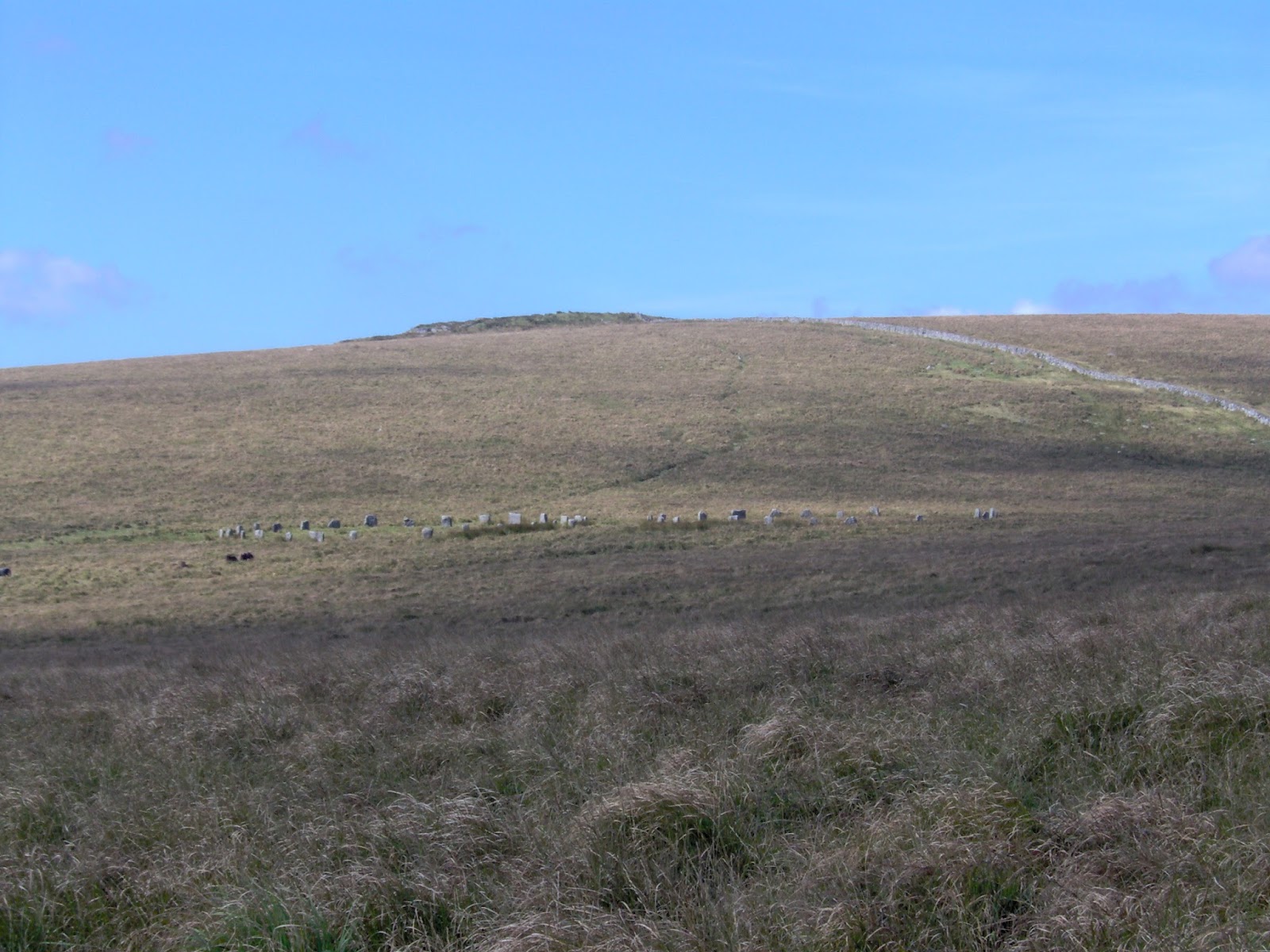
The wooden discs were turned from tough, pale coloured spindle tree wood, a native species which still grows around the edge of the moor. At the time of the burial, this area would have been much more wooded than now. It's strange to imagine what the person who wore these wooden ornaments was like; speaking a language that we wouldn't understand in the present day but perhaps knowing some of the many stone monuments, such as the double circle at Greywethers, that still stand not far from where they were buried and that we can still visit.


Greywethers stone circles on Dartmoor

Radio carbon dating from underneath the fallen stones of nearby Sittaford Tor circle returned a date of about four thousand years ago, so the circle itself is probably older than that. This means the person buried at Whitehorse Hill would have known it and probably visited it as well.

I couldn't resist having a go at recreating the discs myself! We have some idea of what Bronze Age woodturning was like, having images preserved from ancient Egypt. A note about the picture: the lathe would have been horizontal even though conventions in ancient Egyptian art mean that it's illustrated standing vertically.


Image from http://www.turningtools.co.uk/history2/history-turning2.html

These sources helped woodturner Stuart King to recreate the making of the wooden discs for a programme called 'Mystery of the Moor'.


I had to cheat a bit, as the method Stuart King used requires two people to work best and also because I don't have the appropriate reproductions of Bronze Age tools at the moment (although I'm very tempted to acquire or make some now!). It was still fun to make replicas of these objects that connect us to that ancient and mysterious time. 


woodturning

I had some seasoned spindle tree wood that was suitable, and the discs finished well. After turning, I put some natural nut oil onto them, to bring out the colour of the wood and stop them getting too grubby - a beeswax finish could originally have been used but it tends to attract dirt. The larger turnings are 25mm (1") and the smaller ones 15mm (0.59") in diameter.

Whitehorse burial wooden ear ornaments

Here's my friend Sion wearing a pair of discs very similar to those found in the kist at Whitehorse hill, but slightly larger than the bigger ones found in the burial at 30mm (1.18") wide. He said that they are very comfortable to wear and they were also tough enough to withstand a good deal of partying last weekend!


ear stretchers


ear expanders

Sunday, 26 October 2014

Eighteenth century woodworker's clothing and equipment, shown as part of the Hellbrunn Mechanical Theatre in Salzburg, Austria

The Hellbrun Mechanical Theatre is a huge automaton. It was built between 1748 and 1752 and is housed in the Hellbrun palace in Salzburg. The machine was built by a salt miner called Lorenz Rosenegger and was commissioned by Archbishop Andreas Jakob Graf Dietrichstein. 


I came across this animated sculpture while watching a fascinating BBC programme called 'Mechanical Marvels: Clockwork Dreams' which was written and presented by Professor Simon Schaffer. That's him standing in front of the mechanical theatre in the image above. All of the images of the Mechanical Theatre used in this post are screen shots saved from this documentary.

The theatre shows a scene of different trades and professions busily working, watched by the governing elite whose figures move relatively little.

Apart from the incredible skill of Rosenegger in carving the 200-odd figures used in the machine and animating most of them with a water-powered system of mechanisms (together with a water-powered musical organ to cover the sound of the workings in action), I was also struck by the glimpse that the theatre gives into the clothing and tools used by the woodworking trades of the time.


The woodcarver has his workpiece held on a kind of rotating spit-like frame. Chris Pye notes that this type of device is still in common use in some places, such as Southern Germany. I've seen it on illustrations of medieval woodcarvers at work centuries before the Hellbrun machine was constructed. Many contemporary carvers prefer to work on larger pieces with the carving held vertically instead of horizontally, so that it is orientated the same way that it will eventually be displayed.


This frame for holding work is in the studio of Jón Adolf Steinólfsson in Rekjavik, Iceland


This frame is in Joachim Seitfudem's studio. Jo is based in Bristol but trained in Bavaria. 


The sawyers at work. All of the tradesmen are shown wearing aprons and many have coloured lederhosen-style braces across their chests. I wonder if the colours of their hats or braces mark them as members of different craft guilds, or if they are just random?


The turner is at work on a pole lathe (which I imagine would be powered by a springy frame rather than a pole, as it is indoors). His tools are hung on the wall behind him. 


The timber framers build a roof. Two workers wear caps, the others are dressed very similarly to each other with black hats. Journeyman carpenters from this region wear their brimmed black hats as one of the signs of their status even today. Are the two workers lower down the roof journeymen, or do these figures represent different trades altogether?


The cooper works with drawknife and shavehorse to make barrels and buckets. As with the pole lathe shown above, modern green woodworkers use equipment that has basically changed very little from that shown by Rosenegger. This pole lathe and shave horse (made by Tom Redfern) were in use when teaching these skills at the Green Gathering a few years ago.


Schaffer also notes that there is another, darker side to the Hellbrun mechanical theatre. The salt miners were 'radicals and insurrectionists' and Rosenegger had an armed guard to keep him at his work. The machine was not just an entertaining snapshot of life at the time. To its intended audience of wealthy aristocrats, it gave a view of workers behaving themselves in an 'ideal society'.


Tuesday, 30 September 2014

Continuing the tradition: Putting my mark onto the handles of my woodcarving tools

'Tools have a particular appeal because, in a sense, they carry the history of all those who have used them... so you are, in a sense, carrying on a very personal line of dedicated craftsmanship.'

Antiques expert Paul Atterbury, talking to woodcarver Glyn Mould on BBC's 'Antiques Roadshow'


'There is a great sense of continuity, seeing tools passed through several hands and being aware of contact with a carver who may be long dead'

Chris Pye, woodcarver


'Some of these tools go back almost halfway to Gibbons' era (the late 17th and early 18th centuries) and some of the old carvers wrote their names, or stamped their names, on their chisel handles. (Looking at the handle that he is holding) A. Gordon; I wonder who he was? It's sort of like shaking hands with the old fellow whenever I use it. So there's a romance about these tools which affect me, even, after all these years.'

David Esterley, carver and authority on Grinling Gibbons, on BBC's 'Carved with Love: The Genius of British Woodwork' episode entitled 'The Glorious Grinling Gibbons'

'Used tools moralise'
Ian Hamilton Finlay, poet and gardener

*****

Today, I finally got round to doing something that I've been meaning to do for some time. Thanks to an unexpected break between jobs, my carver's mark was stamped onto the wooden handles of all of my carving gouges and chisels.

name on a woodcarving gouge handle

Many handles of woodcarving tools show the stamped or carved names of their previous owners. I suspect that many were so marked in busy workshops, to prevent prized and expensive tools being spirited away by other carvers working there. As Chris Pye says, the names give a sense of connection to those previous owners, as my own hands grip the handle of the same tool to put it back to work once more. 

antique woodworking tools


What letters did W. Hawkins cut with that carver's chisel? Did A. Brown have a hand in creating a carved piece that I have admired in a church or grand house? Or were those carvings destined to travel on the prow of a ship or a fairground ride? Did E. Meadwell find that gouge particularly easy and enjoyable to use, as I now do?

I did ask at Bristol Design, a shop from which I have bought several tools, whether anything was known about the origins of their second-hand chisels and gouges. Charles the proprietor said that nothing was known for most of them, although he had acquired a sizeable number from the collection of a former producer of fairground carvings and also from a ship's figurehead carver. However, neither seems to have marked their names onto the handles. 

He also told me something interesting that he had heard. Years ago, woodcarvers couldn't get their tools insured by insurance companies, so would insure them through their trades union. One of the requirements for cover was that tools could be identified as belonging to a specific owner. This would also explain why some tools have names carefully stamped over others (I have a gouge with 'A. Sprague' carefully covering B. Fare's name). It would reduce the chances of any confusion in the event of claims from several people working in the same shop.

Most of the tools that bear these stamps are quite old. The ones that I can date (from the maker's marks stamped into the blades) were produced between 1890 and the outbreak of World War One. The names on the handles could have been applied at any time and the handles may be replacement ones, but the style of the lettering of many names is quite similar. Perhaps the bespoke stamps were produced by the same company and sold around commercial carver's workshops up and down the country?

woodcarving fishtail gouge

I found a lot of difficulty in getting hold of a name stamp myself. In Chris Pye's book 'Woodcarving: Tools, Materials and Equipment', published a few years ago, he mentions that they can be bought from several suppliers and that adverts can be found in woodcarving magazines. After a long time of asking around carving supplies shops without success and reading magazines without such adverts in them, I decided to just make my own. 

Using printer's metal type was an initial idea but there was some concern that it could be too soft to take repeated knocks into wood. Instead, I used diamond burrs in a Dremel hand drill to carve the end of a steel rod with my carver's mark. 

Here's the initial design, made up from my initials and first scratched into my bedroom wall with a thumbnail when I was about nine years old. I chose it as it is easily carved in any size:


Here's how it looked when cut into the metal rod:


...and here is the mark left by the stamp:


Most of the tool handles took the mark quite well and cleanly, particularly those made of box (Buxus) wood. The only ones that were tricky were those that had been thickly varnished. The varnish tended to fracture a bit but it wasn't too bad. 

By the way, the cut line on the handle above is the only mark for which I know much about the person who made it. That cut was made when it was owned by Jo Seitfudem, who sold the gouge to me. 

The handles were held in a groove between two triangular-sectioned pieces of wood to stop them moving about whilst being marked, which you can see in the top two photos above.


Now my own carving tools have taken their place in this line of tradition. I wonder if a carver in the future, on seeing my stamp well-worn on the handle of an infrequently-used gouge, will wonder who that carver was and what they made during their lifetime? It inspires me to keep on trying to make work that the tool's former and future owners might also be proud of.


Friday, 29 August 2014

Teaching woodcarving with a knife at my studio in Bristol, together with some thoughts about whittling

Yesterday, Jack came to my studio to learn how to carve with a knife.  We had a great day and he wasn't the only one learning new things. He told me about a very interesting video of a talk by Denis Dutton, part of which concerns prehistoric stone tools that were possibly made solely to show the maker's skill; very interesting to a craftsperson!


Jack sent me an email afterwards saying how much he had enjoyed the day and learning a new skill. It also made me think about whittling as carving. Some carvers can be dismissive of whittling with a knife, thinking that it is an 'inferior' kind of carving. This teaching session was a strong reminder of just how daft that view is in my opinion. 

The knife is one of the most versatile tools for a carver. It was clear from watching Jack's progress that the knife work taught many lessons in working with wood that are transferable to using all other edged carving tools: working with the grain, the importance of the slicing cut, sharp blades being vital etc. These points are fundamental to a carver, they certainly aren't trivial things to learn.


The use of a single carving tool to make a complete sculpture is also a good carving exercise. My friend Jo Seitfudem told me once about his father, a master carver in Bavaria, giving him a single gouge and telling him to carve an entire sculpture with it. Without a range of tools to use, the importance of working with the timber itself to achieve a finished piece is much clearer to a novice carver.

A look at the work produced in regions that regularly use knives as a basic carving tool (Africa, Papua New Guinea) also easily illustrates that carving snobbery about their use is just narrow-mindedness.

Here's a photo of the walnut pendant that Jack carved during the session, We agreed that it looks great and it seemed to capture just what he was aiming for, with the tooled finish and the delicately carved spiral that he achieved:


It's interesting how the process of teaching a skill can so often lead to the teacher learning and seeing their speciality with fresh eyes too!


Monday, 4 August 2014

Woodcarving and woodworking tools seen at the British Museum; from the Stone Ages to the Anglo-Saxons in Northern Europe

After writing about ancient Egyptian woodworking and tools from ancient Nubia and Mesopotamia, it's time to head north and look at Europe. I have focussed mainly on the woodworking tools that are in the collection of the British Museum.

Stone Ages


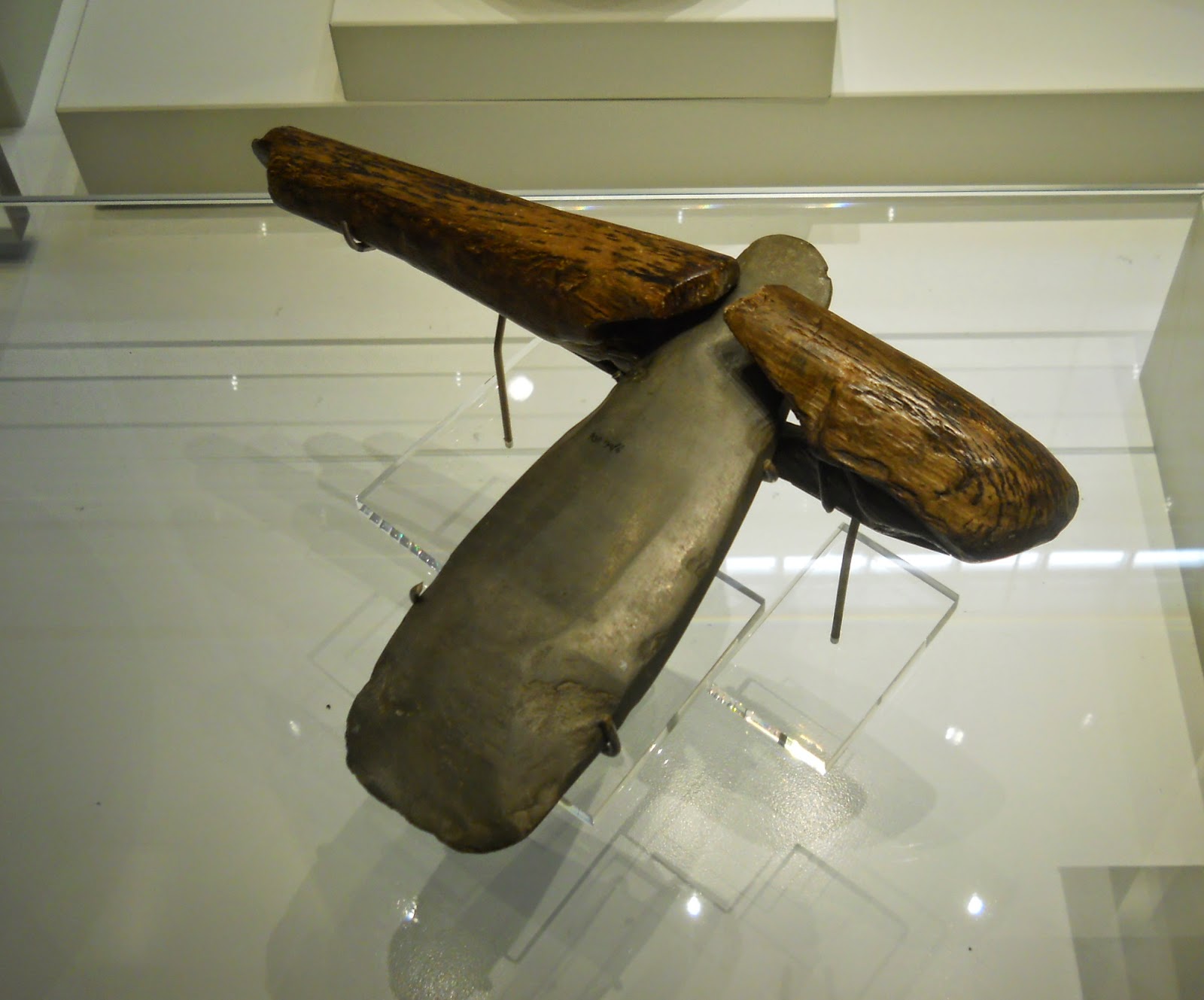
The Stone Ages in Britain ended with the arrival of settlers who knew how to use copper alloys to make tools and weapons, about 4,200 years ago. It's hard to find a lot of evidence of woodworking from the earliest known human habitation of Northern Europe. A perishable material like wood just doesn't often last for long enough. However, there are a reasonable amount of wooden objects known from the last part of the Stone Age, the Neolithic Period, including what was a raised wooden trackway through marshy ground. It was found in Somerset and is called the 'Sweet Track', dating to 5,821 years ago. The stone axe shown above was found at Ehenside tarn in Cumbria and dates to between 5,700 and 5,100 years ago. It is made from a local stone that was also traded elsewhere due to its suitability for toolmaking.

The Neolithic period saw an important change in the making of stone tools in Northern Europe. During the Mesolithic, about 7000 BCE, stones like flint were 'knapped'. Flakes were knocked off the workpiece to form sharp edges in order to make scrapers, knives, axes and other useful bladed tools. During the Neolithic, about 4000BCE, stone started to be ground to shape by using the time-consuming method of rubbing against abrasive stones, or perhaps leather with abrasive rock powder on it, using water to aid the process.

Why spend so much extra time grinding down blades? BBC television's 'Time Team' programme did an interesting experiment for an episode called 'Sussex Ups and Downs' aired in 2006. The action of a ground axe blade was tested (by cutting down a small hazel tree trunk) against a blade made by knapping. The ground blade was found to work much more efficiently, cutting far more cleanly and not becoming damaged by bits of timber getting lodged in the blade and causing fractures to form. It required less effort to use and would last much longer without becoming damaged beyond further use.


The objects in this image were put in a pit dug into a cairn (a mound of stones) and may well have been part of a burial. They were found at Ayton east field in North Yorkshire and date to the Late Neolithic, about 5,300 to 4, 500 years ago. There are three flint axe heads, a flint adze for carpentry work, five flint arrowheads, a flint knife with two flakes, an antler mace head and two boar tusk blades.

After seeing First Nations tools from the North-West Pacific coastline, it is obvious that complex woodcarvings were possible with the tools available in Europe before the discovery of copper alloys. The hard stones were shaped into sophisticated and sharp blades. I also wonder if the teeth of the native European beaver were used to make woodworking tools, as the teeth of American beavers were in the North-West Pacific before contact with Europeans. No such tools have been found in European archeological studies to my knowledge, but in her book Cedar, Hilary Stewart comments on how a split beaver tooth was one of the principal tools for making wooden bowls, spoons and ladles in the NW Pacific region, being the original 'hook' or 'crooked' knife. It strikes me that the boar's tusk blades shown above could perhaps also serve a similar function. She also notes how, when 'roughly hollowing out a cedar bowl using a maul and a bone-tipped chisel I had made, I was surprised by the blade's strength and cutting ability'. Stewart also notes the usefulness of mussel shell (Mytilus californianus) when scraping or shaving wood. However, she notes that it fractures easily when mallet blows are applied even though early ethnographers describe it being used in chisels.

Some very interesting and enigmatic stone carvings are known from the Neolithic. The carved chalk 'Folkton Drums' date from around the end of the Neolithic or the start of the use of copper, about 4,500 to 4,000 years ago. They are unique and were placed under the head and hips of a child buried in a barrow mound. Their purpose is unknown, although the chalk probably came from nearby Folkton Wold in Yorkshire.


These small stone objects shown below fascinate me. Over 400 have been found, mainly in northern and eastern Scotland. They come in various shapes and their use is unknown.


The Bronze Age

These bronze axes date to about 2,750 to 2,500 years ago. Two of the three below were found at Walthamstow in London and in the River Thames near the Tate Gallery, also in London. The other was found in South Yorkshire.


These axe heads were found at Petter's sports field in Surrey, England. They date to the Late Bronze Age, about 3,000 to 2,750 years ago.


The L-shaped wooden handle would fit into the socket at the back of the axehead and would be lashed on using the loop:
Image from:http://www.dorsetaonb.org.uk/assets/downloads/South_Dorset_Ridgeway/Resources/Image_bank/Replica_bronze_axe.jpg
It was interesting to see the similarities between these bronze axe heads and some found in China and Siberia shown below.


The two socketed heads on the left come from the Shang or early Western Zhou dynasties in China and date from between 3,200 and 3,002 years ago. The one on the right (note the loops) is about 3,000 to 2,800 years old and came from Southern Siberia, although it is based on a Chinese design.

There are obvious similarities between the Chinese-style bronze axehead on the right and the Northern European ones. I wonder if they show a kind of 'convergent evolution' of design, where similar requirements created similar tools, or whether they reflect a passing of ideas between cultures, perhaps by contact through ancient trade routes such as the Silk Road.

Again, a lot of wooden items from the Bronze Age must have rotted away over time. The photo below shows a wooden ladle at top left found at Flag Fen in Cambridgeshire and dating to the Middle Bronze Age (about 3,300 years ago). Around it are various bone and pottery utensils from this time until the early Iron Age (2,650 years ago) that were found in Surrey, North Yorkshire and Suffolk, England.


The Iron Age

The files, gouges and chisels in the top row came from Tiefenau in Switzerland. The tools on the left appear to have tangs ready to fit handles onto them, whereas the one on the right seems to have a ready-made handle cast as part of it. The gouge second from the right has a socket to fit a handle. No dates are given for these tools.


The adze head below them came from Lisnacrogher in County Antrim, Ireland. Below it is a circular disc cutter from King Harry Lane cemetery in St Albans, Hertfordshire, England that dates to between 2,014 and 1,064 years ago. 


In the BBC documentary 'A History of Celtic Britain: Age of Iron', Neil Oliver shows examples from a hoard of iron tools discovered near Fiskerton in Lincolnshire (the next two images are screenshots from that programme). They are thought to date to around 2,400 years ago. It is very noticeable how similar they are to tools dating from more recent times. 


Oliver holds up a file and points out that 'if someone was to show you this and say, "this is from my great-grandfather's toolbox"', you would believe them. He also shows a fragment of saw blade and notes that iron working allowed much stronger and  thinner blades than cast bronze, making more efficient tools that were relatively cheap and simple to make and repair compared to their bronze equivalents.


Roman Britain


Many of these Roman tools really are similar to modern examples. The curved blade top right is described as a 'drawknife' and came from Hod Hill in Dorset, England. It dates to the first century CE (or AD, if you prefer).  


I recognise this blade as an 'inshave'. It is used to hollow out chair seats and also by barrel-makers (coopers) for shaping the inside of barrel staves. Similar ones can be bought today from woodworking suppliers. Travelling clockwise from this blade, we come to a solid-handled punch (with a grooved face for decorating woodwork) and a broken spoon-shaped drill bit (probably used with a bow-or strap-drill according to the label), both from the 1st century CE and found at Camerton in Somerset. Bottom right is a tool suitable for use as a 'float', to remove stone in masonry work, as a coarse rasp to remove wood in carpentry or for filing horse's hooves. It also came from Hod Hill and dates to the same time as the inshave. 

The thin-bladed paring chisel on the left came from Walbrook in London and dates to the first or second century CE. It would have been hand-pushed and used for fine work. This tool has the maker's name MARTIALIS stamped onto it, a custom with tool makers that survives to this day.


The tools shown above and in the following two photos probably all date from the first or second century CE. Going clockwise from the top left;

A double-ended spatula found in London, probably used for spreading wax onto wax tablets,

A very well-preserved awl, for making small holes in wood or (more probably) leather, found in London. This one has an iron point, a bronze collar and a handle made from turned boxwood (Buxus sempervirens),

The paring chisel mentioned above,

A socketed carpenter's gouge found at Camerton in Somerset,

A carpenter's firmer chisel with a socket for a wooden handle, found at Smith's Wharf in London,

A firmer chisel with a solid handle, found as part of the 'Sandy Hoard' in Bedfordshire,

A solid-handled mortice chisel, with the handle battered down by hard use. Found at Hod Hill.

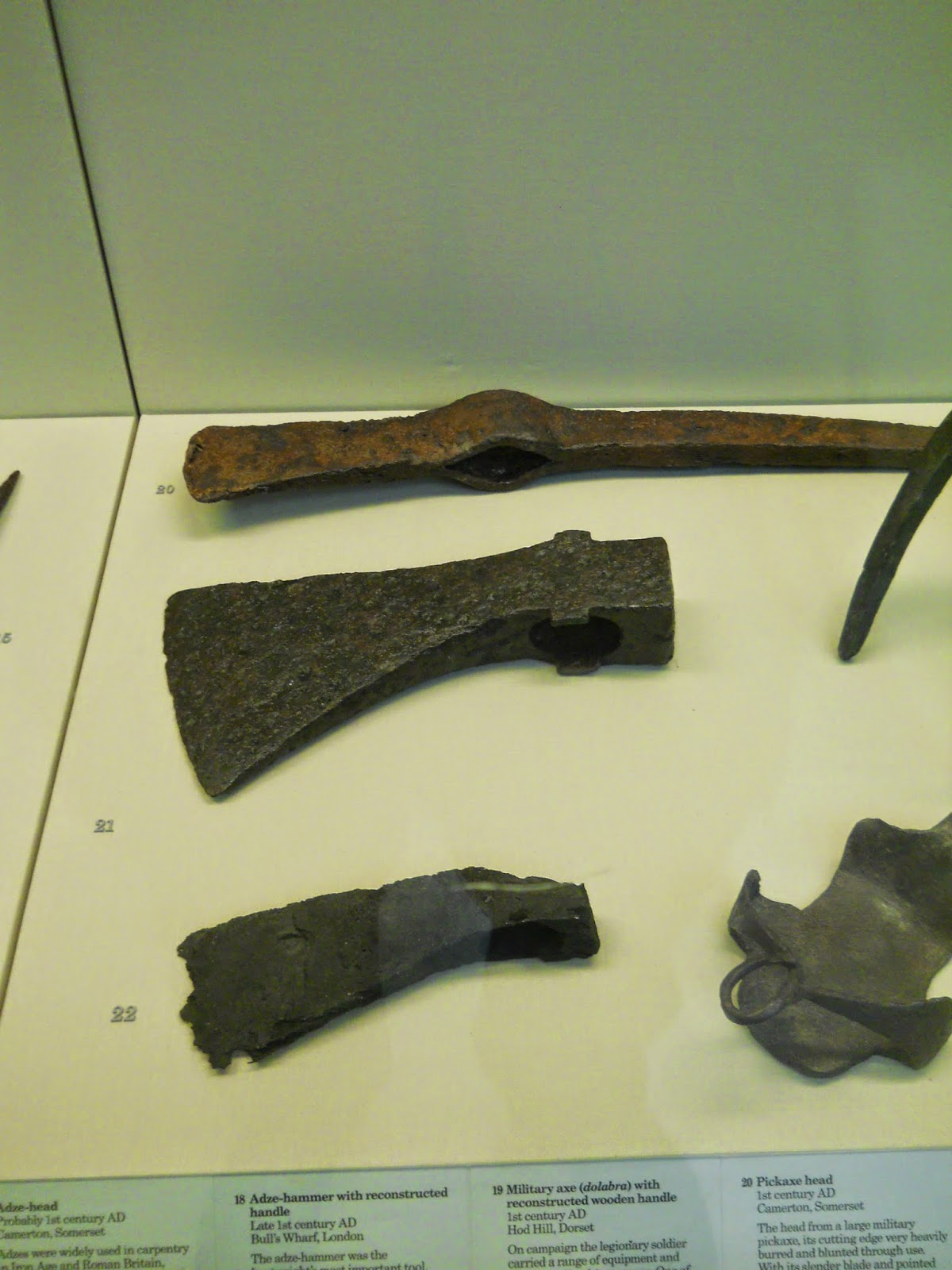
The adze head on the left was found at Camerton. The small hammer head on the other side of the eye hole for the handle has been burred by use.
In the centre is an adze-hammer, used by carpenters and boatbuilders and found at Bull's Wharf in London. The handle is a modern reconstruction.
The axe on the right also has a reconstructed handle. It is a kind of military axe called a dolabra, found at Hod Hill. It would have been carried by a Roman soldier in addition to his weapons and was used for felling trees and construction when on a campaign.


The pickaxe head at the top of this photo is immediately recognisable as such. It was found at Camerton and is a military-pattern tool, used by Roman soldiers for construction work. The axe head below it was also found at Camerton and would have been used to fell trees. It has a short inscription stamped into it, perhaps a maker's mark, but it is now impossible to read it.

The axe head at the bottom came from an unknown source, but represents the commonest kind of Roman axe. A weld line shows that the cutting edge was welded onto the rest of the axe head. This may have been hardened metal, to give a sharper cutting edge.


This ship's figurehead made of oak looks like a Viking one, but it was actually made earlier, during 300-400 CE. It was found in the River Schelde in Belgium and had a tenon allowing it to be removed, maybe for travelling under low bridges. It is not known if the figurehead was made by Gallo-Roman craftsmen, Germanic craftsmen who settled in the local area or by Germanic craftsmen who used the Gallo-Roman style.

The wooden objects shown below were found in various parts of Britain and illustrate some of the humbler day-to-day Roman uses of wood. They include spindles and spindle whorls, a tent peg, a wooden key for a wooden lock, a bowl and a strange object that is listed as a bobbin but which also looks a lot like a yo-yo. The board on the right was a barrel stave, which was reused to line a well near Mansion House in London. It bears two stamps of Fuscius Macrinus, who is thought to have been the cooper who made the barrel.


The Anglo-Saxons


These Anglo-Saxon woodworking tools were found at Hurbuck in County Durham and date to around 1,200 - 1,000 years ago. The curved adze at the top would be used for smoothing and shaping wood. The splendid T-shaped axe head is labelled as being used to 'fell and chop trees', although such a broad yet lightweight cutting edge would seem more suited to hewing felled timber into beams and boards. On the right is a spoon-shaped auger, used to drill holes in wood. You can see Dave Budd's reconstructions of such drills on one of my previous posts, which you can find by clicking on this link.