As well as this blog, I also have a website and Instagram page with lots more images of my work as well as a few more stories.
If you like woodcarvings, you might want to have a look.

Friday, 6 September 2013

Carvings from the last nine hundred years, Bread ovens, Starburst Memorials and grotesques in Bristol Cathedral


Isn't it funny how one can spend years living next to something incredible and yet never take time to see it properly?

Today I visited the Cathedral in the centre of Bristol for only the second time. The main purpose was to see the misericords there, but there were plenty of other things to see as well...

Bristol Cathedral started out as the Abbey of St Augustine, which was founded in about 1140 AD by Robert Fitzhardinge. A lot of the building has been altered since then, but one of the most interesting surviving original parts is the Chapterhouse, which dates to about 1160. This is decorated with beautiful Romanesque carvings and was where the economic and political areas of the abbey's life would have been discussed.


The site was used for worship before the abbey was built, however. During restoration work on the chapterhouse, a stone tablet from Anglo-Saxon times was discovered under the floor. This stone carving dates from just before the Norman Conquest (in 1066) and depicts the 'Harrowing of Hell', with Jesus going to hell to rescue mortal souls sent there. It's one of the most important pieces of Anglo-Saxon art ever found in Britain and is now on display in the Cathedral.


The Cathedral is one of the world's best examples of a medieval 'hall church'. This means that all of the ceilings in the main area of the building (the nave, aisles and quire) are at the same height. This makes the whole building feel 'lighter'. The ceiling vaulting in parts of the cathedral is incredible. Take a close look at this section of the South Choir Aisle shown below, which was built in 1298. The vaulting rises in pyramids off the stone bridges across the aisle:


This vaulting is between the nave and the quire:


The small Berkeley chapel comes off the main area and was the private chapel for the Berkeley family, the descendants of Robert Fitzhardinge. Next to it is a sacristy, where the priests and others would prepare for Masses. It has several interesting features. In the middle is a bread oven. Not what you'd expect within a cathedral but this is where the communion bread was baked.


The ceiling of the sacristy has more fine vaulting; this time 'skeletal', with the ribs of the vaulting not filled in:


Up in one corner, overlooking the Bishop's crozier, is this slightly disturbing caricature. It isn't a waterspouting gargoyle. I wonder why her mouth is so wide open with it's tongue lolling out?


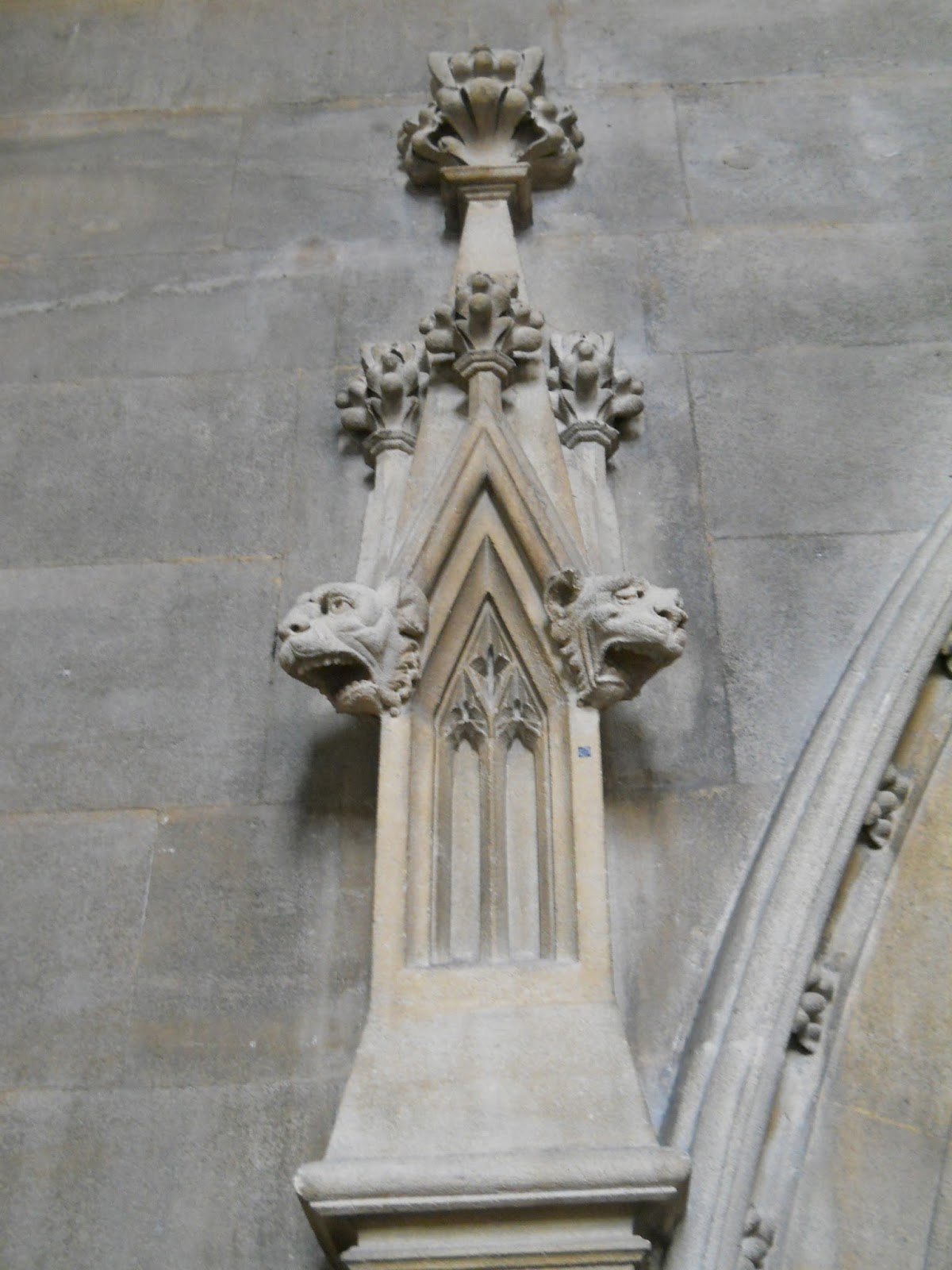
I love looking for the little characters hidden away in corners of these grand buildings by their carvers. Here's a few more to be seen in the Cathedral:


There are some beautiful examples of later carvings too, like this wonderful melancholy Victorian figure:


Like most old churches and cathedrals in Britain, this has had it's share of destruction wreaked upon it. One of the main causes of church demolition in this country, however, didn't have too much impact here. When Henry VIII broke up the Abbey in 1539 during the Dissolution of the Monasteries, the king decided that it would become one of his 'New Foundation' cathedrals. 

This was probably because Bristol's rich citizens lobbied him successfully. So the cathedral was simply rededicated, to the 'Holy and Undivided Trinity', then carried on with the building unscathed.  The medieval nave was in the process of being rebuilt at the time, but a new nave wasn't completed until G. E. Street designed one and it was constructed in 1868, although he retained and used the remaining medieval features sympathetically in the new structure. Perhaps the fact that the structure was being physically rebuilt on a large scale at the the time of the Dissolution gave Henry a more metaphorical reason to use it for his own plans?

Even though Henry didn't come in heavy-handed, the Puritans in the seventeenth century did. Some tombs still show the scars. See how all the faces on the praying knights at the bottom of this tomb from the early seventeenth century have been smashed off ( but not the face of the woman interred there):


In a chapel, one tomb commemorates how it was 'defac'd in the civil war':


Although other family members nearby seem to have got away fairly unscathed:


Unlike other religious buildings in Britain, the cathedral in Bristol was almost ransacked again in 1831, when rebuilding work was in progress. 

The cathedral's officers had voted against allowing most Bristolian people voting rights (only 6,000 out of a population of 104,000 had a vote at the time) and the angry mob were so incensed that they had to be held back by one of the staff at a doorway (you can bet he wasn't one of the officers that had helped cause the problem in the first place!) . The rioters did a lot of damage to the twelfth-century chapterhouse and it was during the renovation work afterwards that the Anglo-Saxon stone carving shown above was found, so some good came out of it in the end. 

Unfortunately, another example from history of the church being firmly on the side of the wealthy, the unpleasant and the corrupt.  I'm glad, however,  that the cathedral building and its beautiful artworks survived. Quite a few of the rioters didn't, but that's another story.

One end of the South Choir Aisle leads to the Eastern Lady Chapel. It was built in 1298 and has been restored many times, but is very colourful. Perhaps it gives an insight into how all cathedrals may have once looked, brightly painted and gilded?


In one wall is a recessed memorial, which is surrounded by an amazing starburst-shaped surround:


There are more like this along the South Choir Aisle:


The stone carvings in front of them are by Kevin Blockley, the Cathedral's archaeologist. He is based in Wales and was a fellow participant in the Bristol Festival of Stone. Many of the sculptures represent microscopic forms in nature, such as this one that he has carved from Iranian onyx:


As said before though, my main reason to visit was the collection of misericords, which date from 1515-1526 and were installed by order of Abbot Robert Elyot. There's plenty to say about them, so they are covered in another post which you can go to by following this link

Saturday, 31 August 2013

Street art in Bristol by Rowdy, Cheo, Andy Council, Brave 1 and someone who is a bit confused

I haven't put up any images of things painted on walls for a while, but here's a couple of things seen today:


I'm pretty sure that this one is by Rowdy, who has been on the scene in Bristol for a long time. One of his 'trademark' motifs is a crocodile's head, which you can see on the gate. His pieces are often very colourful too. A while ago Rowdy's home burnt down in an accident, but he's a nice guy and a few well-known street artists in Bristol (including Banksy and Inkie) got together and donated artwork to be auctioned to help get him back on his feet again. 

Another piece, down the road, is evidence of someone living in a bit of a paradox it seems...


These four panels are near the harbourside and were done by Cheo, whose style is quite distinctive and usually has a bee somewhere:


Back in March, Andy Council created some work in the middle of the Cabot Circus shopping mall. If ever there was a sign of how street art in Bristol has moved into the mainstream, this has to be it. I don't mean to insult Andy in any way by that though, I like his work a lot.


A lot of street artists put work on shops here and are paid to do it. This face is by Brave 1 and is in Bedminster...


Friday, 30 August 2013

A visit from Amigo, carver of signs in limewood

Amigo came round for a visit to my studio today and brought a couple of his house signs with him:


He has been carving since 1989 and is entirely self-taught. Amigo's wood of choice is lime (a species of Tilia, also known as linden). It was a bit of a surprise to me as the timber isn't thought of as being durable outdoors, even though it is a classic wood for carving. He explained that to stop the signs weathering, he first treats them with preservative and then, once it has dried, a mixture of yacht varnish and mineral turpentine. The final coat is of yacht varnish. They apparently seem to last well in all weathers after the treatment.


I like the contrast between the bark, the toolmarked background and the smooth numbers as well as Amigo's fun, informal style of number design.  The acorn is his maker's symbol.

If you would like to contact him and have a chat about his work, you can phone on 0117 904 0907

Thursday, 22 August 2013

Brading, a historic town in the Isle of Wight. Carvings done with power tools. Punishment, torture and the secret of hewing timbers.


This town is on the eastern side of the island and is proud of its long history. It has a few surprising things still to be seen...

Much of the town was involved in smuggling at some point and with this background of illegal activities, it seems appropriate that the whipping post and stocks have been preserved in the Old Town Hall next to the twelfth- century church. The stocks are thought to date to the seventeenth or eighteenth century but there are records of stocks being used here in 1555 and the whipping post was last used in 1833. Why have the stocks got five holes? No one really knows, but one suggestion is that they were specially made to accommodate a regular offender who only had one leg!


At the other end of the street is a metal ring set into the ground. It is a bull ring, to which bulls were tied before being attacked by dogs and then slaughtered. This revolting 'sport' was justified by the belief that this made the meat better. It was thankfully stopped here in 1820.


Next to the ring is a sculpture of a bull which was made by Paul Sivell, a carver based on the island who specialises in using power tools:


He has also carved another sculpture to be seen by the car park next to the church.


Next to the old Town hall and the church is a very interesting building: the Rectory mansion, possibly the oldest building on the island. It lies on Roman foundations but was built in 1228 and some think that timbers from a previous Anglo-Saxon building on the spot were reused in its structure.


The building has a rather fine ship's figurehead on its corner, but I haven't been able to find out the story behind it.


Seeing some of the timbers that have been used in the Rectory house reminded me of chatting to my friend Nigel recently about timbers that he had found whilst renovating a seventeenth century building in Bristol.

Nigel said that when restoring an original doorway in the building, he noticed that only the sides that were facing outwards (and were therefore on show) were cut square. The other faces were left waney edged, as they had come from the tree but with the bark removed. They were hidden, facing into the wall.

Which makes a lot of sense. Hewing timber or sawing by hand to make it square are both long, hard and skilled processes, so why do it on the faces of timbers that don't need it? If there are no joints that require a flat surface to work, then don't bother cutting one. Some of the timbers in the Rectory mansion might also show evidence of this way of thinking.


As does this timber from Baddesley Clinton in Warwickshire:


Not lazy, just smart thinking!


Bowl turning on a pole lathe, jousting, birds of prey and an unlucky king at Carisbrooke Castle.


Carisbrooke Castle is a very interesting place. It lies just outside Newport, the Isle of Wight's biggest town. There are signs of settlement there going back to pre-Roman times, but most of the fortifications date to later than the Norman keep that sits on the motte (or mound) overlooking the site.

The castle has been remodelled several times, which can be seen even at the entrance gatehouse.


The lower part was built in 1335 and has cross-shaped firing points, for bows and crossbows. The gatehouse was extended above the horizontal lines around it in 1378, when the French threatened to attack it during the Hundred Years War. The extended part has circular holes with slits and would be used by defenders firing handguns.

There was extensive remodelling of the castle during the sixteenth century under the guidance of Sir George Carey, due to the threat from the Spanish Armada. However, some of the buildings from this time are now in ruins.

The chapel of St Nicholas in Castro was renovated in 1904, after falling into disrepair through lack of use because the church in the village was more accessible to most people. It is now a memorial to Charles I as well as being the war memorial chapel for the Isle of Wight. There are some nice Edwardian woodcarvings on the pews, showing the symbols for the writers of the gospels.


The castle houses a very interesting museum with many of the exhibits concerned with King Charles I, who was imprisoned at Carisbrooke for fourteen months before being taken to his execution. His daughters were also imprisoned there and one, Princess Elizabeth, died there.

Quite a few of the exhibits are of interest to a carver. One is an ivory gaming piece, dating to Norman times, from a game called 'tables', which was similar to backgammon.


This chamber organ was built in 1602 and is still in working order. It shows the arms of the Earl of Montrose and has Flemish inscriptions taken from the bible carved onto it. I don't think that the electrical flex is connected to the instrument!


There are also other carved pieces on show:


As well as this fragment of a medieval saw blade:


While we were visiting Carisbrooke, there was a 'medieval' joust and displays of medieval skills such as falconry and bowmaking. The joust took place on the bowling green, where Charles I played bowls whilst he was imprisoned. It was previously the drill ground for soldiers stationed at the castle and may well have seen jousting in medieval times.


One of the exhibitors was 'James the Bowl', who was making wooden bowls turned on a pole lathe. I had an interesting chat with him about what he was doing.


James told me that a lot of the designs for the equipment that he was using came from an image of a turner making equipment for the Mary Rose, although the image doesn't show a toolrest, which would have been vital. Many early images don't, perhaps because it would obscure the view and confuse the viewer.

Apparently, many kinds of timber were used to make the turned bowls found on the Mary Rose. Bowls have even been found made from oak, which tends to split and can taint food so is not normally used for this purpose. One timber that was not found is willow.


The shapes of the gouges used to cut the bowls have been worked out from the cut marks on found ones. Robin Wood, a well-known pole lathe bowl turner, has done a lot of work on this subject.


The mandrel, which holds the wooden blank to be turned into the bowl, is also not shown on old pictures. James' one has three flattened points, which he explained helps to keep the blank on. He said that other methods were known to have been adopted, Viking finds have had many points stuck into the blank and sometimes a simple round mortice and tenon was used, with a sliver of green wood in the mortice to wedge it in. The mandrel needs to be pretty tough and could be carried between places, so having iron bands on each end of it to prevent splitting would make sense.


It was very interesting to see what bowl turning in medieval and Tudor times was like and how people have filled in the gaps in historical knowledge by practical experience. The jousting was a lot of fun to watch too!

If you would like to see James' blog, it is at:

Robin Wood is a very well-known and respected pole lathe bowl turner and his website is at:

This is an interesting overview of historical pole lathe turning:

Carisbrooke Castle museum has a website here: