As well as this blog, I also have a website and Instagram page with lots more images of my work as well as a few more stories.
If you like woodcarvings, you might want to have a look.
Showing posts with label festival of stone. Show all posts

Friday, 6 September 2013

Carvings from the last nine hundred years, Bread ovens, Starburst Memorials and grotesques in Bristol Cathedral


Isn't it funny how one can spend years living next to something incredible and yet never take time to see it properly?

Today I visited the Cathedral in the centre of Bristol for only the second time. The main purpose was to see the misericords there, but there were plenty of other things to see as well...

Bristol Cathedral started out as the Abbey of St Augustine, which was founded in about 1140 AD by Robert Fitzhardinge. A lot of the building has been altered since then, but one of the most interesting surviving original parts is the Chapterhouse, which dates to about 1160. This is decorated with beautiful Romanesque carvings and was where the economic and political areas of the abbey's life would have been discussed.


The site was used for worship before the abbey was built, however. During restoration work on the chapterhouse, a stone tablet from Anglo-Saxon times was discovered under the floor. This stone carving dates from just before the Norman Conquest (in 1066) and depicts the 'Harrowing of Hell', with Jesus going to hell to rescue mortal souls sent there. It's one of the most important pieces of Anglo-Saxon art ever found in Britain and is now on display in the Cathedral.


The Cathedral is one of the world's best examples of a medieval 'hall church'. This means that all of the ceilings in the main area of the building (the nave, aisles and quire) are at the same height. This makes the whole building feel 'lighter'. The ceiling vaulting in parts of the cathedral is incredible. Take a close look at this section of the South Choir Aisle shown below, which was built in 1298. The vaulting rises in pyramids off the stone bridges across the aisle:


This vaulting is between the nave and the quire:


The small Berkeley chapel comes off the main area and was the private chapel for the Berkeley family, the descendants of Robert Fitzhardinge. Next to it is a sacristy, where the priests and others would prepare for Masses. It has several interesting features. In the middle is a bread oven. Not what you'd expect within a cathedral but this is where the communion bread was baked.


The ceiling of the sacristy has more fine vaulting; this time 'skeletal', with the ribs of the vaulting not filled in:


Up in one corner, overlooking the Bishop's crozier, is this slightly disturbing caricature. It isn't a waterspouting gargoyle. I wonder why her mouth is so wide open with it's tongue lolling out?


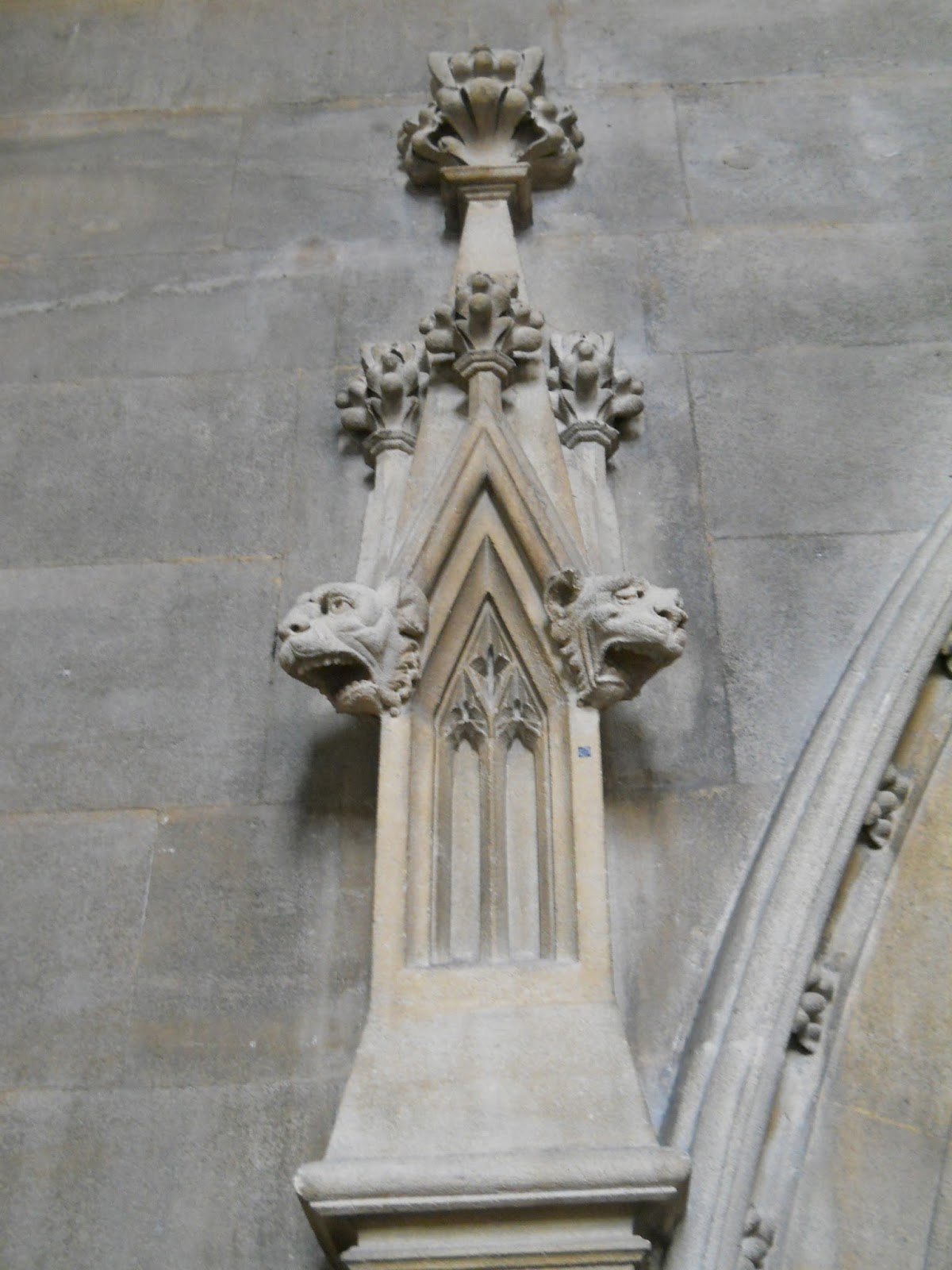
I love looking for the little characters hidden away in corners of these grand buildings by their carvers. Here's a few more to be seen in the Cathedral:


There are some beautiful examples of later carvings too, like this wonderful melancholy Victorian figure:


Like most old churches and cathedrals in Britain, this has had it's share of destruction wreaked upon it. One of the main causes of church demolition in this country, however, didn't have too much impact here. When Henry VIII broke up the Abbey in 1539 during the Dissolution of the Monasteries, the king decided that it would become one of his 'New Foundation' cathedrals. 

This was probably because Bristol's rich citizens lobbied him successfully. So the cathedral was simply rededicated, to the 'Holy and Undivided Trinity', then carried on with the building unscathed.  The medieval nave was in the process of being rebuilt at the time, but a new nave wasn't completed until G. E. Street designed one and it was constructed in 1868, although he retained and used the remaining medieval features sympathetically in the new structure. Perhaps the fact that the structure was being physically rebuilt on a large scale at the the time of the Dissolution gave Henry a more metaphorical reason to use it for his own plans?

Even though Henry didn't come in heavy-handed, the Puritans in the seventeenth century did. Some tombs still show the scars. See how all the faces on the praying knights at the bottom of this tomb from the early seventeenth century have been smashed off ( but not the face of the woman interred there):


In a chapel, one tomb commemorates how it was 'defac'd in the civil war':


Although other family members nearby seem to have got away fairly unscathed:


Unlike other religious buildings in Britain, the cathedral in Bristol was almost ransacked again in 1831, when rebuilding work was in progress. 

The cathedral's officers had voted against allowing most Bristolian people voting rights (only 6,000 out of a population of 104,000 had a vote at the time) and the angry mob were so incensed that they had to be held back by one of the staff at a doorway (you can bet he wasn't one of the officers that had helped cause the problem in the first place!) . The rioters did a lot of damage to the twelfth-century chapterhouse and it was during the renovation work afterwards that the Anglo-Saxon stone carving shown above was found, so some good came out of it in the end. 

Unfortunately, another example from history of the church being firmly on the side of the wealthy, the unpleasant and the corrupt.  I'm glad, however,  that the cathedral building and its beautiful artworks survived. Quite a few of the rioters didn't, but that's another story.

One end of the South Choir Aisle leads to the Eastern Lady Chapel. It was built in 1298 and has been restored many times, but is very colourful. Perhaps it gives an insight into how all cathedrals may have once looked, brightly painted and gilded?


In one wall is a recessed memorial, which is surrounded by an amazing starburst-shaped surround:


There are more like this along the South Choir Aisle:


The stone carvings in front of them are by Kevin Blockley, the Cathedral's archaeologist. He is based in Wales and was a fellow participant in the Bristol Festival of Stone. Many of the sculptures represent microscopic forms in nature, such as this one that he has carved from Iranian onyx:


As said before though, my main reason to visit was the collection of misericords, which date from 1515-1526 and were installed by order of Abbot Robert Elyot. There's plenty to say about them, so they are covered in another post which you can go to by following this link

Monday, 10 June 2013

Bristol Festival of Stone 2013 stone carving competition

The festival of stone ran for the first two weeks of June at the Harbourside in Bristol. As part of it, there was a carving competition which saw about 40 carvers given blocks of Bath limestone to carve.


It was great weather for most of the competition and it was fantastic to be surrounded by and working alongside so many talented carvers, a situation that doesn't happen that often in what can sometimes be quite a solitary, studio-based pursuit.


It also gave me the chance to meet Paul Caton, whose carved wooden bowls I've admired for a long time. It was an opportunity to meet skilled stone carvers from all over Britain, most of whom were very friendly and also enjoying the festival a lot. Some of them came from backgrounds that are not British, such as Samson Kizito who was born in Uganda and Tania Ivanova Tzanova from Bulgaria. It was very interesting seeing what everyone made of the theme: 'Emergence'.

A stone worker from Austria, Dylan Thomas Craig, was also visiting and a group of stonecarvers from France had come over, along with their musician and DJ friends, who added a great atmosphere to the festival.
Two of the French group, Laurent Donnadieu and David Bonhomme, also did a performance piece which involved moving huge blocks of stone using pulleys, accompanied by music.


As Laurent and David began one of their performances, which involved setting the ropes into the pulleys, a drunk in the crowd started heckling them. He soon shut up when he saw the two of them move those rocks though!


This is my sculpture, with an image of my friend's daughter who modelled for me:


 I must admit that it was quite a challenge to work in stone, which I haven't carved on this kind of scale for several years, especially when surrounded by such talented stone carvers. I feel that, to be honest, the sculpture isn't at the same level as most of the others at the festival but it was a very interesting thing to do and a chance to explore an unfamiliar material. 

I also managed to carve a good likeness of the model, which was the technical exercise that I really wanted to achieve. I don't feel ashamed of the sculpture and had great fun making it, although it obviously needs to be worked more to be anywhere near finished. It would be interesting to see it set into a structure, like a wall,  in some way. 

Here's some of the other pieces that were carved in the competition:


It was great to be carving next to Pippa Unwin from South Devon, whose crocodiles won two well-deserved awards in the competition. I was also lucky to be sharing our tent with Iain Cotton (who is based near Bath). It was a great atmosphere in there and that made the festival even more enjoyable.


David Bean, who graduated as a mason two years ago, produced this sculpture:


Jez Fenton, who went to art school with me in Exeter, made this dark-toned piece:


Danny Clahane had come from Cumbria to compete. It was great chatting to him:


This baby turtle won its creator, Mickey Carpenter, an award. It's so simple and effective and was very popular. Mickey is finishing the third year of an apprenticeship at Bath College:


Patrick Barker, who is based in Somerset, made this figure:


Pete Graham from Cornwall carved this bittern coming out of the reeds, which a couple of other carvers were also overheard admiring:


I was very struck by Will Whitmore's tree with a city in its branches (well, that's what it looks like to me)...


...as well as Sam Flintham's two dragons biting each other, which also won an award.


A large part of the material removed from this carving, by Bristol-based Matthew Billington, was chopped out with a normal hand axe- a rather unorthodox method but a very interesting one:


Peter Crinnion carved this piece, which won an award for technical merit:


Patrick McGrath, who works primarily as a prop and model maker for television, carved this abstract form:


This piece by Paul Wilson won an award from the RWA. It reminds me very much of Peter Randall-Page's work:


Richard Mossman and Ben Dearnley are shown here working on a large sculpture to be installed in Ashton Court estate. It commemorates ' The Father of the Bicycle', James Starley . Ben was working on this throughout the festival, as a separate project to the competition, along with his students and some of the French carvers. Hot work!


All in all, great fun and well worth being part of. Look out for the next festival of stone at some point in the future!

Sunday, 24 February 2013

Bristol Festival of Stone, 31st May to the 9th June 2013

I will be doing some carving in Bath limestone at this festival of stonecarving, which is to be held on the harbourside in Bristol.

Although I'm more often covered in wood chippings, I've always enjoyed stone carving and love having the opportunity to get the stoneworking tools out. It was great to have the chance recently as part of Triodos bank's 'Cornerstone' project
(for more info, click on this link:
 http://carvingswithstories.blogspot.co.uk/2012/12/triodos-banks-cornerstone-project.html)


There will be 49 other stone carvers in a carving competition, as well as guest carvers and music. I'm entered in the 4 day carve, from the 5th to the 8th of June. It'll  be great seeing a few old friends and having a look at the other work being produced! Now I just need to work out what to produce...

If you'd like to find out more about the Festival of Stone, there's a website at http://festivalofstone.com