As well as this blog, I also have a website and Instagram page with lots more images of my work as well as a few more stories.
If you like woodcarvings, you might want to have a look.
Showing posts with label historical carving. Show all posts

Sunday, 28 May 2017

Seventeenth century carvings, filming locations and stories of ghosts at Chavenage house in Gloucestershire

Chavenage House

Chavenage House is situated near Tetbury in the Cotswolds. It may seem familiar to some readers, as it's been used as a filming location for many films and television series, including being Trenwith house in the most recent adaptations of Winston Graham's Poldark novels.

The house has only been owned by two families since the Dissolution of the Monasteries. The approach that you can see above is very much as it was left by Edward Stephens in 1576.

Edward's grandson was Colonel Nathaniel Stephens, who was Member of Parliament for Gloucestershire during the English Civil War. He was a somewhat reluctant party to the execution of Charles the First and Oliver Cromwell is said to have stayed in the tapestry-lined bedroom which can be seen on the first floor in the wing on the left in the photo above.


Cromwell's bedroom at Chavenage House

The picture of Cromwell on the wall staring down at the bed is more than a little creepy, as is the tiepin on display set with two clear crystals that cover pieces of the hair of Charles the First, which were cut from his head after it had been chopped from his body.


The adjoining bedroom is named after Cromwell's general and son-in-law Henry Ireton. It is also lined with tapestries and is full of Civil War weapons and armour, including these firearms:


civil war firearms

There is also a leather hat cover hanging on a wall, over what looks to be an Elizabethan or early Stuart carved over mantle:


A chair in the corner of the Ireton room is said to have been sat in by Nathaniel Stephens himself.

civil war chair

The house, and the Cromwell room especially, have many ghost stories attached to them.  On the website for Chavenage, one can read the well-known tale of the curse of the Stephens family:

'After the cessation of hostilities whilst Charles I was imprisoned, it became apparent to Cromwell that the King would have to be executed in order to stop any form of Royalist uprisings. To this end he sent Ireton to Chavenage, to try to persuade Colonel Stephens to add his support to the regicide. Ireton arrived whilst Colonel Stephens was keeping the festival of Christmas in 1648. Stephens, known as a mild man, had shown much irresolution in deciding upon sacrificing the life of King Charles I and was on the verge of wavering when Ireton reached his destination. It is said that they sat up all night and eventually Ireton obtained from Stephens his very reluctant acquiescence. 

Shortly after his daughter Abigail returned from having passed the New Year elsewhere, she, in a fit of horror and anger, laid a curse on her father for bringing the name Stephens into such disrepute. The story goes that the Colonel was soon taken terminally ill and never rose from his bed again. When the Lord of the Manor died and all were assembled for his funeral, a hearse drew up at the door of the manor house driven by a headless man, and the Colonel was seen to rise from his coffin and enter the hearse after a profound reverence to the headless personage, who as he drove away assumed the shape of the martyr King, Charles I - this being regarded as retribution for the Colonel's disloyalty to the King. Thereafter until the line became extinct, whenever the head of the family died, the same ghost of the King appeared to carry him off.' 

The Cromwell room has even been exorcised on the orders of the present owner's grandmother. Did I see anything there? I'm afraid not, although I would say that that room felt noticeably colder than the rest of the house (but that could just be due to it being at the end of a wing).

More carvings can be seen in the Oak Room, which dates to Elizabethan times and has carved panelling that is often dated at 1590. However, it clearly shows the date 1627, which was during the reign of Charles the First.  

I think that the representations of the musicians and dancers are some of the most beautiful carvings that I have seen from this period.


wood carving charles the first

More seventeenth century carvings can be seen in the Great Hall, which was also originally Elizabethan but was modified during the Stuart period.


stuart wood carving


There are some fine character heads on the wall of the chapel that is attached to the house. Apparently, this tower was built as a folly in the seventeenth century before being turned into the chapel.

stone carved face


Another folly can also be seen to the left of the driveway, hidden in the trees.


folly

I was lucky enough to be shown around on this visit by a friend who has visited the house many times as a locations manager on productions such as Wolf Hall, New Worlds and Poldark. Thanks to Leon and also to Caroline Lowsley-Williams, the current manager who very kindly gave us access to see the fascinating history and carvings of Chavenage.


chavenage house

Wednesday, 15 March 2017

Ancient and modern woodworking on the Somerset Levels

Somerset Levels Avalon Marshes

The Avalon Marshes are three nature reserves (Shapwick Heath, Westhay Moor and Ham Wall) on the Somerset Levels, not far from Glastonbury. The wetlands are formed from the remains of peat workings that have since filled with water to form a valuable habitat for many kinds of birds.


westhay moor


As part of new work at Westhay Moor, the Somerset Wildlife Trust had commissioned me to carve designs drawn by children at a local school onto two larch boards, each about 3 metres (8 feet) long.

First, I enlarged the drawings and reproduced them onto the boards using a grid.


Next, the designs were carved using a Dremel, a small drill which had a burr-shaped cutter mounted onto it. I have found that carving into some softwoods (like larch) using power tools can sometimes give a better result than using traditional hand tools, no matter how well-sharpened they are.


The designs were then painted in with durable black gloss paint and finished with a finishing oil.

Somerset woodcarving

While out at the site to deliver the boards to the Trust, we took the chance to explore a bit. 

Westhay Moor

The marshes were beautiful and quiet, with only a few dedicated bird watchers about. We heard a Cetti's warbler and saw a reed bunting; so we got in some birdwatching too. There were several carvings dotted about the marshes that were also interesting to see.


The sculpture shown below refers to the murmurations of starlings, which the reserves are famous for. In winter, millions of starlings roost here and on clear, cold evenings and mornings they swoop and swirl in great clouds over the reeds.


Starling murmuratio

While visiting Westhay Moor, I couldn't miss going to see a new bird hide that was designed and built by my friend Tom Redfern and his colleagues at Roundwood Design.


The two-storey hide is reached via a causeway and gives a great view out over a pool that is very popular with many different kinds of birds.


When you go inside, the roundwood framing that Tom specialises in becomes visible. I think you will agree that it looks great.

round wood timber framing

round wood design

Here's two photos taken by Tom showing how the hide looks with my boards fixed to it:


This area has also turned up many pieces of very important archaeology. The marshy, peaty ground preserves wooden artefacts well as the lack of oxygen prevents decomposition. 

The second oldest walkway ever discovered in Northern Europe was found very nearby - the 'Sweet Track'. 


Image by E. Mortalmans from http://avalonmarshes.org/the-avalon-marshes/heritage/sweet-track/

Found in 1970 and named after its discoverer, Ray Sweet, the 2 kilometre (1.24 miles) long track was constructed in either 3807 or 3808 BCE along the course of an older walkway, known as the 'Post Track'. It was only in use for about 10 years before being abandoned but many finds have been made around it, including an unused jadeite axe head that was created from rock which originated in the Alps.


sweet rack axehead
Image from http://www.somersetheritage.org.uk/record/11000
Many wooden artefacts were also found, including pins made from yew timber, a throwing axe, four paddles and a small wooden doll that could have been a child's toy or a votive offering. They are preserved in different museums now but most of the Sweet Track is still where it was found, although not visible to the public. It is buried again, with a system in place to ensure constant immersion in water so that it doesn't dry out and start to decay.


Saturday, 24 September 2016

The woodcarving tradition of the Ammergauer Alps: visiting Oberammergau and Hans-Joachim Seitfudem's studio in Bad Kohlgrub

oberammergau woodcarvings

The town of Oberammergau is in Bavaria, the most south-easterly state in Germany, not far from the border with Austria. It is famous for the Passion Play, which depicts the suffering and death of Jesus and has been staged there every ten years since 1634. 

The town and the area around it are also renowned for the woodcarving tradition that predates the first performance of the play. In 1508, the Florentine statesman Francesco Vettori visited Oberammergau and described it as a 'very healthy but poor village, where most of the inhabitants were fine woodcarvers. The villagers were famous for carving crucifixes and different scenes inside a walnut shell.' These kinds of sculptures are still produced today; this example was carved by Joachim Seitfudem:


carving in a walnut shell by Joachim Seitfudem


In the 18th century, the woodcarvers from this area would travel around Europe carrying a distinctive type of rack called a 'Kraxe', on which they carried carvings for sale. 


Kraxentrager statue

The peddler, called a 'kraxenträger', is a figure whose hard work and resilience is still celebrated in the area today, both in public statues and in sculptures by contemporary carvers.


Oberammergau kraxenträger

Kraxenträger


Carvings made in Oberammergau can still be seen in many places outside of the area, even in Britain. This nineteenth-century crucifixion scene in the church of St Carantoc, near Newquay in Cornwall, is an example of a piece made by carvers based there.


There are quite a few shops selling woodcarvings in Oberammergau and I visited several of them. It was interesting to see that certain figures and subjects came up again and again. The kraxenträger is one, as is the crucifixion of Jesus, St George slaying the dragon, St Hubertus (who is associated with hunters) and of course Nativity scenes, amongst others. Another secular subject that particularly interested me were the many figures of morris dancers, taken from famous original versions which were carved in 1480 by the Munich-based sculptor Erasmus Grasser.


Erasmus Grasser morris dancer

In one shop, the staff were happy to explain about the process of making the carvings. 


They said that their sculptures were still carved in Oberammergau, however the pressure of producing enough to satisfy demand at a reasonable price meant that most were now made using a pantograph (a copying machine) rather than by hand. A bronze master figure was produced and used to create other figures, which could be scaled up or down by setting the machine differently. Such devices have been in use for centuries and, in a world of computer controlled processes, machines working from a metal master figure are quite traditional in themselves. Once carved, the figures would be checked and finished with wax or painted by hand. 

I have been told, by another local carver, that German law also says that if a sculpture has had at least ten percent of the work done by hand, it can be sold as 'hand carved'. 

Some larger figures will be roughly shaped using a computer-controlled routing device and then carved by hand over a period of two or three days to speed things up. To be honest, this seems fair enough to me in a commercial context. Most carvers would use machinery, such as a bandsaw, to roughly shape a sculpture nowadays and the hand carving would still require a lot of skill to execute well.

The same person told me that some of this carving work is sometimes also done outside of Germany, in countries such as Rumania, then sold by retailers in this area as locally-made. I don't believe that the shop shown above does this but apparently some other, less honest, places do. 


I saw three kinds of wood being used to produce carvings. Larger ones and hand-carved small figures were produced using timber from the lime or linden tree (Tilia sp.), as it is soft and easily worked. Smaller carvings, especially those made by using a pantograph, were also often made from the harder timber of sycamore (Acer pseudoplatanus), which is called 'Ahorn' in German. Traditionally, this would usually be sourced from the South Tyrol region of Italy, but nowadays it sometimes had to be bought in from further afield. In one shop, a small number of carvings were made from pine or larch timber. This didn't seem to be a common practice although I did see an interesting grave marker, also carved from softwood, in a graveyard in the nearby village of Bad Kohlgrub.


Bavarian carved wooden grave marker

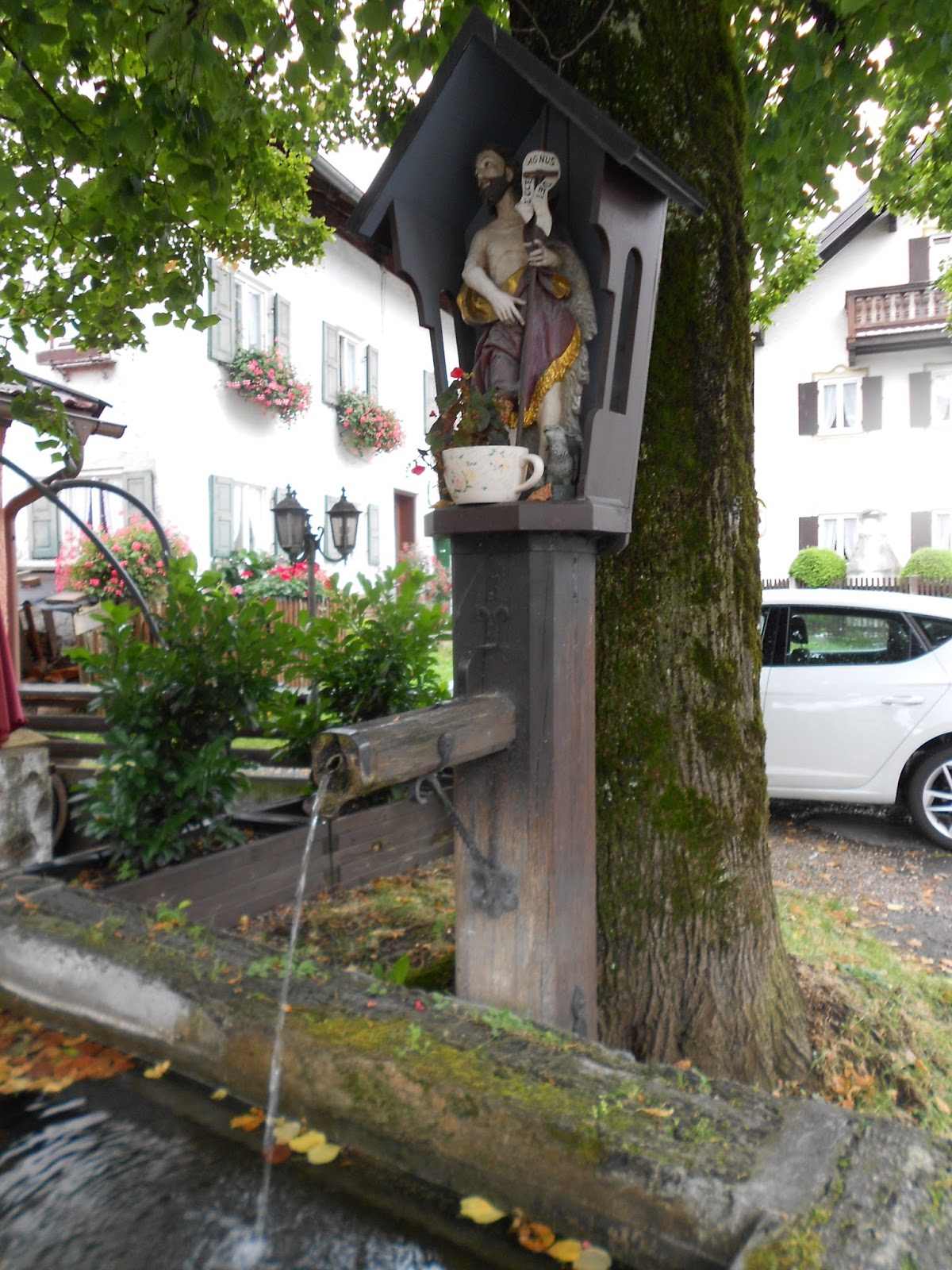
This region is quite staunchly Catholic and many woodcarvings of saints, Jesus or Mary his mother could be seen on local shrines or around important features such as springs of drinking water.


Bavarian woodcarving

To make the wooden carvings ready to be placed outdoors, they are coated with layers of a special compound made from three different kinds of powdered chalk, one of which is Champagne chalk from France. The number of coats used varies between three and seven, with each layer being allowed to dry and then carefully sanded before the next is applied, so that the finer details of the carving aren't obscured. The figure can then be painted and gilded.


The village of Bad Kohlgrub is not far from Oberammergau. One of the most respected local woodcarvers lives and works here; Hans-Joachim Seitfudem. This is his shop:


Hans-Joachim Seitfudem's shop

I was in the village to celebrate the wedding of his son, Joachim, who is also a woodcarver. Jo kindly explained a lot about his father's work, as Hans-Joachim is friendly but speaks very little English and my knowledge of German is not much better.


Unlike the larger woodcarving outlets in Oberammergau, Hans-Joachim does the majority of his carving by hand using linden timber and does not use replicating machines. He is an extraordinarily quick and skilled worker, having explained to Jo that a carver must be fast to make a living.


I was very interested to notice that, even though all his work is done by hand, two sculptures of the same subject would be almost identical. 


There wasn't much in the way of reference material visible around the work area, so I suppose that this must come from familiarity with and repetition of the carving process over decades of work and knowledge passed on from master to pupil. All of the other carvers that I spoke with in the area knew of Hans-Joachim and respected his work very highly.


Smaller figures would have hands and sometimes forearms carved separately, then glued to the rest of the figure using a dowel for strength. This meant that the wood grain could run along both the legs and the hands, making them stronger and less likely to snap.


Hans-Joachim is one of the last master carvers in the area to have had apprentices. It is very expensive for a master woodcarver to train an apprentice, so most young people who wish to learn the trade nowadays go to a carving school. The majority of them are not from the local area, coming instead from other places to study because of the reputation that Oberammergau has. However, it was said to me that the quality cannot be expected to be the same: learning from a real master being far superior.

I did notice that the work of younger carvers that I saw in Oberammergau was often technically excellent, but that attempts to produce their own style often seemed to lack self confidence. Many would emulate other styles and it led me to wonder if the strong tradition of the area held them back from really exploring new forms of expression in woodcarving. At the same time, carving has been around for thousands and thousands of years and has been practised all over the world. It can be a struggle for any carver to find new approaches to it.

Thanks to Jo, Hans-Joachim, Toni and to all of the carvers of the Ammergau Alps who shared their knowledge with me.