As well as this blog, I also have a website and Instagram page with lots more images of my work as well as a few more stories.
If you like woodcarvings, you might want to have a look.
Showing posts with label european larch. Show all posts

Thursday, 26 October 2017

Carving a kestrel and a nuthatch for 'Woodland Arts'


'Woodland Arts' was a small, two day exhibition held on a piece of woodland next to the Clifton Suspension Bridge in Bristol during October 2017. I was invited by the organisers to show some work in it. I like the opportunity to create work for exhibitions, as it allows ideas to be explored that may not have been suited to previous commissions.

I hadn't carved a bird sculpture for a long time, so decided to make a nuthatch. I'd thought of carving one before as I think that they are particularly elegant birds and also interesting, as they are the only British bird that regularly moves headfirst down tree trunks as well as up them. 

There were a lot of offcuts of European larch around my workshop, produced by other businesses there. This wood is durable outdoors and has beautiful ring markings, but is quite tricky to carve with hand tools. I find abrasive discs, burrs and wheels work more efficiently on it, usually mounted on angle grinders.


carving wood using power tools

The action of the discs also gave the sculptures a smoother, more abstract feel that I like a lot. I did consider painting the carvings, but the smoothness seemed to suit a finishing oil better.


After carving in some simple detailing, I fitted a beak and eyes made from small offcuts of greenheart timber. This wood is a piece of Bristol's maritime history. The greenheart was given to me by furniture maker Jim Sharples and was originally part of a tree trunk fitted to the top of the nineteenth century North Junction lock gates. These gates formed the connection between Bristol's harbour and the Avon Gorge, from which ships headed out to sea. When the gates were replaced a few years ago, Jim was asked to make a bench to go next to the Mshed museum in Bristol and had some trimmings left over, which he kindly gave to me. The dark wood was perfect to depict a small bird's beady eyes.


bird wood carving sculpture

After several coats of finishing oil, I mounted a picture hanger on the back of the sculpture, so that the piece could be hung with its beak pointing down - as a real nuthatch moves down a tree. These timbers are durable outdoors, so the sculpture could end up hung on a real tree. I particularly like the grain pattern that loops like contours around the head.


nuthatch sculpture British bird

After making the nuthatch, I fancied making another bird. So I looked for another suitable bit of larch...


larch sculpture log

This piece was to become a falcon. Until I had started roughing out the block, cutting away chunks with a bandsaw, I wan't completely sure if it would be a merlin or a kestrel. 


roughing out sculpture

Eventually I decided on a kestrel as, like the nuthatch, it lives in that area. The body was also shaped using angle grinders fitted with mini arbortech blades or abrasive discs. Again, I really liked the slightly abstracted form and the contour lines winding around the finished body, especially at the bottom of the belly.


Bird sculpture roughed out

As well as greenheart wood, this sculpture uses a piece of  pale-coloured hornbeam wood in the beak. It originally came from a tree that  grew in the grounds of Southmead hospital in Bristol, which had to be removed during building work. The kestrel looks like it has been to hospital itself in this photo, taken when the glue holding the eyes in was still drying.


bird sculpture

I was very happy with this sculpture too and it got a lot of attention at the exhibition.


kestrel bird sculpture 

The show had a good mix of work, including a picture by Lord Bath. He owns Longleat house and was the patron of the show. I won't show an image of his picture here though, as this blog has people of all ages reading it! Thanks to Jasmine who curated the show and Topper, who organised it, for asking me to be part of Woodland Arts.


Wednesday, 15 March 2017

Ancient and modern woodworking on the Somerset Levels

Somerset Levels Avalon Marshes

The Avalon Marshes are three nature reserves (Shapwick Heath, Westhay Moor and Ham Wall) on the Somerset Levels, not far from Glastonbury. The wetlands are formed from the remains of peat workings that have since filled with water to form a valuable habitat for many kinds of birds.


westhay moor


As part of new work at Westhay Moor, the Somerset Wildlife Trust had commissioned me to carve designs drawn by children at a local school onto two larch boards, each about 3 metres (8 feet) long.

First, I enlarged the drawings and reproduced them onto the boards using a grid.


Next, the designs were carved using a Dremel, a small drill which had a burr-shaped cutter mounted onto it. I have found that carving into some softwoods (like larch) using power tools can sometimes give a better result than using traditional hand tools, no matter how well-sharpened they are.


The designs were then painted in with durable black gloss paint and finished with a finishing oil.

Somerset woodcarving

While out at the site to deliver the boards to the Trust, we took the chance to explore a bit. 

Westhay Moor

The marshes were beautiful and quiet, with only a few dedicated bird watchers about. We heard a Cetti's warbler and saw a reed bunting; so we got in some birdwatching too. There were several carvings dotted about the marshes that were also interesting to see.


The sculpture shown below refers to the murmurations of starlings, which the reserves are famous for. In winter, millions of starlings roost here and on clear, cold evenings and mornings they swoop and swirl in great clouds over the reeds.


Starling murmuratio

While visiting Westhay Moor, I couldn't miss going to see a new bird hide that was designed and built by my friend Tom Redfern and his colleagues at Roundwood Design.


The two-storey hide is reached via a causeway and gives a great view out over a pool that is very popular with many different kinds of birds.


When you go inside, the roundwood framing that Tom specialises in becomes visible. I think you will agree that it looks great.

round wood timber framing

round wood design

Here's two photos taken by Tom showing how the hide looks with my boards fixed to it:


This area has also turned up many pieces of very important archaeology. The marshy, peaty ground preserves wooden artefacts well as the lack of oxygen prevents decomposition. 

The second oldest walkway ever discovered in Northern Europe was found very nearby - the 'Sweet Track'. 


Image by E. Mortalmans from http://avalonmarshes.org/the-avalon-marshes/heritage/sweet-track/

Found in 1970 and named after its discoverer, Ray Sweet, the 2 kilometre (1.24 miles) long track was constructed in either 3807 or 3808 BCE along the course of an older walkway, known as the 'Post Track'. It was only in use for about 10 years before being abandoned but many finds have been made around it, including an unused jadeite axe head that was created from rock which originated in the Alps.


sweet rack axehead
Image from http://www.somersetheritage.org.uk/record/11000
Many wooden artefacts were also found, including pins made from yew timber, a throwing axe, four paddles and a small wooden doll that could have been a child's toy or a votive offering. They are preserved in different museums now but most of the Sweet Track is still where it was found, although not visible to the public. It is buried again, with a system in place to ensure constant immersion in water so that it doesn't dry out and start to decay.


Wednesday, 29 July 2015

Carved oak panels and benches as part of an outdoor nature /art trail at St Chad's school


St Chad's primary school is in Patchway, in the north of Bristol. The school has a strip of young native trees such as birch and wild cherry along one side of its grounds.


Mr. Brown, the headmaster, wanted to teach the importance of creativity to the children at the school. He is especially interesting in helping them to see how important reading is and how it can lead to a person being able to create their own stories.

In partnership with an organisation called Southern Brooks, who promote opportunities in the area, a project was devised which included myself and Martin Maudsley, a very talented professional storyteller who is now based in Dorset.

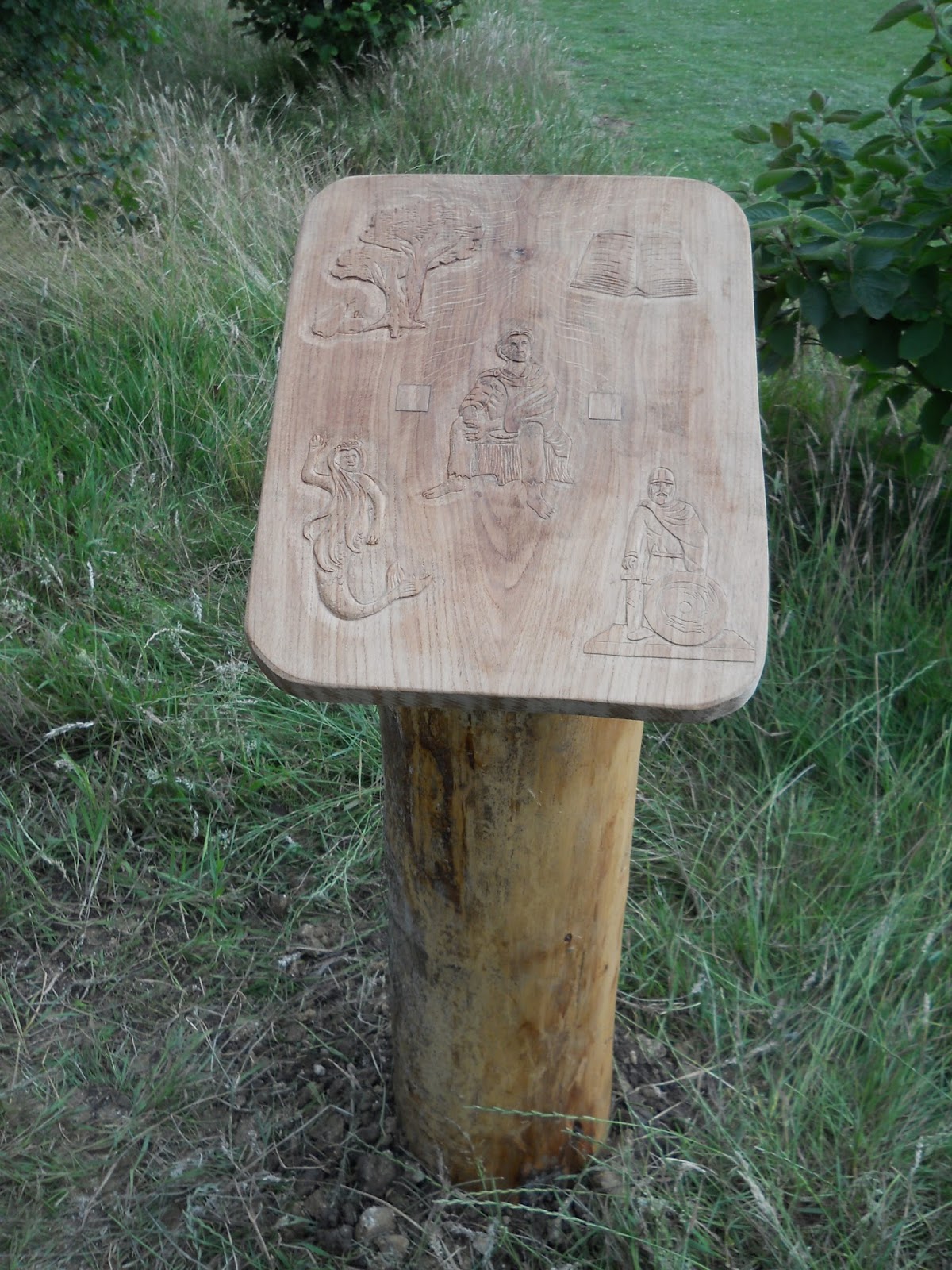
Martin worked with the children to devise stories which were then told to me so that I could design and carve images inspired by them onto oak panels. These panels were then installed in the grounds of the school as a storytelling trail, along with some benches that the children could sit on while developing their own stories (or just chatting and playing).

wooden benches

I went into the school for one day and worked with the children to design dragons, as well as doing some carving with the after school club.

woodcarving tuition at school

Les from a local woodworking group also very kindly came along on one morning and helped dig two post holes and install the durable larch posts into them, for panels to be fitted to.


I also spent a lovely sunny afternoon carving part of the fifth panel live at Patchway community festival and chatting to interested visitors.

demonstrating woodcarving

The first of the five stories was about a young girl who meets a dragon that tells enchanting, beautiful stories. The storyteller in her village dies and she persuades the dragon to come and tell the villagers its stories. The dragon agrees, but only if the villagers turn away and keep their eyes covered to stop them being scared and attacking it.
All goes well until one boy peeps and raises the alarm, however all ends well with the dragon befriending the village and telling stories to them.

dragon carving

dragon carved in wood

The second tale starts with two friends who discover some gold. They argue and so, to save their friendship, they give the gold to a young man to buy seeds in order to plant a garden for everyone to enjoy. The man goes to buy the seeds but instead buys some birds to free them from a miserable captivity by releasing them.
He returns empty-handed and worried because there is nothing to plant. However, the birds return carrying seeds and water in their beaks. They plant them to create a magic garden where not only plants but also ideas and dreams can grow.


The third story is about a woman who sits by some old apple trees and finds herself saying some magic words. The trees form a doorway into a magic garden in which flowers grow that bear precious jewels. She returns and is seen by a greedy man. He forces his way into the magic garden to steal the gems, but becomes trapped there by the trees due to his own greed.


The fourth story is about a farm boy who goes out to cut firewood. The different trees tell him why they are useful and shouldn't be cut, so eventually he burns pine cones instead. Then a small man (the 'Father of the Forest') appears and, for his kindness to the trees, gives the boy a magic wand that can control nature. Things start well but eventually the boy becomes lazy and wants summer all year, which causes big problems with the natural world until the man returns and takes back the wand. The boy realises his mistake and learns to live with the seasons.
The leaves carved around the figure are from the trees that grow in the patch of woodland there. The wooden squares cover the stainless steel coach screws that attach the panels firmly to the posts.


The final story is about St Chad, who goes to a monastery in Saxon times to learn but realises that he is missing having friends despite enjoying his studies. He goes on a journey and comes across a boy trapped in a giant's fruit tree. By piling up the giant fruit, he frees the boy. Next he drains a lake to free a water maiden who is trapped at the bottom of it. She thanks him and makes it rain, refilling the lake. Finally, he finds a statue of a warrior. Realising that someone is trapped inside, Chad frees the warrior by chipping away the stone covering him. It is a local prince, who rewards Chad by giving him some land to settle. Chad founds a school there.

carving at st chads school, pathway


It was great fun carving the plaques and everyone seems very happy indeed with them. Some of the installation was pretty hard work - digging eleven post holes alone by hand into dried clay! Well worth it though, the strip of woodland really looks great and hopefully pupils at the school will be able to enjoy the sculptures and benches for many years to come.

Monday, 8 April 2013

Constructing a 'super-king' sized bed from timber milled onsite using a chainsaw mill


Two friends of mine commissioned me to make this bed for them and yesterday it was delivered and assembled in their house.
All of the timbers used came from trees grown in the local area. The legs are Douglas Fir, the slats and rails are European Larch and the sides and large slabs of timber in the headboard are made from some very special Lawson Cypress.

A few years ago, some large trees were cut down in Ashton Court, Bristol as part of landscaping work and some of the trunks were left lying around to rot. After getting permission from the estates department, Alex, Bob and I took chainsaw mills there and cut the logs of Lawson Cypress into usable planks.


The trees were well known in Bristol and it was great to be able to use the timber to make something that would be appreciated, rather than it being wasted. After leaving the planks to season for several months, work began on the bed.

I've inlaid a small rectangle of wood into the headboard, which was cut from a piece of driftwood collected on a beach near my friends' house on the day of their wedding.


Constructed the bed was quite a long job as I didn't have the equipment to cut the mortises and tenons efficiently with  machines, so needed to finish off every one by hand. The timbers were also quite tricky to work with. My friend Simon Nugent helped a lot by allowing me to use his planer/thicknesser machine but the softwoods tended to tear unless all of the tools were kept very sharp. The quarter-round pieces of Douglas Fir used for the legs were also very hard to secure firmly when cutting mortises into them.

All of which meant that the work took a very long time!


However, it's great to have tried my hand at building such a large bed and for it to have turned out so well.