
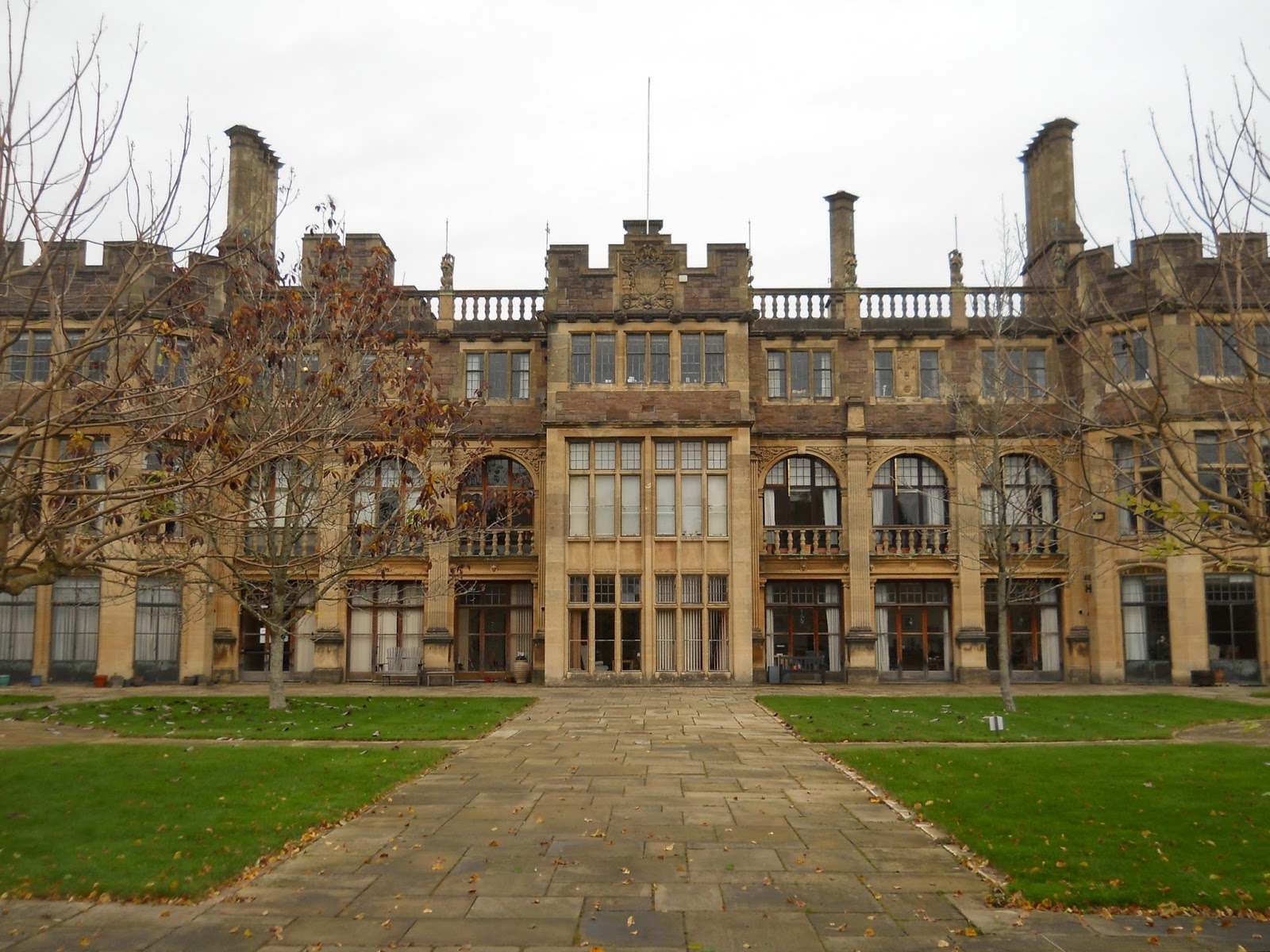
I've worked with the Trust before and did some presentations about carving there earlier this year. It was great to be asked recently by one of the residents if I could help with a project.
St Monica Trust was originally founded to cater particularly for people who followed the doctrine of the Church of England (although they now accept people of other faiths, or none) and that Church is still very important to many residents. The chapel at Cote Lane is an impressive sight.

Peter is a retired architect, a resident at Cote Lane and a keen woodworker. He was interested in making two collection plates, using their fine on-site wood workshop, to donate to the chapel.
Collection (or Offertory) plates are passed around at services and those attending can donate money to go towards the upkeep of the church, or various good causes.
Peter planned to turn the plates from spalted beech wood and to then insert discs turned from rosewood into the bases of them. The beechwood plates were pretty much finished when he came around and looked very nice indeed.

The part that I could help with was carving identical designs into both of the rosewood discs, which were about 100mm (4") in diameter. The carved areas would later be filled with a mixture of resin and metal dust to form a striking finish. I had some previous experience with this technique (which has been used by other makers, including the late Tim Stead), and this meant that Peter and I could discuss how to go about it. I also mentioned to him about the hazards of breathing in the fine metal powder and the fumes given off by some resins when curing, which can both be very harmful.
The elegant design shows three interlocking fishes and was originally created by David Saxon, a retired architect who is also a resident at St Monica Trust.

Fish are a symbol that Christians have used since the early days of their religion to identify it and themselves. You may wonder why:
ΙΧΘΥΣ (Ichthys)
is an acrostic (a word made up of the first letters of several
words) that is made up from the first letters of the Greek
words "Ίησοῦς Χριστός, Θεοῦ Υἱός, Σωτήρ".
These translate into English as "Jesus Christ, Son of God,
Saviour". In
Greek, Ichthys means 'fish'.
There
is also a miracle mentioned in the Bible where Jesus feeds large
numbers of people with a small number of loaves and fishes. Some of
the first disciples of Jesus to be mentioned were also fishermen.
Carving
the discs
To
get two identical designs carved by hand onto each disc, I first
printed out the design and glued it onto the surfaces with spray
mount, then cut straight through into the wood.

The
discs had round blocks underneath, to fix them into the dishes. These
could be held in a clamp made up of a bench hook holding
two pieces of thick plywood with semi-circles cut out of them
and a strip of rubber inserted to give more traction.

I
needed to make the fine lines wider, to prevent them breaking. The
eyes also broke off a couple of times during carving, so circular
plugs were cut out of the round blocks (which would be cut down and
then hidden when glued into the plates) to carefully replace them.
The grain of the wood made it almost impossible to completely avoid
some breakage of the very fine and fragile details during
carving but this was easily worked around with some thought.

Once
the discs had been carved using traditional hand tools, a Dremel
rotary tool was used to clean up recesses and to put some
texture onto the floor of the head areas. This looks pleasingly like
scales, but will be covered with the metal and resin mix and
provide a key.

When
Peter saw them, he was very pleased but requested lines to be cut
that also clearly defined the backs of the fishes. I was happy to do
the carving there and then, so gave him a cup of tea while he waited.
These lines also suggested carving the head area to run into them,
which both us very agreed looked very nice too and made the carved
designs appear more lively.

A few weeks later, the completed plates were on show at St Monica Trust, together with other work made by the residents, as part of an Open Day. I went up to see them.

This image shows the display in the wood workshop watched over by David Saxon, who created the fish design originally. I thought that Peter had done a great job of the plates and I'm very happy to have been able to contribute to the project.

 |
| Image courtesy of Peter Caird |


