As well as this blog, I also have a website and Instagram page with lots more images of my work as well as a few more stories.
If you like woodcarvings, you might want to have a look.
Showing posts with label matthew figurehead. Show all posts

Monday, 16 June 2014

Easton Arts Trail and an update on the Matthew figurehead project


I exhibited work in the Easton Arts Trail over the weekend. There are several Arts Trails around the city of Bristol during different weekends in the year. Artists in a particular area open their houses, with displays of their work, to anyone who wants to come in and see it. Some sell artwork, others use it to show what they do and get publicity. Many participants also sell cakes and drinks. It's a very nice way to meet other creative people living nearby and, to be honest, a lot of people love seeing inside other people's homes!


There were 445 visitors to see my work over the course of the two days and it was a lot of fun. The organisers of the trail are all volunteers and they produce a map so that all the venues can be easily found. Local businesses also get involved, for example local cafes made special one-off dishes for the trail and the local bakery made a bread that could be eaten whilst travelling around the venues. 

While talking about Bristol, there is also news about the Matthew figurehead. The project has come to an end and I'd like to make it clear in this post that any figurehead attached to the ship in the future will be nothing to do with me or my work.

Monday, 11 November 2013

Medieval-style woodcarving blades by Dave Budd, finished with handles


Here's some images of the medieval-style blades that were made for me by Dave Budd in Devon, which I've fitted with handles made from spalted hawthorn (Crataegus monogyna). You can see more about Dave making them in the previous post.

Spalting is fungal action within the cut wood that causes the bands and patches of colour. The next stage would be rotting, but hawthorn timber is tough stuff and the spalting in this wood doesn't seem to have affected it's hardness much, if at all. I haven't seen any particular references to spalted wood being used in medieval tool handles, but if it looks good to me then I suppose it probably did to toolmakers then as well.


Following Dave's advice, the handle for the socketed gouge (the biggest one) was carved to fit into the cone of the socket. Some beeswax was put onto the carved bit before it was pushed in and knocked into place. The wax seems to hold the blade and handle together, whereas gluing might fail with the repeated shocks of mallet blows. The other tools have tangs, spikes that go into the handles.

The forged steel has the look that I wanted, since most if not all tools from those times would either be made by blacksmiths or the carvers themselves. As a guide to size, the largest gouge is about 13" (33 cm) from end of handle to edge of blade.

Two very useful sources for reference information on tools of the period were the St Thomas' Guild blog and woodworkinghistory.com.

If you are interested in the history of woodcarving and carving tools in particular, here is a link to an interesting web page about Viking tools and materials: vikinganswerlady


Wednesday, 30 October 2013

Getting some medieval-style woodcarving tools made by Dave Budd in Devon, to be used when carving the 'Matthew' figurehead

As part of the Matthew figurehead project, I wanted to get some woodcarving tools made which would be similar to those used by carvers and carpenters in the 15th century. It was important that the tools were not only as accurate to the time as possible, but also worked well as they are to become part of my woodcarving kit. Therefore, a mix of traditional and modern techniques and materials would be used to make them.

Dave Budd was the first person to come to mind for the job. He is based to the north of Dartmoor in Devon and is well known for his interest in recreating iron tools. Dave is often at reenactment shows and festivals, demonstrating iron working techniques from the past.

dave budd

So my friend Alex Arthur (a woodsman and charcoal burner) and I headed down to Cheriton Bishop to go and see him. Dave's workshop is tucked away in ten acres of woodland and getting to it involves a walk across a field and through the woods.


After walking a short way along a track, I came to Dave's forge:


The first thing to be done was getting the kettle on!


Dave used a chrome/vanadium alloy steel to make the blades. This means that they will be better in use than alloys used in medieval times. 
First, the iron bar was roughly brought to shape using a power hammer. Again, not a medieval method but it saved a lot of time.


Each blade was then shaped by hand on the anvil and swage block. I wanted the forged look to the blades, as carving tools in medieval times would usually be made by the local blacksmith or by the carvers themselves. 


Another interesting tool that Dave used was the fly press. This was used to stamp his logo onto the blades and to cut the shoulders which butt onto the tang (the spike that goes into the handle).


Finally, after the blades had been shaped, they were ground on an abrasive belt to put on the bevels of the cutting edges.


And here are the three blades that Dave made:


The next stage, after some final shaping, is for the blades to be heated slowly and then cooled to give them the correct temper. There will also be another large gouge made with a socket into which the handle will fit, rather than the tangs that these tools have. I'm then going to make the handles, probably from locally-sourced boxwood, which will be fitted and then the tools should be good to go!

Whilst at the workshop, Dave also showed me two spoon augers that he has made for use at the Peat Moors Teaching Centre in Somerset. Before the familiar spiralling drill bit was invented, spoon augers were the normal tool for cutting holes larger than a gimlet could manage. Anglo Saxon and Viking carpenters would have used spoon augers and chair makers used them even into the nineteenth century. 
The pointed blade is more suitable for drilling into endgrain, whereas the rounded blade is better at cutting into sidegrain, although care needs to be taken that the blades don't catch which could make them snap. The larger auger with the rounded blade has a chest brace fitted, so that the weight of the user's body can be put behind it.


We also had a wander around Dave's woodland and saw his teaching forges, where he runs courses in early smithing techniques.


It was a very enjoyable afternoon in the woods with Alex and Dave and I hope that we get to meet up again soon. You can see more of Dave's work at his website, just click on the link here.


Friday, 4 October 2013

Links to the 'Matthew' in St Mary Redcliffe church in Bristol. A treasure brought back from the original voyage and a more recent model

St Mary Redcliffe is a parish church in Bristol, near to the harbour. Much of it was built between 1292 and 1370, although there were earlier churches on the same site.


The church is so grand that it looks a bit like a Cathedral, thanks to donations by wealthy Bristolians (particularly William Canynges) who would have masses said for their souls there in return. Queen Elizabeth I is supposed to have said of St Mary Redcliffe that  it was "the fairest, goodliest, and most famous parish church in England."


Two items held within the church were of particular interest to me because of their links with the 'Matthew' figurehead project. One is held high up on a stone corbel in a side chapel:


This is a whale rib bone reputedly brought back by John Cabot from the land that he discovered, what is now Newfoundland or Nova Scotia. I don't know of any other surviving artifacts from that original voyage in 1497. This may be the first thing brought by anyone from the New World back to Europe (assuming that the Vikings and St Brendan didn't return with anything).

Another item linked to the Matthew is above the door from the North Porch into the church. It is a model of the replica ship (the one currently in the harbour) which was given to the church to be blessed for luck, in the same way that the owner of a new ship in medieval times would do. 


There is a famous original medieval model used as a blessing object still in existence. It is called the 'Coca de Mataro' and is now in a museum in the Netherlands. It seems appropriate to have the nautical artifacts in this church, as the crew of the original Matthew may well have prayed here for a safe voyage and would have navigated back into the harbour using it as a reference point (although the current spire only dates to the nineteenth century).

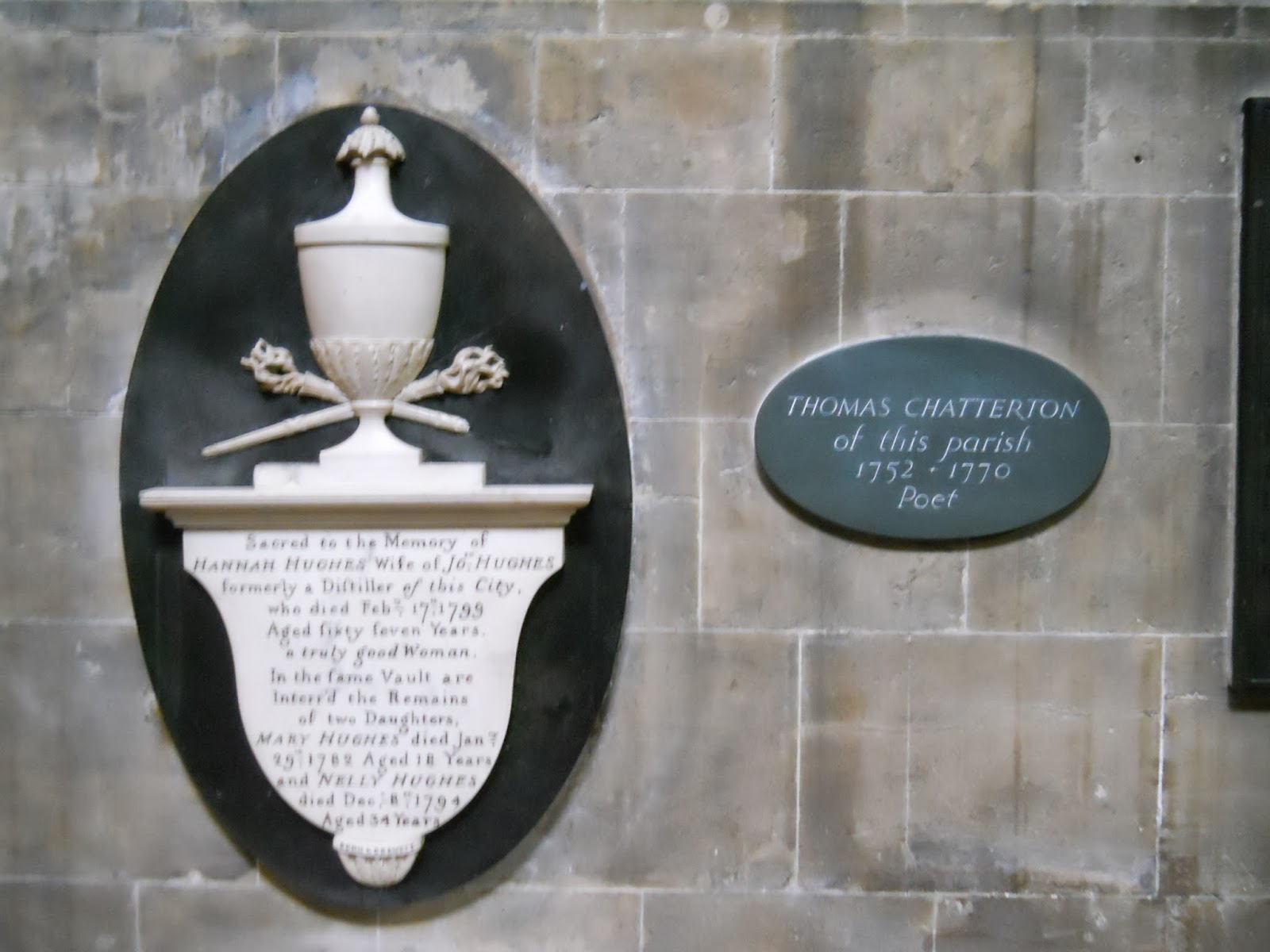
St Mary Redcliffe is full of interesting things. Here is the memorial to the poet Thomas Chatterton, who spent a lot of time in here. You might notice that the memorial next to it commemorates a distiller:
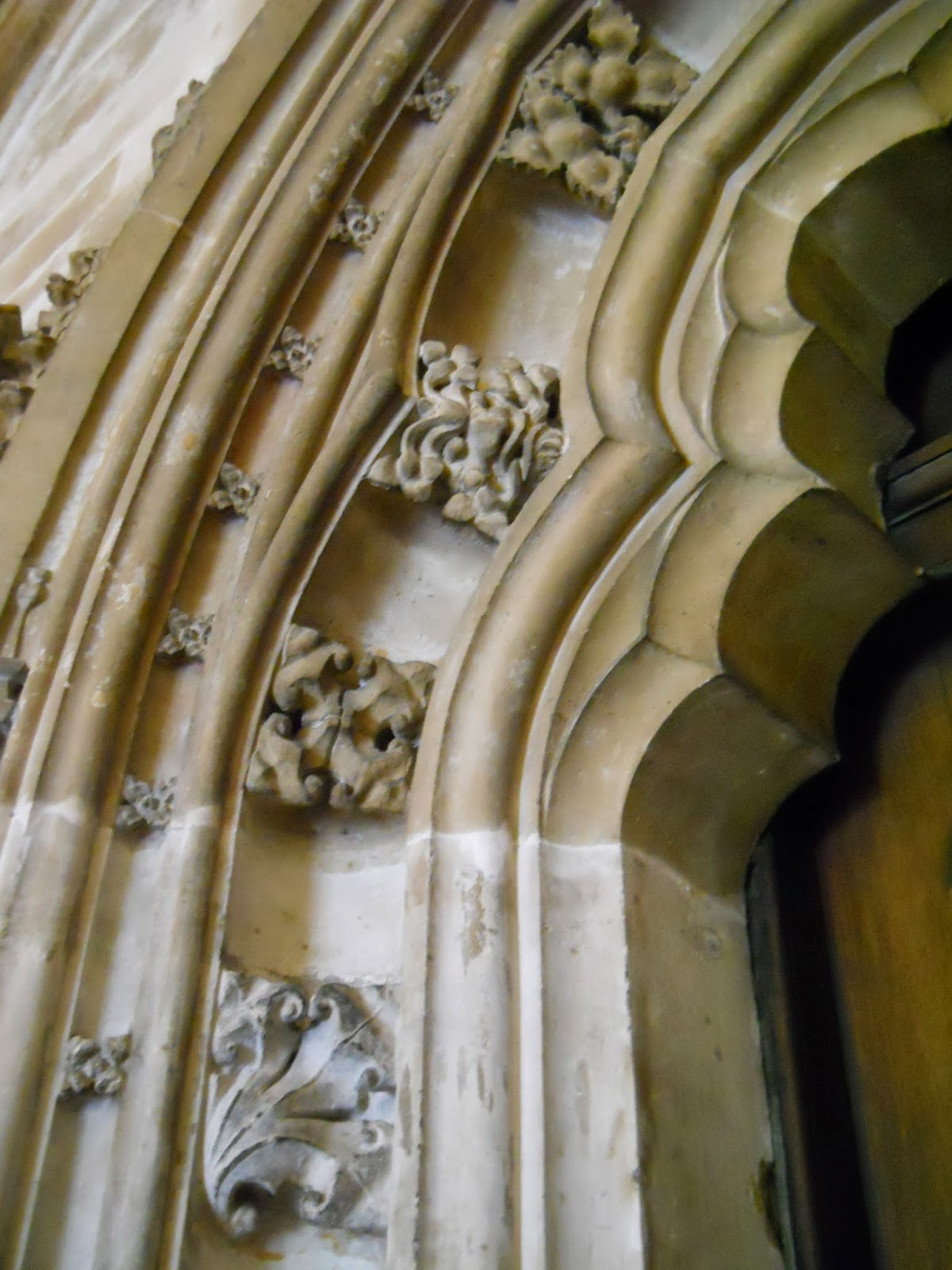

Some of the most interesting things in St Mary Redcliffe are the stone carvings, despite the attentions of Oliver Cromwell's miserable Puritans. The roof bosses are amazing, but you may need binoculars to see some of them!


 I like the grotesques carved around the North porch as well. The stone masons must have enjoyed carving these odd characters:


There are intricate carvings running around inside the porch. It's been suggested that they might show panels in a story, but no one seems to know what that story is any more.


There are also lots and lots of 'green man' figures hidden away in carvings. There is even a very unusual 'green dog' figure here, but unfortunately the Chapel of St John the Baptist, where it is found, was too dark to get a photo:


Thursday, 15 August 2013

Teaching woodcarving with the Carpenters' Fellowship and milling oak for the Matthew figurehead


On Tuesday, I packed my teaching sets of tools and a sleeping bag then headed over to Chelvey woodyard, near Bristol. There was a training week being run there by the Carpenters' Fellowship and I was invited to teach woodcarving skills. That's their logo above.

The Carpenters' Fellowship is an organisation that I'm a member of, which seeks to promote traditional timber framing skills. There were framers from various parts of Britain working on building a training centre at the woodyard from British Larch. It was also a chance for them to be assessed for official construction industry qualifications.


Learning woodcarving gave the participants a chance to see a different skill set and tools from those with which they were building the structure, as well as another skill to add to those that they were experiencing on the training week. It was also very interesting for me to see some of the tools that were used in framing, particularly the power tools, some of which I hadn't come across before.


The carving was on a piece of oak and shows the scene in the framing yard as the frame was being prepared for assembly. Hopefully, it will be fitted in some way into the finished structure as a 'date plaque'.


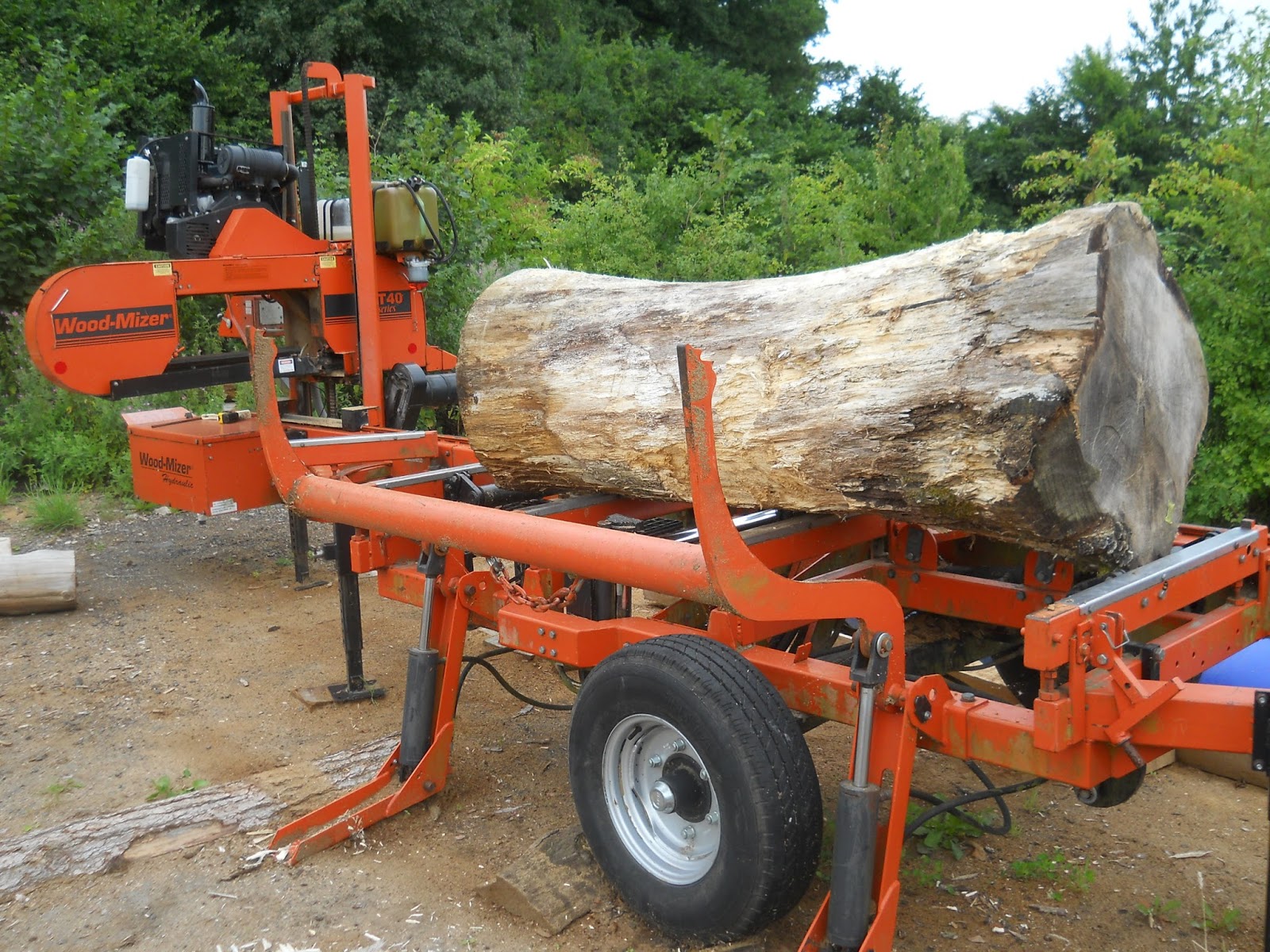
While at the woodyard, I was helped by Will Bolton to mill an oak trunk ready to become the figurehead for the ' Matthew'. The tree originally grew at Nether Stowey, on the Quantock hills in Somerset. It's great to be able to use local oak to make the figurehead and the timber and milling was very generously provided by Nigel Howe at Chelvey. Thanks also to Will for doing most of the hard work with the mobile sawmill.


We used a Wood Mizer to do the milling. This is basically a horizontally-mounted bandsaw which moves on rails along a trailer bed. I suppose we could have used traditional medieval-style pit sawing methods to cut the trunk, but that's a heck of a lot of time taken, hard work and also skill. The Wood Mizer had the job done in a couple of hours.


Regular readers (thank you, by the way!) may recall that Lawson Cypress from Ashton Court in Bristol was to be used for the figurehead. I had got to the stage where the blocks were cut out ready to be carved. However the Cypress timber, though durable outdoors, didn't seem to have the strength to be able to withstand the battering that it would get at sea. Oak can take that kind of punishment and is also authentic for the period that the replica of the Matthew represents.


I am going to let the oak blocks dry for a bit and see how it responds, before roughing the figurehead shape out of the individual blocks and then letting it season further. This means that any movement in the seasoning timber can be accounted for when gluing the blocks together. Once glued, I'll be able to do the final finishing carving, hopefully using tools similar to those that a medieval shipwright would have used.


You can find out more about the Carpenters' Fellowship here:

Here are some previous posts about the Matthew figurehead:


Saturday, 27 July 2013

The preview for 'Inspired' at Ashton Court

The 'Inspired' exhibition at Ashton Court is looking fantastic. The invitation-only preview was held today and gave a chance to meet the other makers who are showing.


Today began at 6.45 am with a chat to local radio about the wooden model of the Matthew figurehead that I'll be carving at the exhibition during the coming week from 10am 'til 4pm. Unfortunately I can't really remember what was said as my brain wasn't really switched on at that hour!

The work in 'Inspired' really is inspiring. As with all of Sue's shows, the quality is superb and it's great to be exhibiting next to such interesting pieces.

My contribution is a mammal that would feed on the insects depicted in my 'metainsecta' series. The whole piece is made from found and recycled timber.


I only managed to take a few shots of some of the other work there, before my camera battery ran out. Here's those few to give a little taste of what can be seen. I hope to post some more when I revisit with full battery power;


The table and chair in the foreground are by John Makepeace, the chair and lamp on the far left by Nick Crossling, the glass vase in the window by Becky Wills of Yellow Dog Glass and the bench by Dan Burrough.


This sculpture is by Glenn Morris and is inspired by his travels in the Arctic.


Avril Farley makes these beautiful ceramics with their interesting crystallised glazes.


These sculptures are by Margaret Lovell


This little yew wood stool is by John Makepeace, who is exhibiting four pieces 


I like this chest from Waywood a lot, it's hard to resist touching the surface of it!


Graham Ilkin's 'Betty' chest is full of interesting wood colours and patterns


Jonathon Markowitz's 'Humby' desk and chair have a very cool, clean-lined modern look to them.

The exhibition is on until the 4th August at Ashton Court Mansion, Bristol. You can visit between 10am and 4pm and admission is free.