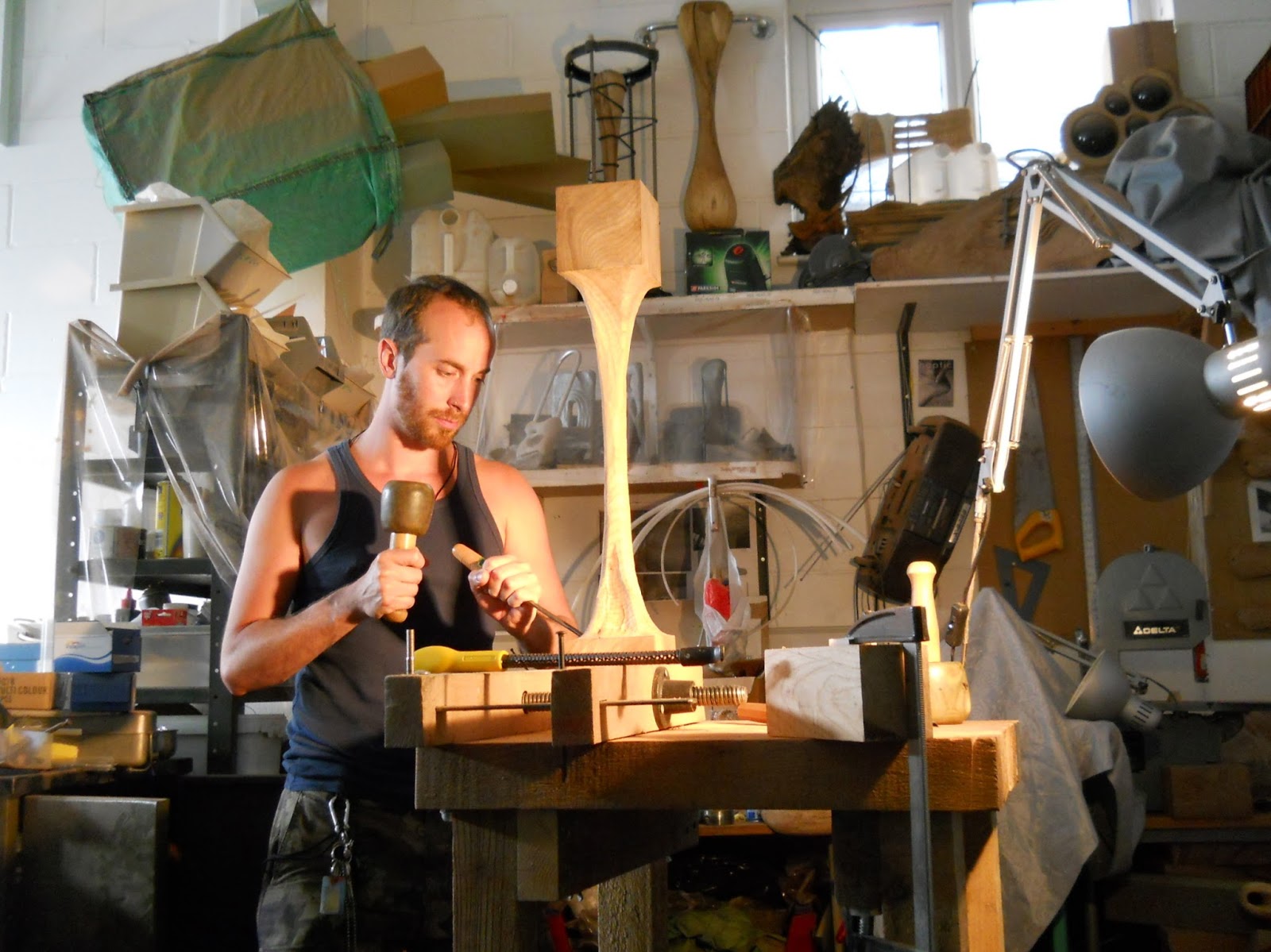
As well as this blog, I also have a website and Instagram page with lots more images of my work as well as a few more stories.
If you like woodcarvings, you might want to have a look.
Showing posts with label artworks. Show all posts

Friday, 11 March 2022

'New Beginnings' - collaborating with artist Luke Jerram on his new sculpture in Bristol


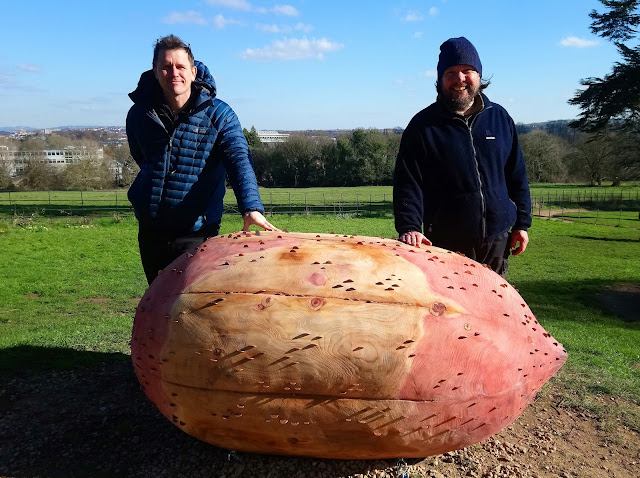
Luke Jerram sculpture New Beginnings

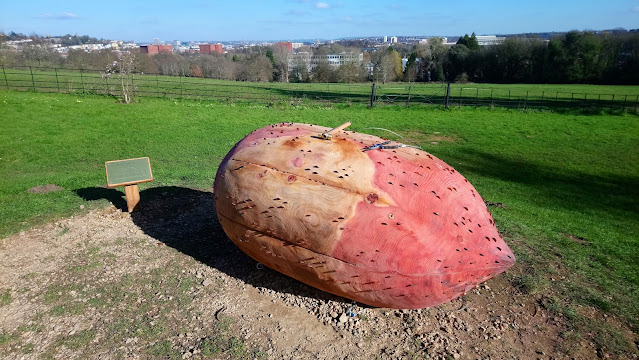
Luke Jerram is a Bristol-based artist (on the left in the photo above) whose work is known around the world. So it was very exciting to be invited to collaborate with him in the making of a new experimental sculpture, which is called 'New Beginnings' and is now installed at Ashton Court in Bristol.


The sculpture was carved from locally-sourced sequoia wood, which was then carved and assembled at my workshop next to the Ashton Court estate. Visitors are invited to use the pliers and hammer provided to add their own small-denomination coins to the sculpture and to make a wish while tapping them in.

Luke says that "I love idea of a seed: as a capsule of information and an object of potential that contains everything inside, a plant needs to grow. I hope the public enjoy interacting with this new sculpture and it acts as a capsule for their hopes, dreams and imagination!"

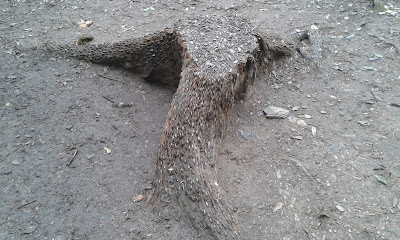
The project, which is hoped to be the first in a series, was inspired by 'wishing trees': these are trees or stumps (usually dead) which have coins pushed or knocked into them for luck. The tradition is thought to be at least a couple of hundred years old. Here is an example from Portmeirion in Wales:

wishing tree portmeirion

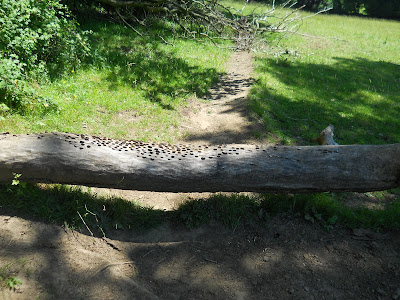
...and another from near the village of Uley, on the edge of the Cotswolds:

uley bury wishing tree


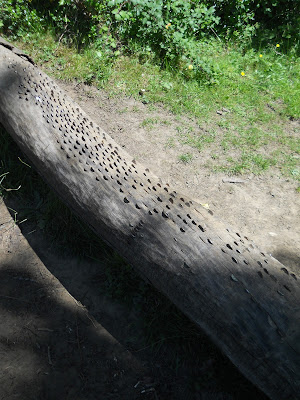
wishing tree ally


I'm looking forward to seeing how the sculpture changes over time as more coins are added! If you are in Bristol you could visit the beautiful estate, which is open to the public and free, then add your own coin and wish if you'd like to.

Thursday, 21 July 2016

'Hollow', an art installation at the University of Bristol using timbers from 10,000 different species of tree


It would probably be fair to say that I'm fascinated by different kinds of timber to the point of being a wood nerd, so I was very interested to hear about this art installation in the Royal Fort Gardens in Bristol. 


These landscaped gardens, originally laid out by renowned designer Humphry Repton, are part of the University of Bristol. To celebrate the opening of the university's new Life Sciences building, it commissioned this permanent artwork from an organisation called Situations who worked with artist Katie Paterson and architects Zeller and Moye to create it. 


'Hollow' consists of a Modernist-style shell made from Douglas fir timbers, which surrounds a space built from and containing pieces of wood from 10,000 different species of tree. These have come from almost every country in the world and include pieces of the banyan tree under which the Buddha found enlightenment and a ginkgo tree that survived the atomic blast in Hiroshima.


Light comes in through transparent panels above and there is only room inside for one or two people at a time. The entrance is quite narrow, so some people might find it difficult to get inside.


One thing that I noticed was how the wooden shell deadens sound outside the chamber. It is a very serene space. The pieces of wood aren't marked in any way to show what they are and where they are from, which I'd loved to have known but the mystery added to the atmosphere of the space. I wonder if there is a list of the timbers used online anywhere?

Even the floor of the space is made up of blocks, some of which are fossilised timbers that are over 390 million years old. 


As I looked closer, more details became apparent. Above a visitor's head, the patterns of squared blocks shaped to let light through hide rough, unfinished pieces of wood in a partially hidden second layer.


This isn't the only large installation in these beautiful landscaped gardens. If you get the chance, it might be worth seeing it for yourself.


Sunday, 28 June 2015

Phil Young: carving wood, as part of his distinctive sculptures, at his studio in Bristol

 
I've known Phil Young for quite a while now, in fact we went to the University of Plymouth in Exeter at the same time, studying three-dimensional design. It was great to catch up with him a couple of days ago and see what he's been up to.

Phil, as 'Dendrophile',  uses a variety of materials in his distinctive sculptures, often using carved wood to deceive the eye into seeing this material as having been distorted by different clamps, bindings etc.


'My work explores the tactile nature of these materials and our innate associations with them. I enjoy tricking the eye into believing wood has stretchy and squashy properties like flesh and how people react to this because of their strong connection to trees.'

I really like the way that Phil captures movement and distortion of the forms using the solid timber. Getting that sense of movement isn't always easy in woodcarving and he really gets it across well.


One of his pieces was recently shown in New York, which Phil seems to be taking in his stride. When not working on his sculptures, he practices his fire juggling skills and also works for a local college, working alongside students who need some extra academic help (such as those with Asperger's syndrome) with their creative studies.

Tuesday, 28 April 2015

A day in Leigh Woods; Burwalls cave, Luke Jerram's stranded boats and a wooden sofa

Leigh Woods runs along one side of the Avon Gorge near Bristol and is home to some very rare species of trees and plants. I went there a few days ago with a friend of mine, Duncan.

First we visited the legendary Burwalls Cave. This cave is quite a scramble to get to, but it's worth it. When we went, the ramsons (also called wild garlic) were covering the woodland floor, giving the mild garlicky smell that always means 'summer is coming' to me.


The cave itself is just under where Burwalls House now sits at one end of the Clifton Suspension Bridge. Before the mansion and the bridge were built, there was an Iron Age hill fort there.


Although some of the cave looks natural, I'm sure that other parts were dug out, built up and remodelled to make the place more like a grotto when such things were fashionable. The Bristol area has a couple of other notable grottoes, including ones at Goldney House and Warmley. 

Unfortunately, the cave was a mess when we arrived, with old sleeping bags and rubbish all over the place.  There were no signs of any current occupants either.


We couldn't really leave it in such a state, so we bagged up the rubbish and piled away the camping gear (being very watchful for discarded needles, of which there didn't seem to be any luckily). It was a real shame to see such a great spot, that many people have enjoyed finding for the first time, left full of discarded junk. Often before there has been cooking equipment and similar useful items left there tidily for other visitors to use, but this was different.


It looked a lot better afterwards, and in one dark corner we were rewarded by coming across a roosting bat. We also let the rangers, who look after the cave, know what was there. Hopefully it will be in a more welcoming state now.


After a bit of a mad scramble to get back to the parapet of the Suspension Bridge, we walked up into Leigh Woods. It was good to be there again, especially at this time of year when everything is gearing into summer.  The visit also gave an opportunity to visit the Centenary Bench and see how it was doing, as well as getting some knife carving done.


Two of the National Trust rangers at Leigh Woods have carved a great-looking wooden sofa, from cedar which originally grew on the Tyntesfield estate.  It is where the car park used to be by the Trust's offices :


There was another new artwork to be visited in the trees nearby. Luke Jerram is a well-known artist and has made installation artworks around Bristol before. He has placed five fishing boats in the woods as a piece called 'Withdrawn'. It addresses the problem of overfishing and its effects on the environment.


It was interesting to see, although it was a shame that the boats weren't safe to climb onto. Even though it wasn't the point behind the artwork, some of Jerram's previous installation pieces have involved a lot of viewer participation (playing pianos left around the city or sliding down a huge water slide) and it made just standing and looking at the boats feel a bit like there was more that could be happening.  


The walk there was lovely though, with the bluebells in the hazel coppices starting to come into flower. I'm glad that the artwork is there and that it gives people who might not be visiting the woods otherwise a reason to see them when they're at (what I would consider) their most beautiful.

Monday, 28 July 2014

Two African woodcarvings representing actual objects, made for very different reasons...


This ebony carving of a chainsaw is an artwork called I Want That You Want What I Want That You Want. It was in an exhibition called 'The Museum of Forgotten History' by the artist Maarten Vanden Eynde, which was shown at the Arnolfini gallery in Bristol in 2012.

The sculpture was made by a woodcarver in Cameroon in 2010 and was exchanged with Vanden Eynde for the actual Stihl chainsaw that was copied in ebony.

The next carved representation is less refined in its carving but is possibly a matter of life-and-death to those who use it, members of the Konso people of Ethiopia. It was seen in the British Museum in London and represents a Kalashnikov AK-47 assault rifle.


The exhibit label says that 'Hand-carved wooden AK-47 rifles are frequently carried by poor road workers in southern Ethiopia as a form of defensive camouflage, and by their children to deter potential thieves while tending goats and other livestock. Road building works have brought itinerant labourers into contact with pastoralist groups in this remote region where traditional cattle raids have become commercialised rustling. The black 'metal' parts of the gun are painted using tar and pitch from the road-works'