As well as this blog, I also have a website and Instagram page with lots more images of my work as well as a few more stories.
If you like woodcarvings, you might want to have a look.
Showing posts with label play structure. Show all posts

Monday, 27 November 2017

Making playground instruments for St Werburghs Community Centre in Bristol, using locally grown timber and some reclaimed materials

Recently, one idea that has interested me is making sculptures that can be played as instruments. This linked nicely into a recent commission. A community centre in Bristol wanted instruments to go in their new garden next to the M32 motorway.

playground instruments bristol

The spaces where the instruments were to be installed weren't big, being between already existing planters. This limited the amount of keys, chime bars etc. that could be used in each one . After chatting with the director of the centre I designed and made them some playable structures that we felt also looked good.


The reddish-coloured woods, used for the xylophone keys amongst other things, are sepele and utile. These are both timbers from trees that grow in West Africa. I tend to only use reclaimed tropical woods in my work and these were no exception, having been bearers for timber deliveries to a local company which are usually destined for burning. The posts and other timbers are European Larch; a durable locally-grown timber. 


metallophone and xylophone

One particularly enjoyable part of making these was turning the 'rattle poles' on my Myford lathe, for the last instrument played in the video.


wooden playground instruments

They are quite big pieces and it was a fun challenge to turn them evenly and for both of them to be as similar as possible.


wood turning on a Myford Lathe

I had help from volunteers during the installation, which made the job a lot easier! Everyone was very happy with the new instruments, including me (as you can probably tell by the big smile at the end of the video).

Wednesday, 1 February 2017

A drum stool with a difference! Making carved wooden drums as seats

The story of this project begins last summer...

I had been invited to make some carvings for Gwalia farm near Machynlleth in North Wales, in return for a stay there at their stunning 'Cabin by the Lake'. This beautiful spot has a private lake, canoe and wood-fired hot tub.


Gwalia cabin by the Lake

Luckily, an oak tree on the farm had just dropped a large branch and so there was plenty of timber to carve!


The cabin was missing some nice seating around the fire, so by the end of the week I'd carved an owl stool...

carved wooden owl stool

As well as a stool with a carving of a Natterer's bat (as a few of them were flying around the cabin at dusk).The second stool also had slits cut into it, to make bars which made a note when struck. They are a bit similar to a West African 'krin' drum:


Natterer's bat carving in oak wood

Krin drum


I really liked the drum idea and showed a few people when back in Bristol. Jono at Touchwood Play realised that the drum stools would work very well in a new project that they were working on. After making a couple more examples to refine the idea, I was commissioned to make six of the stools.

First there was a trip out to Backwell, near Bristol, to look at the oak timber available. It had to be of a certain diameter to make a good stool. Once the logs were back at my workshop, the hard work began!


Bower Ashton woodyard

Firstly, the logs were cut to size, the bark removed using a mallet and chisel and then the stools were smoothed to remove tool marks. I used a chainsaw to cut the bars into the logs.


chainsaw carving

The bars then needed to be sanded and cleaned up, which took a lot of time. Once that had been done, I carved two rows of ridges onto each stool, to make an effect a little bit similar to an instrument called a 'guiro'.


krin drum stools

The drums still needed sticks to play them with. These were turned from locally-grown hornbeam timber. Hornbeam is a very tough wood, traditionally used to make butcher's chopping blocks and the teeth for large cogs, such as in mill workings. It was perfect for this job.


woodturning on an electric lathe

The sticks were chained onto the drums using good-quality stainless steel chain (as stainless steel doesn't react with and discolour oak, unlike normal iron or steel). There was also a hole drilled into each drum to hold the sticks when not in use. The chain is attached halfway along the stick to avoid it making a dangerous looping foot snare when stored in its holder.


The drums just needed a few coats of finishing oil and they were done. Using a tuning app on a phone, we also managed to find out what notes the different bars made. There was a surprising range! Quite a few were A or B, but one played three C notes with an octave between each. Others played Gs and Fs. You can hear them on this Youtube video:


I'd like to refine the tuning methods on future drums, although the tuning on these drums will probably change a bit over time anyway, as the wood dries.  

I did notice that small cracks in the oak, formed during seasoning, didn't seem to affect the sound much at all.


The drums will eventually be mounted in a circle onto a wooden platform in a play tower. They will be fixed down using large screws, so that they can't fall over or be thrown and injure anyone. To allow them to resonate and make a good sound, there will be rubber feet under each one. I've placed wooden sticks under them in these photos to allow a good resonance when playing them in the workshop.


carved wooden drum

Saturday, 5 October 2013

Teaching Woodcarving in the Sunshine at Bradley Stoke in Bristol


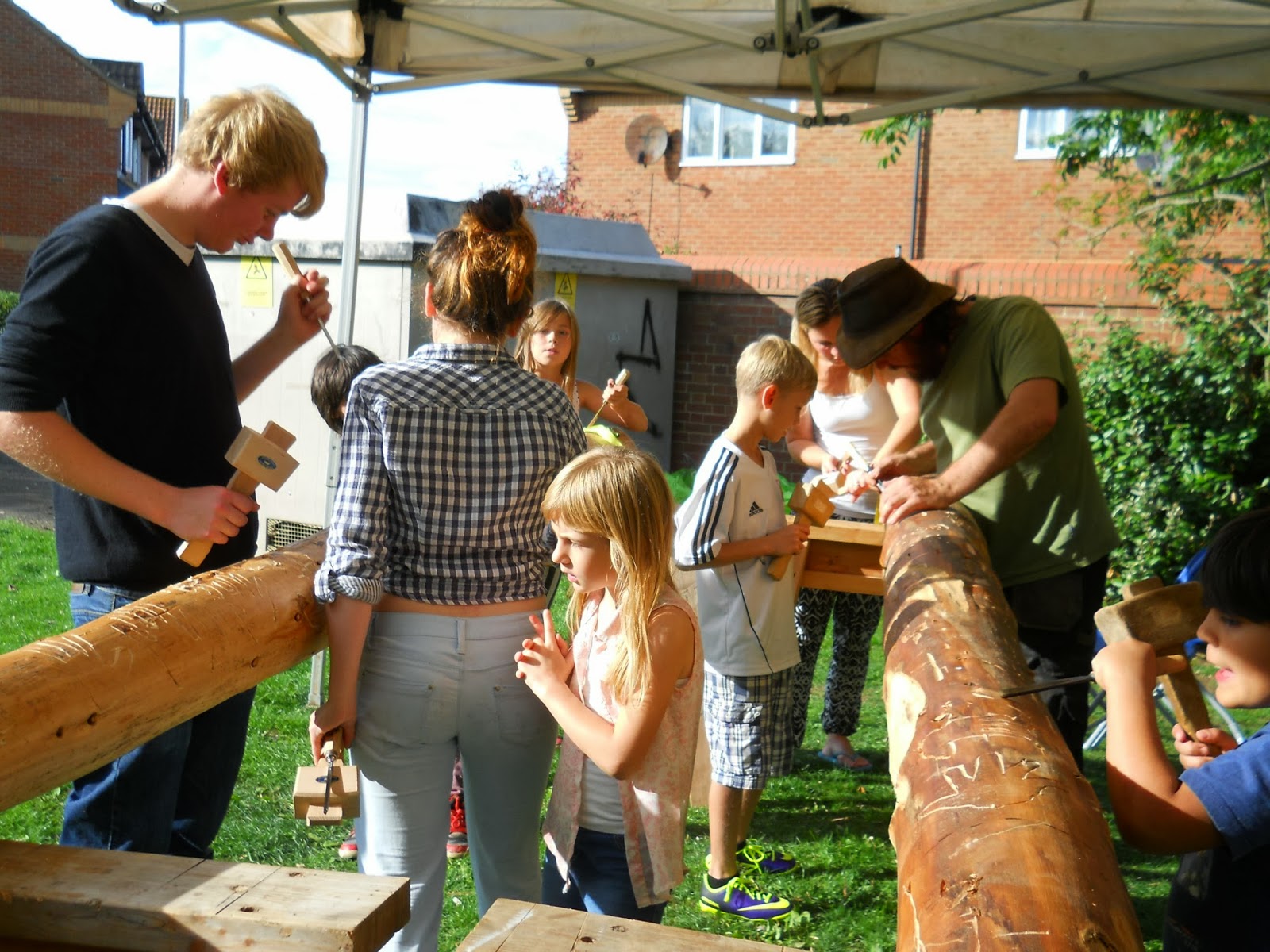
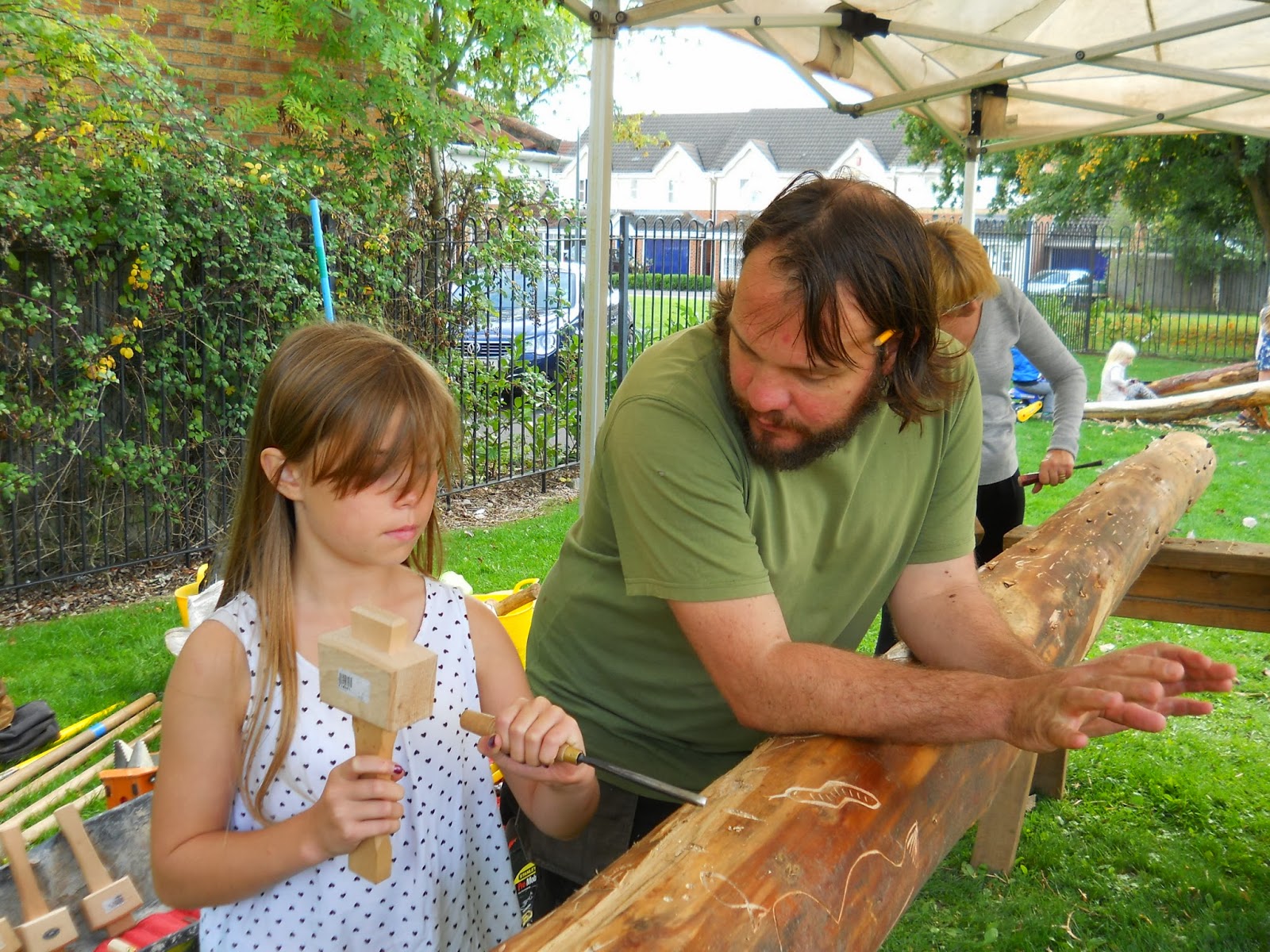
There was a lot of fun had in Bradley Stoke today. It has been a lovely sunny weekend and I've been teaching local people woodcarving on behalf of Touchwood Enterprises, a local company which makes play structures using local, sustainably sourced timber whenever possible. Both Touchwood and I are members of the Forest of Avon Products, a not-for-profit cooperative based around the Bristol area.


Touchwood are making a play structure for Knightstone, a housing association, and asked me if I would work with them to carve some larch poles with local residents. It will be fitted into a green space in Bradley Stoke for them to enjoy.


Working alongside me, Katie and Ellie from Knightstone and Nico, who led the peeling of the bark off the larch poles and the digging of holes, everyone got stuck in and worked really hard.


We had some very keen hole diggers at work:


Who checked the quality of the holes very carefully after they had been dug:


Everything was also helped along by a plentiful supply of free tea, coffee and delicious cupcakes, supplied by the 'Dandy Cabin'. 


Friday, 17 May 2013

Making a goat play ramp structure at Boiling Wells for St Werburghs City farm

A group of volunteers from Lloyds bank came to the farm today as part of 'Give and Gain Day', when businesses send their staff out of the office for the day to help in community projects.

The young goats needed a new play structure to jump all over. We had a lot of timber left over from a volunteer day earlier in the week (kindly provided by Skanska engineering), so the Lloyds folks put together a couple of platforms and ramps for the kids to climb about on.


I oversaw it, but the group really did most of the hard work themselves and the results are shown below. Don't they look great! Very happy goats.