As well as this blog, I also have a website and Instagram page with lots more images of my work as well as a few more stories.
If you like woodcarvings, you might want to have a look.

Tuesday, 27 September 2016

Revisiting Eggenfelden: my first large woodcarving and the first piece made using chisels, carved and painted over twenty years ago


In the summer of 1995, an international environmental work camp was held outside Eggenfelden in Bavaria. I was the only British person there, with other volunteers from the US, Canada, France, Germany, Slovenia, Poland, Czech republic and Lithuania.

We worked with the LBV (Landesbund für Vogelschutz), a local environmental group, to transform a disused electricity substation into a wildlife sanctuary with spaces for birds and bats to roost. It was a great time, camping in the adjoining field and cooking for each other.


Woodcarving had interested me more and more over the previous year but I'd only produced work using found timber with my Opinel knife up until that point. As the construction project drew towards a close, I asked if it would be okay to carve a date plaque for the building. With a piece of softwood (probably larch), a gouge and two carpenter's chisels donated by the neighbour, the date plaque took shape. I painted it and then fixed it onto the tower. 


carving a wooden date plaque


With the help of Emmanuelle, a French volunteer, the two metal doors on the structure were  also brightly painted.


painted flowers

At the end of the work camp a small conifer tree was put onto the roof, the traditional way that the end of a building project is celebrated in the area.


At the time, I never got a decent photo of the carved plaque and had always regretted it. The panel was the largest project that I'd worked on for several years afterwards and it was also my first carving made without using my knife. I often wondered if the panel was still there and what it looked like.

So last week, with mounting excitement, I sat in a car travelling along a dusty farm track towards the same spot. The satellite view on Google maps had told me that the building was still there, but were the panel and paintings?

As the car pulled up next to the tower, I pretty much threw myself out and ran round to the other side. There it was, aged but with the colours still visible and the whole panel looking in much better shape than I'd feared!


The painted doors hadn't fared quite as well, with one almost completely faded and rusted away.


However, the birds and bat on the main door were still quite easy to make out. I wonder why someone had gone to the trouble to paint out the blue tit sitting on the fencepost?


It was fantastic to see that the plaque was still there and also that the tower was clearly still very much serving its purpose as a wildlife refuge. 


LBV Bayern


LBV Projekt Eggenfelden


Saturday, 24 September 2016

The woodcarving tradition of the Ammergauer Alps: visiting Oberammergau and Hans-Joachim Seitfudem's studio in Bad Kohlgrub

oberammergau woodcarvings

The town of Oberammergau is in Bavaria, the most south-easterly state in Germany, not far from the border with Austria. It is famous for the Passion Play, which depicts the suffering and death of Jesus and has been staged there every ten years since 1634. 

The town and the area around it are also renowned for the woodcarving tradition that predates the first performance of the play. In 1508, the Florentine statesman Francesco Vettori visited Oberammergau and described it as a 'very healthy but poor village, where most of the inhabitants were fine woodcarvers. The villagers were famous for carving crucifixes and different scenes inside a walnut shell.' These kinds of sculptures are still produced today; this example was carved by Joachim Seitfudem:


carving in a walnut shell by Joachim Seitfudem


In the 18th century, the woodcarvers from this area would travel around Europe carrying a distinctive type of rack called a 'Kraxe', on which they carried carvings for sale. 


Kraxentrager statue

The peddler, called a 'kraxenträger', is a figure whose hard work and resilience is still celebrated in the area today, both in public statues and in sculptures by contemporary carvers.


Oberammergau kraxenträger

Kraxenträger


Carvings made in Oberammergau can still be seen in many places outside of the area, even in Britain. This nineteenth-century crucifixion scene in the church of St Carantoc, near Newquay in Cornwall, is an example of a piece made by carvers based there.


There are quite a few shops selling woodcarvings in Oberammergau and I visited several of them. It was interesting to see that certain figures and subjects came up again and again. The kraxenträger is one, as is the crucifixion of Jesus, St George slaying the dragon, St Hubertus (who is associated with hunters) and of course Nativity scenes, amongst others. Another secular subject that particularly interested me were the many figures of morris dancers, taken from famous original versions which were carved in 1480 by the Munich-based sculptor Erasmus Grasser.


Erasmus Grasser morris dancer

In one shop, the staff were happy to explain about the process of making the carvings. 


They said that their sculptures were still carved in Oberammergau, however the pressure of producing enough to satisfy demand at a reasonable price meant that most were now made using a pantograph (a copying machine) rather than by hand. A bronze master figure was produced and used to create other figures, which could be scaled up or down by setting the machine differently. Such devices have been in use for centuries and, in a world of computer controlled processes, machines working from a metal master figure are quite traditional in themselves. Once carved, the figures would be checked and finished with wax or painted by hand. 

I have been told, by another local carver, that German law also says that if a sculpture has had at least ten percent of the work done by hand, it can be sold as 'hand carved'. 

Some larger figures will be roughly shaped using a computer-controlled routing device and then carved by hand over a period of two or three days to speed things up. To be honest, this seems fair enough to me in a commercial context. Most carvers would use machinery, such as a bandsaw, to roughly shape a sculpture nowadays and the hand carving would still require a lot of skill to execute well.

The same person told me that some of this carving work is sometimes also done outside of Germany, in countries such as Rumania, then sold by retailers in this area as locally-made. I don't believe that the shop shown above does this but apparently some other, less honest, places do. 


I saw three kinds of wood being used to produce carvings. Larger ones and hand-carved small figures were produced using timber from the lime or linden tree (Tilia sp.), as it is soft and easily worked. Smaller carvings, especially those made by using a pantograph, were also often made from the harder timber of sycamore (Acer pseudoplatanus), which is called 'Ahorn' in German. Traditionally, this would usually be sourced from the South Tyrol region of Italy, but nowadays it sometimes had to be bought in from further afield. In one shop, a small number of carvings were made from pine or larch timber. This didn't seem to be a common practice although I did see an interesting grave marker, also carved from softwood, in a graveyard in the nearby village of Bad Kohlgrub.


Bavarian carved wooden grave marker

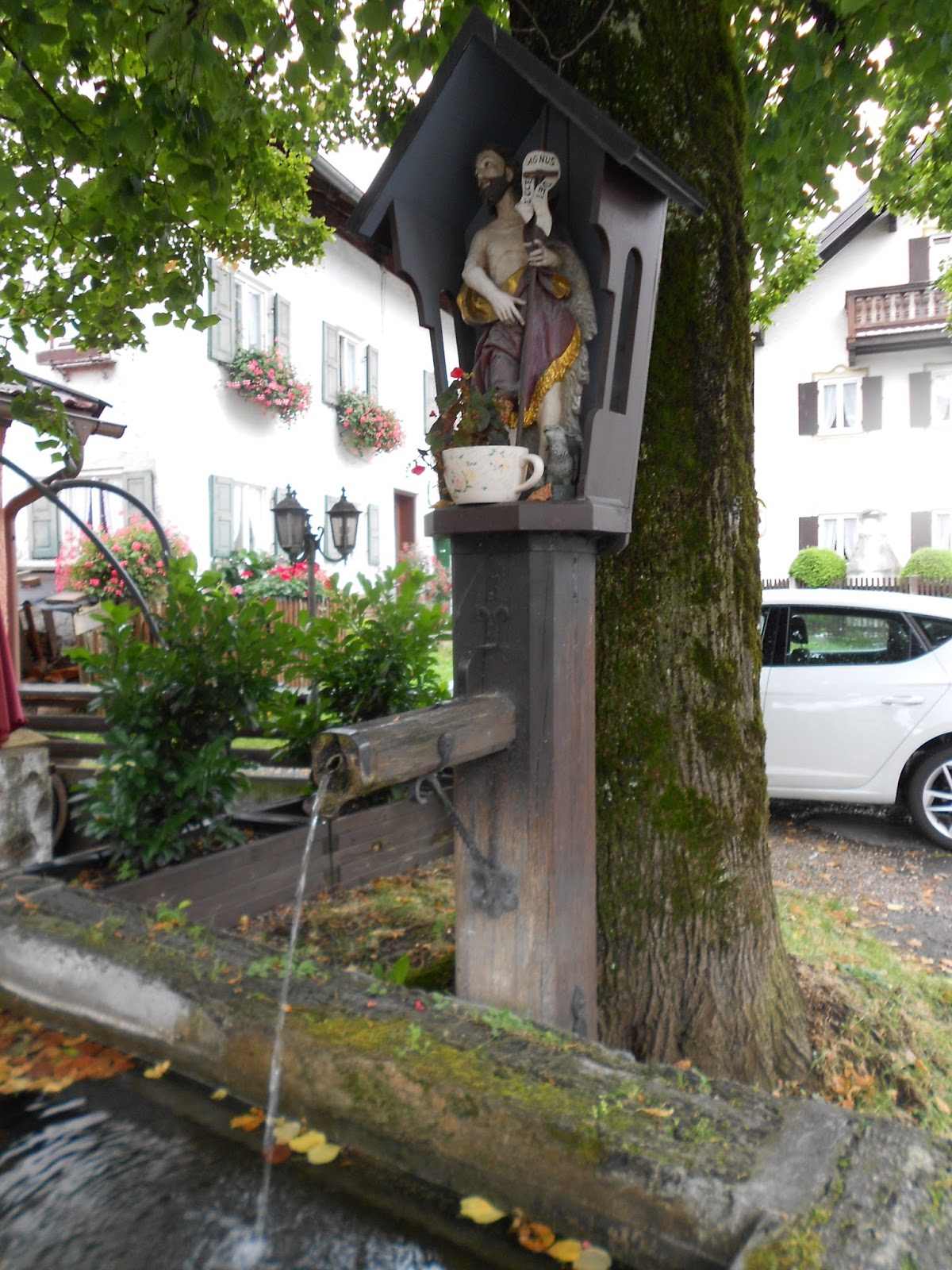
This region is quite staunchly Catholic and many woodcarvings of saints, Jesus or Mary his mother could be seen on local shrines or around important features such as springs of drinking water.


Bavarian woodcarving

To make the wooden carvings ready to be placed outdoors, they are coated with layers of a special compound made from three different kinds of powdered chalk, one of which is Champagne chalk from France. The number of coats used varies between three and seven, with each layer being allowed to dry and then carefully sanded before the next is applied, so that the finer details of the carving aren't obscured. The figure can then be painted and gilded.


The village of Bad Kohlgrub is not far from Oberammergau. One of the most respected local woodcarvers lives and works here; Hans-Joachim Seitfudem. This is his shop:


Hans-Joachim Seitfudem's shop

I was in the village to celebrate the wedding of his son, Joachim, who is also a woodcarver. Jo kindly explained a lot about his father's work, as Hans-Joachim is friendly but speaks very little English and my knowledge of German is not much better.


Unlike the larger woodcarving outlets in Oberammergau, Hans-Joachim does the majority of his carving by hand using linden timber and does not use replicating machines. He is an extraordinarily quick and skilled worker, having explained to Jo that a carver must be fast to make a living.


I was very interested to notice that, even though all his work is done by hand, two sculptures of the same subject would be almost identical. 


There wasn't much in the way of reference material visible around the work area, so I suppose that this must come from familiarity with and repetition of the carving process over decades of work and knowledge passed on from master to pupil. All of the other carvers that I spoke with in the area knew of Hans-Joachim and respected his work very highly.


Smaller figures would have hands and sometimes forearms carved separately, then glued to the rest of the figure using a dowel for strength. This meant that the wood grain could run along both the legs and the hands, making them stronger and less likely to snap.


Hans-Joachim is one of the last master carvers in the area to have had apprentices. It is very expensive for a master woodcarver to train an apprentice, so most young people who wish to learn the trade nowadays go to a carving school. The majority of them are not from the local area, coming instead from other places to study because of the reputation that Oberammergau has. However, it was said to me that the quality cannot be expected to be the same: learning from a real master being far superior.

I did notice that the work of younger carvers that I saw in Oberammergau was often technically excellent, but that attempts to produce their own style often seemed to lack self confidence. Many would emulate other styles and it led me to wonder if the strong tradition of the area held them back from really exploring new forms of expression in woodcarving. At the same time, carving has been around for thousands and thousands of years and has been practised all over the world. It can be a struggle for any carver to find new approaches to it.

Thanks to Jo, Hans-Joachim, Toni and to all of the carvers of the Ammergau Alps who shared their knowledge with me. 

Monday, 5 September 2016

Writing a blog about woodcarving and wondering: what keeps bloggers going?

jetty on the lake at Gwalia Farm, near Machynlleth in North Wales


Sometimes it is hard to find the time to keep writing blog posts. Recently, it has certainly felt that way.

It isn't due to a single reason. I'm currently giving my website a complete overhaul to bring it into the modern world after thirteen years of loyal service. A new Facebook page needs updating now and again with projects that could also be written about here. A fairly debilitating injury also kept me out of my studio for about a month and made it hard to create new work to write about (it's a lot better now though).

When looking at the stats for the blog and unexpectedly seeing thousands of hits, then realising that they are obviously Russian spambots, it can seem a bit futile carrying on putting in the research and writing time to create worthwhile posts. They are written, sent out into the void and often that is it, apart from some stats that may or may not be some form of spam. It's a feeling that I'm sure other bloggers know all too well.

But then sometimes something happens to remind you why it is worthwhile. This morning I received an email from a Dr Basman, who is writing an academic paper on the way that 'software should aspire to the vernacular and personal values of the Arts and Crafts movement'. He asked if he could cite and use images from my post about meeting the spoon carver 'Barn the Spoon'

I really appreciated being asked but it was also great to know that someone out there is interested enough to want to use material from this blog in that kind of way. I also know that a school in the US lists my post about ancient Egyptian woodworking as recommended course reading for its students.

These things make writing blog posts worthwhile. I love hearing from people who have read them and found something there of interest. A lot of original research has gone into many of these posts, much of it unavailable anywhere else on the web to my knowledge. Any gains from writing here are certainly not financial! 

So, hopefully without sounding sycophantic or schmaltzy, I just wanted to say thank you for reading my blog. I hope that you enjoy it and, if there is anything that interests you, please do feel free to get in touch. It's great to know that you're out there.

Unless you're a spambot!

Thursday, 21 July 2016

'Hollow', an art installation at the University of Bristol using timbers from 10,000 different species of tree


It would probably be fair to say that I'm fascinated by different kinds of timber to the point of being a wood nerd, so I was very interested to hear about this art installation in the Royal Fort Gardens in Bristol. 


These landscaped gardens, originally laid out by renowned designer Humphry Repton, are part of the University of Bristol. To celebrate the opening of the university's new Life Sciences building, it commissioned this permanent artwork from an organisation called Situations who worked with artist Katie Paterson and architects Zeller and Moye to create it. 


'Hollow' consists of a Modernist-style shell made from Douglas fir timbers, which surrounds a space built from and containing pieces of wood from 10,000 different species of tree. These have come from almost every country in the world and include pieces of the banyan tree under which the Buddha found enlightenment and a ginkgo tree that survived the atomic blast in Hiroshima.


Light comes in through transparent panels above and there is only room inside for one or two people at a time. The entrance is quite narrow, so some people might find it difficult to get inside.


One thing that I noticed was how the wooden shell deadens sound outside the chamber. It is a very serene space. The pieces of wood aren't marked in any way to show what they are and where they are from, which I'd loved to have known but the mystery added to the atmosphere of the space. I wonder if there is a list of the timbers used online anywhere?

Even the floor of the space is made up of blocks, some of which are fossilised timbers that are over 390 million years old. 


As I looked closer, more details became apparent. Above a visitor's head, the patterns of squared blocks shaped to let light through hide rough, unfinished pieces of wood in a partially hidden second layer.


This isn't the only large installation in these beautiful landscaped gardens. If you get the chance, it might be worth seeing it for yourself.


Sunday, 19 June 2016

Timber-framed houses along Friar Street in Worcester- wonky buildings, planning using geometry and the daisy wheel

Worcester has quite a few surviving timber-framed buildings and many of them can be found along Friar Street, in the city centre. Halfway along the street is Greyfriars, which was built in 1480 as a merchant's house and has been in the care of the National Trust since 1966: 


Not as old (but also looking great) is the facade of this pub on the corner of the street.


One thing that I noticed was how wonky the jettied first floors on some of the buildings were...


The building in the lower photo shown above makes me wonder if the builders got hold of the longest suitable piece of oak that they could find to support the front wall of the first floor and then built the rest around it. The slope on the first floor of the building in the photo above it makes me wonder if they had just been on the ciders beforehand!


When these timber-framed buildings were constructed, timber didn't usually come in regular sizes. Since everything had to be cut, split or hewn by hand, carpenters would make use of what they had available and so if a beam was a bit uneven, that would just be accounted for when building around it. 

I went to a very interesting talk by Laurie Smith a while ago. He is an expert on the geometrical methods that builders used to plan constructions throughout much of history. 


When factors such as irregular sizes of materials meant that exact measurements using units such as inches were not as useful in planning a construction, things were laid out using geometry.


Laurie Smith showed us how proportions and angles were worked out using simple geometrical techniques, meaning that they could be planned using just a ruler, a pair of compasses and a scribe (such as a piece of chalk). 

At one point, he remarked that he enjoyed looking at old buildings and working out how they had been altered from their original form over time. This could be done by a knowledge of the use of geometry in planning. He could tell if a gable had been removed or rooms added because they didn't follow the patterns that were easy to spot if one has the knowledge of these procedures.

One reminder of these planning techniques that can be seen in some old buildings is a 'daisy wheel', like this one from Court Farm at Himbleton in Worcestershire:


Image from: http://www.explorethepast.co.uk/2014/10/averting-evil-evidence-from.html

Some believe that these daisy wheels were used to ward off evil in old buildings. Laurie Smith said to me that he hadn't delved into that possible side of their history, but that they certainly were an example of a design used in planning geometry as well.

A pub on Friar Street called 'The Cardinal's Hat' proclaims that it is 'Worcester's Oldest Inn'.  


Apparently there has been a pub on the site since the fourteenth century, when the inn catered to pilgrims and visitors to the nearby Friary (which ended with the Dissolution of the Monasteries by Henry VIII). The current building dates to the mid-seventeenth century and I took a moment to check out the carvings in the spandrels around the front door. These are over a window to one side:


These carvings are over the main entrance. I wonder if the letters 'D' and 'CB' refer to the pub's owners at the time, the carvers or to something else?