As well as this blog, I also have a website and Instagram page with lots more images of my work as well as a few more stories.
If you like woodcarvings, you might want to have a look.

Monday, 28 September 2015

Visiting Dismaland; a 'bemusement park', complete with some woodcarving!

There has been a lot of talk recently in certain quarters about the 'Dismaland' exhibition in Weston-super-mare. I was kindly given a ticket by a friend and went along last week.

Dismaland mike ross big rig jig

The exhibition has been laid out like a small theme park with a decidedly dystopian air. It has been put together at a tiny derelict waterpark on the seafront at Weston-super-mare near Bristol.

The 'Tropicana' was well-known in these parts and many from Bristol, Weston and the surrounding area  have fond memories of it. The artist Banksy is known to have strong links to the area and, I believe, was one of the main organisers of the exhibition. Perhaps he also remembers swimming there. It did seem the perfect place to stage the show.

Dismaland

Staff at the exhibition (identified by their pink "Dismal' tabards and Mickey-mouse-style ears) had been instructed to be deliberately rude to visitors and the ticket buying system was also deliberately made to be infuriating and random. Tickets were made more available to people living in the area via the local newspaper. One member of staff admitted in front of me that he'd stopped being horrible to people because everyone was being nice back and he couldn't be bothered to be nasty any more.

I have to say that I enjoyed Dismaland a lot more than I thought I would! I was slightly expecting an overhyped show full of irritating hipsters and, although there were quite a few art crowd types floating about, the exhibition was unusual and fun. A couple of heavy rain showers just seemed to add to the atmosphere and it was great to see it all lit up at night.

Dismaland banksy mermaid

Fifty artists from 17 countries had been invited to show their work and these included some very well-known names such as Damien Hirst and Jenny Holzer. One of the pieces from Hirst's workshops was a white pony with a golden horn in a vitrine (a glass case full of preserving solution).


It didn't seem that particular fuss was made of the bigger names though, which was good to see. Many artist's work could only be identified by their names spray-painted with stencils on the floor or, like Mike Ross' 'Big Rig Jig' in the first photo, from the programme's descriptions. It wasn't possible to get photos of it all and, to be honest, you can probably find better images online anyway- as one staff member yelled at those taking photos near her. I'll just show a few that stood out for me and which I got reasonable shots of...

Michael Beitz dismaland

American Michael Beitz made this looping picnic table and the following toilet paper roll one. I like the sense of fun in his work.

michael beitz dismaland

Another American, Scott Hove, made a series of sculptures that look like vicious cakes:

scott hove dismaland

Banksy put quite a few pieces into the exhibition, including the mermaid sculpture shown in a photo above and an installation with Death on the dodgems. He also showed the picture below.

Dismaland banksy

I chuckled a bit to see that, despite all the other artists with work in Dismaland, the stencils on the pavements outside pointing the way to the show only had his name:


Jimmy Cauty showed a huge artwork called the Aftermath Displacement Principle. He and others made 3000 tiny figures of riot police for it over several years. Aged 17, Cauty produced a picture to illustrate the Lord of the Rings which became one of Athena's best-selling posters. He also co-founded the music projects the KLF, the Justified Ancients of MuMu and the Orb, all of which had a lot of success. He also, notoriously, burnt a million pounds as part of the K foundation with Bill Drummond. The piece at Dismaland was certainly epic too. It was a gigantic model diorama showing the immediate aftermath of a massive civil disorder, with the only figures visible being police.

jimmy cauty dismaland


I could have looked at it for ages as there was so much going on in the tiny world but the exhibition was closing and the staff were yelling even more than usual, so it was time to move on. In the programme, Cauty says that one of his favourite quotes about art is that:

'being an artist is like going on a journey and finding interesting artefacts, and bringing them back and showing them to people.'

Even though he's probably right when he also says that he thinks the sentiment in that saying is far more positive than the reality of being an artist, I still like it too.

There were a few artefacts by Maskull Laserre on display, including this one carved in wood:

maskull laserre dismaland

Laserre's work has been mentioned in a previous post. He is based in Canada and often carves things into wooden objects. I wasn't sure about the finish left on some previous carvings, but it was possible to go right up to this one and the finish was excellently done even though some of the wood had obviously started to dote (softening up before rotting) and so must have been more difficult to work with. I also liked the sawdust and woodchips left inside the ribcage.


Laserre also works in other materials, including metal. A piece by him based around a chair and a trap was nearby.


Heading out into the town of Weston-super-mare after walking around this dystopia for two hours certainly felt strange! No loud music or shouting allowed in the local multi-storey carpark...


Teaching woodcarving for the NHS at 'Fresh Arts' festival 2015 in Southmead hospital

Recently, I've been working on a major new commission for 'Fresh Arts', the arts organisation for North Bristol National Health Service Trust. It is a relief carved oak panel to be installed in the main concourse at the new Southmead Hospital, which is now the main hospital serving Bristol and the surrounding area.


fresh arts festival 2015


As part of the commission, I was asked to do some carving on the panel with passing patients, staff and visitors to the hospital at the 'Fresh Arts' festival, organised in association with Willis Newson. I have to say that I really enjoyed the two days there. Some patients even came down from the wards to have a go.

teaching woodcarving

It's always really interesting to see what people think of carving when they haven't tried it before. I got a strong feeling that some of them got a lot from the experience and a few people spoke of how relaxing they found the process. 

southmead hospital woodcarving

I've often thought of the similarities between the repetitive motions of a carver using their tools confidently and someone who is using a mantra in meditation. Both involve a focus of attention on a repeated action towards a purpose that usually isn't immediately fulfilled. Carving can definitely (but not always!) be a relaxing activity in itself.

There were a group of Japanese artists and designers also participating in the festival, including Architecture students from Tsukuba university.


I'm fascinated by the Japanese approach to art and craft and the sense of aesthetics there. One day, it would be great to have the opportunity to show my own carvings in Japan, particularly the 'Mechanical Insects' series. For now, I really enjoyed seeing the group producing their work. 


There were several other artists, poets and creative people also working in the festival, including Sue Mayfield's writing workshops and Guy Begbie doing bookbinding next to me. It was great to chat with them and everyone else. There were also choirs of singers entertaining everyone.


The panel is now back in my workshop, where I'll be working on it for the next couple of months.


I plan to make it interesting for blind and partially-sighted people as much as for sighted people like myself. To research this, I've been in touch with a blind artist and carver called Alan Michael Rayner, who is based in Wakefield, as well as the RNIB and arts organisations such as Arthouse and LivingPaintings, who work with blind people. They have all been very helpful and generous with their time and knowledge. I'll let you know how it develops!

Francis Austen, keen woodworker and brother of Jane Austen the novelist

Jane Austen's House museum can be found in the pretty village of Chawton in Hampshire.

jane austen's house museum

The novelist lived there, with her mother and sister, from 1809 until her death in 1817. She did a lot of writing and editing of her novels whilst living at Chawton and the house contains many items that Jane would have known; her jewellery, a rare example of her actual handwriting and clothing and even the table at which she is thought to have written.

jane austen's house

Now less well-known than Jane were her brothers Francis and Charles, who were successful officers in the British Navy. Some of their possessions are on display in the museum, including a sword presented to Charles by Simรณn Bolivar the famous revolutionary

Francis lived from 1774 to 1865 and, according to an information panel at the museum:

'from a boy was hard-working and resourceful, and as a man was known for keeping strict discipline on board ship... Both were known for their genuine decency, love of family and active Christian faith.'

Francis was also a keen woodturner, joiner and carver and is thought by many to have inspired the character of Captain Harville in the novel Persuasion, being a good example of Naval characters being treated very sympathetically in Austen's novels. The museum has a few items of woodcarving known or thought to have been made by Francis Austen and I thought it might be nice to show them here.

This toy chest was made by him for one of his children:

francis austen jane's brother  carving

There are also two cases for letters and writing equipment that are thought to have been made and carved by him on display:


They may not be the most amazing examples of early nineteenth-century carving that can be found, but they definitely have their own charm and I'd say that the writing cases in particular certainly show some skill in carving. It's interesting to see the creative output of another of the Austen family.

Monday, 14 September 2015

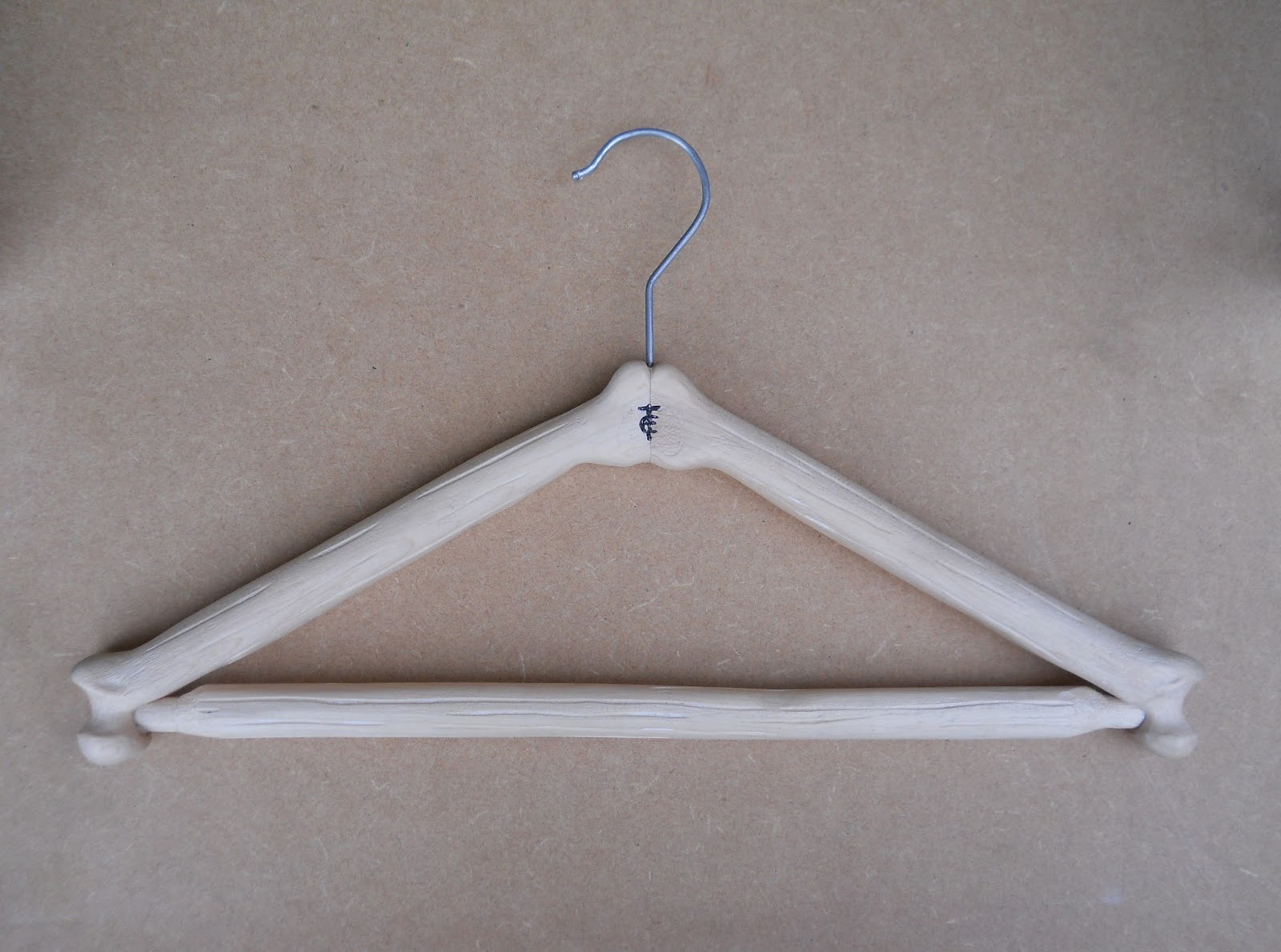
An unusual carved wooden coat hanger commission

carved wooden coat hanger

unusual coat hanger

I was asked to carve a wooden coat hanger that looked as if it was made from old bones, for a shop called 'Tee and Coffin' which will sell alternative-style clothing. Sycamore wood seemed the best choice, as it is relatively strong, fairly inexpensive and also has a nice 'bone-like' pale colour.

carved coat hanger

The hanger was carved in three pieces, which were then joined together. A lot of the carving work was done using my Opinel knife, with later texturing carved using a small veiner gouge and a Dremel with a ball-shaped burr fitted. This texturing really helped the carving to look bone-like.


The hanging loop was taken from an old coat hanger, as bending wood to fit would have been difficult and would possibly not have worked anyway. The client also preferred that look.


Wednesday, 29 July 2015

Carved oak panels and benches as part of an outdoor nature /art trail at St Chad's school


St Chad's primary school is in Patchway, in the north of Bristol. The school has a strip of young native trees such as birch and wild cherry along one side of its grounds.


Mr. Brown, the headmaster, wanted to teach the importance of creativity to the children at the school. He is especially interesting in helping them to see how important reading is and how it can lead to a person being able to create their own stories.

In partnership with an organisation called Southern Brooks, who promote opportunities in the area, a project was devised which included myself and Martin Maudsley, a very talented professional storyteller who is now based in Dorset.

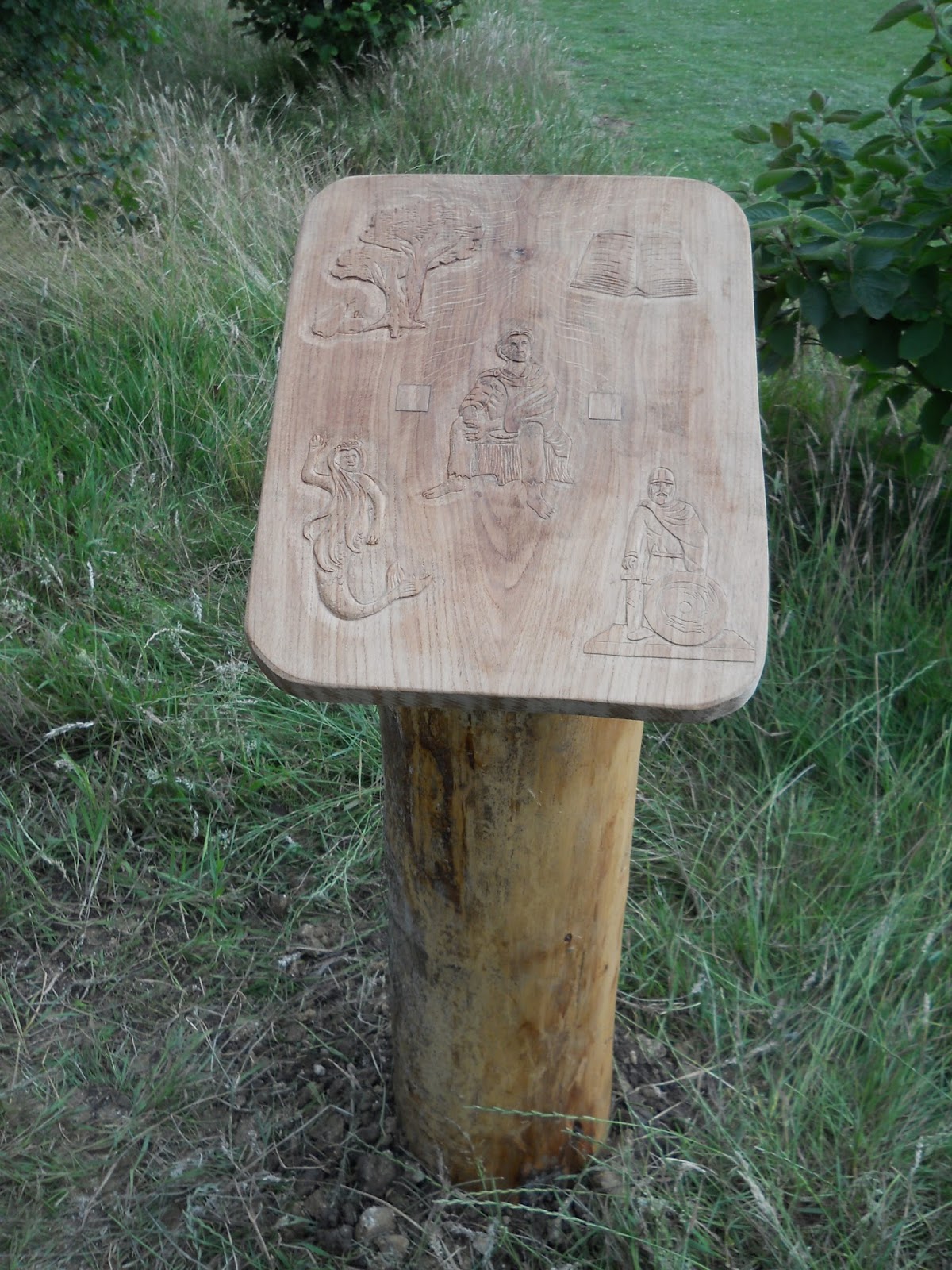
Martin worked with the children to devise stories which were then told to me so that I could design and carve images inspired by them onto oak panels. These panels were then installed in the grounds of the school as a storytelling trail, along with some benches that the children could sit on while developing their own stories (or just chatting and playing).

wooden benches

I went into the school for one day and worked with the children to design dragons, as well as doing some carving with the after school club.

woodcarving tuition at school

Les from a local woodworking group also very kindly came along on one morning and helped dig two post holes and install the durable larch posts into them, for panels to be fitted to.


I also spent a lovely sunny afternoon carving part of the fifth panel live at Patchway community festival and chatting to interested visitors.

demonstrating woodcarving

The first of the five stories was about a young girl who meets a dragon that tells enchanting, beautiful stories. The storyteller in her village dies and she persuades the dragon to come and tell the villagers its stories. The dragon agrees, but only if the villagers turn away and keep their eyes covered to stop them being scared and attacking it.
All goes well until one boy peeps and raises the alarm, however all ends well with the dragon befriending the village and telling stories to them.

dragon carving

dragon carved in wood

The second tale starts with two friends who discover some gold. They argue and so, to save their friendship, they give the gold to a young man to buy seeds in order to plant a garden for everyone to enjoy. The man goes to buy the seeds but instead buys some birds to free them from a miserable captivity by releasing them.
He returns empty-handed and worried because there is nothing to plant. However, the birds return carrying seeds and water in their beaks. They plant them to create a magic garden where not only plants but also ideas and dreams can grow.


The third story is about a woman who sits by some old apple trees and finds herself saying some magic words. The trees form a doorway into a magic garden in which flowers grow that bear precious jewels. She returns and is seen by a greedy man. He forces his way into the magic garden to steal the gems, but becomes trapped there by the trees due to his own greed.


The fourth story is about a farm boy who goes out to cut firewood. The different trees tell him why they are useful and shouldn't be cut, so eventually he burns pine cones instead. Then a small man (the 'Father of the Forest') appears and, for his kindness to the trees, gives the boy a magic wand that can control nature. Things start well but eventually the boy becomes lazy and wants summer all year, which causes big problems with the natural world until the man returns and takes back the wand. The boy realises his mistake and learns to live with the seasons.
The leaves carved around the figure are from the trees that grow in the patch of woodland there. The wooden squares cover the stainless steel coach screws that attach the panels firmly to the posts.


The final story is about St Chad, who goes to a monastery in Saxon times to learn but realises that he is missing having friends despite enjoying his studies. He goes on a journey and comes across a boy trapped in a giant's fruit tree. By piling up the giant fruit, he frees the boy. Next he drains a lake to free a water maiden who is trapped at the bottom of it. She thanks him and makes it rain, refilling the lake. Finally, he finds a statue of a warrior. Realising that someone is trapped inside, Chad frees the warrior by chipping away the stone covering him. It is a local prince, who rewards Chad by giving him some land to settle. Chad founds a school there.

carving at st chads school, pathway


It was great fun carving the plaques and everyone seems very happy indeed with them. Some of the installation was pretty hard work - digging eleven post holes alone by hand into dried clay! Well worth it though, the strip of woodland really looks great and hopefully pupils at the school will be able to enjoy the sculptures and benches for many years to come.