As well as this blog, I also have a website and Instagram page with lots more images of my work as well as a few more stories.
If you like woodcarvings, you might want to have a look.
Showing posts with label whittling. Show all posts

Saturday, 24 October 2015

Two beautiful handmade knives given to me by friends

Recently, I was given two very different and very beautiful knives by friends. I know that some people reading this are fascinated by well-made blades, just as I am. Perhaps you might be interested to see these ones.


My friends Timo (on the left) and Nat (on the right) are currently travelling as journeymen. Timo is a blacksmith and Nat a woodworker. Timo created the blade at a forge he worked with whilst travelling and also made the stand. He found the antler at a place that he stopped for one night in Berlin and has fitted it to the blade. Even though the handle has the spikes of the antler left intact, it is incredibly comfortable to hold.


The blade is also stamped with marks. The three interlocking circles are Timo's own mark. The eye shaped motifs are traditional markings inspired by the Sami knifesmiths in Scandinavia, which are supposed to protect against bad luck. The knife's shape is also inspired by traditional Sami knives.


Nat worked the piece of copper that covers the end of the handle next to the blade. It is beautifully shaped to fit. When it was presented the blade was deliberately left blunt, as it is traditionally unlucky to give a sharp knife in case the blade cuts the friendship. 

Timo's own knife (which he also made) is similar but less ornate. It is also incredibly comfortable to use.


This was the very special moment when the knife was presented by our friends the journeymen.

Journeymen in the German tradition
Image copyright and courtesy of Ibolya Feher

The next knife is quite different, but also very beautiful. It was made by my friend Patrick Small and uses a high quality bought blade fitted to a wooden handle that he has made. 

Patrick Small

The handle is superbly comfortable to hold and the small blade is designed for the fine shaping of small, handheld wooden sculptures. The small wooden sheath protects the blade when the knife is not in use.


I'm sure that you will agree that these knives are both stunning objects. Thank you to my friends Timo, Nat and Patrick.

Monday, 14 September 2015

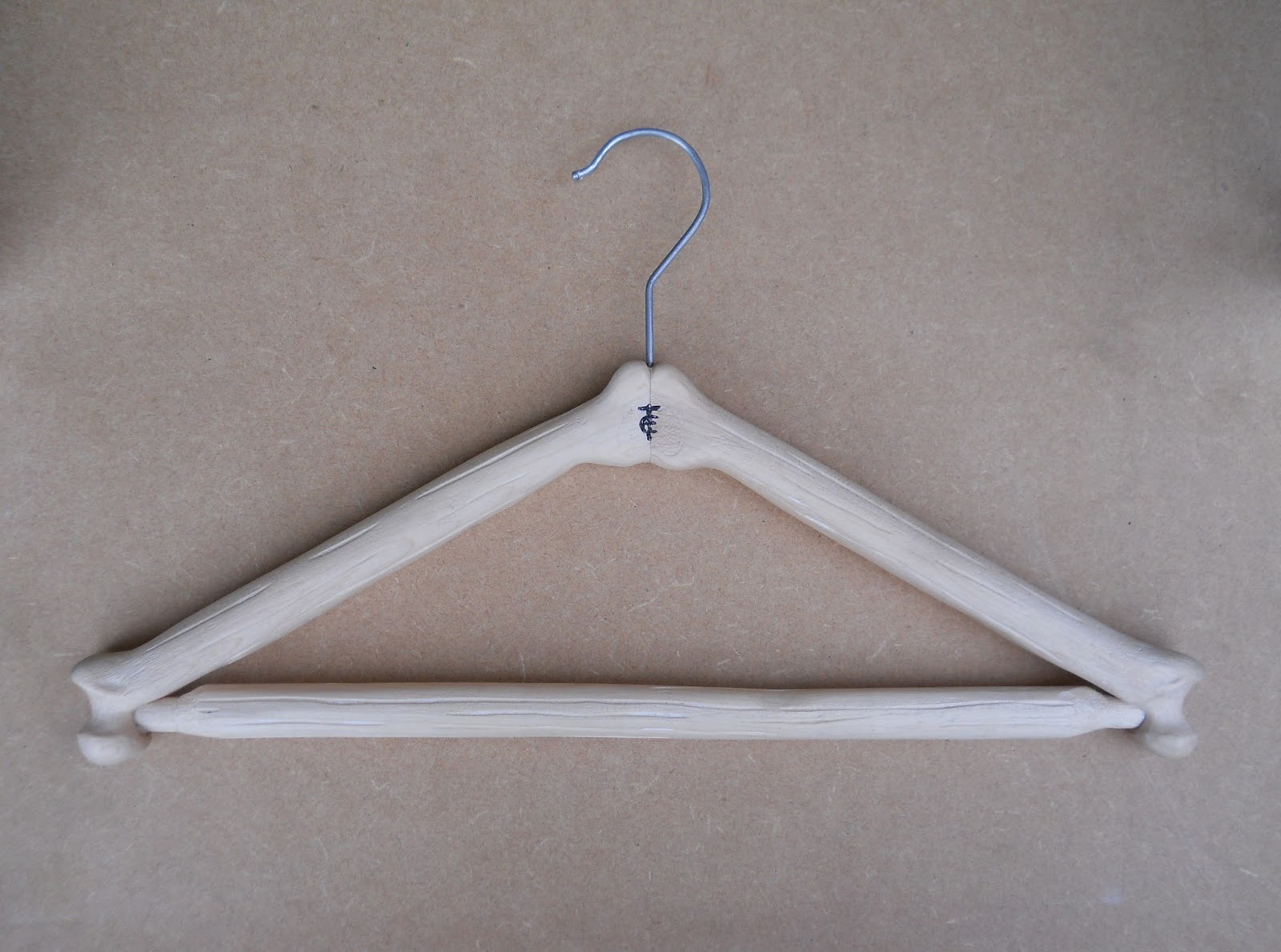
An unusual carved wooden coat hanger commission

carved wooden coat hanger

unusual coat hanger

I was asked to carve a wooden coat hanger that looked as if it was made from old bones, for a shop called 'Tee and Coffin' which will sell alternative-style clothing. Sycamore wood seemed the best choice, as it is relatively strong, fairly inexpensive and also has a nice 'bone-like' pale colour.

carved coat hanger

The hanger was carved in three pieces, which were then joined together. A lot of the carving work was done using my Opinel knife, with later texturing carved using a small veiner gouge and a Dremel with a ball-shaped burr fitted. This texturing really helped the carving to look bone-like.


The hanging loop was taken from an old coat hanger, as bending wood to fit would have been difficult and would possibly not have worked anyway. The client also preferred that look.


Wednesday, 4 March 2015

Making a carved wooden brooch with a celtic design, to be worn as a kiltpin

A kiltpin is traditionally worn pinned to one corner of the front of a kilt. It's not supposed to go through both of the layers of material underneath, as this would make the kilt move badly and could possibly damage the material. Instead it is more of a decoration on the kilt's apron (the flat, unpleated part worn to the front).

The origin of wearing a kiltpin is thought to go back to Queen Victoria using a hat pin to secure her kilted skirt on a windy day. I had made a sgian dubh (the knife carried in one's sock -called the 'hose'- with a kilt) and wanted to make a matching kiltpin to go with it. Obviously, it had to be carved too!


The kiltpin is 50mm (2") in diameter. The yellowish wood is box (Buxus sempervirens) wood, which I picked up whilst out walking in Gloucestershire. Box is a native tree in Britain and a traditional use for the timber is in wood engraving plates. It was the ideal wood for the kiltpin as it is very tough but carves well and can take a good finish. You can see the piece of found wood with the sanded start of the kiltpin in this picture:


It is inlaid with laburnum from the garden of the house that I grew up in - the same wood used to make the handle and sheath of the sgian dubh. Apparently my father would hang a hammock from this tree for my mother to rest in when she was pregnant with me.

There are also three pieces of solid silver inlay and the central setting is a piece of microgranite that originally came from Ailsa Craig. This interesting stone is also set into the end of the sgian dubh and you can read more about it here.

The boxwood was sanded to shape to begin with. The stone to go in the centre was then ground to shape with diamond burrs and polished.


Once the position of the stone setting was known, marked and hollowed out then the rest of the design could be drawn on with a pencil...


... before being carefully carved using my Opinel lock knife. No tricks for that part of the process, just a lot of practice and a sharp blade! The holes for the silver inlay were drilled and then the stone and silver were fixed in with two-part epoxy.


The pin on the back was fixed on using epoxy and three small brass rivets to give extra security.


Here's the kiltpin with the sgian dubh. If you are interested, I would consider commissions to make similar ones. Now I'm looking forward to seeing the knife and pin being worn with the kilt!

sgian dubh and kiltpin


Friday, 29 August 2014

Teaching woodcarving with a knife at my studio in Bristol, together with some thoughts about whittling

Yesterday, Jack came to my studio to learn how to carve with a knife.  We had a great day and he wasn't the only one learning new things. He told me about a very interesting video of a talk by Denis Dutton, part of which concerns prehistoric stone tools that were possibly made solely to show the maker's skill; very interesting to a craftsperson!


Jack sent me an email afterwards saying how much he had enjoyed the day and learning a new skill. It also made me think about whittling as carving. Some carvers can be dismissive of whittling with a knife, thinking that it is an 'inferior' kind of carving. This teaching session was a strong reminder of just how daft that view is in my opinion. 

The knife is one of the most versatile tools for a carver. It was clear from watching Jack's progress that the knife work taught many lessons in working with wood that are transferable to using all other edged carving tools: working with the grain, the importance of the slicing cut, sharp blades being vital etc. These points are fundamental to a carver, they certainly aren't trivial things to learn.


The use of a single carving tool to make a complete sculpture is also a good carving exercise. My friend Jo Seitfudem told me once about his father, a master carver in Bavaria, giving him a single gouge and telling him to carve an entire sculpture with it. Without a range of tools to use, the importance of working with the timber itself to achieve a finished piece is much clearer to a novice carver.

A look at the work produced in regions that regularly use knives as a basic carving tool (Africa, Papua New Guinea) also easily illustrates that carving snobbery about their use is just narrow-mindedness.

Here's a photo of the walnut pendant that Jack carved during the session, We agreed that it looks great and it seemed to capture just what he was aiming for, with the tooled finish and the delicately carved spiral that he achieved:


It's interesting how the process of teaching a skill can so often lead to the teacher learning and seeing their speciality with fresh eyes too!


Saturday, 5 October 2013

Chatting with Joachim Seitfudem about the Bavarian woodcarving tradition (and lots of other stuff)

I dropped by today to visit Jo in his studio at The Island in the centre of Bristol. It was great to catch up with him and to see two panels that he has recently carved in the traditional Bavarian style. He learned much of his craft from his father Hans-Joachim Seitfudem, who is a master carver there.


Jo is currently making more contemporary-styled work but said that fancied carving the panels to make sure that he doesn't lose the skills that he learnt in Bavaria from his father.


They are both carved from lime (linden) wood. It's interesting to see how he gets the shapes on the relief panel by cutting planes into the timber; flat surfaces that add up to give the curved surfaces making up the design. He also much prefers a finish that shows the tool cuts, rather than one that is sanded. We agreed that the latter can look very 'plasticky' if done badly.


Jo noted that things tend to be in threes in Bavarian carving (see the three dogs in the panel). He also showed me a small figure that he carved under his father's guidance when he was about fifteen or sixteen years old. His dad gave his a small carving knife and told him to whittle it using that and no other tools. It seems like a good way to learn the importance of working with the wood without relying on your tools to do everything for you.


Against what the general advice to people looking for whittling knives seems to be, I noticed that the carving knife that Jo uses has a sharply curved bevel on both sides, so that it is almost sharpened to have two angles of bevel on each side. It was originally his father's. Usually, the advice in most articles or blogs is that the knife should have a single bevel, sloping from the back to the cutting edge.  My own knife is similar to his in that there is a second, steeper, bevel to the blade. The steep bevels mean that the knife travels naturally out of the cut towards the surface, rather than wanting to travel straight on into the timber. A knife with this steep bevel can do some pretty fine work too:


We also had an interesting chat about the guild system in Bavaria. Woodcarvers have a guild system there, like carpenters and many other traditional trades. The carvers can also follow a journeyman path, where they study with at least two master carvers before making a 'master piece' to become a master themselves (if the master piece is good enough). Traditionally, only master carvers could open a workshop so the quality of work in the trade was kept high. Jo said that he did not complete his training to master level, mainly because it is quite expensive (about 10,000 euros).

Guild journeyman carvers dress, like other wood-based trades, in black with a black hat. The earring that they wear in the left ear is of gold, with a small carving tool (gouge, mallet etc.) that they have carved from wood fixed to it. Like other woodworking  guilds the ear is pierced using a rusty nail, which the journeyman will then carry on them often in their hat band. We discussed how sad it is that the traditional skills have become more fractured in Britain, which does not have a guild system in the same way. There is a 'Guild of Master Carvers' in existence here, but it is a very different kind of thing.

Jo has a show in Bath at the 44AD gallery from the 7th to the 13th of October 2013. You can see some of his current work from a previous show here.

Wednesday, 31 July 2013

Part Two: Making the Metainsectivore. Whittling and carving an imaginary creature based on the HI-MEMS project from found and recycled timbers

Once the idea of a predatory mammal that would eat the 'metainsecta' creatures had been settled on as the subject, it was time to set about making the sculpture.

First of all, sketching out a few ideas on paper helped to give a clearer vision. It allowed me to work out  how the different features such an animal would have evolved for it's lifestyle could come together and also what kind of pose to show it in.

Then, I made a very simple clay model to further settle things in my mind. The model is very different from the final sculpture. but it has a charm of it's own. I think it looks a bit like an aardvark!


With the pose of the animal starting to become more apparent, it was easier to choose a block of wood for the body. I settled on a piece of locally-grown cherry wood. It was the right size and colour and not too strongly grained (which might have interfered with seeing detail). It is also great to carve - it would certainly be in my top three favourite timbers to work on.


Sketching out the form of the sculpture very roughly and directly onto the block showed where to cut away material to get the basic form. I cut some waste away with a bandsaw, but the piece of wood was a little too large and difficult to secure whilst cutting. Instead, roughly shaping with a Holey Galahad seemed a better option.


This tool is a metal disc shaped like half a ring doughnut and covered with small, tough metal spikes. It fits onto a standard angle grinder and spins round, removing timber, with the holes in it allowing the user to see where they are cutting more easily. You need to be careful when using it, but it's a handy tool to have.
You might notice the steel-toed boots, dust mask, safety specs, ear defenders and chainsaw gloves in the photo above. Not taking any chances!


The Galahad roughed out the shape from the block nicely, but then it was time to turn to more traditional carving methods. With the piece still fixed onto a woodcarver's adjustable stand, it came back into the workshop...


The shape of the head, body and the limbs was then carved by hand during the next sessions using traditional gouges and chisels, some over a hundred years old. This process took over 35 hours.


The hands and feet were whittled from apple wood, picked up in the garden of my rented accommodation years ago. I used a four inch long Opinel lock knife, the same one that I taught myself to carve with about nineteen years ago. It is still my favourite carving tool and can achieve some surprisingly delicate work with a bit of practice. 


The colour of the apple wood contrasts nicely with the cherry. It's very different to most apple timber that I've come across before.


Before being fitted, the hands and feet also had their claws glued on with two-part epoxy adhesive. The claws were carved from locally-grown holly using the Opinel and then sanded.


Whilst working on the hands and feet, the muzzle and eyes were also taking shape. The muzzle was whittled with the Opinel from an offcut piece of English Walnut, with the nostrils and whisker holes shaped using a Dremel hand drill. The mandible was carved from the same cherry timber as the head and body, the teeth are locally-grown boxwood and the tongue a piece of Yellow Box Gum, a didgeridoo offcut picked up whilst travelling in Australia.


The eyes were carved from an offcut of Pau Amarello that was being thrown away at a woodyard. I wouldn't choose to buy this timber newly cut as it grows in Brazil, even though it isn't classed as threatened there. However, it seems wrong to chuck away any offcuts of an exotic timber and I also keep even the smallest potentially usable pieces that are offcuts of my own carving.  The same is true for the ebony inlaid as the pupils in the eyes. I believe that Madagascan ebony is endangered and shouldn't be bought in any circumstances, but I have lots of small bits of African ebony that were broken sculptures or were going to be thrown away by other people and I save them down to the smallest usable piece. When it is gone, that's it. I might experiment with charred holly or something similar instead.


The eyes were finished with gloss varnish to give them a shine. The varnish can be better dripped on than painted on, to avoid brushmarks. They were set in using two part epoxy mixed with wood dust, to give a tiny differently coloured ring around them, like an eyelid membrane. They are quite staring, which suits a creature that is supposed to be a nocturnal hunter.

The next job was to  carve the fur texture. The Dremel hand drill was good for this, using two differently sized rotary burrs (ridged spherical bits). The rounded burrs gave a smoother, less coarse appearance to the carved fur.


After all the components for the mammal were complete it was time to glue it together using slow-drying two part epoxy ( I used Araldite):


...and while it was setting, there was time to carve the pupa that it is about to eat. This was whittled using the Opinel from an offcut of English brown oak and was inlaid with boxwood, plum, cherry and holly, all grown in the local area.
The pupa was finished with Danish oil, as this gave a slight sheen to the surface.


The base on which it all stands was reshaped from a piece of Honduras mahogany that had been salvaged from the renovation of a school in Exeter in Devon. It was varnished and then had a bit of sawdust sprinkled on it, to look like a taxidermist's vignette. It proved surprisingly difficult to find the correct shape of branch to complete the piece and it took about an hour of searching around the woodyard and a shortlist of about ten candidates to find the right one!

Finally, it was time to assemble the sculpture. I glued it together using slow-drying two part epoxy. The quicker-drying stuff really isn't worth bothering with, it has no strength in it. All the pieces were supported using a selection of blocks and sticks while they dried. The whiskers, made from fibres of bamboo from an old skewer, were glued in at this point.


Finding the right finish for the areas meant to represent skin and fur presented a bit of a problem. Waxes and oils would give a slight shine to the surface, which wasn't appropriate for the 'furry' finish. I chose instead to use wood preserver, which doesn't have any kind of shine at all when it dries. It was only applied to areas that hadn't already been finished with, for example, varnish.

So, after over one hundred hours of work, the metainsectivore was finished and ready to show.


If you have come here from my website, clicking here will take you back there.


Monday, 29 July 2013

Part One: Designing 'Metainsectivore' - an imaginary creature in the 'Metainsecta' series carved from found and recycled wood and inspired by the HI-MEMS project


This piece was carved to show in the 'Inspired' exhibition, but there really isn't enough space there to  talk about why it looks the way that it does.

Metainsectivore is part of a series that I've been working on for several years based around the 'HI-MEMS' project. This is funded by DARPA, the US defence department's research and development division. The project seeks to implant control devices into insects in the pupal phase, when the juvenile (the caterpillar or maggot etc.) breaks down inside its casing and reassembles as the adult (also called the imago).

Instead of individually implanting control mechanisms into each pupa (especially given the number of potential offspring of insects), it would seem more logical to implant a nanofactory instead. This would be some kind of nanotechnology that could not only create the devices desired inside the host creature, but could also recreate itself to be passed on to offspring of that creature.


Of course, once such hybrids were in the world, it could perhaps be hard to recall them. Particularly when the rapid process of reproduction in host and technology could give the opportunity in both for mutation, variation and so evolution. Genetically modified crops are already commonplace in the US and in a future time of war, perhaps modified animals would be released without too much thought.


What would these creatures become? Being that other living things would also adapt to take advantage of them as a food source, what would their predators and other animals in their environment come to look like? These are the themes that I've been exploring. There is some artistic licence of course; for example, I don't think that adapted pupae would have external electronic-looking boards. I have also used features of insects that don't have a metamorphic stage inside a pupa.


I've also tried not to give an obvious strong value judgement on the project that inspired it in the series, although I have my own opinions which probably come through. This series is as much about the potential for strange beauty that could arise, even if it is also unsettling. 

One piece is inspired by record players and by the genetic engineering in the film 'Bladerunner'. It is a weevil that walks around and plays a record through mouthparts shaped like stylus, in a future where fragile vinyl discs are rare and valuable commodities and genetic engineering is commonplace. Such a creature would be unable to feed so could not live for long.


All of the sculptures are carved entirely from wood, occasionally powdered and fixed in resin (even the 'vinyl' record above is charcoal dust in resin). This is partly for the technical challenge as a woodcarver and partly because I like the idea of using quite a few traditional carving methods and tools with more modern techniques to create these strange, futuristic creatures. That's why the pieces also have a feel of the Victorian naturalist's preserved specimens. Maybe the detachment of those 'collectors' relates closely to that of the scientist involved in the HI-MEMS programme.

The Metainsectivore is a mammal that would feed on the new insects. It is loosely based on a number of existing creatures, including quolls, cats, tarsiers and aye-ayes. Its adaptations to its lifestyle include:

Large eyes and ears suited to nocturnal hunting
A beak-like snout covered in tough hair (like a rhino's horn) to protect its face from dangerous prey
Small, sharp teeth
A relatively long, flexible neck to allow its head to grab food or to get out of the way quickly
Hands and feet adapted to move quickly through undergrowth in pursuit of food and to be able to pick apart food to remove inedible parts
One long claw on each hand to pick out indigestible pieces from prey or to prise them out of crevices.

The timbers used include;
Cherry from a local tree surgeon
English walnut from an offcut given by a friend
Boxwood from Gloucestershire
South American mahogany from a bookcase taken out during a school renovation in Exeter and due to be thrown away
An ebony offcut given by a cabinet-maker friend who was going to get rid of it
Pau Amarello from a pile of waste offcuts of bowl blanks at a timber yard
Apple from a garden in Birmingham, UK
Holly from the local area
Yellow Box Gum from ann offcut of a didgeridoo
An offcut of brown English oak from a friend who was building a bed
Plum from Gloucestershire

... and whiskers made of bamboo fibres from an old skewer! 

If you have come here from my website, clicking here will take you back there.