As well as this blog, I also have a website and Instagram page with lots more images of my work as well as a few more stories.
If you like woodcarvings, you might want to have a look.
Showing posts with label ancient egypt. Show all posts

Monday, 15 January 2018

Making replicas of the earliest objects made by woodturning ever found in Britain, from Whitehorse hill on Dartmoor

I like woodturning. It's a nice compliment to my carving work and there's also something that feels quite relaxing about putting the tools to the spinning timber and watching the shapes develop.

There have been a couple of commissions recently that have allowed me to do some turning and which have also been a little more challenging. Making some of the components for the instruments that are now installed in St Werburghs Community Centre meant turning larger pieces than I've worked on before. 

Woodturning on Myford ML8 lathe

I was also asked by a local furniture maker called Dave Porter to turn eight discs, 60mm (2.36") wide, from European oak to decorate some furniture that he was making. It was a nice test of skill to try and make the discs as similar as possible, whilst turning them by hand. Both of us were happy with the outcome. Here they are, with one spare:


woodturning oak

After making these commissions, I came across the story of the Whitehorse hill burial

This Bronze Age burial happened nearly four thousand years ago in what is now the wild, empty middle of Dartmoor national park - a place that is very important to me. This view, taken near Whitehorse hill, shows what the area looks like:


Dartmoor landscape

In 2001, a walker found a small, rectangular burial chamber made from stones protruding from a remanent 'hag' of peat, which had been left standing as the peat surrounding it was cut away. These small stone boxes or chambers are known as kists, cists or kistvaens.

The erosion of the peat stack had uncovered the kist and one of the stones had fallen. The rest looked like it could also fall out at some point soon, so the decision was made to open the burial and see what was inside. This was even more exciting as most kists on Dartmoor have been excavated or robbed at some point but this one, having been hidden underground in a fairly remote part of the moor, was probably intact.


Whitehorse hill Bronze Age kist
Image by Cornwall Archaeological Unit, from https://www.archaeology.co.uk/articles/cist-whitehorse-hill.htm

In 2011, the kist was opened. Inside, well preserved by the peat (which excludes oxygen so preventing the decay of organic matter), was a bundle wrapped in an animal pelt, thought to be from a bear.

The contents of the bundle were the cremated remains of what is believed to have been a woman of high status, aged somewhere between 15 and 25 years old. The presence of a necklace and absence of weapons in the burial led researchers to think the deceased was probably female. She was buried in August or September (from the purple moorland grasses laid on the floor of the kist at the time). On top of these grasses was laid what looks like a woven belt or sash decorated with calfskin leather, then the wrapped cremation on that.


Apart from the remains, the wrapping held a woven bag made of lime bast (the fibres under the bark of a lime tree). This contained several objects: a necklace made from beads of clay, shale, amber and also a single bead of tin, a flint flake, a copper pin, a woven cattle hair band or bracelet decorated with small tin beads and two pairs of wooden discs. 


Image from https://new.devon.gov.uk/historicenvironment/latest-news/bears-and-beads-on-whitehorse-hill/
These wooden discs are the earliest examples of wood turning ever found in Britain. They could have been ornaments fitted into a leather bag or belt, but most people think that they were body ornaments, similar to modern ear expanders. They would have been worn in stretched ear piercings, or perhaps in lip, nose or cheek piercings. 

Some think that the smaller studs were perhaps the intermediate ones used as the hole was being stretched, before the larger ones were worn. Personally, I think they might have been worn at the same time as they show similar amounts of wear and were buried together.

The wooden discs were turned from tough, pale coloured spindle tree wood, a native species which still grows around the edge of the moor. At the time of the burial, this area would have been much more wooded than now. It's strange to imagine what the person who wore these wooden ornaments was like; speaking a language that we wouldn't understand in the present day but perhaps knowing some of the many stone monuments, such as the double circle at Greywethers, that still stand not far from where they were buried and that we can still visit.
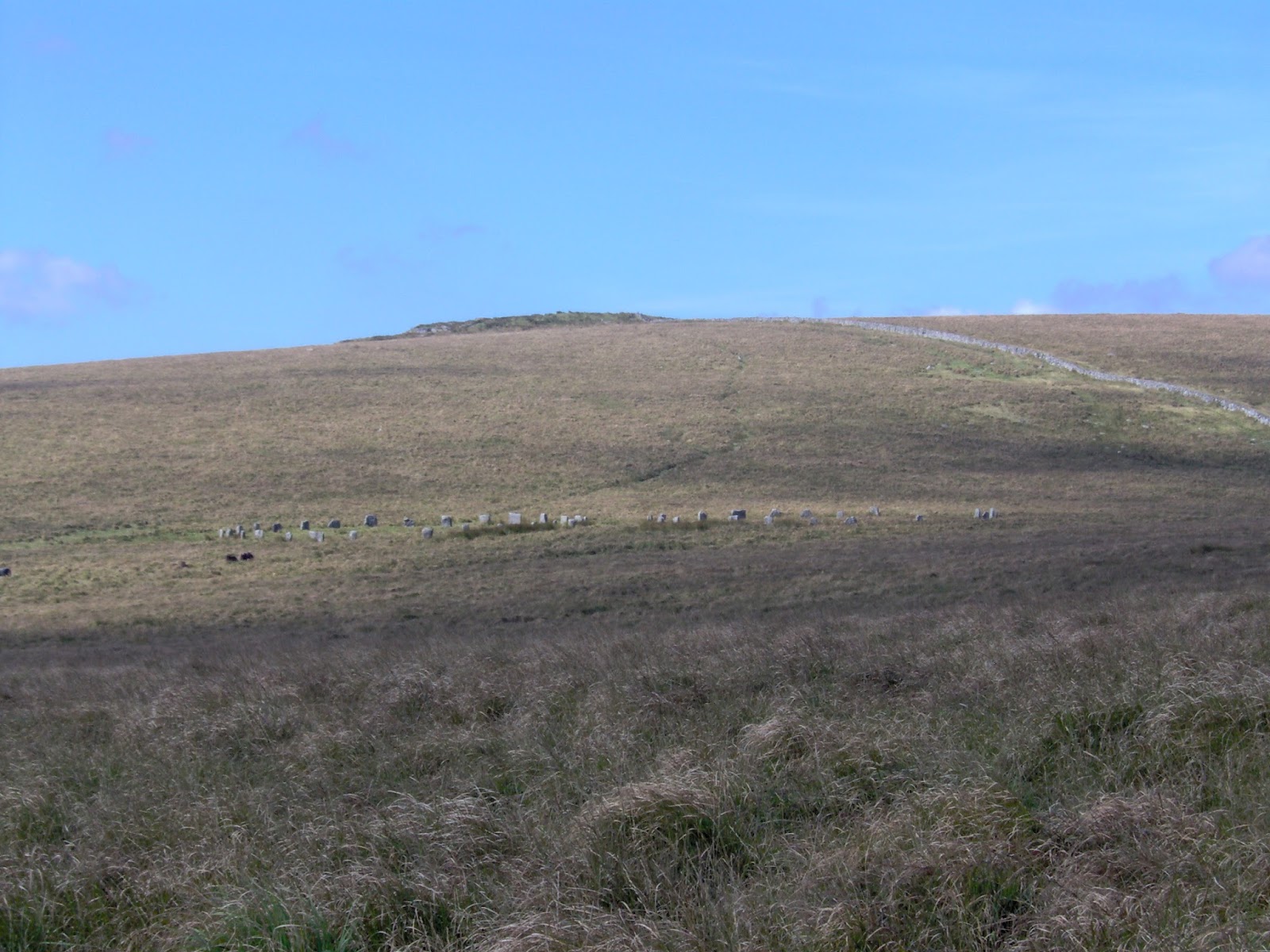

Greywethers stone circles on Dartmoor

Radio carbon dating from underneath the fallen stones of nearby Sittaford Tor circle returned a date of about four thousand years ago, so the circle itself is probably older than that. This means the person buried at Whitehorse Hill would have known it and probably visited it as well.

I couldn't resist having a go at recreating the discs myself! We have some idea of what Bronze Age woodturning was like, having images preserved from ancient Egypt. A note about the picture: the lathe would have been horizontal even though conventions in ancient Egyptian art mean that it's illustrated standing vertically.


Image from http://www.turningtools.co.uk/history2/history-turning2.html

These sources helped woodturner Stuart King to recreate the making of the wooden discs for a programme called 'Mystery of the Moor'.


I had to cheat a bit, as the method Stuart King used requires two people to work best and also because I don't have the appropriate reproductions of Bronze Age tools at the moment (although I'm very tempted to acquire or make some now!). It was still fun to make replicas of these objects that connect us to that ancient and mysterious time. 


woodturning

I had some seasoned spindle tree wood that was suitable, and the discs finished well. After turning, I put some natural nut oil onto them, to bring out the colour of the wood and stop them getting too grubby - a beeswax finish could originally have been used but it tends to attract dirt. The larger turnings are 25mm (1") and the smaller ones 15mm (0.59") in diameter.

Whitehorse burial wooden ear ornaments

Here's my friend Sion wearing a pair of discs very similar to those found in the kist at Whitehorse hill, but slightly larger than the bigger ones found in the burial at 30mm (1.18") wide. He said that they are very comfortable to wear and they were also tough enough to withstand a good deal of partying last weekend!


ear stretchers


ear expanders

Wednesday, 30 July 2014

Woodcarving and woodworking tools seen at the British Museum; from ancient Nubia and Mesopotamia around 4,000 to 5,000 years ago


The British Museum is so full of incredible objects that a visit can be a bit overwhelming. Sometimes it is nice to just pick out a particular theme and to follow that through the galleries. On a recent visit, I took the chance to explore the history of woodcarving tools a bit further. A lot of the factual information here came from museum labels for the exhibits.

Ancient Nubia

Many sophisticated cultures developed in Nubia (along the Nile river in what is now northern Sudan and southern Egypt) in ancient times. This copper adze blade and axe head were found at the site of the ancient city of Faras. The remains of the city are now under the waters of Lake Nasser, having been flooded following the building of the Aswan dam.


They date to around 5,000 years ago and were probably imported from Egypt, Nubia's powerful neighbour. You can find out more about ancient Egyptian woodcarving and the making of copper alloys by visiting my previous post about it.

The Kerma civilisation developed in Nubia from about 4,500 years ago. It was based around the urban centre of Kerma, which the ancient Egyptians called 'Kush'. The city was known for skilled bronze (copper alloyed with arsenic or tin)  workers. Going from left to right, this stone axe head, stone grinder and whetstone (for sharpening metal blades) date to between about 3,760 and 3,560 years ago. The whetstone was one of ten hones interred with a sacrificial burial. It has traces of red pigment on it. I wonder if that was purely ritualistic, or if these stones were used with some kind of compound such as ground ochre to improve their sharpening performance?


Early Mesopotamia


These tools date from about 8,000 to about 6,200 years ago, to the early days of farming and of the development of towns and villages. The copper chisel in the centre was found at Tell Arpachiyah, in what was Northern Mesopotamia and is now near Mosul in Iraq. It is one of the earliest copper tools ever found. The tool to the left is a bone awl from the same place, set into bitumen. Between them is a sickle blade, also set in bitumen. Behind is a worked stone hoe blade and on the right, a stone mace head. In northern Mesopotamia, flint and metal were used for tools whereas in the south, pottery was generally used.

Ancient Sumerian

The Sumerian city of Ur was located at the site of what is now Tell al-Muqayyar in southern Iraq. At its peak, it was very powerful and wealthy. Some believe that Abraham (Abram or Ibrahim), the great prophet of the Jewish, Muslim and Christian faiths, may have been born here about 4,000 years ago. Archaeologists discovered a large cemetery area here dating to the Early Dynastic III period, about 4,600 to 4,300 years ago. Many of the stunning treasures excavated from this area are now in the British Museum. The copper used to make many of the tools probably came from Oman. 

These copper alloy chisels all have a flattened, triangular-shaped end away from the cutting edge. It doesn't look like a useful shape to be struck with a mallet or held in the hand, so I wonder if that end would have been held in some kind of handle? If that was the case, the shape wouldn't have been easy to drive into a wooden handle (like modern square- or round- sectioned tangs), so maybe that had a slot cut into it and was then bound together with the blade held inside? Perhaps the blade was simply wrapped in leather or another material to make a handle? I don't know of any evidence for this, by the way.
The chisel blade furthest on the right has an original engraving in cuneiform script on it.

The image below shows whetstones and chisel blades found in the tomb of Puabi, a very powerful and wealthy Sumerian woman. The beautifully-shaped honing stones on the right were found being worn by several of Puabi's male attendants buried with her.


The chisels are, according to the exhibit label, 'made of base gold with the surface artificially enriched'. Gold seems a strange choice for practical cutting tools. It is quite soft and so doesn't usually hold a cutting edge well. Perhaps, like the model tools found in the grave of the Egyptian king Khasekhemwy, these were meant as representations of (rather than working examples of) actual tools.

Several adzes were found in the Ur cemetery area. Unlike many ancient adzes the blades have a socket for the handle attached, rather than being lashed to the wooden handle like the adze blade shown above.


You may have noticed that two of the copper alloy adze blades have an animal's leg design engraved into them. Many tools and containers in these 'royal' graves have the same mark. No one is sure if it was the emblem of the royal house, the emblem of the manufacturers or something else.

The graceful-looking adze head in the central picture above is a replica of one in the collection of the University Museum in Philadelphia. The original is made of gold: another non-working representation of an actual tool? The objects shown with it are a gold spear head, a cluster of arrow heads corroded together and a whetstone.

The axe heads shown below illustrate something that is worth considering when looking at these objects.


The one on the right is made of silver - perhaps another mainly ceremonial representation. These objects probably came from the tombs of very wealthy and powerful people. It is hard to say whether these axes were just for use by guards and, if so, would they have looked considerably different to those used by craftspeople? During these times, there doesn't generally seem to have been the large differences in axe head shape according to the job required from it that can be seen in later axes, for example from the Anglo-Saxon times in Britain. However, perhaps the specialist craftsperson's hewing axes just weren't preserved in any graves?


Akkadian Ur and Canaan

From 4,300 to 4,150 years ago, the city of Ur was ruled by the Akkadians who succeeded the previous Sumerian rulers. The adze head below comes from the late Early Dynasty III or Akkadian periods. The handle is modern.


Notice the axe head shown bottom-right in the collection above. It is very different in shape to the earlier ones. This 'fenestrated' shape ('fenestrated' because of the 'windows' in the axehead) developed between 4,500 and 4,000 years ago, in the area around what is now called the Levant. The Canaanite axes below show this form with complete sockets for a handle. These windows meant that the whole axe was lighter in use. I wonder if this development was confined to military axes, given that the lighter weight would also benefit other people using them. Would these heads have been too vulnerable to distortion by twisting or side-to-side movements if embedded in timber? It's hard to say without any practical testing.


Ancient Babylonian

A hoard of 86 copper alloy and bronze tools and farming implements was found at Kutalla (what is now Tell Sifr in Iraq). They are about 4000 years old. Some were in a good, usable state although others were damaged. Axe heads (note: not of the fenestrated type), a chisel and a saw can all be seen amongst other tools. It is thought that they were held originally in a big agricultural establishment, where it would be customary to check the total weight of items issued and returned at the end of each season.


Friday, 7 February 2014

Ancient Egyptian wood carving and stone carving tools


Whilst looking around the museum in Bristol, I saw these ancient carving tools on display and thought it might be nice to share them with you.

The tools were bought by the museum in 1919 from a Captain E.A. Mackay. The metal is a copper alloy, which makes the carving achievements of those ancient craftsmen seem all the more amazing as the copper alloy is softer than the steel used in modern tools. Other elements used in ancient copper alloys included antimony and arsenic. Arsenic often occurs naturally in copper ore, so may have been the original alloying material with copper to make bronze. Eventually it was superseded by the use of tin, as tin was easier to add in specific amounts and was non-toxic . It wasn't until the time of the last pharaohs, long after these objects were used, that Egyptians began to use iron for this purpose.

The chisel with a wooden handle seems very similar in size and shape to a modern palm chisel and was probably used for detailed work without a mallet. It is thought to date to between 3,300 and 3,600 years ago, what was the eighteenth dynasty of the New Kingdom. The awl in front of it (a spike used for making small holes) is thought to date to the same period.

The larger chisel in the holder to the right would have been used with a mallet. It is believed to be older, from the twelfth dynasty of the Middle Kingdom about 3,800 to 4,000 years ago.

Ancient Egyptian images of woodworkers show them using many tools that woodworkers into the medieval ages of Europe were still using variations of. Axes and saws were used to roughly shape the wood into planks and blocks, adzes shaped it further, awls and bow drills were used to make holes and chisels and mallets were used for fine work. Much of the timber used was probably imported from what is now eastern Africa and the Lebanon, as Egypt did not have large forests at that time.

http://en.wikipedia.org/wiki/File:Maler_der_Grabkammer_der_Bildhauer_Nebamun_und_Ipuki_004.jpg

Nearby, there are examples of stone carving tools. The mallets certainly look familiar; I have a couple very like them in my own studio! The caption on the display speculates that the worn one may have been buried with a carver in the belief that, although it was worn out in this world, it would be perfect again in the next. They are thought to date to the third dynasty of the Old Kingdom, between 4,620 and 4,700 years ago according to the museum caption.


The stones on the shelf would be used for grinding down stone sculptures to smooth them. The copper alloy chisel in front of them dates to the eighteenth dynasty of the New Kingdom, between 3,300 and 3,600 years ago. It would have been used to shape stone, with a more rounded, bar-like shape of chisel used afterwards to smooth the sculpture. 

The British Museum Collection

There are more tools on display at the British Museum in London. The information used here comes from the labels with each exhibit.

King Djer reigned during the First Dynasty, about 5,100 to 4,900 years ago. His tomb is surrounded by the remains of over 300 people; his wives, guards and servants. They must have committed suicide or been killed at the time of the king's entombment, to serve him in the afterlife. One retainer was called 'Hem', meaning simply 'servant'. He was a craftsman and was interred with two copper chisels, a copper adze head and the tool on the right, which is thought to have been used to cut leather. The copper axe head on the left was one of several found with other bodies. It was a high-status possession and these people were probably special guards. This axe head is inscribed, including with an elephant design, but no one knows what the inscription means.


King Khasekhemwy ruled during the Second Dynasty, about 4,904 to 4,700 years ago. He was keen on construction and developments in such things as large-scale use of dressed stone during his reign led the way for the later building of the Pyramids. 194 thin copper models of tools were found underneath a collapsed wall in his tomb. They include models of chisels, harpoons, adzes and needles. Many are in  groups of eight, possibly reflecting the Egyptian working week of eight days according to the label. I wonder why they are models and not genuine tools?


The New Kingdom dated from about 3,564 to 3,084 years ago. Below is shown a wooden mallet from this time, found at Thebes. See the similarities between the shape of this one and the much older ones shown in the Bristol Museum display above. The bow-drill found at Deir el-Bahri exhibited next to it uses bronze bits to drill holes. The end of the wooden bit holder would be steadied inside a hollow cut into the conical wooden piece displayed behind the drill. The bow would then be moved back-and-forth to spin the drill bit.


The tools shown next come from different periods. The chisel with its wooden handle dates, like the saw immediately below it, to the New Kingdom in Thebes. They use bronze blades, like the pull-saw at the bottom which came from Deir el-Bahri and dates to the 18th Dynasty about 3,600 to 3,300 years ago.


The two bronze-bladed adzes also date to the 18th Dynasty. The one on the left is from Thebes during the reign of Tuthmosis III which was about 3,493 to 3,439 years ago. The one on the right was found at Deir el-Bahri and was used during Hatshepsut's reign 3,493 to 3,471 years ago. This adze still has the original leather thongs holding the blade on. Its wooden handle is carved with a hieroglyphic inscription. Compare these tools to the image of the workers using an adze and a saw shown above.


A label near these tools also shows some commonly-used ancient Egyptian woodworking joints:


These damaged corners from coffins show how joints would also be strengthened using dowels or cramps, made from a close-grained wood such as sidder. 


The sidder wood cramp top right in the photo above dates to the 17th or early 18th Dynasty, 3,600 to 3,500 years ago. It is inscribed with the name 'Ameny'; maybe the name of the cramp's maker or its user, in a similar way that modern workers in busy workshops or building sites write their names on their tools to stop them 'going for a walk'. The coffin boards on the left comes from Asyut during the 12th Dynasty, about 3,950 years ago. They have been joined with such cramps. The dowelled joint on the right is from the same location and period as the cramp-joined boards and has some dowels from the Middle Kingdom (4025-3,630 years ago) displayed below it.

What timbers did ancient Egyptians use? 

It can be hard to tell from the names that they gave them, but scientists have analysed woods under the microscope and worked out what many of them are from their cellular structures. They are generally associated with things made for funerals, as these have been preserved in tombs.

The main local timbers used were sycomore fig (Ficus sycomorus), tamarisk (Tamarix sp.) and Nile acacia.  To make coffins and the like, carpenters would need longer, straighter boards and these were obtained by trade, mainly with the Levant. Coniferous softwoods such as cedar as well as juniper and cypress were bought and used. Cedar was especially reserved for the coffins of high-ranking people, although different parts of a coffin could use different timbers, depending on their suitability for different purposes. You can find out more, including some ancient Egyptian names for different timbers, at the digitalegypt website.

There are some more images of ancient Egyptian woodworking tools on this post by Marijn, of the St Thomas Guild: follow this link. There is also an illustrated history of the development of the saw online here.

A Personal Favourite

Finally, I had to include my favourite piece of ancient Egyptian woodcarving. It is a statue of a priest who would have said prayers for the dead. His name was Ka'aper. 

He lived during the fifth dynasty of the Old Kingdom. Dating this period seems quite difficult, but it is somewhere between 4,686 and 4,520 years ago. The people who excavated the carving, at Saqqara, thought that the statue looked like the chief of their village so they called it 'Sheikh el-Balad' which means 'village chief'.

The statue is 112 cm (about 3' 8") tall and is carved from sycamore wood (I'm assuming that this refers to sycomore fig (F. sycomorus)). The eyes were made to look 'alive' by using a copper lining with white quartz and a central disc of rock crystal.

http://www.ibcousinie.info/Egypte%202010/Mes%20Photos/01le%20Caire/Le%20Musee/Ka_aper.jpg

People in other parts of the world use similar optical tricks on their carved statues. For example, in New Zealand traditional Maori woodcarvings have inlaid paua (abalone) shell eyes that twinkle in firelight to look like they are watching.

Photograph copyright James Shook from Wikimedia Commons