As well as this blog, I also have a website and Instagram page with lots more images of my work as well as a few more stories.
If you like woodcarvings, you might want to have a look.
Showing posts with label british museum. Show all posts

Monday, 4 August 2014

Woodcarving and woodworking tools seen at the British Museum; from the Stone Ages to the Anglo-Saxons in Northern Europe

After writing about ancient Egyptian woodworking and tools from ancient Nubia and Mesopotamia, it's time to head north and look at Europe. I have focussed mainly on the woodworking tools that are in the collection of the British Museum.

Stone Ages


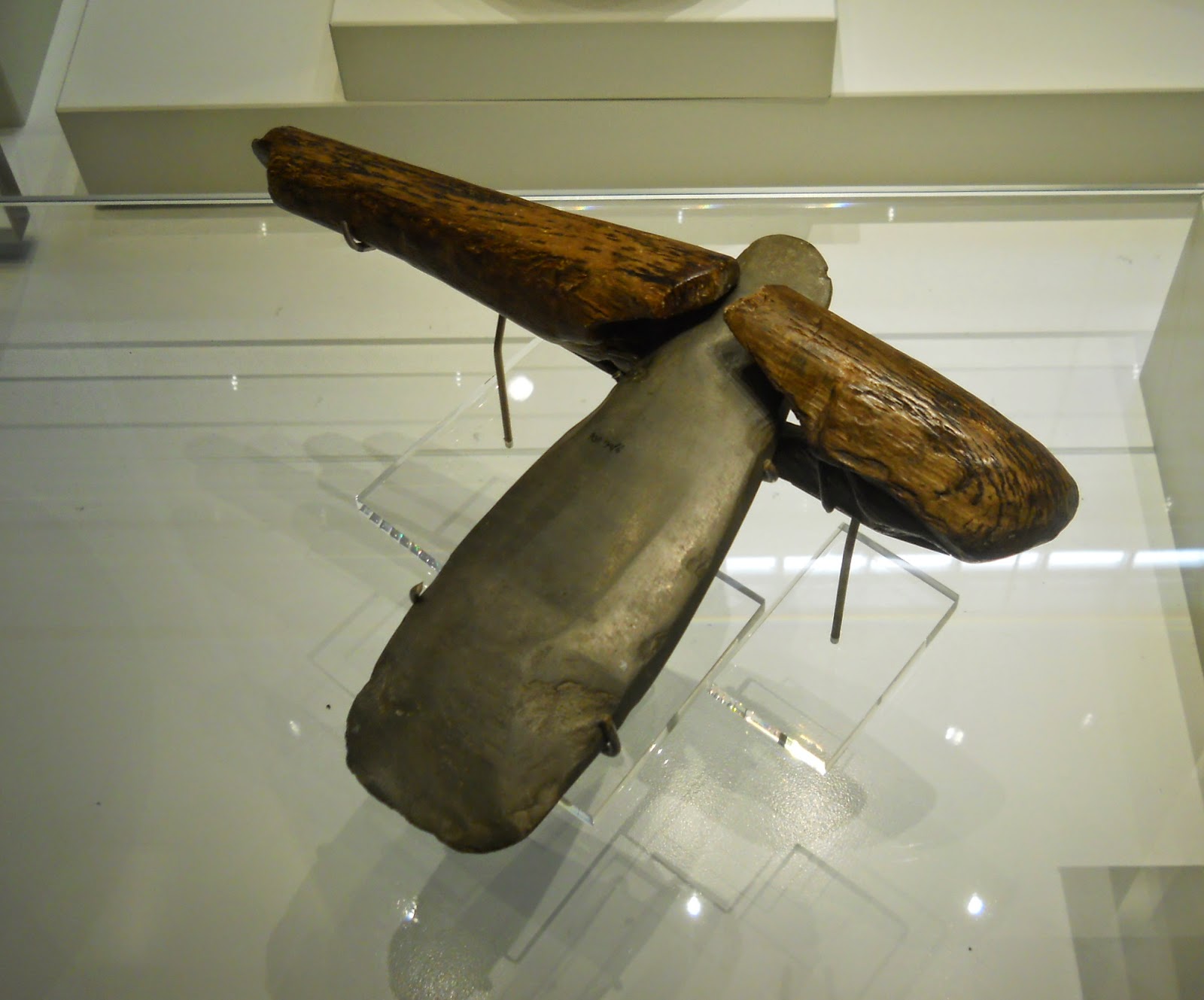
The Stone Ages in Britain ended with the arrival of settlers who knew how to use copper alloys to make tools and weapons, about 4,200 years ago. It's hard to find a lot of evidence of woodworking from the earliest known human habitation of Northern Europe. A perishable material like wood just doesn't often last for long enough. However, there are a reasonable amount of wooden objects known from the last part of the Stone Age, the Neolithic Period, including what was a raised wooden trackway through marshy ground. It was found in Somerset and is called the 'Sweet Track', dating to 5,821 years ago. The stone axe shown above was found at Ehenside tarn in Cumbria and dates to between 5,700 and 5,100 years ago. It is made from a local stone that was also traded elsewhere due to its suitability for toolmaking.

The Neolithic period saw an important change in the making of stone tools in Northern Europe. During the Mesolithic, about 7000 BCE, stones like flint were 'knapped'. Flakes were knocked off the workpiece to form sharp edges in order to make scrapers, knives, axes and other useful bladed tools. During the Neolithic, about 4000BCE, stone started to be ground to shape by using the time-consuming method of rubbing against abrasive stones, or perhaps leather with abrasive rock powder on it, using water to aid the process.

Why spend so much extra time grinding down blades? BBC television's 'Time Team' programme did an interesting experiment for an episode called 'Sussex Ups and Downs' aired in 2006. The action of a ground axe blade was tested (by cutting down a small hazel tree trunk) against a blade made by knapping. The ground blade was found to work much more efficiently, cutting far more cleanly and not becoming damaged by bits of timber getting lodged in the blade and causing fractures to form. It required less effort to use and would last much longer without becoming damaged beyond further use.


The objects in this image were put in a pit dug into a cairn (a mound of stones) and may well have been part of a burial. They were found at Ayton east field in North Yorkshire and date to the Late Neolithic, about 5,300 to 4, 500 years ago. There are three flint axe heads, a flint adze for carpentry work, five flint arrowheads, a flint knife with two flakes, an antler mace head and two boar tusk blades.

After seeing First Nations tools from the North-West Pacific coastline, it is obvious that complex woodcarvings were possible with the tools available in Europe before the discovery of copper alloys. The hard stones were shaped into sophisticated and sharp blades. I also wonder if the teeth of the native European beaver were used to make woodworking tools, as the teeth of American beavers were in the North-West Pacific before contact with Europeans. No such tools have been found in European archeological studies to my knowledge, but in her book Cedar, Hilary Stewart comments on how a split beaver tooth was one of the principal tools for making wooden bowls, spoons and ladles in the NW Pacific region, being the original 'hook' or 'crooked' knife. It strikes me that the boar's tusk blades shown above could perhaps also serve a similar function. She also notes how, when 'roughly hollowing out a cedar bowl using a maul and a bone-tipped chisel I had made, I was surprised by the blade's strength and cutting ability'. Stewart also notes the usefulness of mussel shell (Mytilus californianus) when scraping or shaving wood. However, she notes that it fractures easily when mallet blows are applied even though early ethnographers describe it being used in chisels.

Some very interesting and enigmatic stone carvings are known from the Neolithic. The carved chalk 'Folkton Drums' date from around the end of the Neolithic or the start of the use of copper, about 4,500 to 4,000 years ago. They are unique and were placed under the head and hips of a child buried in a barrow mound. Their purpose is unknown, although the chalk probably came from nearby Folkton Wold in Yorkshire.


These small stone objects shown below fascinate me. Over 400 have been found, mainly in northern and eastern Scotland. They come in various shapes and their use is unknown.


The Bronze Age

These bronze axes date to about 2,750 to 2,500 years ago. Two of the three below were found at Walthamstow in London and in the River Thames near the Tate Gallery, also in London. The other was found in South Yorkshire.


These axe heads were found at Petter's sports field in Surrey, England. They date to the Late Bronze Age, about 3,000 to 2,750 years ago.


The L-shaped wooden handle would fit into the socket at the back of the axehead and would be lashed on using the loop:
Image from:http://www.dorsetaonb.org.uk/assets/downloads/South_Dorset_Ridgeway/Resources/Image_bank/Replica_bronze_axe.jpg
It was interesting to see the similarities between these bronze axe heads and some found in China and Siberia shown below.


The two socketed heads on the left come from the Shang or early Western Zhou dynasties in China and date from between 3,200 and 3,002 years ago. The one on the right (note the loops) is about 3,000 to 2,800 years old and came from Southern Siberia, although it is based on a Chinese design.

There are obvious similarities between the Chinese-style bronze axehead on the right and the Northern European ones. I wonder if they show a kind of 'convergent evolution' of design, where similar requirements created similar tools, or whether they reflect a passing of ideas between cultures, perhaps by contact through ancient trade routes such as the Silk Road.

Again, a lot of wooden items from the Bronze Age must have rotted away over time. The photo below shows a wooden ladle at top left found at Flag Fen in Cambridgeshire and dating to the Middle Bronze Age (about 3,300 years ago). Around it are various bone and pottery utensils from this time until the early Iron Age (2,650 years ago) that were found in Surrey, North Yorkshire and Suffolk, England.


The Iron Age

The files, gouges and chisels in the top row came from Tiefenau in Switzerland. The tools on the left appear to have tangs ready to fit handles onto them, whereas the one on the right seems to have a ready-made handle cast as part of it. The gouge second from the right has a socket to fit a handle. No dates are given for these tools.


The adze head below them came from Lisnacrogher in County Antrim, Ireland. Below it is a circular disc cutter from King Harry Lane cemetery in St Albans, Hertfordshire, England that dates to between 2,014 and 1,064 years ago. 


In the BBC documentary 'A History of Celtic Britain: Age of Iron', Neil Oliver shows examples from a hoard of iron tools discovered near Fiskerton in Lincolnshire (the next two images are screenshots from that programme). They are thought to date to around 2,400 years ago. It is very noticeable how similar they are to tools dating from more recent times. 


Oliver holds up a file and points out that 'if someone was to show you this and say, "this is from my great-grandfather's toolbox"', you would believe them. He also shows a fragment of saw blade and notes that iron working allowed much stronger and  thinner blades than cast bronze, making more efficient tools that were relatively cheap and simple to make and repair compared to their bronze equivalents.


Roman Britain


Many of these Roman tools really are similar to modern examples. The curved blade top right is described as a 'drawknife' and came from Hod Hill in Dorset, England. It dates to the first century CE (or AD, if you prefer).  


I recognise this blade as an 'inshave'. It is used to hollow out chair seats and also by barrel-makers (coopers) for shaping the inside of barrel staves. Similar ones can be bought today from woodworking suppliers. Travelling clockwise from this blade, we come to a solid-handled punch (with a grooved face for decorating woodwork) and a broken spoon-shaped drill bit (probably used with a bow-or strap-drill according to the label), both from the 1st century CE and found at Camerton in Somerset. Bottom right is a tool suitable for use as a 'float', to remove stone in masonry work, as a coarse rasp to remove wood in carpentry or for filing horse's hooves. It also came from Hod Hill and dates to the same time as the inshave. 

The thin-bladed paring chisel on the left came from Walbrook in London and dates to the first or second century CE. It would have been hand-pushed and used for fine work. This tool has the maker's name MARTIALIS stamped onto it, a custom with tool makers that survives to this day.


The tools shown above and in the following two photos probably all date from the first or second century CE. Going clockwise from the top left;

A double-ended spatula found in London, probably used for spreading wax onto wax tablets,

A very well-preserved awl, for making small holes in wood or (more probably) leather, found in London. This one has an iron point, a bronze collar and a handle made from turned boxwood (Buxus sempervirens),

The paring chisel mentioned above,

A socketed carpenter's gouge found at Camerton in Somerset,

A carpenter's firmer chisel with a socket for a wooden handle, found at Smith's Wharf in London,

A firmer chisel with a solid handle, found as part of the 'Sandy Hoard' in Bedfordshire,

A solid-handled mortice chisel, with the handle battered down by hard use. Found at Hod Hill.

The adze head on the left was found at Camerton. The small hammer head on the other side of the eye hole for the handle has been burred by use.
In the centre is an adze-hammer, used by carpenters and boatbuilders and found at Bull's Wharf in London. The handle is a modern reconstruction.
The axe on the right also has a reconstructed handle. It is a kind of military axe called a dolabra, found at Hod Hill. It would have been carried by a Roman soldier in addition to his weapons and was used for felling trees and construction when on a campaign.


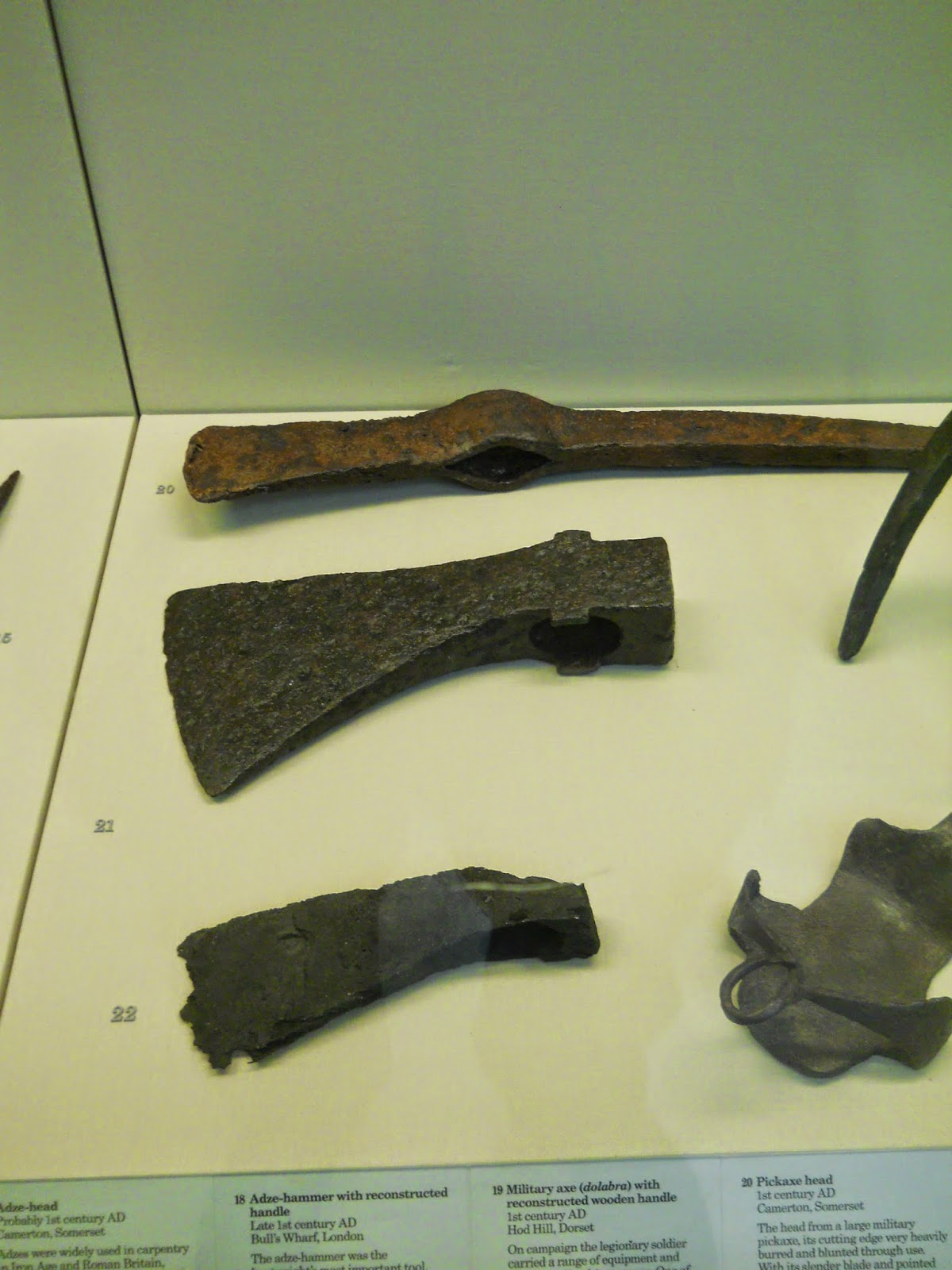
The pickaxe head at the top of this photo is immediately recognisable as such. It was found at Camerton and is a military-pattern tool, used by Roman soldiers for construction work. The axe head below it was also found at Camerton and would have been used to fell trees. It has a short inscription stamped into it, perhaps a maker's mark, but it is now impossible to read it.

The axe head at the bottom came from an unknown source, but represents the commonest kind of Roman axe. A weld line shows that the cutting edge was welded onto the rest of the axe head. This may have been hardened metal, to give a sharper cutting edge.


This ship's figurehead made of oak looks like a Viking one, but it was actually made earlier, during 300-400 CE. It was found in the River Schelde in Belgium and had a tenon allowing it to be removed, maybe for travelling under low bridges. It is not known if the figurehead was made by Gallo-Roman craftsmen, Germanic craftsmen who settled in the local area or by Germanic craftsmen who used the Gallo-Roman style.

The wooden objects shown below were found in various parts of Britain and illustrate some of the humbler day-to-day Roman uses of wood. They include spindles and spindle whorls, a tent peg, a wooden key for a wooden lock, a bowl and a strange object that is listed as a bobbin but which also looks a lot like a yo-yo. The board on the right was a barrel stave, which was reused to line a well near Mansion House in London. It bears two stamps of Fuscius Macrinus, who is thought to have been the cooper who made the barrel.


The Anglo-Saxons


These Anglo-Saxon woodworking tools were found at Hurbuck in County Durham and date to around 1,200 - 1,000 years ago. The curved adze at the top would be used for smoothing and shaping wood. The splendid T-shaped axe head is labelled as being used to 'fell and chop trees', although such a broad yet lightweight cutting edge would seem more suited to hewing felled timber into beams and boards. On the right is a spoon-shaped auger, used to drill holes in wood. You can see Dave Budd's reconstructions of such drills on one of my previous posts, which you can find by clicking on this link.

Wednesday, 30 July 2014

Woodcarving and woodworking tools seen at the British Museum; from ancient Nubia and Mesopotamia around 4,000 to 5,000 years ago


The British Museum is so full of incredible objects that a visit can be a bit overwhelming. Sometimes it is nice to just pick out a particular theme and to follow that through the galleries. On a recent visit, I took the chance to explore the history of woodcarving tools a bit further. A lot of the factual information here came from museum labels for the exhibits.

Ancient Nubia

Many sophisticated cultures developed in Nubia (along the Nile river in what is now northern Sudan and southern Egypt) in ancient times. This copper adze blade and axe head were found at the site of the ancient city of Faras. The remains of the city are now under the waters of Lake Nasser, having been flooded following the building of the Aswan dam.


They date to around 5,000 years ago and were probably imported from Egypt, Nubia's powerful neighbour. You can find out more about ancient Egyptian woodcarving and the making of copper alloys by visiting my previous post about it.

The Kerma civilisation developed in Nubia from about 4,500 years ago. It was based around the urban centre of Kerma, which the ancient Egyptians called 'Kush'. The city was known for skilled bronze (copper alloyed with arsenic or tin)  workers. Going from left to right, this stone axe head, stone grinder and whetstone (for sharpening metal blades) date to between about 3,760 and 3,560 years ago. The whetstone was one of ten hones interred with a sacrificial burial. It has traces of red pigment on it. I wonder if that was purely ritualistic, or if these stones were used with some kind of compound such as ground ochre to improve their sharpening performance?


Early Mesopotamia


These tools date from about 8,000 to about 6,200 years ago, to the early days of farming and of the development of towns and villages. The copper chisel in the centre was found at Tell Arpachiyah, in what was Northern Mesopotamia and is now near Mosul in Iraq. It is one of the earliest copper tools ever found. The tool to the left is a bone awl from the same place, set into bitumen. Between them is a sickle blade, also set in bitumen. Behind is a worked stone hoe blade and on the right, a stone mace head. In northern Mesopotamia, flint and metal were used for tools whereas in the south, pottery was generally used.

Ancient Sumerian

The Sumerian city of Ur was located at the site of what is now Tell al-Muqayyar in southern Iraq. At its peak, it was very powerful and wealthy. Some believe that Abraham (Abram or Ibrahim), the great prophet of the Jewish, Muslim and Christian faiths, may have been born here about 4,000 years ago. Archaeologists discovered a large cemetery area here dating to the Early Dynastic III period, about 4,600 to 4,300 years ago. Many of the stunning treasures excavated from this area are now in the British Museum. The copper used to make many of the tools probably came from Oman. 

These copper alloy chisels all have a flattened, triangular-shaped end away from the cutting edge. It doesn't look like a useful shape to be struck with a mallet or held in the hand, so I wonder if that end would have been held in some kind of handle? If that was the case, the shape wouldn't have been easy to drive into a wooden handle (like modern square- or round- sectioned tangs), so maybe that had a slot cut into it and was then bound together with the blade held inside? Perhaps the blade was simply wrapped in leather or another material to make a handle? I don't know of any evidence for this, by the way.
The chisel blade furthest on the right has an original engraving in cuneiform script on it.

The image below shows whetstones and chisel blades found in the tomb of Puabi, a very powerful and wealthy Sumerian woman. The beautifully-shaped honing stones on the right were found being worn by several of Puabi's male attendants buried with her.


The chisels are, according to the exhibit label, 'made of base gold with the surface artificially enriched'. Gold seems a strange choice for practical cutting tools. It is quite soft and so doesn't usually hold a cutting edge well. Perhaps, like the model tools found in the grave of the Egyptian king Khasekhemwy, these were meant as representations of (rather than working examples of) actual tools.

Several adzes were found in the Ur cemetery area. Unlike many ancient adzes the blades have a socket for the handle attached, rather than being lashed to the wooden handle like the adze blade shown above.


You may have noticed that two of the copper alloy adze blades have an animal's leg design engraved into them. Many tools and containers in these 'royal' graves have the same mark. No one is sure if it was the emblem of the royal house, the emblem of the manufacturers or something else.

The graceful-looking adze head in the central picture above is a replica of one in the collection of the University Museum in Philadelphia. The original is made of gold: another non-working representation of an actual tool? The objects shown with it are a gold spear head, a cluster of arrow heads corroded together and a whetstone.

The axe heads shown below illustrate something that is worth considering when looking at these objects.


The one on the right is made of silver - perhaps another mainly ceremonial representation. These objects probably came from the tombs of very wealthy and powerful people. It is hard to say whether these axes were just for use by guards and, if so, would they have looked considerably different to those used by craftspeople? During these times, there doesn't generally seem to have been the large differences in axe head shape according to the job required from it that can be seen in later axes, for example from the Anglo-Saxon times in Britain. However, perhaps the specialist craftsperson's hewing axes just weren't preserved in any graves?


Akkadian Ur and Canaan

From 4,300 to 4,150 years ago, the city of Ur was ruled by the Akkadians who succeeded the previous Sumerian rulers. The adze head below comes from the late Early Dynasty III or Akkadian periods. The handle is modern.


Notice the axe head shown bottom-right in the collection above. It is very different in shape to the earlier ones. This 'fenestrated' shape ('fenestrated' because of the 'windows' in the axehead) developed between 4,500 and 4,000 years ago, in the area around what is now called the Levant. The Canaanite axes below show this form with complete sockets for a handle. These windows meant that the whole axe was lighter in use. I wonder if this development was confined to military axes, given that the lighter weight would also benefit other people using them. Would these heads have been too vulnerable to distortion by twisting or side-to-side movements if embedded in timber? It's hard to say without any practical testing.


Ancient Babylonian

A hoard of 86 copper alloy and bronze tools and farming implements was found at Kutalla (what is now Tell Sifr in Iraq). They are about 4000 years old. Some were in a good, usable state although others were damaged. Axe heads (note: not of the fenestrated type), a chisel and a saw can all be seen amongst other tools. It is thought that they were held originally in a big agricultural establishment, where it would be customary to check the total weight of items issued and returned at the end of each season.


Monday, 28 July 2014

Two African woodcarvings representing actual objects, made for very different reasons...


This ebony carving of a chainsaw is an artwork called I Want That You Want What I Want That You Want. It was in an exhibition called 'The Museum of Forgotten History' by the artist Maarten Vanden Eynde, which was shown at the Arnolfini gallery in Bristol in 2012.

The sculpture was made by a woodcarver in Cameroon in 2010 and was exchanged with Vanden Eynde for the actual Stihl chainsaw that was copied in ebony.

The next carved representation is less refined in its carving but is possibly a matter of life-and-death to those who use it, members of the Konso people of Ethiopia. It was seen in the British Museum in London and represents a Kalashnikov AK-47 assault rifle.


The exhibit label says that 'Hand-carved wooden AK-47 rifles are frequently carried by poor road workers in southern Ethiopia as a form of defensive camouflage, and by their children to deter potential thieves while tending goats and other livestock. Road building works have brought itinerant labourers into contact with pastoralist groups in this remote region where traditional cattle raids have become commercialised rustling. The black 'metal' parts of the gun are painted using tar and pitch from the road-works'

Friday, 7 February 2014

Ancient Egyptian wood carving and stone carving tools


Whilst looking around the museum in Bristol, I saw these ancient carving tools on display and thought it might be nice to share them with you.

The tools were bought by the museum in 1919 from a Captain E.A. Mackay. The metal is a copper alloy, which makes the carving achievements of those ancient craftsmen seem all the more amazing as the copper alloy is softer than the steel used in modern tools. Other elements used in ancient copper alloys included antimony and arsenic. Arsenic often occurs naturally in copper ore, so may have been the original alloying material with copper to make bronze. Eventually it was superseded by the use of tin, as tin was easier to add in specific amounts and was non-toxic . It wasn't until the time of the last pharaohs, long after these objects were used, that Egyptians began to use iron for this purpose.

The chisel with a wooden handle seems very similar in size and shape to a modern palm chisel and was probably used for detailed work without a mallet. It is thought to date to between 3,300 and 3,600 years ago, what was the eighteenth dynasty of the New Kingdom. The awl in front of it (a spike used for making small holes) is thought to date to the same period.

The larger chisel in the holder to the right would have been used with a mallet. It is believed to be older, from the twelfth dynasty of the Middle Kingdom about 3,800 to 4,000 years ago.

Ancient Egyptian images of woodworkers show them using many tools that woodworkers into the medieval ages of Europe were still using variations of. Axes and saws were used to roughly shape the wood into planks and blocks, adzes shaped it further, awls and bow drills were used to make holes and chisels and mallets were used for fine work. Much of the timber used was probably imported from what is now eastern Africa and the Lebanon, as Egypt did not have large forests at that time.

http://en.wikipedia.org/wiki/File:Maler_der_Grabkammer_der_Bildhauer_Nebamun_und_Ipuki_004.jpg

Nearby, there are examples of stone carving tools. The mallets certainly look familiar; I have a couple very like them in my own studio! The caption on the display speculates that the worn one may have been buried with a carver in the belief that, although it was worn out in this world, it would be perfect again in the next. They are thought to date to the third dynasty of the Old Kingdom, between 4,620 and 4,700 years ago according to the museum caption.


The stones on the shelf would be used for grinding down stone sculptures to smooth them. The copper alloy chisel in front of them dates to the eighteenth dynasty of the New Kingdom, between 3,300 and 3,600 years ago. It would have been used to shape stone, with a more rounded, bar-like shape of chisel used afterwards to smooth the sculpture. 

The British Museum Collection

There are more tools on display at the British Museum in London. The information used here comes from the labels with each exhibit.

King Djer reigned during the First Dynasty, about 5,100 to 4,900 years ago. His tomb is surrounded by the remains of over 300 people; his wives, guards and servants. They must have committed suicide or been killed at the time of the king's entombment, to serve him in the afterlife. One retainer was called 'Hem', meaning simply 'servant'. He was a craftsman and was interred with two copper chisels, a copper adze head and the tool on the right, which is thought to have been used to cut leather. The copper axe head on the left was one of several found with other bodies. It was a high-status possession and these people were probably special guards. This axe head is inscribed, including with an elephant design, but no one knows what the inscription means.


King Khasekhemwy ruled during the Second Dynasty, about 4,904 to 4,700 years ago. He was keen on construction and developments in such things as large-scale use of dressed stone during his reign led the way for the later building of the Pyramids. 194 thin copper models of tools were found underneath a collapsed wall in his tomb. They include models of chisels, harpoons, adzes and needles. Many are in  groups of eight, possibly reflecting the Egyptian working week of eight days according to the label. I wonder why they are models and not genuine tools?


The New Kingdom dated from about 3,564 to 3,084 years ago. Below is shown a wooden mallet from this time, found at Thebes. See the similarities between the shape of this one and the much older ones shown in the Bristol Museum display above. The bow-drill found at Deir el-Bahri exhibited next to it uses bronze bits to drill holes. The end of the wooden bit holder would be steadied inside a hollow cut into the conical wooden piece displayed behind the drill. The bow would then be moved back-and-forth to spin the drill bit.


The tools shown next come from different periods. The chisel with its wooden handle dates, like the saw immediately below it, to the New Kingdom in Thebes. They use bronze blades, like the pull-saw at the bottom which came from Deir el-Bahri and dates to the 18th Dynasty about 3,600 to 3,300 years ago.


The two bronze-bladed adzes also date to the 18th Dynasty. The one on the left is from Thebes during the reign of Tuthmosis III which was about 3,493 to 3,439 years ago. The one on the right was found at Deir el-Bahri and was used during Hatshepsut's reign 3,493 to 3,471 years ago. This adze still has the original leather thongs holding the blade on. Its wooden handle is carved with a hieroglyphic inscription. Compare these tools to the image of the workers using an adze and a saw shown above.


A label near these tools also shows some commonly-used ancient Egyptian woodworking joints:


These damaged corners from coffins show how joints would also be strengthened using dowels or cramps, made from a close-grained wood such as sidder. 


The sidder wood cramp top right in the photo above dates to the 17th or early 18th Dynasty, 3,600 to 3,500 years ago. It is inscribed with the name 'Ameny'; maybe the name of the cramp's maker or its user, in a similar way that modern workers in busy workshops or building sites write their names on their tools to stop them 'going for a walk'. The coffin boards on the left comes from Asyut during the 12th Dynasty, about 3,950 years ago. They have been joined with such cramps. The dowelled joint on the right is from the same location and period as the cramp-joined boards and has some dowels from the Middle Kingdom (4025-3,630 years ago) displayed below it.

What timbers did ancient Egyptians use? 

It can be hard to tell from the names that they gave them, but scientists have analysed woods under the microscope and worked out what many of them are from their cellular structures. They are generally associated with things made for funerals, as these have been preserved in tombs.

The main local timbers used were sycomore fig (Ficus sycomorus), tamarisk (Tamarix sp.) and Nile acacia.  To make coffins and the like, carpenters would need longer, straighter boards and these were obtained by trade, mainly with the Levant. Coniferous softwoods such as cedar as well as juniper and cypress were bought and used. Cedar was especially reserved for the coffins of high-ranking people, although different parts of a coffin could use different timbers, depending on their suitability for different purposes. You can find out more, including some ancient Egyptian names for different timbers, at the digitalegypt website.

There are some more images of ancient Egyptian woodworking tools on this post by Marijn, of the St Thomas Guild: follow this link. There is also an illustrated history of the development of the saw online here.

A Personal Favourite

Finally, I had to include my favourite piece of ancient Egyptian woodcarving. It is a statue of a priest who would have said prayers for the dead. His name was Ka'aper. 

He lived during the fifth dynasty of the Old Kingdom. Dating this period seems quite difficult, but it is somewhere between 4,686 and 4,520 years ago. The people who excavated the carving, at Saqqara, thought that the statue looked like the chief of their village so they called it 'Sheikh el-Balad' which means 'village chief'.

The statue is 112 cm (about 3' 8") tall and is carved from sycamore wood (I'm assuming that this refers to sycomore fig (F. sycomorus)). The eyes were made to look 'alive' by using a copper lining with white quartz and a central disc of rock crystal.

http://www.ibcousinie.info/Egypte%202010/Mes%20Photos/01le%20Caire/Le%20Musee/Ka_aper.jpg

People in other parts of the world use similar optical tricks on their carved statues. For example, in New Zealand traditional Maori woodcarvings have inlaid paua (abalone) shell eyes that twinkle in firelight to look like they are watching.

Photograph copyright James Shook from Wikimedia Commons