This blog has just been included in a 'digest' blog site, which might be interesting to anyone interested in what's going on in Bristol, UK. There's a link to it here:
http://www.bristolblogs.com
The site is broken down into different sections, such as 'opinion', 'international', 'food' etc. It regularly takes excerpts from a range of local blogs and posts them. A nice way of finding out a bit more about what makes people in this interesting, creative and vibrant city tick...

My name is Alistair Park and I'm a professional carver who is based in Bristol, England. I've been carving for over twenty-eight years and I also enjoy teaching my skills to people of all ages. You'll find posts here about all kinds of things to do with carving; the work that I do, the people that I meet and the things that I see which inspire me. Please feel free to comment on anything of interest, it'd be great to hear from you!
Wednesday, 2 January 2013

Monday, 31 December 2012
'Cornucopia' at the Grant Bradley Gallery in Bedminster
I've been invited to show in this exhibition in February
The exhibition has been co-curated by Will Stevens, who organises a life drawing class in Bristol that I go to. Some of the other people showing work are quite well-known Bristol makers and there are about 30 exhibitors, so it should be a good 'un!
Here's the website for the life drawing class as well:
http://www.lifedrawingclasses.co.uk/
I've just posted about one of the pieces that I'll be showing in 'Cornucopia'. It's at http://carvingswithstories.blogspot.co.uk/2013/01/carving-self-portrait-in-wood-for.html
Hope you like it!
The exhibition has been co-curated by Will Stevens, who organises a life drawing class in Bristol that I go to. Some of the other people showing work are quite well-known Bristol makers and there are about 30 exhibitors, so it should be a good 'un!
Here's the website for the life drawing class as well:
http://www.lifedrawingclasses.co.uk/
I've just posted about one of the pieces that I'll be showing in 'Cornucopia'. It's at http://carvingswithstories.blogspot.co.uk/2013/01/carving-self-portrait-in-wood-for.html
Hope you like it!
Triodos Bank's 'Cornerstone' project- YouTube video
Here are a couple of videos that are on YouTube as part of Triodos Bank's 'Cornerstone' project, with a me talking about why I carved what I did on the stone. Thanks to Faye for inviting me!
You can find out more about the project here:
http://www.triodos.co.uk/en/about-triodos/news-and-media/colour-of-money/cornerstone_art_project/
For the more health and safety conscious, I know that I'm not wearing goggles and there's no extraction etc. The position of the stone was adjusted and extraction put on just after this film was shot when the serious carving began, honest!!
Saturday, 29 December 2012
Carved Oak plaque for Bristol's Castle Lodge freemasons
I completed a carved oak plaque a few weeks ago for someone who wished to commemorate his grandfather, who was an important freemason in Bristol. The plaque is made from recycled oak and was carved freehand, using a Dremel hand drill for the lettering and traditional hand tools to carve the square and compasses (the traditional symbol of the freemasons).

The lettering was in a font which I haven't carved before and so was an interesting challenge. Designing the square and compasses symbol was too. Symbolism is very important to masons and I had to do some careful research so as not to include, or leave out, anything in the design that would make it incorrect.

The plaque will be displayed in the Castle Lodge on Park Street in the centre of Bristol. It's interesting putting my name and mark on the back of a plaque going to somewhere like this lodge. The plaque may still be there long after I'm gone and, when it is next taken down from the wall, I wonder what legacy of it's maker will still remain?


The lettering was in a font which I haven't carved before and so was an interesting challenge. Designing the square and compasses symbol was too. Symbolism is very important to masons and I had to do some careful research so as not to include, or leave out, anything in the design that would make it incorrect.


Wednesday, 26 December 2012
Recycling in a 17th century Bristol building-a peek at post-civil war carpentry and pit sawing
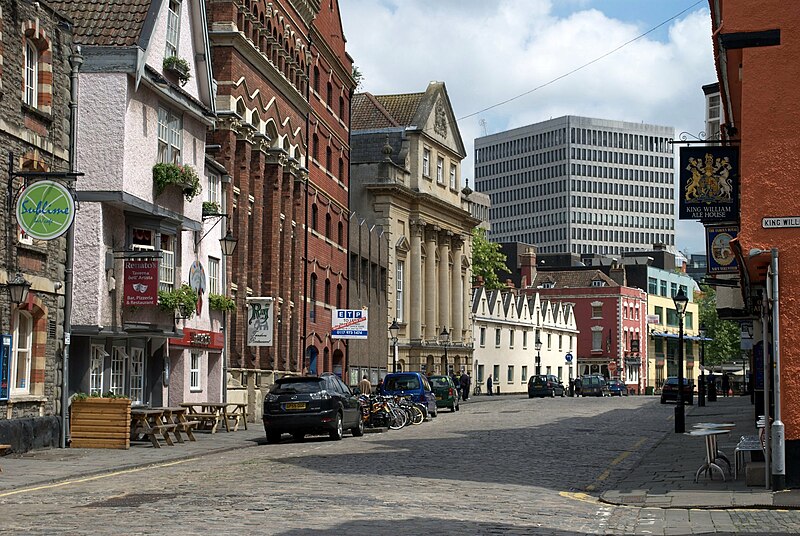
It was very interesting seeing how the grade II listed building was put together and changed over time- the bays at the front sheared off and the frontage flattened in line with Victorian fashion, the peaks of the gabled roof at the front pushed back so that the frontage has a flat top in line with Georgian trends etc. The rear of the building shown above has the loading hatch put in when it was a Victorian warehouse.
One of the most interesting parts was seeing where some of the lathwork and plastering on internal walls had been stripped away, so that the original seventeenth century studding (the supporting timber framework) could be seen.

Bristol was devastated during the English Civil War in the 17th century, with sieges and high taxes bringing the city to it's knees. When these buildings were constructed it made sense to re-use building materials left about the place after years of war, rather than expensive new materials. The bits of wood in this photo show this. Some have been cut with saws in a sawpit*, but others have been hewn into shape with axes, and still show the marks. Some, like the bit top left, are strange shapes. This is because they came from much older damaged buildings or ships and were brought here to be cut into shape then fitted. They are still here centuries later.
'Make do and mend' indeed!
*When someone is in charge, we call them 'top dog'. When they have no power or little chance of success (e.g. in sporting events) we call them the 'underdog'. Ever wondered why?
These terms come from the old way of sawing logs into timber. One person would stand in a pit across which the log to be cut would be laid. The other, more experienced, person would stand on top of the log and direct the cutting . Each would be holding a handle at an opposite end of a big two-handled saw. The man on top (or 'top dog') didn't have to work the saw as hard and stayed out of the mud and dust, whereas the 'underdog' in the pit would work much harder pushing and pulling the saw upwards, whilst being covered in sawdust and mud. Here's an image of one type of pit saw in use:
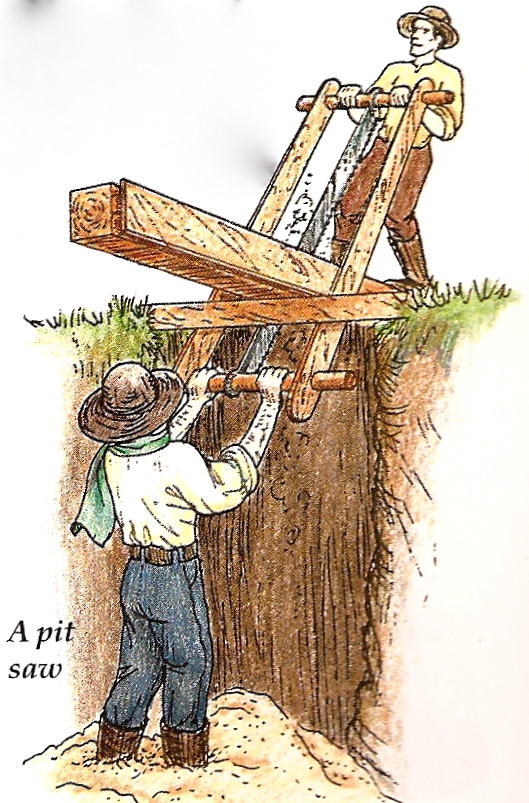
These terms come from the old way of sawing logs into timber. One person would stand in a pit across which the log to be cut would be laid. The other, more experienced, person would stand on top of the log and direct the cutting . Each would be holding a handle at an opposite end of a big two-handled saw. The man on top (or 'top dog') didn't have to work the saw as hard and stayed out of the mud and dust, whereas the 'underdog' in the pit would work much harder pushing and pulling the saw upwards, whilst being covered in sawdust and mud. Here's an image of one type of pit saw in use:
image from blog.carbideprocessors.com
Monday, 24 December 2012
Josef Dobner- 'Der Gaukler'
I just wanted to put a couple of images of this carving on my blog, because I think it's great.
It is 51cm (20") tall and was carved using lime wood in 1926, by a man named Josef Dobner. He died in 1972.
'Der Gaukler' means something like 'the entertainer' or 'the joker' when translated from German into English. I wonder if it is a self-portrait?

The carving is kept at the Belvedere museum in Vienna, which is part of the Austrian State Museum and is well worth a visit. The copyrights on both of these images are owned by them.

It is 51cm (20") tall and was carved using lime wood in 1926, by a man named Josef Dobner. He died in 1972.
'Der Gaukler' means something like 'the entertainer' or 'the joker' when translated from German into English. I wonder if it is a self-portrait?


April 2020
Sonia Williams has contacted me and very kindly sent a photograph that she took in Hallstatt, Austria about 1962. It shows Josef Dobner (on the right) standing with his brother Thomas who was an architect.
 |
| Photo © Sonia Williams. Reproduced here with permission |
Sonia recalled meeting Professor Dobner and his family many times at their home in Villach, in Austria. He also introduced her to the painter Willi Götzl. After studying in Austria as a pupil of Götzl, she is now based in Norfolk in England. Thank you to Sonia for sharing her memories and for permission to use this photograph.
Sunday, 23 December 2012
Chris Pye's woodcarving secrets and a woodcarving poem
I get regular email newsletters from a very skilled woodcarver named Chris Pye. I really admire his thoughtful attitude towards carving as well as his work.
The repetiton of the cut in carving (gouge, chisel or knife cutting over and over again) has struck me for a long time as a kind of mantra. It gives a pattern within which it is easy to slip off into thought. You also need to be pretty philosophical if a bit of carving breaks off unexpectedly!
Anyway, the most recent newsletter had a couple of sections which really caught my eye and I'd like to share them here, for those who can't see the original newsletter. Thanks to Chris for sharing them with his readers...

 After
five days
After
five days
The repetiton of the cut in carving (gouge, chisel or knife cutting over and over again) has struck me for a long time as a kind of mantra. It gives a pattern within which it is easy to slip off into thought. You also need to be pretty philosophical if a bit of carving breaks off unexpectedly!
Anyway, the most recent newsletter had a couple of sections which really caught my eye and I'd like to share them here, for those who can't see the original newsletter. Thanks to Chris for sharing them with his readers...
"Top
10 Secrets of Woodcarving!
I
scribbled this list, with it's notes, on a scrap of paper about 25
years ago. I came across it the other day and realised that, since
then, I hadn't changed my mind at all!
I
was thinking of the qualities that I believe go to making up a really
good carver: things good carvers consider as they carve, or with
which they work; things students should always bear in mind.
1
Do
it! Practise.
Do it a lot.
2
Persistence!
Don't stop.
3
Regular
steps!
Incremental challenges.
4
Preparation!
You
can't have too much research, which includes drawing and modelling.
5
Tools!
The
right ones, and enough of them.
6
Correct
bevels and edge!
Sharp tools, cutting efficiently.
7
Work
from the tool! The
tools
are
the carving.
8
Slicing
cuts! The
'cut of the carver'.
9
Carve
the form into the spaces!
Not the other way round.
10
Light and Shadow! Gives
3 dimensionality."

The other bit that particularly stood out was this Taoist poem:
Chuang
Tzu: Poem of the Woodcarver
trans.
Thomas Merton
Khing,
the master carver, made a bell stand
Of
precious wood. When it was finished,
All
who saw it were astounded. They said it must be
The
work of spirits.
The Prince of Lu said to the master carver:
“What
is your secret?”
Khing
replied: “I am only a workman:
I
have no secret. There is only this:
When I began to think about the
work you commanded
I
guarded my spirit, did not expend it
On
trifles, that were not to the point.
I
fasted in order to set
My
heart at rest.
After
three days fasting,
I
had forgotten gain and success.
 After
five days
After
five days
I
had forgotten praise or criticism.
After
seven days
I
had forgotten my body
With
all its limbs.
“By
this time all thought of your Highness
And
of the court had faded away.
All
that might distract me from the work
Had
vanished.
I
was collected in the single thought
Of
the bell stand.
“Then
I went to the forest
To
see the trees in their own natural state.
When
the right tree appeared before my eyes,
The
bell stand also appeared in it, clearly, beyond doubt.
All
I had to do was to put forth my hand
and
begin.
“If
I had not met this particular tree
There
would have been
No
bell stand at all.
“What
happened?
My
own collected thought
Encountered
the hidden potential in the wood;
From
this live encounter came the work
Which
you ascribe to the spirits.”
***************
Chuang
Tzu was a 3-4th century BCE Chinese Taoist.
Chris Pye has a website which can be found by clicking on this link: www.chrispye-woodcarving.com
Subscribe to:
Posts (Atom)