As well as this blog, I also have a website and Instagram page with lots more images of my work as well as a few more stories.
If you like woodcarvings, you might want to have a look.
Showing posts with label victorian architecture. Show all posts

Wednesday, 30 March 2016

Bristol Byzantine and the Café Wall Illusion

One thing that I love about Bristol is that, although it is not a big city, it can still surprise. After a while living here, I learnt about Bristol's own architectural style only a couple of weeks ago.


Buildings on King Street

'Bristol Byzantine' - it has a great name!


Bristol Byzantine came about in the mid to late nineteenth century and was generally used for industrial buildings and warehouses. One of the architects associated with it is Edward Godwin, who was born in Bristol. 


Buildings on Victoria Street


35 King Street

The style may have originated when William Venn Gough and Archibald Ponton (who designed the Granary on Welsh Back which was built in 1869) met John Addington Symonds, a Bristol-born historian of the Italian Renaissance. Some believe the name was coined by the architectural historian Sir John Summerson.

The Arnolfini (Bush House)

The style is heavily influenced by Byzantine and Moorish architecture from buildings in Venice and Istanbul and one building in particular, the Granary on Welsh Back, really shows the influence of Islamic architecture.


The Granary (or Walt and James' Granary)

Some characteristics of the Bristol Byzantine style include: windows that often have arched tops and are aligned in vertical columns on stories above the ground floor, a generally sturdy and robust appearance, rock-faced exterior walls on the ground floor and that the buildings are constructed using grey Pennant sandstone, yellow Bath limestone and/ or colourful bricks that were made from clay sourced from the Cattybrook brickpits near Almondsbury.


The Brew House (formerly part of Rogers' Brewery)

Not all buildings show all of these features but once you start looking, more and more buildings in Bristol show the unmistakable influence of Godwin and his colleagues. 


Brunel building, Gardiner Haskins department store

Browns restaurant, formerly Bristol Museum

Many famous Bristolian landmark buildings are examples of Bristol Byzantine. Others include the Carriage Works on Stokes Croft and Clarks timber merchants in St Phillips.


Colston Hall

Even the iconic towers of the Clifton Suspension Bridge have features in common with Bristol Byzantine: robust design, arch-topped vertical columns. They were completed by Hawkshaw and Barlow in the mid nineteenth century, after Isambard Kingdom Brunel had died with the bridge still uncompleted. Brunel's original towers were to have been a much more elaborate mock-Egyptian style.


Image by A.Pingstone

Some modern Bristol buildings show echoes of the style, such as the vertically-aligned arch topped windows:


I was chatting to some people about Bristol Byzantine and one person there said "Have you also heard of the Café Wall illusion?"


This optical illusion was first officially described by the late Professor Richard Gregory. It is named after these tiles on the wall of a café at the bottom of St Michaels Hill in Bristol, which one of his students mentioned to him. The horizontal lines are truly horizontal, but the offset tiles in two contrasting colours make them look like they're sloping diagonally.

I wonder what other architectural surprises Bristol still has in store?

Thursday, 22 August 2013

What's that on the hill? Bembridge fort, a 'Palmerston folly' on the Isle of Wight


From our campsite near St Helens on the Isle of Wight, we could see a strange mound on the brow of a nearby hill. It looked a bit like an Iron Age hill fort, but small mounds could be seen rising from it. We decided to go up there and have a look, although we didn't expect to find what we did.


This is Bembridge fort, which was built between 1862 and 1867 to defend the island from French invasion by the forces of Napoleon III. It was meant to be the main stronghold for the Isle of Wight's southern coast and cost £48,925 - a huge sum of money at the time. 


The fort is one of a system of defences that were ordered by Lord Palmerston, In the end, the French didn't try to invade and so the forts came to be called Palmerston's Follies. It was used by the War Department until 1948, with coastal artillery defences stationed here during the First World War and air defences and Home Guard during the Second world War. The site is now owned by the National Trust but is semi-derelict and has a private tenant, so is not open to the public except for guided tours by appointment only.


If you'd like to see inside, tours are run every Tuesday from April to October and groups of ten or more may be able to book a tour during the week. Ring 01983 741020 or email the National Trust for details.


Sunday, 19 May 2013

Birmingham's Jewellery Quarter- the last remaining industrial quarter in Birmingham, with 200 protected buildings that survived wartime bombs

This area lies about a mile outside Birmingham city centre, in an area called Hockley. The city has always had a bit of a reputation for being a grim, industrial centre and it has to be said that Hockley isn't renowned for it's beauty, even in Birmingham.

Wandering around the Jewellery Quarter yesterday though, I remembered how beautiful some of the  architecture that can be found in Britain's industrial cities is. I've always had a particular soft spot for Victorian Gothic: it's spires and turrets, carvings and decorative ceramics. They give little touches of beauty and extravagance in some of Britain's most run-down urban areas.


In it's heyday, Birmingham had 'quarters', areas where particular trades would congregate and customers would travel to them knowing that a good choice was available in a small area. Some other examples were the saddlery quarter and the gun makers quarter. Only one of these old quarters is left now: the jewellery quarter.

It has been a centre for jewellery making for over 250 years. The Birmingham Assay Office opened there in 1773, one of four in Britain (the others being London, Edinburgh and Sheffield). An assay office is where precious metals are tested for purity and then hallmarked to show their legitimacy - Birmingham's hallmark stamp is an anchor:

Image from:http://www.edinburghsilver.co/blog/the-sterling-standard/

In 1890, the school of jewellery making opened in the quarter. It is still there and still a centre of training in the craft:


Pretty much every building within the roughly square mile of the quarter seems associated with the trade in some way; workshops, retailers, tool sellers, traders in precious metals and stones, medallion and medal casters. Sometimes one walks past a window in a small street and gets a glimpse back in time, into a tiny workshop with a jeweller using the same tools and techniques as when the quarter began.

The area also escaped the worst of the damage caused by the Blitz bombs during the Second World War. Birmingham, as an industrial centre, was badly hit generally but there are still over 200 listed, protected buildings in the Jewellery Quarter that survived. I took some photos of things noticed whilst walking around and thought it would be nice to share them with you here:


This public toilet, 'The Temple of Relief', is situated next to the train station in the quarter.


The Jewellery Quarter has it's own website, which you can find by following this link:

You can find out more about the Birmingham Assay Office and hallmarks here:
http://www.theassayoffice.co.uk/index.html

Wednesday, 26 December 2012

Recycling in a 17th century Bristol building-a peek at post-civil war carpentry and pit sawing


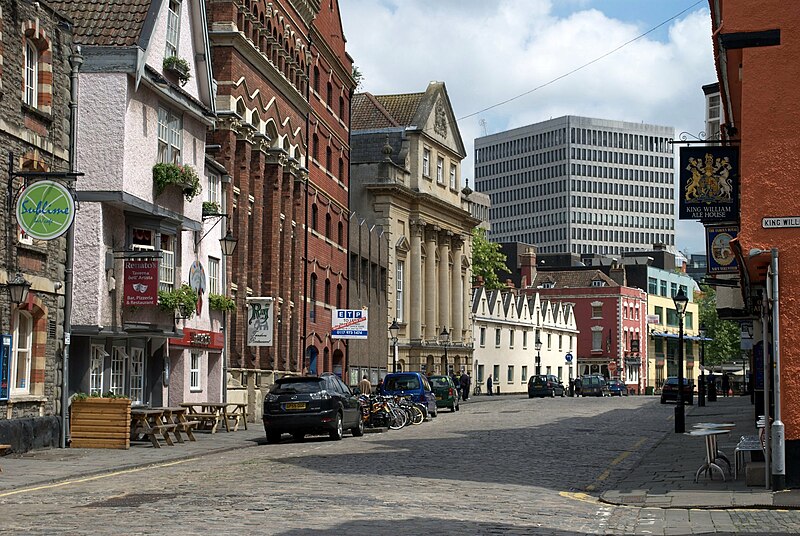
File:King Street, Bristol (June2010).jpg

A friend of mine has recently bought a building on King Street in Bristol. This cobbled street has a row of buildings on it which were built not long after the end of the English Civil War in about 1665. A group of us woodies went over to have a look around at Nigel's invitation.

It was very interesting seeing how the grade II listed building was put together and changed over time- the bays at the front sheared off and the frontage flattened in line with Victorian fashion, the peaks of the gabled roof at the front pushed back so that the frontage has a flat top in line with Georgian trends etc. The rear of the building shown above has the loading hatch put in when it was a Victorian warehouse.

One of the most interesting parts was seeing where some of the lathwork and plastering on internal walls had been stripped away, so that the original seventeenth century studding (the supporting timber framework) could be seen.


Bristol was devastated during the English Civil War in the 17th century, with sieges and high taxes bringing the city to it's knees. When these buildings were constructed it made sense to re-use building materials left about the place after years of war, rather than expensive new materials. The bits of wood in this photo show this. Some have been cut with saws in a sawpit*, but others have been hewn into shape with axes, and still show the marks. Some, like the bit top left, are strange shapes. This is because they came from much older damaged buildings or ships and were brought here to be cut into shape then fitted. They are still here centuries later.

'Make do and mend' indeed!

*When someone is in charge, we call them 'top dog'. When they have no power or little chance of success (e.g. in sporting events) we call them the 'underdog'. Ever wondered why?
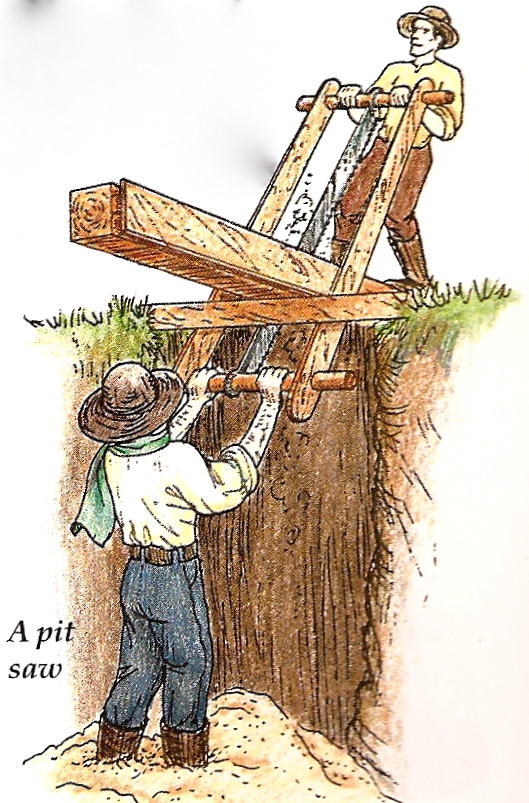
These terms come from the old way of sawing logs into timber. One person would stand in a pit across which the log to be cut would be laid. The other, more experienced, person would stand on top of the log and direct the cutting . Each would be holding a handle at an opposite end of a big two-handled saw. The man on top (or 'top dog') didn't have to work the saw as hard and stayed out of the mud and dust, whereas the 'underdog' in the pit would work much harder pushing and pulling the saw upwards, whilst being covered in sawdust and mud. Here's an image of one type of pit saw in use:


image from blog.carbideprocessors.com