As well as this blog, I also have a website and Instagram page with lots more images of my work as well as a few more stories.
If you like woodcarvings, you might want to have a look.
Showing posts with label ancient structures. Show all posts

Thursday, 3 August 2017

When you wish upon a tree... the curious tradition of wishing trees in Britain and Ireland

coin tree

Uley is a small village on the edge of the Cotswolds in Gloucestershire. It is overlooked by a large Iron Age hill fort named Uley Bury: rings of large ditches and earth banks that are over 2500 years old.

I got the chance to explore Uley a bit more through a guided walk with Cotswold Guided Walks. As we climbed up towards the hill fort, a fallen tree across the path revealed a strange decoration - dozens of coins hammered into it.


wish tree (coin tree) Uley

None of the coins seemed older than the twentieth century, indeed the tree would probably have rotted away by now if it had fallen that long ago. It was completely dead. Not all the coins were pocket change of low value either - there were a few commemorative coins bashed in, with their edges following the line of the woodgrain.


This is a wish tree. These particular ones are known as 'coin trees' and can be found all over Britain. People hammer coins in and make a wish, usually for the end of an illness. The trees may be stumps or fallen, or sometimes living. Apparently the metal toxins may sometimes even be concentrated enough to kill the living trees. 

It seems to be a surprisingly recent phenomenon, the first examples of these being recorded in the early eighteenth century. The one at Uley also shows an example of Christian and Pagan beliefs mixing, as some coins have been added in the shape of a crucifix.


coin tree mixing Christianity and Paganism

This wasn't the first coin tree that I'd come across. There are also some at Portmeirion in Wales. The coins inserted into some of these are so densely packed that, from a distance, they seem almost like a chainmail coat around the timber.

Coin tree Portmeirion

There is another kind of wishing tree in Britain and Ireland. These are the 'clootie trees'. Clootie trees are, I think, an older tradition than coin trees and are trees that are more usually associated with a place that pagans would consider to have particular power: springs of water, ancient burial sites etc. 

A clootie tree will have rags and ribbons tied into its branches, sometimes many of them. The name 'clootie' comes from the Scottish name for a small piece of rag or cloth.

Thorn trees (Blackthorn or Hawthorn) seem particularly likely to be so decorated, perhaps because they are quite commonly found and are also considered to be powerful trees in Paganism. A small clootie tree can be found directly in front of the blind 'entrance' to Bela's Knap Neolithic long barrow in Gloucestershire.

Clootie tree

This little tree is certainly not very old but is already decorated with brightly-coloured rags and ribbons.

clootie tree bells knap

I've also seen clootie trees at Berry Pomeroy in Devon and also the thorn tree on Wearyall hill in Glastonbury in Somerset, which I'm very sad to say has since been badly damaged by vandals.

Why tie things in trees? Some suggest that it could have similar roots to traditions in the Far East. For example, followers of Shintoism in Japan hang paper streamers called shide from ropes around or in trees that are considered especially important and sacred. The two could be an example of ideas spreading along ancient trade routes or may not be directly linked, being instead an example of similar traditions arising in different places.

I certainly like to come across a clootie or a coin tree on a walk: a strange testament to the way that humans perceive and interact with the power of trees.

Saturday, 28 September 2013

Some ancient stone carvings and structures in Cornwall: mysterious stone chambers, circles, pavements and labyrinths

Although my trip to Cornwall included visiting a few churches to look at the carvings and stories within them, these weren't the only carvings and man-made structures that I'd like to write about here. Some were far, far older.

Perhaps the oldest structure was Trethevy quoit on Bodmin Moor. This is a dolmen, a chamber made from huge stones thought to date to the end of the Neolithic (Late Stone Age), about 5,500 years ago. There are a few in Britain, some having shown evidence of burials within them but they may have also had other purposes such as territorial markers. No one really knows with certainty the original purpose of these chambers, but they are also found as far away as Korea and India.


On the same side of the moor one can find the Hurlers, a row of three (or possibly four) stone circles and outlying stones, which may date to the Bronze Age or may be older. They lie in a SSW-NNE alignment.


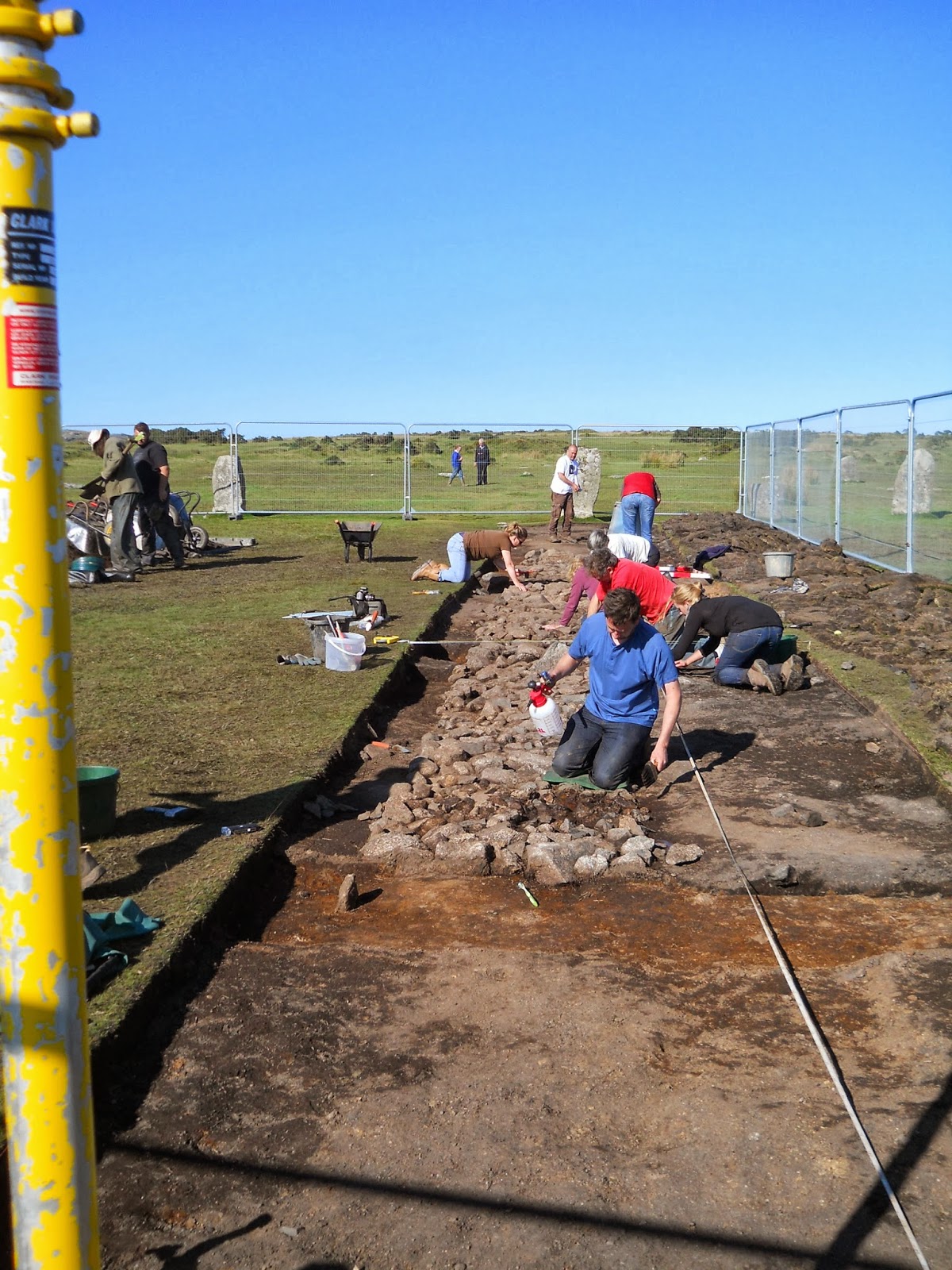
We were very lucky to visit them whilst an excavation was taking place to uncover a 'pavement' of white quartz stones, which appears to link two of the circles and runs in the same orientation. The quartz structure has only been uncovered in modern times once before, in 1938, and will be covered over again once the project is completed. The local community was assisting with the dig, which was tied in to a study of the astronomical orientations of the site that is being conducted by the Roseland Observatory. It's interesting to think what the Hurlers must once have looked like. The stones in the circles show evidence of having been hammered to shape and the pavement of quartz must have glowed and twinkled in certain light conditions.


On the north coast of Cornwall lies another mysterious site that may date to the Bronze Age. The walk to this one began at Tintagel, a site closely linked with legends of King Arthur.


The castle ruins that can be seen today are comparatively recent, having been built in the 13th century by Richard, Earl of Cornwall. There is archaeological evidence for much older use of the headland though, going back to Romano-British times. However, no traces of an actual settlement on the site then have so far been found, although evidence for early trade with Mediterranean societies has been discovered here.

After a walk of about two hours along the beautiful coastline, past Bossiney Haven...


... one arrives at  Rocky Valley.


The river is followed upstream for a while...


... to a ruined watermill.


On a rockface behind the mill ruins are carved two of the most intriguing carvings that I know of. They are surrounded by offerings tied to trees and scratched into stones, which have then been lodged into cracks in the rock. A plaque nearby notes that they are 'probably of the early Bronze Age (1800 - 1400 BC)'. In truth, they are almost impossible to date. They are two labyrinths.


This design is a unicursal maze. There are no dead-ends or branches, just a single path travelling into the centre then out again. The design is ancient, a square version having been found on a clay tablet from the Mycenaean palace at Pylos, which was destroyed by fire around 1200 BC.

Stone carvings that may be more recent, although still very old, can be seen back on Bodmin moor. One is the Longstone, or Long Tom; a cross carved in granite. Some people believe that this is an example of the Christianisation of an ancient menhir (standing stone). Rather than destroy the pagan relic a cross might have been carved onto it, perhaps because it was too useful as a wayside marker on the inhospitable moor to be taken down or because of some other particular importance to local people. 


Another nearby monument of carved granite is certainly Christian, albeit still very old. It is called King Doniert's Stone but is actually two granite bases for crosses, which have interesting Celtic knotwork and an inscription carved into them.

The inscription says in Latin 'Doniert Progavit Pro Anima', which translates as 'Doniert ordered (this cross) for (the good of) his soul'. Doniert is thought to be King Durngarth of Cornwall, who drowned in the river Fowey around AD 875. 


The stones are decorated with carvings of late 9th century style and sockets carved into the tops of the stones may once have held separate parts of the monument; perhaps wooden cross heads?
An underground passage cut into the hard granite begins about 8 metres (26.25 feet) from the stones and terminates below them in a cross-shaped chamber. The relationship between the stones and the passageway and chamber is unknown. 
As with most, if not all, of the ancient carvings and man-made structures in the county, this Cornish monument leaves the visitor considering questions to which we will probably never know the answers.