As well as this blog, I also have a website and Instagram page with lots more images of my work as well as a few more stories.
If you like woodcarvings, you might want to have a look.

Thursday, 9 March 2023

Documenting the hidden world of the bell ringers: making a peal board


Peal board at st James church Mangotsfield

What is a peal board?

Well, before this commission in 2022 I'd never heard of one either. Making it gave a chance to see a tiny glimpse of something that most people outside of bell ringing never see. In this post we go up the stairs in the church tower, through a small door and into the bell loft to have a glimpse at the hidden world of the bell ringers.


Bell ringing ropes hanging in the bell loft of St James' church, Mangotsfield

Bells are traditionally rung to call people to worship in Christian churches in Britain. Ringing developed from the use of a single bell to several, which are rung in complicated patterns that require a lot of skill from all participants to play accurately. Each ringer in the tower will play a single bell by pulling on a rope to make it swing, so that the sound fits in with the pattern being played.

A peal board is a wooden panel made to record special sessions of bell ringing. These sessions may last for two or more hours and are done very occasionally to commemorate particular events or people, usually having a close connection to that church or bell ringing group. The board shows information such as who rang the peal, what pattern was rung and who or what was being commemorated amongst other things.

The commissioned board was made from a solid oak panel fitted into an oak frame and will be hung alongside others in the bell loft, where the ropes used in ringing hang down from the bells above. You can see some other boards and bell ropes in the picture above, along with images of previous bell ringers and Tower Captains (head bell ringers) associated with the church of St James, in Mangotsfield on the edge of Bristol.


bell ringers rules


I was commissioned by Jon, the Tower Captain at St James, to make this peal board. He also very kindly showed me around the bell tower there. 


St James church, Mangotsfield, Bristol


The tower dates back to the fourteenth century, the spire was added in the nineteenth century but the bells are more recent. They were first cast in 1922 but were taken down and recast in 1992 at John Taylor and Co in Loughborough. 

To have a look at them, we climbed up a ladder from the bell loft and then through a hatch. Next came a clamber up and through the steel frame that houses the eight bells. This frame is unusual in that it sits at an angle in the tower in order to fit.


Bells in St James church, Mangotsfield, Bristol


After going out through another small door, we had a fine view from the tower over the surrounding houses to the Gloucestershire countryside beyond.


Mangotsfield, Bristol

The oldest peal board in St James goes back to 1922, when the bells were first installed, although some in other churches are apparently much older. The one I made will be there for as long as bells are rung in the tower and I'm sure that, given its particular interest to certain people, would be a collector's item after that. It occurred to me that these peal boards are important documents of the history of ringing in that bell tower. 


Woodcarver painting carved design


I wanted to carve and paint part of the design to record this so, after discussions with Jon, the frame now features an image of the actual tenor bell which hangs above it, along with bell ropes and sallies (the wider, colourful grips on the ropes) in the colours of the ones presently in the church. There is text painted on the reverse of the frame recording who made the board and where it was originally hung.


  Text on reverse of peal board


I wonder who will be surprised, after taking down the panel perhaps hundreds of years from now, to see this text. What will the world around them look like by then?

Friday, 11 March 2022

'New Beginnings' - collaborating with artist Luke Jerram on his new sculpture in Bristol


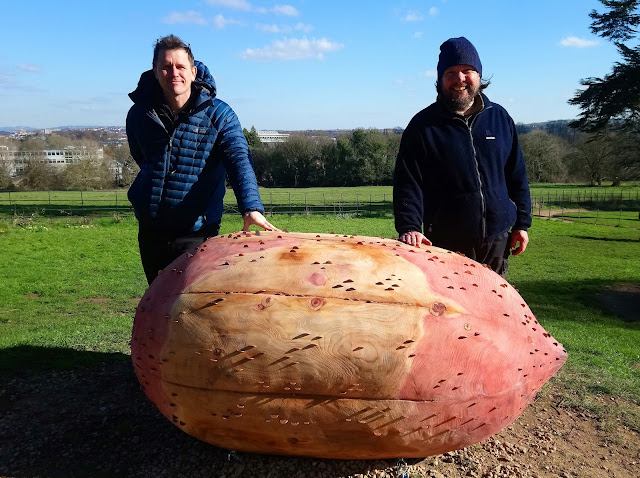
Luke Jerram sculpture New Beginnings

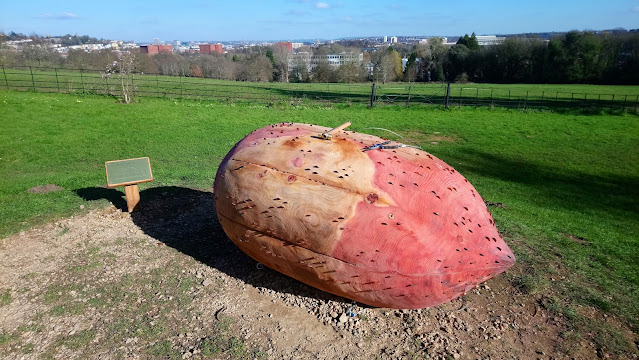
Luke Jerram is a Bristol-based artist (on the left in the photo above) whose work is known around the world. So it was very exciting to be invited to collaborate with him in the making of a new experimental sculpture, which is called 'New Beginnings' and is now installed at Ashton Court in Bristol.


The sculpture was carved from locally-sourced sequoia wood, which was then carved and assembled at my workshop next to the Ashton Court estate. Visitors are invited to use the pliers and hammer provided to add their own small-denomination coins to the sculpture and to make a wish while tapping them in.

Luke says that "I love idea of a seed: as a capsule of information and an object of potential that contains everything inside, a plant needs to grow. I hope the public enjoy interacting with this new sculpture and it acts as a capsule for their hopes, dreams and imagination!"

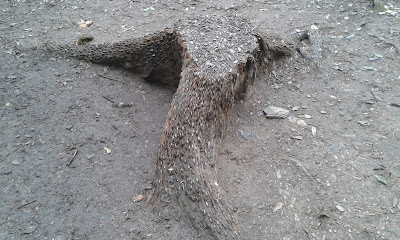
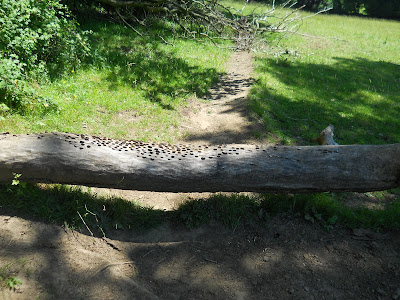
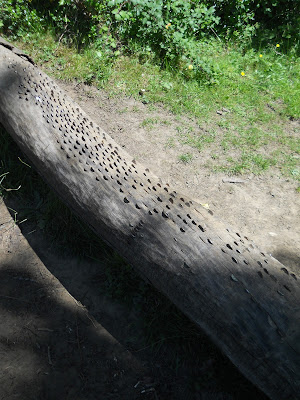
The project, which is hoped to be the first in a series, was inspired by 'wishing trees': these are trees or stumps (usually dead) which have coins pushed or knocked into them for luck. The tradition is thought to be at least a couple of hundred years old. Here is an example from Portmeirion in Wales:

wishing tree portmeirion

...and another from near the village of Uley, on the edge of the Cotswolds:

uley bury wishing tree


wishing tree ally


I'm looking forward to seeing how the sculpture changes over time as more coins are added! If you are in Bristol you could visit the beautiful estate, which is open to the public and free, then add your own coin and wish if you'd like to.

Thursday, 10 January 2019

Inuit stone carving - a detective story

inuit carving by pauloosie weetaluktuk

When I was much, much younger, long before I discovered carving, my father came into the room one day and gave me a stone sculpture of a person holding a sack. My great-aunt Mary had died and the small statue was passed on from her to me.

The Inuit figure had been brought back from Canada by my grandmother in about 1965. That was really all that was known about it. As I learnt more about carving generally, the sculpture interested and intrigued me more and more.


paulousie weetaluktuk sculpture carving

The weight and shape of the dark serpentine, veined with greenish tints and flecked with red, make it so pleasing to hold in one hand. It was clear that someone had worked the design around the shape of the original stone: the dents and depressions of that rock were still visible, albeit smoothed out. 


pauloosie weetaluktuk sculpture

On the base was carved the number 1760. I knew that it wouldn't be a date mark but was it a catalogue number?


Who had carved this mysterious sculpture and where? For years I didn't know. Even a trip to the Canadian Museum of History in Ottawa failed to turn up anything, with the resident expert being out on that day and subsequent email enquiries to him going unanswered. 

Reading books on the subject showed that the sculpture probably came from around the east coast of Hudson Bay but that was about it.


Paulosie Weetaluktuk


Then I learnt about disc numbers.

Disc numbers were used from 1941 to 1972 (or 1978 in Quebec) and were introduced to help various organisations (such as government agencies) to identify Inuit individuals. Before then people would have one name, given to them by elders. When missionaries arrived, many Inuit took Christian names but often altered them to make them sound more local: so Thomas might become Tumasi. 

After the Mounted Police census in the 1940s, identification numbers were assigned to each person and were often used as signatures by Inuit carvers in the 1950s and '60s. The numbers (preceded by an E for east or W for west) were also stamped onto discs which would be worn around the neck or sewn into a parka. This practice was phased out after surnames became officially adopted by Inuit in 1969. 


Image from: https://www.vice.com/en_ca/article/xd7ka4/the-little-known-history-of-how-the-canadian-government-made-inuit-wear-eskimo-tags

Using a site that traces Inuit artists by their disc numbers, I discovered that my carving had been made by Pauloosie (or Paulosie) Weetaluktuk. He was born in 1938, died in 2012 and lived at Inukjuak, a town on the east coast of Hudson Bay which was formerly known as Port Harrison. 

I haven't been able to find any photos of Pauloosie Weetaluktuk that show his face, but have found a presentation that he gave as a member of the 'local grocers' association' to the Royal Commission on Aboriginal Peoples in June 1992. It gives interesting glimpses of his life as a carver in a place very different to that in which I live.

He talked through a translator as he didn't read or understand English. The main topic was the high cost of living in such a remote place (he said that it was three or four times higher than in more southerly parts of Canada) and how that makes it difficult to survive there. The increases in taxes and high living costs mean that carvings 'do not make much money' any more and it is tough selling skins and handicrafts as there is 'hardly any value in them'.

Pauloosie Weetaluktuk said that: 'Our operating budget has to be very high these days. There are people who have never been employed in their lives, who have depended on carving and they were able hunters, but now that the price of carving has gone down, you just see them as men but they don't operate as men any more. They don't have anything to base their lives on or their manhood on.' 

Sometimes it can be easy to forget the hardships that the people who created a carving might have faced in making a living. This presentation cuts through any of that to show how tough supporting oneself was at that time and in that place. I wonder if things are any better there now? 

I wish that I could have met Pauloosie Weetaluktuk, creator of this beautiful sculpture that has meant a lot to me for a long time, and told him what I've just told you

Monday, 3 December 2018

Woody street art in Bristol

Bristol has a lot of interesting street art away from the Banksy pieces that many people know and the large works done for Upfest in Southville. 

Easton, in the east of the city, has a lot of stuff by less well-known artists scattered through its alleyways and corners. These two pieces have appeared on walls around Bellevue Road. 

Bristol street art

Bristol street art


I like them, especially as to my eye they bring together woodworking and street art!

Saturday, 17 November 2018

Green men and a bowing crow - 'In the Downbelow'

I went into the crypt under the church of St John on the Wall in Bristol today, to see 'In the Downbelow', the latest exhibition by the sculptor and model maker Tom Astley


st john on the wall crypt

The crypt dates back to the early 14th century and one of the highlights of the place, for me, was the collection of carved green man faces on the roof bosses. They are quite low down compared to most churches and cathedrals, so can be easily studied from floor level.


st john on the wall green men

This one has a fine set on teeth on show!


The crypt is very atmospheric and had inspired Tom to create some artworks especially to display in this space. It was interesting to see his new pieces, showing the distinctive style that he's developed.

This sculpture is entitled 'Plague doctor' and was based on the physicians, with their strange beaked masks, who tended to victims of the Black Death.


plague doctor tom Astley

The sculpture 'Lady of Letters' came about because a tomb effigy of a wealthy noblewoman in the crypt shows her writing kit tied to her waist.


This 'Lord of Misrule' has a paper crown and would take over his duties during the Festival of St Stephen. The tradition lasted in Britain until the sixteenth century. Other images based on the idea can be seen amongst the misericords in Bristol Cathedral.

lord of misrule Tom Astley

The final sculpture in the exhibition was inspired by the green men carved overhead.


green man tom Astley

You might agree that the darkly atmospheric artworks fit perfectly in the vaulted stone space of the crypt. 

'In the Downbelow' runs from the 17th to the 30th November and is open Tuesday to Saturday, 11am until 6pm.

Wednesday, 12 September 2018

The Binaural Diaries visit the woodyard - field recording the sounds of woodworking

The Binaural Diaries is a project run by Ollie Hall. He records sounds and publishes them online. It started as a way of collecting interesting samples for music but has developed into more of a sound diary: 'binaural' refers to two microphones recording sounds which are transmitted separately to the two ears of the listener.


field recording sounds

I chose a few sounds that woodworkers might know but those who don't work with wood may not be aware of. The recordings are of: a sharp woodcarving gouge cutting through seasoned lime wood, detail carving in oak, a side axe cutting larch wood, a drawknife in use on larch and wood being cleaved using a froe and mallet. There was also the chance to talk very briefly about what I was doing in each recording.

It's interesting to think about what you do from a completely different viewpoint. I realised that many of the sounds made in woodworking were things that had previously been taken for granted but which added to the whole process. There is a real satisfaction gained from hearing a tool cut cleanly and some sounds indicate when a change needs to be made (for example, cutting from a different direction as the grain pattern changes). 

Spoon carving at Boiling Wells in Bristol, with the Boiling Wellness group


In July, I got the welcome chance to return to Boiling Wells in St Werburghs to teach spoon carving. 


After four and a half years working there, funding cuts meant that I was made redundant in 2014. I had been back a couple of times to teach since then and it is always good to see the place develop and grow.


This time, I was spoon carving with the 'Boiling wellness' group. It was great to be back in the nature reserve, carving wood with enthusiastic volunteers. We had a lot of fun and everyone got the chance to try a range of woodworking tools, some of which they might not have come across otherwise.


Doing spoon carving sessions with groups is always interesting as people come up with such a range of designs and styles when given the chance to do so. Once they had got the hang of using the tools safely, there was plenty of room for creativity to come out; working with the grain patterns in the wood for example. I hope that people have had the chance to finish their spoons with the techniques we discussed and that they all enjoyed the day as much as I did!


Monday, 21 May 2018

Making the Jackie Collins Woman of the Year award for Jacqueline Gold, the boss of Ann Summers


Each year, for the last three years, I've been honoured to be asked to carve this award. It is presented annually by the cancer charity Penny Brohn UK to a woman who is particularly inspiring: not only because of their professional or charity work but also because they have spoken publicly about their fight with cancer.

The recipient in 2018 was Jacqueline Gold, who is the chief executive of Ann Summers. This company sell lingerie and other items to spice up people's love lives, from shops in town centres all over the UK. 

Each award is specially designed for the person who will receive it and this year's was no exception. The charity contacted Ms Gold's Personal Assistant, who told them what things she likes, then that information was relayed to me and informed the first design ideas. 

I used some Lawson Cypress timber (known as Port Orford cedar in the US) from Bristol, as the charity's headquarters are just up the road from the place where the tree grew.


I find that this wood is often easier to carve using power tools than hand tools. No matter how sharp the gouges or chisels, the timber will tear a bit whereas cutting discs and abrasives fitted to power tools give a good finish quickly.


The final design was a rabbit, which was inspired by one of Ann Summers' most famous products. I feel that that the sculpture echoes it in a subtle and fun way. The serene-looking bunny has certainly been a hit at the workshops around my studio and apparently among the staff at Penny Brohn UK. I hope that Jacquline Gold likes it too.


There is a box in the back of the rabbit, suitable for holding small items such as keys, change or batteries. The lid is held on using rare earth magnets and has a really satisfying 'thunk' noise when it closes!


Here's a photo of Jacqueline Gold receiving her award:

Photo credit: Andre Regini

Sunday, 25 March 2018

The story of a saw

w tyzack and sons and turner saw

Like many woodcarvers and other woodworkers, I have a lot of old tools: some with names of previous owners stamped on them. Sometimes I wonder about these tools. Were they once used to produce pieces that I have admired in some great cathedral or stately home by a journeyman worker whose name is now forgotten?

It's rare that the story of one of these tools turns up unexpectedly. That happened with this saw. 

It is a tenon saw made by the firm of W Tyzack, Sons and Turner. The blade is stamped with the words 'Made specially for John Hall, High St, Bullring, Birmingham'.


antique tenon saw

I inherited the saw from my grandfather Norman. Although still pretty sharp, it had some damage to the handle and so I've displayed it on the wall of my workshop, rather than risk further damage in use.


Norman

Norman was brought up in the slums of Birmingham and wrote about his early years in a few short essays, a copy of which has been preserved in the city archives. I'd never read it until last week.

One of the chapters talks about the Bull Ring, the market area of Birmingham at the time. In a paragraph, the story of the saw came to life:

'Higher up in High Street, stood a gas-lit ironmongers, John Hall. It was from this shop that my father, who had just started work at a cabinet makers, bought his first saw. It was brass-backed and cost three shillings and sixpence, which he paid off at sixpence per week. This saw, of a quality not found today, Is now about 90 years old (author's note: this was in 1989) and is a prized possession in my tool kit.'

I never knew that Fred, Norman's father, was ever a cabinet maker and nothing that he made has been passed down in the family to my knowledge. 


Both men have now passed away (Fred before I was born) but I feel closer to both of them when I look at this saw.

Monday, 15 January 2018

Making replicas of the earliest objects made by woodturning ever found in Britain, from Whitehorse hill on Dartmoor

I like woodturning. It's a nice compliment to my carving work and there's also something that feels quite relaxing about putting the tools to the spinning timber and watching the shapes develop.

There have been a couple of commissions recently that have allowed me to do some turning and which have also been a little more challenging. Making some of the components for the instruments that are now installed in St Werburghs Community Centre meant turning larger pieces than I've worked on before. 

Woodturning on Myford ML8 lathe

I was also asked by a local furniture maker called Dave Porter to turn eight discs, 60mm (2.36") wide, from European oak to decorate some furniture that he was making. It was a nice test of skill to try and make the discs as similar as possible, whilst turning them by hand. Both of us were happy with the outcome. Here they are, with one spare:


woodturning oak

After making these commissions, I came across the story of the Whitehorse hill burial

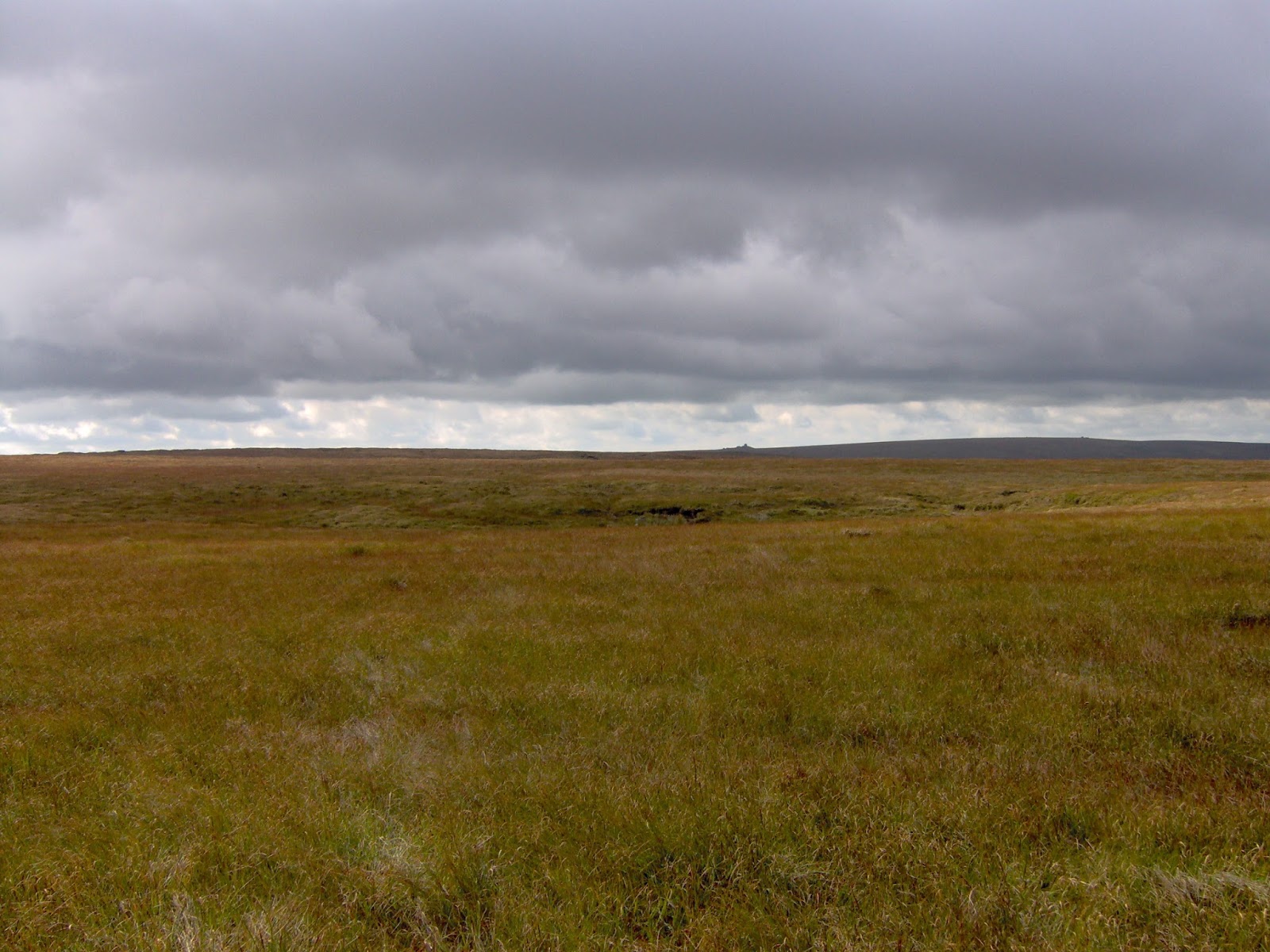
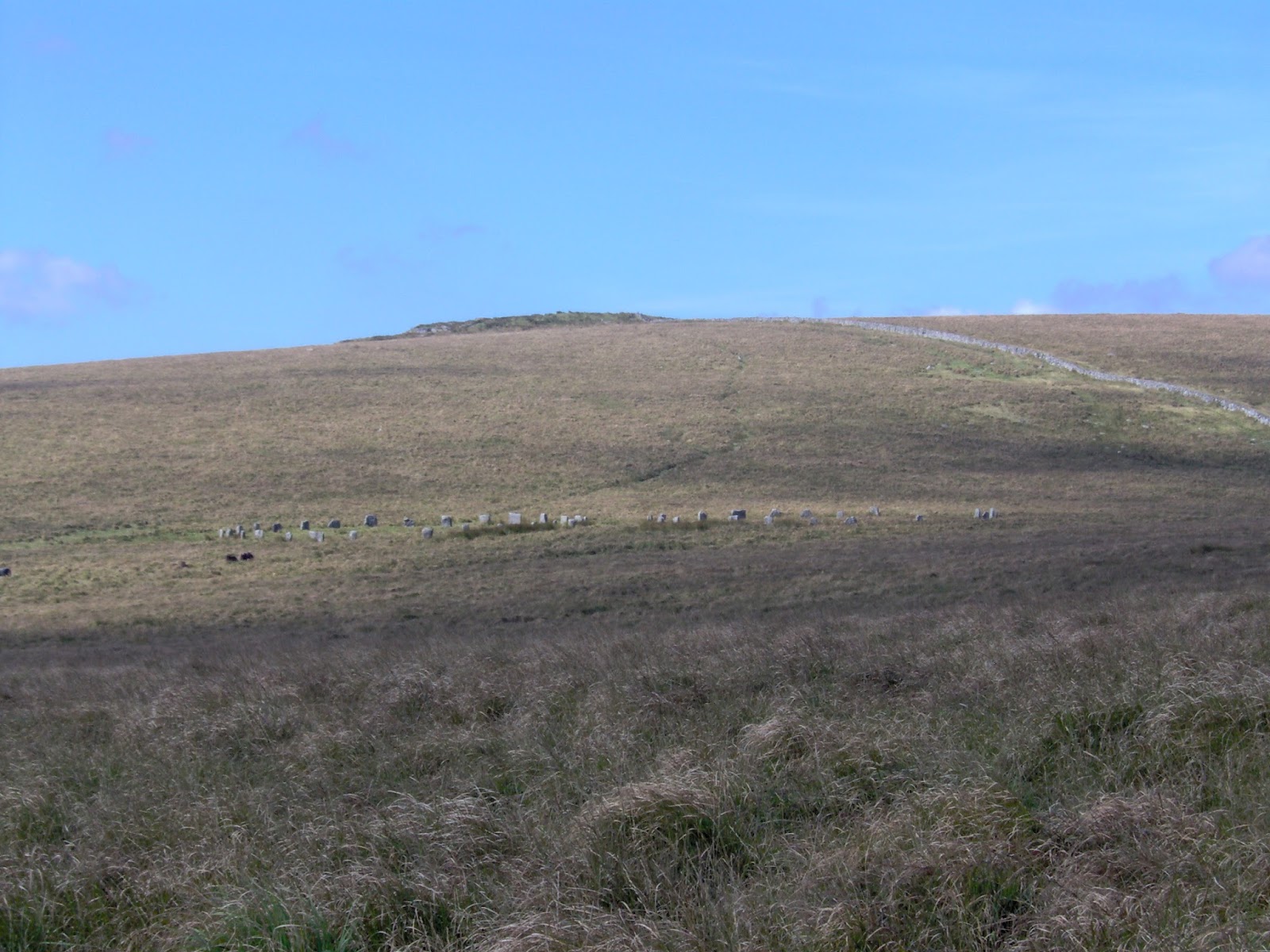
This Bronze Age burial happened nearly four thousand years ago in what is now the wild, empty middle of Dartmoor national park - a place that is very important to me. This view, taken near Whitehorse hill, shows what the area looks like:


Dartmoor landscape

In 2001, a walker found a small, rectangular burial chamber made from stones protruding from a remanent 'hag' of peat, which had been left standing as the peat surrounding it was cut away. These small stone boxes or chambers are known as kists, cists or kistvaens.

The erosion of the peat stack had uncovered the kist and one of the stones had fallen. The rest looked like it could also fall out at some point soon, so the decision was made to open the burial and see what was inside. This was even more exciting as most kists on Dartmoor have been excavated or robbed at some point but this one, having been hidden underground in a fairly remote part of the moor, was probably intact.


Whitehorse hill Bronze Age kist
Image by Cornwall Archaeological Unit, from https://www.archaeology.co.uk/articles/cist-whitehorse-hill.htm

In 2011, the kist was opened. Inside, well preserved by the peat (which excludes oxygen so preventing the decay of organic matter), was a bundle wrapped in an animal pelt, thought to be from a bear.

The contents of the bundle were the cremated remains of what is believed to have been a woman of high status, aged somewhere between 15 and 25 years old. The presence of a necklace and absence of weapons in the burial led researchers to think the deceased was probably female. She was buried in August or September (from the purple moorland grasses laid on the floor of the kist at the time). On top of these grasses was laid what looks like a woven belt or sash decorated with calfskin leather, then the wrapped cremation on that.


Apart from the remains, the wrapping held a woven bag made of lime bast (the fibres under the bark of a lime tree). This contained several objects: a necklace made from beads of clay, shale, amber and also a single bead of tin, a flint flake, a copper pin, a woven cattle hair band or bracelet decorated with small tin beads and two pairs of wooden discs. 


Image from https://new.devon.gov.uk/historicenvironment/latest-news/bears-and-beads-on-whitehorse-hill/
These wooden discs are the earliest examples of wood turning ever found in Britain. They could have been ornaments fitted into a leather bag or belt, but most people think that they were body ornaments, similar to modern ear expanders. They would have been worn in stretched ear piercings, or perhaps in lip, nose or cheek piercings. 

Some think that the smaller studs were perhaps the intermediate ones used as the hole was being stretched, before the larger ones were worn. Personally, I think they might have been worn at the same time as they show similar amounts of wear and were buried together.

The wooden discs were turned from tough, pale coloured spindle tree wood, a native species which still grows around the edge of the moor. At the time of the burial, this area would have been much more wooded than now. It's strange to imagine what the person who wore these wooden ornaments was like; speaking a language that we wouldn't understand in the present day but perhaps knowing some of the many stone monuments, such as the double circle at Greywethers, that still stand not far from where they were buried and that we can still visit.


Greywethers stone circles on Dartmoor

Radio carbon dating from underneath the fallen stones of nearby Sittaford Tor circle returned a date of about four thousand years ago, so the circle itself is probably older than that. This means the person buried at Whitehorse Hill would have known it and probably visited it as well.

I couldn't resist having a go at recreating the discs myself! We have some idea of what Bronze Age woodturning was like, having images preserved from ancient Egypt. A note about the picture: the lathe would have been horizontal even though conventions in ancient Egyptian art mean that it's illustrated standing vertically.


Image from http://www.turningtools.co.uk/history2/history-turning2.html

These sources helped woodturner Stuart King to recreate the making of the wooden discs for a programme called 'Mystery of the Moor'.


I had to cheat a bit, as the method Stuart King used requires two people to work best and also because I don't have the appropriate reproductions of Bronze Age tools at the moment (although I'm very tempted to acquire or make some now!). It was still fun to make replicas of these objects that connect us to that ancient and mysterious time. 


woodturning

I had some seasoned spindle tree wood that was suitable, and the discs finished well. After turning, I put some natural nut oil onto them, to bring out the colour of the wood and stop them getting too grubby - a beeswax finish could originally have been used but it tends to attract dirt. The larger turnings are 25mm (1") and the smaller ones 15mm (0.59") in diameter.

Whitehorse burial wooden ear ornaments

Here's my friend Sion wearing a pair of discs very similar to those found in the kist at Whitehorse hill, but slightly larger than the bigger ones found in the burial at 30mm (1.18") wide. He said that they are very comfortable to wear and they were also tough enough to withstand a good deal of partying last weekend!


ear stretchers


ear expanders