My name is Alistair Park and I'm a professional carver who is based in Bristol, England. I've been carving for over twenty-eight years and I also enjoy teaching my skills to people of all ages. You'll find posts here about all kinds of things to do with carving; the work that I do, the people that I meet and the things that I see which inspire me. Please feel free to comment on anything of interest, it'd be great to hear from you!
If you like woodcarvings, you might want to have a look.
Tuesday, 7 February 2017
Exploring Bristol with Hazen Audel: craftsman and presenter of 'Primal Survivor' on the National Geographic channel
Hazen Audel was in Bristol doing some work connected to the show that he presents, called 'Primal Survivor'. As well as his television work, he is also a very keen craftsman, working particularly with metal and wood.
A few weeks previously, I'd been running a woodcarving tutorial for Alex, who has worked with him on the series for Icon Films. He knew that Hazen would love finding out more about the handmade objects and historic buildings to be seen in the city and thought that it would be great if I could show him around.
I always enjoy meeting other makers, particularly those with an interest in woodworking, so was very happy to do it. In fact, the prospect of exploring the city that I know pretty well with someone who was seeing a lot of it for the first time (and who is also interested in making stuff) was really exciting!
First of all, we visited the Cathedral. The very first thing was an Anglo-Saxon sculpture that is around a thousand years old. We also got to see the misericords, including one which I believe shows one of the first turkeys ever brought back to Britain. Straightaway, Hazen noticed the beautiful, elaborate hand-forged iron gates and door hinges around the Cathedral; pointing out stunning constructions that I would almost certainly have just walked past if there on my own.
Next was a visit to the Central library to see the Grinling Gibbons overmantle. This had to be included on the itinerary.
One of the librarians very kindly took time to show us the room in which the overmantle is kept and to point out some of the other treasures in there, such as this beautifully designed Arts and Crafts chair which neatly converts into steps to access high shelves.
Next, we walked over to St Mary Redcliffe church to see the stone carvings and a whale rib that is reputed to be one of the first things ever brought back from the New World to Europe on John Cabot's ship. A bone seems a curious object to have been chosen but in those days such an object must have been like bringing back a chest full of gold:
"There are huge whales there and no one is hunting them!"
I also pointed out the roof bosses under the tower. One shows a very rare image of a green man-like dog or cow. Nearby is another carving showing a man defecating! Medieval Christian attitudes to religious buildings were certainly very different to modern ones - see if you can spot both of them in the picture below:
After a walk along King Street (which contains many 17th century buildings) and dropping in at Icon Film's offices, we stopped off at the Hatchet Inn for lunch.
The Hatchet is reputed to have first got a license to sell alcohol in 1606, making it the oldest pub in Bristol. Before that it was Frogmore farm and monastery. Legend has it that the pub door has a layer of human skin from an executed felon, hidden under layers of paint and tar. If you are wondering about ghosts; well, I've had strange experiences in there before - but that's another story!
After finishing lunch, we headed up to Bristol Design. This second-hand tool shop is a must-see for anyone who loves working with tools and Hazen had been there before, so we had a chat about them and then headed on, stopping occasionally to look more closely at things of interest on the way, such as the Cafe Wall illusion.
After walking down Jacobs Wells Road, we headed over to my studio at Bower Ashton. This route gave a chance to look at the Hotwells area of Bristol, the Harbour and to see the Suspension Bridge spanning the Avon Gorge.
Several of the members of the Forest of Avon Products cooperative who have workshops at the Bower Ashton Woodyard were about and chatted to Hazen about the wide variety of projects that they were working on.
After visiting my own workshop, the weather had taken a turn for the worse and it had been a long day so he got a taxi back to where he was staying in town.
All in all, it had been a very enjoyable day. It was great to spend time with Hazen and it also made me realise how, even though we packed in a lot of things, there was still so much we hadn't had the chance to see in Bristol in one day. When given the opportunity to explore the place that you live with fresh eyes, it quickly becomes apparent how much is taken for granted or passed by in ignorance each day.
Wednesday, 1 February 2017
A drum stool with a difference! Making carved wooden drums as seats
The story of this project begins last summer...
I had been invited to make some carvings for Gwalia farm near Machynlleth in North Wales, in return for a stay there at their stunning 'Cabin by the Lake'. This beautiful spot has a private lake, canoe and wood-fired hot tub.
Luckily, an oak tree on the farm had just dropped a large branch and so there was plenty of timber to carve!
As well as a stool with a carving of a Natterer's bat (as a few of them were flying around the cabin at dusk).The second stool also had slits cut into it, to make bars which made a note when struck. They are a bit similar to a West African 'krin' drum:
I really liked the drum idea and showed a few people when back in Bristol. Jono at Touchwood Play realised that the drum stools would work very well in a new project that they were working on. After making a couple more examples to refine the idea, I was commissioned to make six of the stools.
First there was a trip out to Backwell, near Bristol, to look at the oak timber available. It had to be of a certain diameter to make a good stool. Once the logs were back at my workshop, the hard work began!
Firstly, the logs were cut to size, the bark removed using a mallet and chisel and then the stools were smoothed to remove tool marks. I used a chainsaw to cut the bars into the logs.
The bars then needed to be sanded and cleaned up, which took a lot of time. Once that had been done, I carved two rows of ridges onto each stool, to make an effect a little bit similar to an instrument called a 'guiro'.
The drums still needed sticks to play them with. These were turned from locally-grown hornbeam timber. Hornbeam is a very tough wood, traditionally used to make butcher's chopping blocks and the teeth for large cogs, such as in mill workings. It was perfect for this job.
The sticks were chained onto the drums using good-quality stainless steel chain (as stainless steel doesn't react with and discolour oak, unlike normal iron or steel). There was also a hole drilled into each drum to hold the sticks when not in use. The chain is attached halfway along the stick to avoid it making a dangerous looping foot snare when stored in its holder.
The drums just needed a few coats of finishing oil and they were done. Using a tuning app on a phone, we also managed to find out what notes the different bars made. There was a surprising range! Quite a few were A or B, but one played three C notes with an octave between each. Others played Gs and Fs. You can hear them on this Youtube video:
I'd like to refine the tuning methods on future drums, although the tuning on these drums will probably change a bit over time anyway, as the wood dries.
I did notice that small cracks in the oak, formed during seasoning, didn't seem to affect the sound much at all.
The drums will eventually be mounted in a circle onto a wooden platform in a play tower. They will be fixed down using large screws, so that they can't fall over or be thrown and injure anyone. To allow them to resonate and make a good sound, there will be rubber feet under each one. I've placed wooden sticks under them in these photos to allow a good resonance when playing them in the workshop.
I had been invited to make some carvings for Gwalia farm near Machynlleth in North Wales, in return for a stay there at their stunning 'Cabin by the Lake'. This beautiful spot has a private lake, canoe and wood-fired hot tub.
Luckily, an oak tree on the farm had just dropped a large branch and so there was plenty of timber to carve!
The cabin was missing some nice seating around the fire, so by the end of the week I'd carved an owl stool...
I really liked the drum idea and showed a few people when back in Bristol. Jono at Touchwood Play realised that the drum stools would work very well in a new project that they were working on. After making a couple more examples to refine the idea, I was commissioned to make six of the stools.
First there was a trip out to Backwell, near Bristol, to look at the oak timber available. It had to be of a certain diameter to make a good stool. Once the logs were back at my workshop, the hard work began!
Firstly, the logs were cut to size, the bark removed using a mallet and chisel and then the stools were smoothed to remove tool marks. I used a chainsaw to cut the bars into the logs.
The bars then needed to be sanded and cleaned up, which took a lot of time. Once that had been done, I carved two rows of ridges onto each stool, to make an effect a little bit similar to an instrument called a 'guiro'.
The drums still needed sticks to play them with. These were turned from locally-grown hornbeam timber. Hornbeam is a very tough wood, traditionally used to make butcher's chopping blocks and the teeth for large cogs, such as in mill workings. It was perfect for this job.
The sticks were chained onto the drums using good-quality stainless steel chain (as stainless steel doesn't react with and discolour oak, unlike normal iron or steel). There was also a hole drilled into each drum to hold the sticks when not in use. The chain is attached halfway along the stick to avoid it making a dangerous looping foot snare when stored in its holder.
The drums just needed a few coats of finishing oil and they were done. Using a tuning app on a phone, we also managed to find out what notes the different bars made. There was a surprising range! Quite a few were A or B, but one played three C notes with an octave between each. Others played Gs and Fs. You can hear them on this Youtube video:
I'd like to refine the tuning methods on future drums, although the tuning on these drums will probably change a bit over time anyway, as the wood dries.
I did notice that small cracks in the oak, formed during seasoning, didn't seem to affect the sound much at all.
The drums will eventually be mounted in a circle onto a wooden platform in a play tower. They will be fixed down using large screws, so that they can't fall over or be thrown and injure anyone. To allow them to resonate and make a good sound, there will be rubber feet under each one. I've placed wooden sticks under them in these photos to allow a good resonance when playing them in the workshop.
Monday, 2 January 2017
Carving a scene featuring a canoe from the North American pioneer days
This picture, slightly larger than an A4 sheet of paper in size, was commissioned as a gift. The recipient loves his canoe and so the person who commissioned me to make it wanted the panel to show a canoe being used in a historical setting, as well as an otter and a heron (which were favourites of the person receiving the present).
Luckily the grey heron that is commonly seen along European waterways has a North American cousin, the great blue heron, which looks similar apart from being slightly bigger.
The oak panel was carved using a mix of traditional tools and a Dremel hand drill. The drill was used to give the texturing effects to the woodlands in the background.
The mountain man and his Algonquin friend/guide look more surprised than overjoyed to see the heron take flight. Maybe they are carefully watching to see exactly what disturbed it?
I think that the picture has the feel of a 'Boy's Own' style illustration from the 1940s or 50s, which is perfect! I'm also very pleased with the way that the grain of the wood adds to the feel of movement in the image.
I'm also happy to let you know that Kirsty, who commissioned the carving, was very pleased with it. She wrote on my Facebook page to say:
'I'm extremely honoured and happy to have commissioned this beautiful plaque. You're a hugely talented fella, Alistair. The whole process, from conception to passing it over to the delighted recipient, was wonderful x'
Thursday, 15 December 2016
'Starman', a portrait of David Bowie carved in wood
They are strange, the routes that lead into some projects.
I had signed up to have a stall at the St Werburghs Community Centre Christmas fair in Bristol and planned to sell wooden stars. I've always liked these stars, made from locally-grown larch timber, so decided to make a few and see if they appealed to other people too.
After making quite a few of the larch stars, I cut a couple from some oak that was lying around in the studio. The largest one, the same size as the largest stars shown on the table, is about 18cm (7") across. It seemed to need a carving on it and the star shape made me think of the song 'Starman'.
I like to test myself by carving portraits. They aren't easy. Carving a face can be tricky enough, particularly in relief. All the elements of a face carved in relief need to work together without having the same distances between them as in a face seen in full three dimensions: the tip of the nose doesn't come out as much as in a real face, for example.
To successfully make it look like a well-known person is even tougher.
A day was spent before the fair carving to get the piece looking roughly right, then more work was done during the fair itself, in quiet moments between talking to visitors.
I left the portrait with the tool cuts still visible. Sanding carvings of faces can sometimes make them look lifeless and 'plasticky' and hopefully this finish keeps some vitality in the appearance of the carving.
The star sat in front of me at my workbench for a few days after the fair, being taken down and worked on again as the changing light showed areas that needed reworking. I'm happy with it now.
Tuesday, 22 November 2016
Repairing damaged African sculptures, made from wood which has been made to look like ebony
Occasionally I'm asked to repair or restore a damaged sculpture. They have needed repair due to a range of reasons, ranging from wear-and-tear to having been knocked over by someone's mother-in-law!
These two racing male cheetahs, 90 cm (3 feet) long, were carved in Tanzania and had been damaged in transit to the UK. Although the wood looks superficially similar to ebony, it is actually another kind of timber (probably Ironwood [Olea capensis] or Bleedwood [Pterocarpus angolensis]) that has had a dark stain and then black shoe polish applied. This darkening really brings out the form of the sculpture, as it reduces the visual impact of the timber's grain.
Since both of these are a fairly widespread and common trees in Tanzania, I must admit to being happy that a different wood has been used to make this sculpture instead of ebony. Genuine African ebony trees (Diospyros crassiflora) are not native to this area, as well as being much scarcer and threatened by over-exploitation, so it was good to see a Tanzanian sculptor using what I believe to be local timber.
The tail of one cheetah was almost completely broken off and there were a couple of other nasty breaks as well.
Some might be surprised to find out that these cheetahs were constructed from at least ten different pieces of wood, carefully jointed and then held together by nails. This actually has more than one benefit. It means that the carver wastes less timber than if the whole sculpture was carved from a single piece of wood. It also means that the grain runs along each leg and tail, so making them stronger and less likely to break across the grain.
The joins between pieces of wood were also filled with some kind of pitch or resin, which has been modelled in places to follow the shape of the carving. It was interesting to see this, as I've found the technique used in other sculptures from East Africa too.
To repair the piece, I carefully fixed the broken pieces together, with an internal supporting rod if necessary, then filled the remaining gaps with a paste made from wood dust mixed into a resin compound.
This was left overnight and then any remaining holes or gaps filled with the same mixture. When it was all filled and set, the repair was very carefully sanded smooth and then polished with black wax polish.
It's quite a time-consuming and fiddly job, as the resin must set fully between each application. After the work was finished though, it was great to finally see the sculpture restored back to its former glory. The sense of movement and energy is very well portrayed, which I think is one of the hardest things to get across when removing material to shape a carving.
You may also like to see this previous commission to repair a damaged sculpture by the renowned Zambian sculptor, Friday Tembo. The owners were personal friends of Mr. Tembo, who had since passed away, so this repair was even more important to them. When it arrived at my workshop, the piece looked like this:
It shows a shaman in the act of transforming between the form of a fish and that of a man. The repair took a while, but it was interesting to use this process to study in more depth how this unusual artwork had been made and the techniques that had been used.
Friday, 28 October 2016
New website!
Whew!
Normally feeling under the weather isn't particularly useful. The latest bout of cold/flu/ sniffles has definitely had a happy outcome though. Instead of going out and about and
after a couple of weeks of hammering away at a keyboard, my new website is finally on line.
Why not check it out? If you have any feedback too, I'd love to hear it.
Normally feeling under the weather isn't particularly useful. The latest bout of cold/flu/ sniffles has definitely had a happy outcome though. Instead of going out and about and
after a couple of weeks of hammering away at a keyboard, my new website is finally on line.
Why not check it out? If you have any feedback too, I'd love to hear it.
Monday, 10 October 2016
When a journeyman goes home: a travelling 'naver' returns to Copenhagen
I've written before about the tradition of the German travelling journeymen. One post is a more general overview and the other a more detailed look at some of the traditions that come with this life. Another post talks about what some of the geselle (German journeyman) traditions mean to me, as a settled craftsperson in Britain.
Nat was the first person travelling in the tradition of the German guilds that I had met and talked to about it. Through him I also met several other people doing the same thing and I feel quite privileged to have had an opportunity to do so. Meeting journeymen travelling in the tradition is not that common an occurrence in Britain, even amongst craftspeople. Some of those that he put me in contact with I would now also call friends.
The normal length of travelling is three years and a long day. The long day is the part that lets someone keep going if they don't feel that it's time to stop yet. During their travels, journeymen carry a map with a circle marking an area with a fifty kilometre radius and their hometown at the centre. They are not allowed to go into that area for the whole of their time travelling in the tradition (unless there is an emergency, such as a member of their immediate family becoming seriously ill).
Nat himself is Danish and came into the tradition as a naver, which is the Danish equivalent of the German journeyman. Danish navers are not as frequently encountered as German gesellen and I was told that Nat was one of few Danish navers currently travelling at that point. He himself was travelling in the German tradition, having been introduced into the tradition by a German journeyman.
After over five years, it was time for Nat to go home.
Having been notified in advance of the day and location, Nat's friends and family were gathering next to a town sign on a busy road just outside of Copenhagen. The weather was bright with some cloud and the first chill of autumn on the breeze. As the journeymen would be hitchhiking to the spot, times were very approximate - he would be there some time after 3.30pm.
I could feel the excitement build, with people crossing the highway to see as far as possible along it. It was great to have a chance to meet and chat with the others who were also waiting. Four journeymen arrived early, then headed back down the road to find the others so that they could all arrive together.
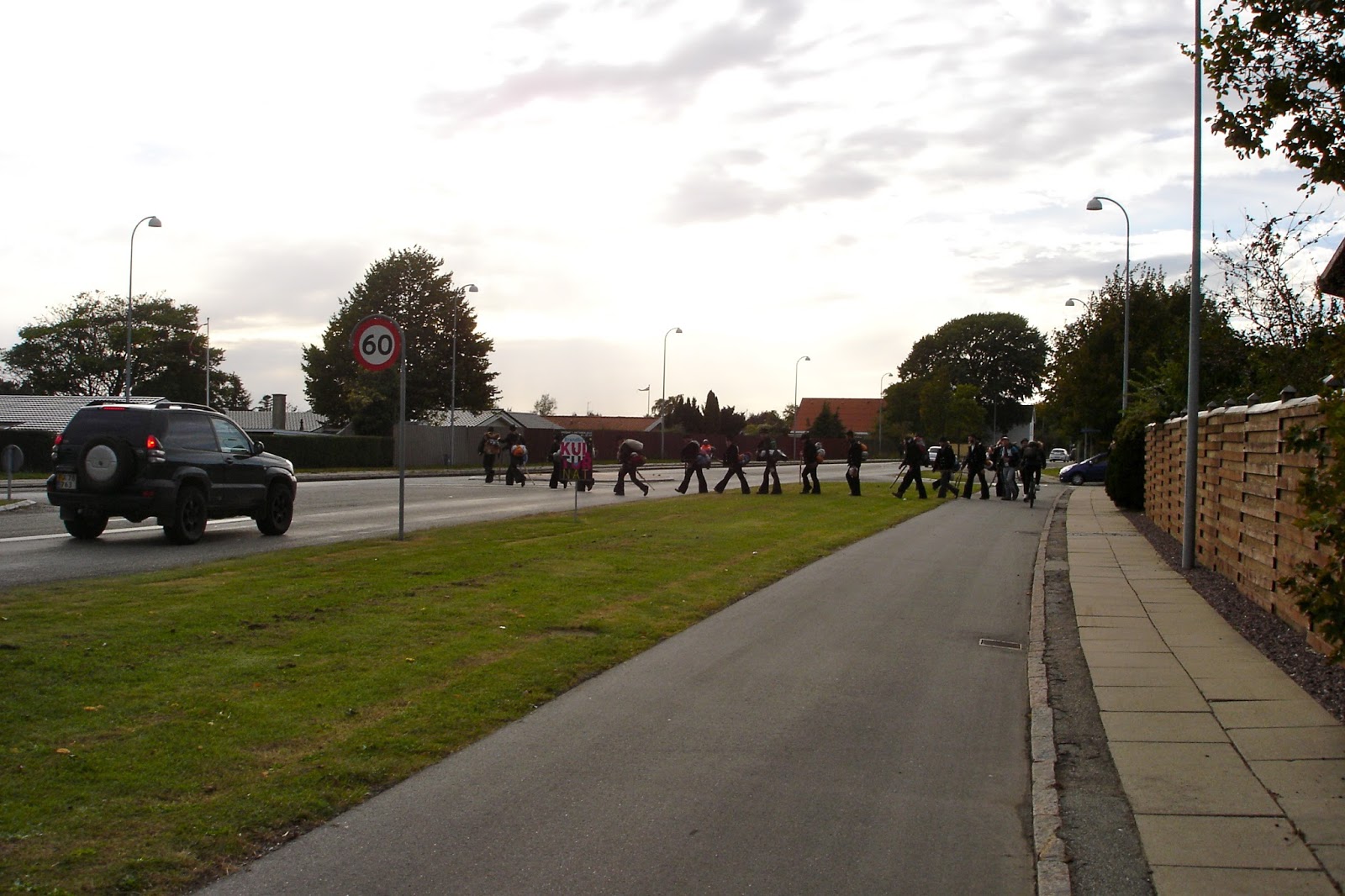
Eventually, at about 5pm, a group of around twenty figures wearing the distinctive clothes and carrying the spiral Stenz sticks of the gesellen came into view. All of the friends and family gathered on the other side of the sign. As they got closer, the cluster of journeymen separated into a line and, walking in single file, the line snaked around and back on itself.
It wound up alleyways and across the road, before finally gathering on an island in the middle of the carriageway. There, a few words were said between them, there was a cheer and Nat drained the last of a bottle.
The group approached the other side of the sign from the waiting friends and family. Not all of the people in it were currently journeymen, some I knew had already finished their own travels but had put on their wandering clothes again for this day.
They then formed two lines with their stenz sticks held between them.
Nat climbed up onto this 'ladder' and clambered up to the sign. He then climbed back over, his journeying years done. I knew that in his pocket, in accordance with tradition, would be five euros: the same amount that he left with.
After a while, it was realised that the bottle wasn't there! The sign must have been moved in the meantime. So any rubbish was gathered up to be taken away and the hole was carefully refilled before everyone went off into Copenhagen to celebrate Nat's homecoming.
The next day, there was another party, although everyone seemed a little more subdued after the drinking of the night before (together with the partying that had gone on before they arrived at the sign). All of the journeymen got up on a stage in front of the family and friends and short speeches were made before some traditional travelling songs were sung. It was simple but also quite moving.
Nat's family had brought clothes with them, which he changed into from his travelling clothes while the songs continued. Then there was a quiz. All of the stenz sticks were put into the middle and Nat had to guess whose stick each one was. Not easy with so many travelling companions there!
It was great to catch up with old friends at the party, as well as meeting new ones.
I hope that these posts allow English-speaking people who haven't met journeymen travelling in the German tradition to learn a bit more about it. It would be good to think that they might open a few extra doors to those travelling in the UK and elsewhere, where the traditions are less well known and understood than in continental Europe.
And, of course, good luck to Nat for his next adventures!
Nat was the first person travelling in the tradition of the German guilds that I had met and talked to about it. Through him I also met several other people doing the same thing and I feel quite privileged to have had an opportunity to do so. Meeting journeymen travelling in the tradition is not that common an occurrence in Britain, even amongst craftspeople. Some of those that he put me in contact with I would now also call friends.
![]() |
| Journeymen in Berlin around 1900 Image from: http://denstoredanske.dk/Erhverv,_karriere_og_ledelse/Håndværk/Håndværk_generelt/naver |
The normal length of travelling is three years and a long day. The long day is the part that lets someone keep going if they don't feel that it's time to stop yet. During their travels, journeymen carry a map with a circle marking an area with a fifty kilometre radius and their hometown at the centre. They are not allowed to go into that area for the whole of their time travelling in the tradition (unless there is an emergency, such as a member of their immediate family becoming seriously ill).
Nat himself is Danish and came into the tradition as a naver, which is the Danish equivalent of the German journeyman. Danish navers are not as frequently encountered as German gesellen and I was told that Nat was one of few Danish navers currently travelling at that point. He himself was travelling in the German tradition, having been introduced into the tradition by a German journeyman.
After over five years, it was time for Nat to go home.
Having been notified in advance of the day and location, Nat's friends and family were gathering next to a town sign on a busy road just outside of Copenhagen. The weather was bright with some cloud and the first chill of autumn on the breeze. As the journeymen would be hitchhiking to the spot, times were very approximate - he would be there some time after 3.30pm.
I could feel the excitement build, with people crossing the highway to see as far as possible along it. It was great to have a chance to meet and chat with the others who were also waiting. Four journeymen arrived early, then headed back down the road to find the others so that they could all arrive together.
Eventually, at about 5pm, a group of around twenty figures wearing the distinctive clothes and carrying the spiral Stenz sticks of the gesellen came into view. All of the friends and family gathered on the other side of the sign. As they got closer, the cluster of journeymen separated into a line and, walking in single file, the line snaked around and back on itself.
It wound up alleyways and across the road, before finally gathering on an island in the middle of the carriageway. There, a few words were said between them, there was a cheer and Nat drained the last of a bottle.
The group approached the other side of the sign from the waiting friends and family. Not all of the people in it were currently journeymen, some I knew had already finished their own travels but had put on their wandering clothes again for this day.
They then formed two lines with their stenz sticks held between them.
Nat climbed up onto this 'ladder' and clambered up to the sign. He then climbed back over, his journeying years done. I knew that in his pocket, in accordance with tradition, would be five euros: the same amount that he left with.
There was still one more thing to do while we were there. When he left, Nat's friends and family had put letters for him into a bottle which was then sealed and buried at a certain depth five paces from the sign. Traditionally, Nat would dig the hole to bury it and his family would try to throw handfuls of earth back in to show that they didn't want him to go, while his journeymen friends defended the hole from being refilled.
There were a few toots on car horns from passing motorists as the spade was brought out and Nat started to dig to retrieve the bottle, with some journeyman songs being sung at the same time.
Eventually, other friends took over the work to give him a chance to talk to those who had come to see him.
The next day, there was another party, although everyone seemed a little more subdued after the drinking of the night before (together with the partying that had gone on before they arrived at the sign). All of the journeymen got up on a stage in front of the family and friends and short speeches were made before some traditional travelling songs were sung. It was simple but also quite moving.
Nat's family had brought clothes with them, which he changed into from his travelling clothes while the songs continued. Then there was a quiz. All of the stenz sticks were put into the middle and Nat had to guess whose stick each one was. Not easy with so many travelling companions there!
It was great to catch up with old friends at the party, as well as meeting new ones.
I hope that these posts allow English-speaking people who haven't met journeymen travelling in the German tradition to learn a bit more about it. It would be good to think that they might open a few extra doors to those travelling in the UK and elsewhere, where the traditions are less well known and understood than in continental Europe.
And, of course, good luck to Nat for his next adventures!
Subscribe to:
Comments (Atom)