As well as this blog, I also have a website and Instagram page with lots more images of my work as well as a few more stories.
If you like woodcarvings, you might want to have a look.

Monday, 1 July 2013

Renovating a vintage second-hand (or third- or fourth- or fifth-hand!) 'Addis' woodcarving tool

'Tools contain a virile grace which is inextricably bound up in the substance of the materials. Moreover, the intrinsic appeal of the basic work or tool is often enhanced by accumulated wear from generations of use and also the patina which time has lent them. This metamorphosis is an example of a dynamic or evolving art that occurs naturally, unlike the manipulated dynamic art of the present day' 
Tony Murland

My friend Patrick recently kindly gave me an old woodcarving gouge. I just thought I'd chat a bit about it and what I did to bring it back into use. Hopefully this post may interest other woodcarvers out there as we all seem to be, to some extent, tool nuts. It may also be of interest to people who are thinking of buying second-hand carving tools for the first time.


First impressions

The gouge had been kept in a fairly damp environment and had developed some surface rusting, but the main stress points (such as where the blade meets the 'shoulder' [or 'bolster'] - the flared bit that butts up against the handle) seemed sound and unlikely to break when the gouge was used with a mallet.

The rusting inside the concave face of the blade (the 'flute' or 'mouth') was not too bad. This is important as rust pitting on the convex, outside face of a blade like this can frequently be removed when sharpening, as part of the bevel of the cutting edge. However, deep pitting on the inside, concave face would interfere with the cutting edge. This would make the gouge hard to sharpen effectively and would leave marks on cut surfaces.

I did clean off the worst of the rust on the blade by gently grinding it away and also oiled the steel to protect it from further damage. Some people like to remove the forge blackening on blades like these anyway, as the black can come off on your hands and dirty the surface of the work.

The handle of the gouge was almost certainly not the original one. 'Addis' tools from around the time that this one was made tend to have handles like the ones on the image below.

Image from www.oldtools.co.uk
The handle on my gouge looks very much like a 'Henry Taylor' made replacement handle, which are currently available. It was fitted slightly crooked and felt a little too short for comfortable use. Better to remove it, plug the hole in it and redrill for use on a more suitable, longer bladed tool.


Time for a new handle

I had decided to rehandle my new gouge to make it more useful and because it wasn't the original one anyway. The old handle was carefully levered off using a flathead screwdriver. The new, longer handle was shaped from a piece of ash (Fraxinus excelsior) wood, using a bandsaw and sanding belt then finished with some linseed oil. Unfortunately, I don't have access to a lathe at the moment so couldn't turn one, but this handle serves very well. 

It was important to take care that the hole drilled to fit the 'tang' of the blade (the spike that goes into the handle- see below) was as close to the centre of the handle as possible, so that the blade would not be offcentre or crooked and so feel awkward in use. Fitting a new handle also gave a chance to examine the tang for straightness, rust damage and other weaknesses, which were happily not a problem with this one. I drilled the hole for the tang into the new handle with a drill bit of a suitable width, then redrilled, to just enough depth to accommodate the widening of the tang, with a wider bit. A piece of masking tape wrapped around each bit served as a marker to make sure that the drill bits went in to the correct depth and no more.


Old Woodcarving Tools

How old is the gouge that I was given? According to Gary Laroff's very interesting essay on the history and markings of Addis tools (which can be seen here: http://swingleydev.com/archive/get.php?message_id=157681&submit_thread=1) it was probably made by J.B. Addis and sons in Sheffield in the early 1900's, during a period up until around World War Two.

It is amazing how old some of the carving tools that one finds (and uses) are! An Addis gouge recently seen in a local tool shop (on sale for about normal price) was made between 1852 and 1864. Many of my own carving tools were made around 1890.
Unfortunately, very old and much-loved tools will eventually be sharpened back past the tempered steel of the cutting edge, to where the steel is softer and unable to hold an edge in use. The blade can be carefully retempered, but the handle and/or the blade may be too short for comfortable use by then and the tool may be of more worth as a curio than as a working carving gouge.

The steel of very old tools can also become a bit brittle over time. Having said that, woodcarving chisels and gouges by makers such as Addis, Herring Bros. and Ward and Payne are frequently the best that you could hope to find. If that sounds like a bit of misplaced woodcarving patriotism, a fellow woodcarver called Jo Seitfudem, who comes from a Bavarian woodcarving family, recently told me that he feels the same way. The knowledge of steel working and tool making in London and Sheffield back then seems to have been much greater than today.

I recently learned (from Charles at Bristol Design) that the techniques of tempering the steel were very different for older tools. In metal blade manufacture using hot processes (i.e not shaping the steel when it is cold by, for example, filing it to shape) the hot steel is plunged, when at a certain temperature, into a liquid (such as water or oil) to quench it. This helps to give it certain properties, for example a particular hardness suitable for the job it is intended to do, as well as relieving stresses set up in the metal during the shaping process. In old methods of tool manufacture, arsenic salts were used in different concentrations in the quenching bath to accurately cool the metal to a particular point. By going along a line of varying concentrations, the steel could be very accurately cooled and tempered at the desired rate. Unfortunately, arsenic is also very toxic and was very poisonous for the skilled manufacturers using it. Nowadays, accurate thermostats mean that such dangerous techniques no longer need to be used.

Yep, sometimes it's a good thing that they don't make 'em like they used to!


To regrind or not to regrind?

I also needed to decide whether to re-grind the cutting edge of the blade to make it square across. Some folks love to have the corners of the cutting edge swept back into a curve, so that the blade slices through the wood grain. Some prefer to have cutting edges at roughly right angles to the centre line of the blade.
I decided to keep the rounded , 'bullnosed' cutting edge as this sweep (curvature across the width) of blade is very useful in lettercutting and for carving eyes, both of which purposes would find use for a bullnosed gouge. Before reshaping a second-hand blade with no obvious damage done to it, I like to think why the previous owner would have kept the edge of the blade the shape that they did. Perhaps they had a good reason?

Here's how the renovated gouge looks:

You may have noticed that the ferrule (the brass cylinder that goes around the handle at the end nearest to the blade) wasn't replaced on the new handle. Well, to be honest it didn't seem necessary and could be a bit of a hassle to fit when the handle was not lathe-turned. 
The shoulder of the gouge blade is big and well-made and should be enough to stop the spike of the tang being driven into the handle by use and so causing it to split. If the gouge was likely to have more aggressive use then fitting a ferrule could be useful but this one is probably to be used more gently anyway.

And the final test?
It cuts really well on my current project and is comfortable to use. I'm very happy with it. Thanks very much to Patrick and I hope that you have enjoyed this look at bringing a vintage woodcarving gouge back into use. If you did, then you may also be interested in this post, about the names marked on many old carving tool handles. 

Friday, 21 June 2013

Talking about the Forest of Avon Wood Products Cooperative at 'Bristopia', part of the Bristol Big Green Week


I was invited to give a talk today at 'at-Bristol' as part of an exhibition called 'Bristopia', which looks at the future of Bristol as a centre for sustainable development.This is especially relevant as the city has just been declared European Green Capital for 2015.

My talk was about the not-for-profit marketing cooperative that I'm a member of: the Forest of Avon Products. We try to promote local, sustainable wood use and recycling of timber and have been part of the woodworking scene in Bristol for 14 years.

The co-op is based around the Bower Ashton Woodyard in Bristol and we are currently trying to secure an extension of our lease from the council. This would allow expansion of the companies who are already tenants (including renovating the derelict historic buildings in the courtyard around us) and would also open more workshop space for other designers and makers. Eventually, the woodyard could easily become a national or international hub of expertise in supplying and processing local timbers.

If you would like to see more about the Forest of Avon Products Cooperative, follow this link:
http://www.forestofavonproducts.co.uk/

You can also see more at this previous post:
http://carvingswithstories.blogspot.co.uk/2013/06/the-forest-of-avon-products-cooperative.html

Visiting Patrick Small, a local woodcarver, ceramicist and jewellery maker

It was great to catch up recently with Patrick, who works from a studio at his home in Bristol. It's one of those studios that has a very cosy feel to it, filled with books, clippings from magazines and objects that he has collected along the way.


It's always interesting to see what he is making at the moment as Patrick's work covers carving, jewellery and ceramics. Recently, he has moved back to carving after making a lot of jewellery. One line of things being made at the moment are these ritual wands:


We ended up having a couple of pints at the local pub and having one of those chats that woodcarvers can only have with other woodcarvers:

"Ashley Iles are my favourite make of gouges. I love 'em, but I know that you don't get on with them"
" No, I find the steel too soft and I can never get a decent edge on them, although I love my new Ray Gonzalez hooked skew"
etc., etc.

Pity the other patrons sitting within earshot!

We also discussed things like the need to not undersell yourself as a maker. When chatting to the Icelandic carver Jón Adólf Steinólfsson earlier this year, he also noted this. 


Jón Adólf said that when it comes to pricing his work, he really values the opinion of his partner Karin as she can see it's value with a more objective eye than he can, as the maker of the work. Both Patrick and I noted that there is definitely a tendency amongst many makers that we know in Britain to play down their hard-won skills and to underprice their own products, to the detriment of marketing their work. Perhaps Jón Adólf's attitude towards marketing yourself is also influenced by his contact with the American craft makers' world, which seems to be much more direct in some ways than the frequently more reserved British approach. Making an effort not to be too modest and not to undersell yourself seems like a good approach to take to me.

Of course, however, one needs to be able to back up any claims that one makes!

If you would like to see more of Patrick's beautiful work, you can visit his website at:
http://www.smallcreations.co.uk

You can also see more about meeting Jón Adólf Steinólfsson at:
http://carvingswithstories.blogspot.co.uk/2013/03/woods-and-woodcarving-in-iceland-bit-of.html

Tuesday, 18 June 2013

The European woodworking guilds and the journeymen

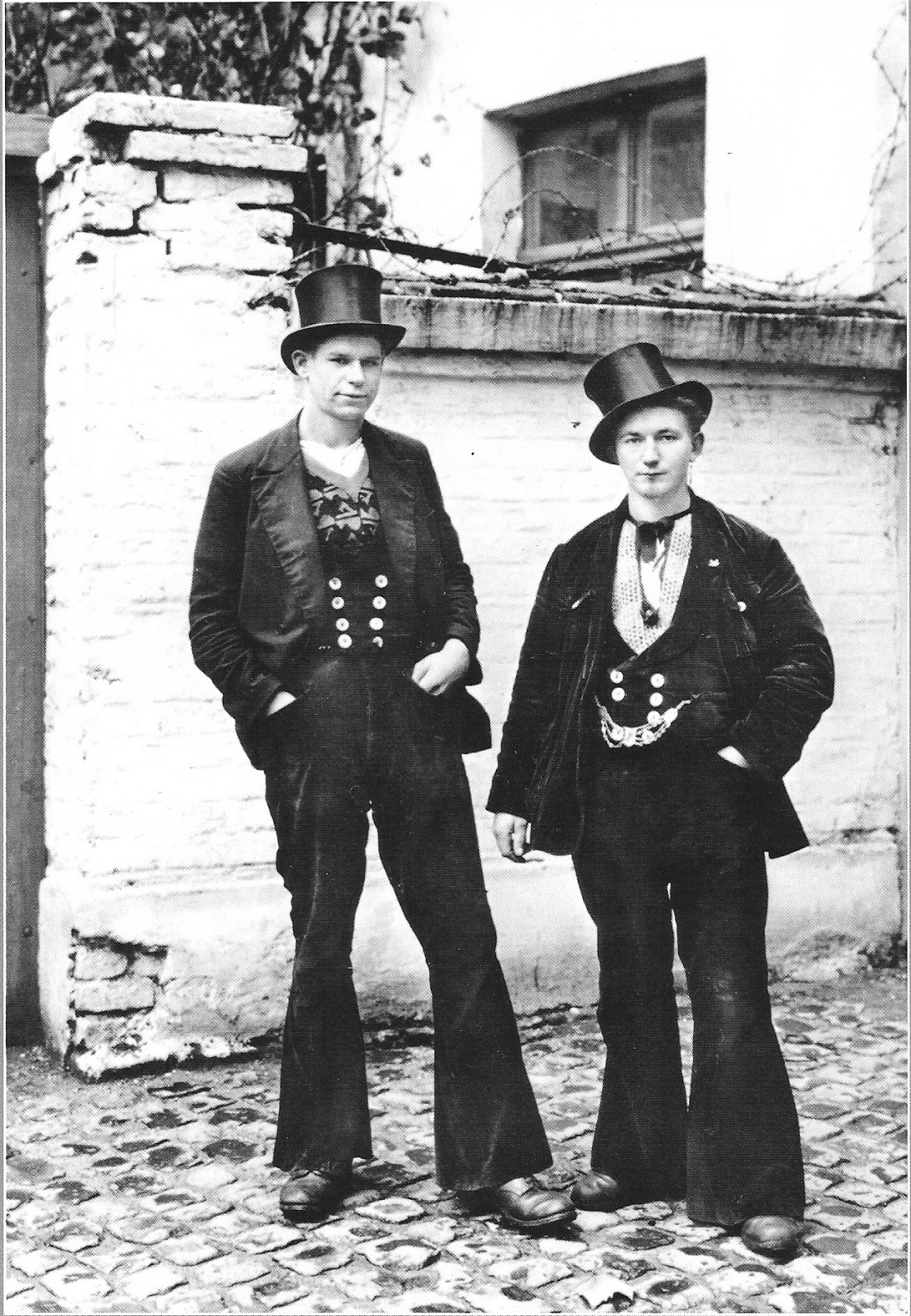
(Image from 'The Mortice and Tenon, Spring 2013)

This photograph is on the back cover of the most recent edition of 'The Mortice and Tenon', which is the quarterly journal of the Carpenters' Fellowship.
These are journeymen carpenters in Germany and the picture was taken in 1928 by August Sander. Journeymen carpenters still wear almost identical outfits today with justified pride and can be identified by them.

Some other trades, such as builders and metalworkers, also have a tradition of travelling journeymen. They often wear similar clothes to those of carpenters and may belong to the same travelling 'clubs'. Details such as the colour of the fabric and designs on the belt buckles will differ from those of woodworking trades. Some journeymen also wear different clothes to the ones shown above, such as breeches and knee-high boots.

Image by A.Stemmer from https://commons.wikimedia.org/wiki/File:Gesellen1.jpg
The tradition of the journeyman carpenter is a very long, very interesting and very well respected one in Europe. In Germany, once a carpenter has completed their professional training, they must travel for three years and a day and are forbidden to work within 50 km (about 30 miles) of their home town or the place that they did their apprenticeship. These rules may vary slightly between different clubs.

If you'd like to see what happens when a travelling journeyman goes home, I've written about it in another post. Some join a guild or society and will usually follow it's strict code of conduct (Schacht).  

Others do not join a particular group, but are free-journeymen. They also observe the same codes of conduct, but are not bound to attend meetings and to observe other obligations that members of a journeyman society might do.

(Image from www.flyingshavings.co.uk)

The carpenter journeymen of Germany are sometimes called 'Zimmermen' and can be easily recognised by the way that they dress and certain traditional objects that they carry. Like the two carpenters above, woodworking members of a 'guild' or club will often wear a black and white three-piece suit with, sometimes, an identifying tie. The blue ties worn by the two men above show that they are members of the 'Roland's Brothers' club, which was officially founded in 1891. The red ties worn by the men shaking hands in the photo above this one show that they are members of the 'Free Brothers' club, which was founded in 1910. These clubs are two of the older ones, the oldest and one of the most traditional of the clubs being the 'Righteous Brothers'. None of these clubs will admit female members.

A journal (Wanderbuch) is carried which the bearer must not fill in. Those that they work with will fill it with notes but the journeyman will collect stamps from officials (at post offices for example) to show where they have been.

They wear their hat (usually a black one) at all times when travelling and will carry a cloth bag holding their possessions and a cane (the Stenz) made from a twisted branch.  I have seen photos of journeymen working in the baking heat of a workshop in Zanzibar but still wearing their black hats, black waistcoats and trousers. They are justly proud of what this dress code means and the tradition that they carry. Free journeymen will wear a white shirt with the collar tucked inside, but the rest of the outfit may be chosen at will.

The wide-brimmed hat (similar to that worn by the men on the right in the two photos immediately above) is usually worn by someone in their first year of travelling. The wide brim would come in useful if someone was working above you and generating sawdust, as it stopped the sawdust getting into your eyes. However, such a large hat can be a bit more difficult to travel with and so more experienced journeymen wear smaller hats, which are also much more practical.


If you look carefully at the left ear of the man on the right of the top photograph, you can just see a long earring hanging from it. This earring is called the Ohrhänger and is worn with pride, always in the left ear. Sometimes, it will show the tools associated with the wearer's craft. In the case of the carpenters, this could include tools that a carpenter uses - perhaps a pair of compasses, a saw, a carpenter's axe or a hewing axe. Other possible symbols include a hexagram (symbolising the geometry of carpentry) and two plumb bobs. One society, named Axt und Kelle, wear earrings showing an axe, a builder's trowel and the rising sun.

The earrings serve several purposes. They identify the wearer as a trained carpenter and they could be used in the worst case to pay for their funeral if they died whilst travelling. If the wearer should bring the guild into disrepute by bad workmanship or behaviour, the earring can be forcibly torn out leaving a jagged scar and identifying them as a Schlitzohr. How is the ear pierced for the earring? With a hammer, a nail, a block of wood and large amounts of alcohol of course.

Journeymen don't wear plastic buttons on their clothes. Instead, they are usually made from mother-of-pearl; a material with some value. These buttons could therefore be used in payment and as collateral if the wearer has no money.

In France, the Compagnons de devoir are trade guilds. They are also very old, dating back to medieval times, but have different traditions to the German ones. The two systems were apparently closer in form to each other before the French system was reformed in the 1950s.  The French guilds teach around communal houses which are strictly governed by 'The Rule'. Like German guilds, high standards of moral and professional conduct are expected to be followed. Travel is also important in acquiring knowledge and skills.

It seems sad that in Britain, the tradition of the carpentry guilds has been lost to some extent. They were particularly important in medieval times as tradesmen would travel around Europe working on large building projects. However, in Britain the dissolution of the monasteries and the joyless actions of the puritans probably meant that work was too hard to find to sustain the guilds in the same way as those in mainland Europe.

There are the livery companies of carpenters, of turners and of joiners based in London, the 'Worshipful Companies', but their good work is mainly in helping trainees financially by awards rather than by networks and practical training. Of course, many guild journeymen from Europe still travel to the UK, like the two gentlemen in the more recent photo above, and the Carpenters' Fellowship has strong links to the carpenter's guilds in both France and Germany.

(Image from http://the189.com/design/art/constantin-brancusi-artist-and-sculptor/)

I was intrigued to read that some believe that Constantin Brancusi, one of the most influential sculptors of the twentieth century, came through a guild system. He left his home in Romania in 1904 and travelled to Paris but there is little record of him until he turned up there. Pierre Cabanne, in his book on Brancusi,  believes that this journey may have seen the young woodworker helped and given shelter by the guild, which he could have been in contact with whilst studying and working in the town of Craiova. It's interesting to think that the ancient guild system in Europe could have profoundly influenced sculpture in this way even into the present day.

This is a very brief look at the European carpenter's guilds and their journeyman traditions. If you are interested, why not check out these sites:

There is a lot more about journeymen travelling in the German tradition on this blog post. It was written after hanging out with Nat and Leo, who were 'travelling in the tradition' at the time.

You can read more about German journeymen on Robin Wood's blog here:
http://greenwood-carving.blogspot.co.uk/2010/07/german-journeyman.html

There is also an interesting Wikipedia page about them:
http://en.wikipedia.org/wiki/Journeyman

There is information about the German and French guilds here:
http://www.en.charpentiers.culture.fr/thepeople/compagons/thecarpentersguildingermany

The Carpenter's Fellowship website can be found here:
http://www.carpentersfellowship.co.uk/

Monday, 10 June 2013

Bristol Festival of Stone 2013 stone carving competition

The festival of stone ran for the first two weeks of June at the Harbourside in Bristol. As part of it, there was a carving competition which saw about 40 carvers given blocks of Bath limestone to carve.


It was great weather for most of the competition and it was fantastic to be surrounded by and working alongside so many talented carvers, a situation that doesn't happen that often in what can sometimes be quite a solitary, studio-based pursuit.


It also gave me the chance to meet Paul Caton, whose carved wooden bowls I've admired for a long time. It was an opportunity to meet skilled stone carvers from all over Britain, most of whom were very friendly and also enjoying the festival a lot. Some of them came from backgrounds that are not British, such as Samson Kizito who was born in Uganda and Tania Ivanova Tzanova from Bulgaria. It was very interesting seeing what everyone made of the theme: 'Emergence'.

A stone worker from Austria, Dylan Thomas Craig, was also visiting and a group of stonecarvers from France had come over, along with their musician and DJ friends, who added a great atmosphere to the festival.
Two of the French group, Laurent Donnadieu and David Bonhomme, also did a performance piece which involved moving huge blocks of stone using pulleys, accompanied by music.


As Laurent and David began one of their performances, which involved setting the ropes into the pulleys, a drunk in the crowd started heckling them. He soon shut up when he saw the two of them move those rocks though!


This is my sculpture, with an image of my friend's daughter who modelled for me:


 I must admit that it was quite a challenge to work in stone, which I haven't carved on this kind of scale for several years, especially when surrounded by such talented stone carvers. I feel that, to be honest, the sculpture isn't at the same level as most of the others at the festival but it was a very interesting thing to do and a chance to explore an unfamiliar material. 

I also managed to carve a good likeness of the model, which was the technical exercise that I really wanted to achieve. I don't feel ashamed of the sculpture and had great fun making it, although it obviously needs to be worked more to be anywhere near finished. It would be interesting to see it set into a structure, like a wall,  in some way. 

Here's some of the other pieces that were carved in the competition:


It was great to be carving next to Pippa Unwin from South Devon, whose crocodiles won two well-deserved awards in the competition. I was also lucky to be sharing our tent with Iain Cotton (who is based near Bath). It was a great atmosphere in there and that made the festival even more enjoyable.


David Bean, who graduated as a mason two years ago, produced this sculpture:


Jez Fenton, who went to art school with me in Exeter, made this dark-toned piece:


Danny Clahane had come from Cumbria to compete. It was great chatting to him:


This baby turtle won its creator, Mickey Carpenter, an award. It's so simple and effective and was very popular. Mickey is finishing the third year of an apprenticeship at Bath College:


Patrick Barker, who is based in Somerset, made this figure:


Pete Graham from Cornwall carved this bittern coming out of the reeds, which a couple of other carvers were also overheard admiring:


I was very struck by Will Whitmore's tree with a city in its branches (well, that's what it looks like to me)...


...as well as Sam Flintham's two dragons biting each other, which also won an award.


A large part of the material removed from this carving, by Bristol-based Matthew Billington, was chopped out with a normal hand axe- a rather unorthodox method but a very interesting one:


Peter Crinnion carved this piece, which won an award for technical merit:


Patrick McGrath, who works primarily as a prop and model maker for television, carved this abstract form:


This piece by Paul Wilson won an award from the RWA. It reminds me very much of Peter Randall-Page's work:


Richard Mossman and Ben Dearnley are shown here working on a large sculpture to be installed in Ashton Court estate. It commemorates ' The Father of the Bicycle', James Starley . Ben was working on this throughout the festival, as a separate project to the competition, along with his students and some of the French carvers. Hot work!


All in all, great fun and well worth being part of. Look out for the next festival of stone at some point in the future!

Misericords and carvings in St Davids Cathedral, Pembrokeshire, Wales


St Davids Cathedral is tucked away in Britain's smallest city, St Davids in Pembrokeshire, which has a population of about 1,600 people.

There has been a church on the site since the sixth century. Work began on the present building in 1181 and the nave roof and ceiling were built between 1530 and 1540. It managed to avoid the worst of Henry VIII's destructive excesses during the Reformation, largely because it housed the remains of his ancestor Edmund Tudor, Earl of Richmond. However, Cromwell's parliamentarians destroyed much of it in 1648 (the same sad, familiar story as with many of Britain's greatest works of art that happened to be in places of worship) although it was restored in stages between 1793 and 1910.


I found it to have a 'cosier' feel than many of Britain's other cathedrals. It isn't as soaringly grand as some and the ceiling in the nave is made of wood, not stone. I really like the slightly humbler feel that I found there. The woodwork is pretty amazing as well!


The carved stones to the left and right date to the 10th or 11th century and the one in the centre is a patterned ring cross dating to the 9th or 10th century. They are kept in the gatehouse. William the Conqueror visited the church at St Davids in 1081 to pray and probably saw these stones.


These woodcarvings are next to the entrance into the nave. I'm guessing that they date to the renovations of the 19th or 20th century, but I don't know for sure.


This beautiful lantern ceiling is at the base of the tower and sits above the choir. The ceiling is medieval and the windows date to the 14th century. Nearby, standing over Edmund Tudor's tomb, is this painted ceiling which brightens up that part of the cathedral:


The wooden ceiling above the nave was carved from Irish oak in the 16th century and features carved pendants. The crucifix (or 'rood')  is a 20th century replacement of an earlier one.


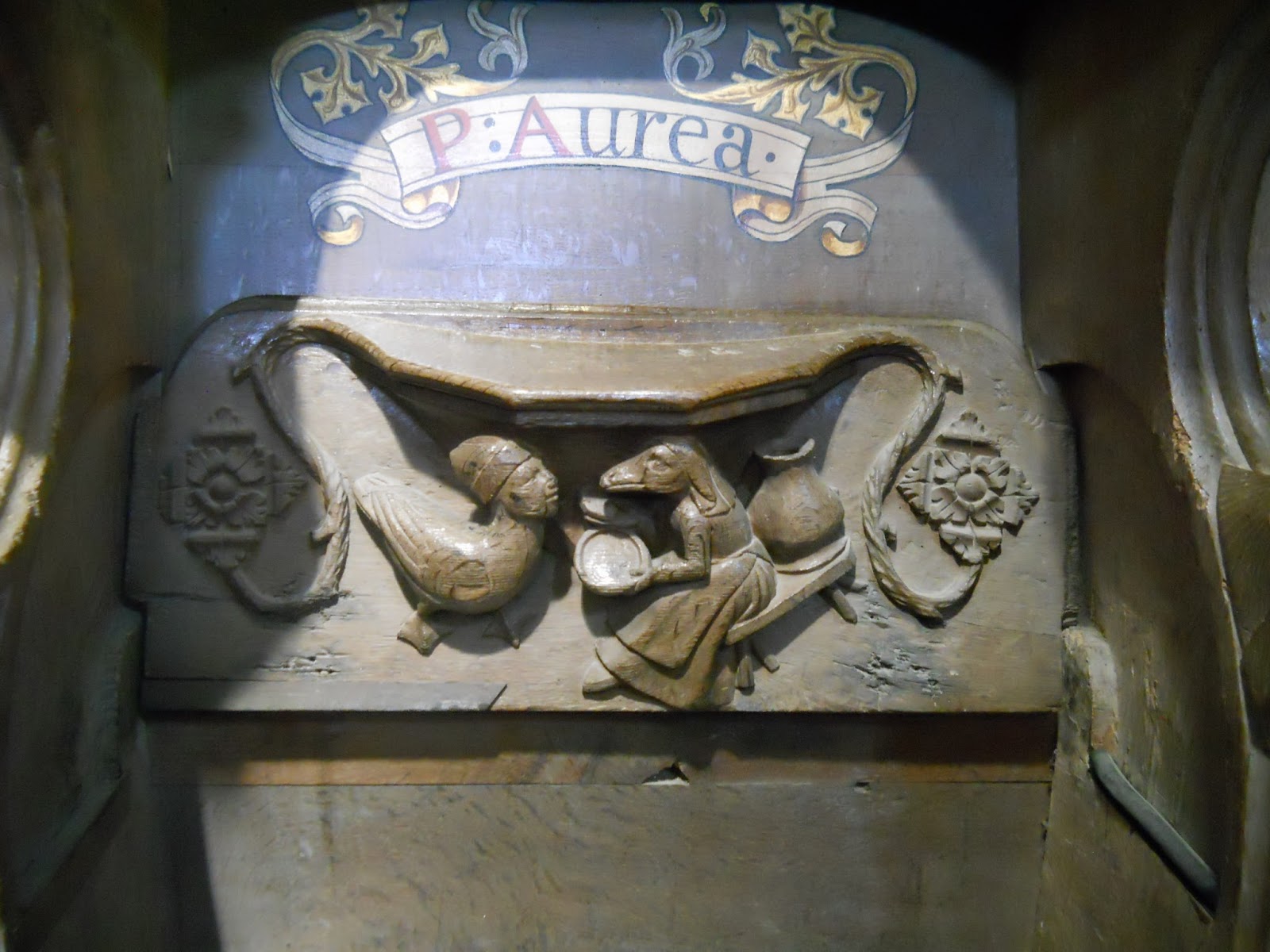
One of my favourite parts of the cathedral are the carved wooden misericords in the choir stalls. These were carved in the late 15th century from oak. Dorothy and Henry Kraus, in their book 'The Hidden World of Misericords', comment on how many British misericords were produced during the fifteenth century and that they are notable for their precocity. At that time, the French or Belgian sets were inferior in quality to those being installed here.

The name 'misericord' comes from the Latin for mercy and they are little seats which allowed the clergy to rest whilst standing for long periods of time during services. According to the Krauses, there are 3500 catalogued misericords in churches, chapel, abbeys and cathedrals throughout Britain. The collection at St Davids is one of the larger ones.

The seats fold back down, so the misericord carvings were rather hidden and medieval carvers could carve subjects that were not as reverential and religious as elsewhere in the cathedral. Instead, some carvings poke fun at the clergy or illustrate little moral tales. We don't know what some misericords illustrate, as the sayings or stories that inspired them have been lost, but they still give a fascinating glimpse into the minds of the medieval carvers who made them. 

The Krauses comment :
'That so much English underseat carving should have survived Protestant iconoclasm was no doubt due in large measure to the prevailingly secular subject matter.'

The lettering painted onto the backrests shows the names and offices of the medieval clergy who used those seats at one time.


Tuesday, 4 June 2013

The Forest of Avon Products Cooperative at Bower Ashton Woodyard, Bristol


We had a bit of a get together last Friday at the yard where I have my studio. The purpose was to raise the profile of the Forest of Avon Products Cooperative and let more people know about what we do.


There was homemade cider and axe throwing (but not at the same time!) and all the tenants at the yard got to show off some of our work. Bob Slade also demonstrated timber milling using a chainsaw mill.


Joe Cooper, who owns Touchwood Enterprises, also delivered a presentation about the Cooperative to a group of invited guests.


All of the tenants of the Woodyard are members of the FOAP Coop, which promotes sustainable, local timber use.